 Finding Hope
What I Did In Lockdown – Part 2
Posted on December 2, 2020
On the 31st October, it was announced that England would be going into lockdown again on the 5th November so it seemed appropriate to revive this list. Having said that, it hasn’t felt like a lockdown at all with so many business, schools, and activities continuing still open; life seems to have continued as normal, which has felt very stressful. I don’t want to make generalisations though. I know that many people have stuck to the rules and been very careful and I am so grateful to everyone who has done so.
As a disabled person, my life hasn’t changed much with the lockdown. The only significant change has been that I haven’t been able to swim, the only exercise I am currently able to do. I can admit that that has been very frustrating and upsetting but if it helps to keep people safe, then that is something that I’m more than willing to do. I just hope that the sacrifices so many people are making are worth it – most so much bigger than mine – that they outweigh the lack of care that some people have shown. Just my two cents.
Now, to the list…
- Reimagined one of my old songs for a Masters assignment.
- Wrote and posted eight blog posts.
- Spend half a day recording vocals for various songs.
- Celebrated graduation (online) with my friends who did the course full time even though I’m part time and will graduate next November.
- Wrote an essay about how important writing is, especially when it comes to mental health and neurodiversity for publication.
- Had an interview published (x)
- Recorded the ‘BEHIND THE SONG: Honest’ video.
- Recorded a video explaining what’s next for the Honest EP.
- Recorded the reimagination of my old song.
- Had a massive meltdown on Bonfire Night.
- Had multiple blogs post about ‘Honest’ (x) (x) (x) (x) (x)
- Worked on the arrangement and production of the reimagination of my old song.
- Celebrated Joe Biden winning the presidency (safely, of course).
- Prepared for the panel I was speaking on about being an autistic student during the pandemic.
- Worked on the essay for this module of the Masters.
- PopWrapped posted my personal essay about the importance of writing in my life (x)
- Received Halsey’s poetry book, ‘I Would Leave Me If I Could.’
- Watched Halsey’s livestream for the book release.
- Had a really lovely full EP review (the first one!) posted (x)
- Edited and finished the music video for ‘Honest’ with Richard.
- Worked on my reimagination of a cover, another university assignment.
- Started watching His Dark Materials Series 2.
- Watched The Queen’s Gambit on Netflix.
- Did lots of my Christmas shopping.
- Took Lucy to the vet for her second operation and took care of her afterwards.
- Posted the ‘BEHIND THE SONG: Honest‘ video.
- Announced the music video for ‘Honest.’
- Had several excruciating nerve pain attacks; as of mid-November, I’ve been waiting for a hospital appointment for about eight months and on a schedule of painkillers that aren’t as effective as I’d like.
- Raged about the unfairness of Taylor Swift being denied the opportunity to buy her Masters yet again.
- Managed to get my favourite vocals plug-in in a pre-Black Friday sale.
- Rewatched Noughts + Crosses.
- Dyed my hair.
- Wrote a rap…
- Spoke on a panel at UniversitiesUK’s conference (about how the Covid-19 pandemic is affecting Higher Education), sharing my experience as an autistic student during the pandemic.
- Watched ‘Tim Minchin: Apart Together, The Album Live!’ and loved so many of his new songs.
- Uploaded the ‘Honest’ music video to YouTube and posted about it on social media.
- Wrote and posted a blog post about Agents of Shield, Daisy Johnson, and how much they mean to me.
- Had multiple production sessions with Richard.
- Saw a doctor for the pain and blocking of my ear; I was diagnosed with an ear infection and given a medicinal spray to help get rid of it.
- Had my heart rate and blood pressure checked to find out whether I’m in a position to try a different anxiety medication.
- Bought Melodyne to help with producing my own demos (thank goodness for Black Friday sales because I could never afford these plug-ins otherwise).
- Watched folklore: the long pond studio sessions and completely adored it.
- Found out that I finally have an appointment for the nerve pain I’ve been experiencing and it’s in less than a month.
- Watched the film, Close, in which Noomi Rapace is just awesome.
- Spent several days feeling like I was on the edge of a meltdown, alternating between crying and sleeping.
- Finished watching The Split Series 2 and Nicola Walker’s performance had me in tears multiple times.
- My EP, Honest, surpassed 30,000 streams on Spotify!
- Had a really positive response to one of my songs in class that resulted in a really positive conversation about inclusivity and accessibility for neurodivergent students.
- FaceTimed with my Granny to celebrate her birthday.
- Had a lovely time watching one of my cats watching a TV programme about puppies; she was absolutely fascinated and kept touching the screen.
I hope that was interesting to read, that you got something out of this post. Hopefully there won’t be cause to revive it again but if there is, I guess we’ll see what I get up to. I hope you’re all staying safe and are coping the best you can. See you in the next post.
A Day In My Life (University With Autism Spectrum Disorder)
Posted on November 28, 2020
As opposed to my usual week-in-the-life posts, I thought I’d do something slightly different this time and zoom in on what it’s like to be an autistic student at university (one doing an MA in COVID-19 times anyway). This is obviously just my experience – as the saying goes, ‘if you’ve met one autistic person, you’ve met one autistic person’ – but I thought it might be an interesting post to write. I feel like it’s so important to share our experiences as autistic people, especially when media is being created that can be harmful to us (i.e. everything that’s been going on with Sia’s new film – I feel like I should be writing about that but I still don’t know how to; it makes me so upset that I can’t really write anything that feels articulate enough to represent the significance of the issue). So I hope this is an interesting read.
THE NIGHT BEFORE
Monday was hugely busy, with a production session, two doctors appointments, and working on the essay of the module in the spaces between. I’ve been working on it somewhat steadily but since I have a feedback session coming up, I’ve been a bit more random in my approach to writing it – fitting writing time in wherever I can or just writing about certain things as they occur to me – so that I can get as much out of that session as possible.
So it was one of those days where I barely had time to think.
On Monday evenings, the Masters course have a song sharing session between 7.30pm and 9.30pm. I’ve been a couple of times but I tend to find it too much. I’m most creative at night and so filling my head with new songs and song analysis right before I try to sleep really messes up my ability to sleep, which I have to try to do relatively early with my first class on a Tuesday at 9am. And if I don’t get enough sleep on a Monday night, I’m useless in every class on the one day I have classes. So, unless there’s a really good reason, I can’t really prioritise them.
I also find them quite hard socially: as much as doing the Masters course part time was the right thing for me, it has meant that for both years, I’ve never quite felt part of the group. There’s a handful of us in the same position and I can’t speak for them but it’s always left me feeling a bit ‘other,’ like I don’t really fit anywhere – not quite part of the group in the first year and even less part of the group in this second year. Everyone on the course is lovely but it does have a pretty big impact on the social side of the course. And when you struggle with feeling like you don’t fit in, it’s hard to feel it in yet another area of your life. So sometimes that factor just makes it too hard on my mental health. Maybe it will feel easier when one of my best friends rejoins the course in January.
So, instead, I used the time to do some more work on my essay before emailing everything required for the feedback session to my tutor (I wanted to make sure he had enough time to go through it all before we met on Wednesday afternoon). Then I tried to unwind a bit. Somehow I still ended up going to bed too late – not that 11pm is hugely late but for me, the night before a class, it’s on the border of being dangerously late.
I have a prescription for sleeping pills because my anti-depressants can cause problems with my sleep but I try to avoid them where I can. Having said that, knowing how exhausting a uni day can be, I usually take one the night before to make sure I’ve had enough sleep to give me the best chance of getting through said long uni day.
THE DAY ITSELF
I wouldn’t say I slept well and I struggled to get up but I’ve had worse nights so I just tried to push through the fatigue. I got dressed and made up and then collapsed on the sofa for a rest. Standing for the time it takes to shower, get dressed, and do my make up makes me feel weak, and lightheaded, and sick – something we’re still investigating with, unfortunately, very little progress – but getting up as early as I had meant that I did have enough time for some recovery time. It’s all down to planning. My life is dependent on planning. I also managed to eat some breakfast and take all of my pills. I’m taking quite a few at the moment – more than the ‘normal’ ones that help me maintain my mental health – because of a Vitamin D deficiency and horrible nerve pain down my left side (I’ve been waiting for a hospital appointment for the latter since about April or May, which may be my personal record for appointment waiting times).
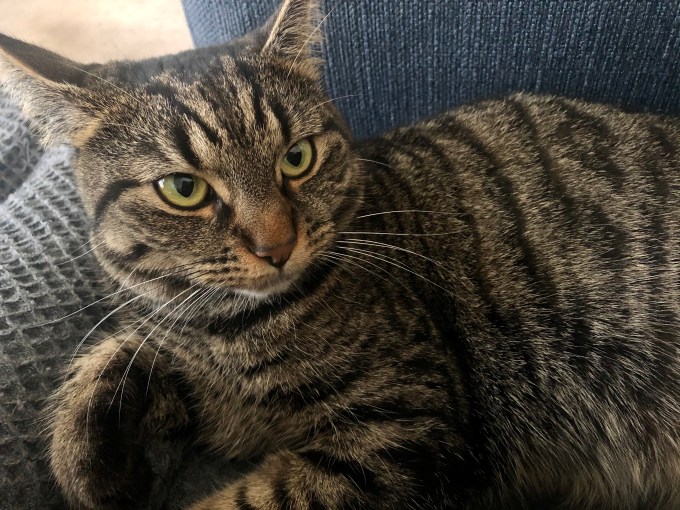
My seminar started at nine (if you’ve read my previous university posts, you’ll remember that I’m doing all of my classes online this semester). My normal tutor (who is legitimately one of the loveliest people I’ve ever met) started the class before handing us over to a guest tutor who gave us a two hour class on arranging strings and horns. He was incredibly knowledgeable and engaging and so it was really interesting. Plus, Tiger came and sat with me for most of it, which was very nice. University with cats is a definite advantage of online lectures.
I was struggling to concentrate by the end of the class so I was relieved when we wrapped up. It was a lot of knowledge and sensory information to try to process and sort through and digest. I felt more than a bit dazed. Fortunately, the session was recorded so I can either go back and listen to it in shorter sections or go back and search for something specific.
My next class wasn’t until five so I had rather a lot of time to fill. Pre-pandemic, I’d hang out at uni and do cowrites, go to the favourite local coffee shop with friends, or work on whatever was on the list at the time but I’m finding it much harder to use this time effectively, whether that’s due to having my classes online or down to the pandemic just really screwing with my brain. Stuff that wasn’t hard before is now and the only thing I can put it down to is the pandemic, even if I don’t know precisely why. All I know is that it’s a weird time and so it shouldn’t be surprising that certain things aren’t the same as they were before. But it’s still frustrating to have such a big block of time that I could be using productively and not have my brain cooperate. Early in the semester, I ended up staring at my laptop screen, desperately trying to work on stuff and just not being able to. I got more and more frustrated and demoralised and eventually I just had to accept that this is not productive time. So I’ve been trying to come up with ways to fill it that aren’t too demanding but still feel like there’s a point to them; I don’t want to feel like I’ve wasted it by just staring at my phone or mindlessly jumping between the open windows on my laptop because that’s just not good for my general mental health. So I’ve been trying things like reading or watching new movies or TV shows – these have been good sources of inspiration in a time where I’ve struggled to find inspiration – or having a nap if I need one… Things that don’t require a lot of energy but still feel worthwhile (most of the time).
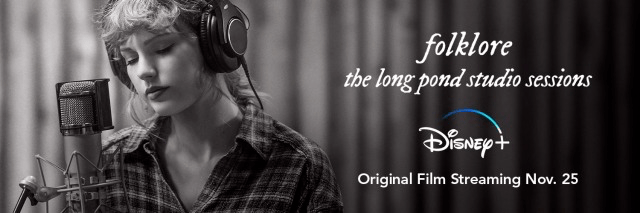
I did a quick scroll through my social medias to see if there was anything that needed replying to and then did some admin work: replying to emails, updating my bullet journal, and so on. Just as I was about to move onto something else, I got a load of notifications from social media, all Taylor Swift announcing her acoustic concert film going up on Disney+, folklore: the long pond studio sessions. That was so exciting that it temporarily scrambled my brain, in both a good and a bad way. As an autistic person, I’m really not a fan of surprise drops because I just get hit by a tidal wave of emotions and I feel so overwhelmed that I actually feel sick. I don’t want to sound ungrateful for the film because I am so, so grateful for all that Taylor has been putting out during the pandemic (her work really has been one of the things that’s helped me during this time) but the suddenness with which she’s been announcing things has been difficult because that doesn’t give me enough time to do the emotional processing that I need to do. So although I eventually settled into being really excited, I spent a lot of the day feeling painfully twisted up and anxious over the mess of emotion I was experiencing.
That did leave me floundering quite a bit, I have to confess. So, to try and take my mind off of everything I was feeling, my Mum and I caught up with the latest episode of His Dark Materials. It did help a bit. It’s such a great show; the casting, the acting, the sets, the interwoven storylines, etc are all so beautifully done. I loved the first series and I’m really enjoying the second one. I love Dafne Keen as Lyra (I so related to Lyra’s reaction to popcorn – it was freaking hilarious) and Amir Wilson as Will but I think it was Ruth Wilson as Marissa Coulter and Lin-Manuel Miranda as Lee Scoresby who really stole the show this week (pun actually not intended – if you know me, you’ll know I love a good pun). Their big scene together was just so powerful and how Ruth Wilson played the aftermath was particularly emotive.
I spent an hour or so working on a new blog post but after a while, I was just getting slower and slower and eventually I gave up and had a nap. I slept for about two hours before struggling up for my second class at five. I could’ve easily slept longer but I did my best to shake it off and concentrate on the workshop. This is where we (in this case, all of the 100% online students – the rest are blended and do the workshop in person onsite) share the songs we’ve been working on over the week and get feedback from the rest of the group. For most of the semester, we’ve had briefs each week but now we’re just working on whatever’s right for us. So, for example, I didn’t have a song to present because I’ve been working on the feedback for previous songs and the essay, rather than a new song (although I did recently write a rap, although I’m not sure whether I ever want anyone to hear it). Everyone else had songs to play though so I could still participate and give feedback, although I’m not sure how helpful I was because of how tired I was. But I tried. Some days I was just have less energy to work with than others.
I had an hour break before the evening session, which runs from seven to nine; they’re technically extra-curricular but I try to attend them when I can, especially now that they’re online and therefore more accessible. I don’t want to miss out on anything I don’t have to.
During my break, I had a quick dinner and catch up with my parents. The Grammy nominations had also been announced so I went through those. I’m super pleased for Taylor Swift: folklore is such a great album. Six nominations – Album of the Year, Song of the Year, Best Pop Solo Performance, Best Pop Duo/Group Performance, Best Pop Vocal Album, Best Song Written For Visual Media – is incredible and I’m really excited for her. Personally, I think she deserves at least several of those, especially considering the other nominees. I’m absolutely psyched for Ingrid Andress and her three nominations: Best New Artist, Best Country Song, and Best Country Album. I’ve been following her for years, having met her in Nashville at least a couple of years before her album was released. She’s an amazing writer and it would be just so awesome for her to win even one Grammy award this early in her career. But I’m concerned about her chances; she has some serious competition in all of those categories. The Best Country Song category, for example, is incredible, full of so many amazing songwriters that I love so much: Natalie Hemby (‘Bluebird’ by Miranda Lambert and ‘Crowded Table’ by The Highwomen, a group of which she’s a member), Maren Morris (‘The Bones’), and then Ingrid, of course. I want them all to win it. I was disappointed that Halsey still hasn’t been nominated. Manic is such an incredible album, as is Badlands (Live from Webster Hall), and it’s so frustrating that she doesn’t get the industry recognition she deserves. Especially given how popular ‘Without Me’ was, I’m really shocked that she’s never been nominated.
I just made it in time for the late session, which involved two of last years graduates presenting their final projects, one about using songwriting to explore different aspects of personality and the other about the experience of their gender transitioning and how sharing that story has the potential to increase understanding and empathy and break down barriers. They were both really cool projects but it was also massively helpful to see their processes, how they’d developed their ideas and researched them and how that research had lead them to writing the songs they wrote. It was fascinating and I definitely feel more prepared for my own project. I’ve got several ideas I’ve been turning over and the presentations have been helpful in my decision making process too. So I got a lot out of it, even if I was completely exhausted by the time the session finished.
It was about half nine and I probably could’ve gone straight to bed but I went and spent some time with my Mum, watching some TV together as we both wound down from the day. But it wasn’t long before we were both falling asleep so we put the cats to bed (they sleep in the kitchen so that we’re not woken up at five – the time they start demanding breakfast) and headed to bed ourselves.
THE NEXT MORNING
I’m not one of sleeping in so I always set an alarm. Then I can get up and start doing things (I have a real problem with needing to be productive) but usually, the day after a uni day, I sleep through the alarms I set. It doesn’t seem to change anything though. I keep setting alarms and sleeping through them. But that morning was special. I dragged myself out of bed at eight to watch folklore: the long pond studio sessions, as soon as it was available. It wasn’t particularly enjoyable to get up when I was so exhausted but it was absolutely worth it. The film was amazing, so amazing that I still haven’t figured out how to put all my feelings into words yet.
Since this post is just about my day at uni, I won’t write much more but just as I wrote about the Monday night, I thought I’d write about the Wednesday morning. Usually there isn’t a brand new Taylor Swift film to watch so I try to rest and recover my energy – physical, mental, and emotional – from the day before. As I said, I’m struggling with this need to be productive all of the time so with that in mind, I try to schedule undemanding tasks for Wednesdays. That particular day, I had a couple of half hour tutorials with tutors, so I spent the morning making sure I was ready for those. I’d already made notes of what I want to ask and discuss so I spent the rest of the morning going through those to make sure I felt as prepared as possible.
So, as you can probably tell, it takes a lot of planning and prioritising and rationing of energy to make it possible for me to go (or at the moment, ‘go’) to university, to make it possible to live my life in the most positive and productive (to a healthy extent) way. This isn’t an unusual day for me. While stuff like big Taylor Swift announcements and the Grammy nominations don’t happen every day, there’s often something that can cause emotional reactions like the ones described and I deal with fatigue and anxiety everyday. It’s one big juggling act. Every day. One enormous, exhausting juggling act every day.
A Week In My Life (November Reading Week)
Posted on November 14, 2020
While I was going to write a series of posts about the events of this week, the way all of those events played out made that much more difficult than I’d anticipated so, after a lot of thought, I decided to put them all together in one post because I still really wanted to write about all of them. It was an intense week, with some really big events and a lot of anxiety.
The week in this post started on Monday 2nd November and ended on Sunday 8th November 2020, the autumn semester’s reading week. It involved an Autism webinar, the US election, Bonfire night, as well as the beginning of England’s second national lockdown.
MONDAY
My Mum was visiting her Mum, masked, social distanced, and outside where possible before we all go into lockdown again. So I was all on my lonesome, which is pretty unusual these days. Apart from the cats. Once Queen Lucy realised I was awake, she was climbing all over me, very clearly telling me that it was time for breakfast. So I dragged myself out of bed and went downstairs to feed the pride.
I spent the morning doing various admin tasks like replying to emails and finishing a couple of blog posts before having a shower, getting back to my computer in time to get a ticket to Tim Minchin’s upcoming livestream for his new album, Apart Together. It’s scheduled for the end of November so that will be something really fun to look forward to during lockdown. In the description of the event, they describe him as an ‘inimitable poly-talent,’ which is absolutely true and I just can’t help thinking what it would be like to be described that way. What an awesome compliment.
That done, I settled into my little home studio space and got to work. There were a handful of songs that I had been neglecting and so I finally forced myself to stop procrastinating and prioritising other things and spent several hours recording vocals for them. It’s stupid: I don’t know why I put off recording vocals so much. I guess they make me feel anxious and insecure, like I’ll listen to myself and suddenly realise what a terrible singer I am (which, yes, I recognise is ridiculous because while I know I’m not the greatest singer out there, I know I’m not terrible). But anyway, I always put it off and then when I finally do it, I remember how much I enjoy it. As I said… ridiculous, and yet we’ve all had that experience in one way or another.
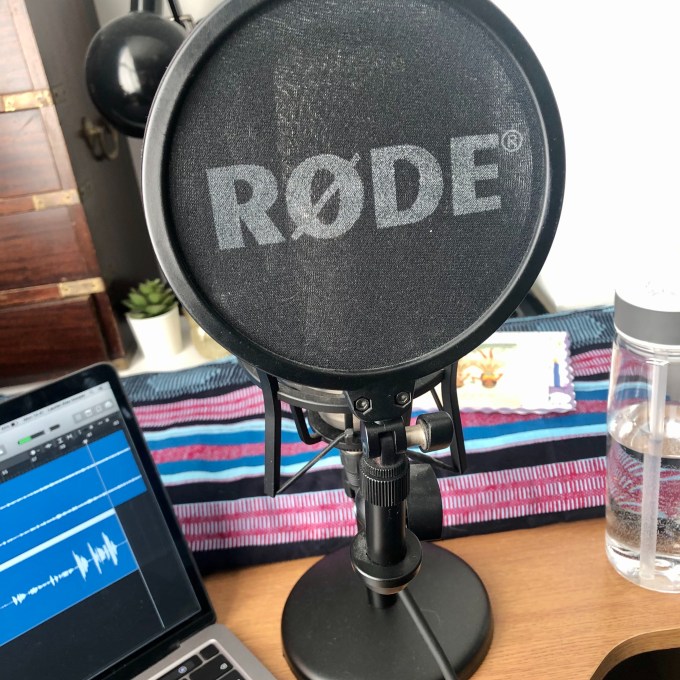
It was a challenge because it was really windy outside, so windy that the microphone was picking it up and I had to delete multiple takes because the wind noise was so obtrusive. And then, Lucy decided that she was being left out of something important. I managed to convince her to lie on my bed (instead of climbing all over me) but even her stretching and clawing the duvet was making it into the recordings. I ended up barricading myself in my bedroom for the rest of the tracks. Fortunately, she (and the others) didn’t start yowling until just as I was finishing up so I was able get everything done without the feline interruptions. I think they’ve developed a form of separation anxiety after having me at their complete disposal (by which I mean I’m available to be sat on at almost all times) since late February and the closed door was just unacceptable.


I had a short time to rest and order my thoughts (change hats, if you will) before signing into an online meeting about an upcoming conference that I’m a panelist for. Just typing that out is wild to me; this is something I’ve always wanted to do. I mean, ideally it would’ve been on a literal panel, talking directly to people, rather than through a screen, but I’m not complaining. I’m nervous but excited. The other panelists were all really nice and we had a good discussion and planning session.
I was pretty knackered after all of that so I lay down on the sofa and attempted to do some blog post writing. I didn’t get very far – I think I was just too tired – but I made progress on a couple of posts so that was something.
I had a place on a webinar in the evening about Autism in young people but as hard as I tried, I couldn’t get into it and the anxiety and frustration and confusion – likely combined with my anxiety about the pandemic, the US election, and the impending lockdown – resulted in a lot of distress. I wouldn’t call it a panic attack or a meltdown but it was a serious overload of difficult and upsetting feelings. I talked to Mum about it afterwards and she suggested emailing them to see if they had a recording I could watch since I’d paid for a ticket and then not been able to attend. So that was a job for the next morning; I was too upset and all over the place to try and write a coherent email.
Despite not attending the webinar, I ended up staying up far too late, bouncing between writing for my blog and in my diary. Lucy curled up with me and, completely exhausted, I was asleep in a matter of minutes.
TUESDAY
I woke up with a headache that even my prescription painkillers couldn’t kick. I’d had a busy day planned out, with the US election the next day (I knew it would dramatically affect my emotions and therefore my ability to work so I’d planned to get as much done beforehand as possible). I tried to get up and get things done but I just felt so unwell that I ended up shifting my week around to give myself a lighter day. I just couldn’t do the more demanding tasks I’d planned to do.
I didn’t manage to get much done that morning. My head was pounding and I was tired and I just couldn’t concentrate enough to get as much done as I would’ve liked to. I did start the essay for this module for the Masters, working out the different sections and the elements I could talk the most about. I also managed a little bit of blog writing; I swear, just as I think I have a decent buffer of posts, they’re gone and I’m panic writing to make sure that I have something to post (not that I’m panic writing this post – I just thought I had more posts lined up than I do).
Early afternoon, I joined the the video call set up by a group from my Masters classes last year (they were the full timers who’d done the whole course in one year while, as a part timer, I’m taking two years to do all of the modules) to watch their online graduation ceremony. As far as I know, everyone was watching the ceremony but not everyone was in the video call, including one of my best friends but we were chatting via WhatsApp. When the ceremony ended, the university had organised video calls for each course and so the majority of the full timers logged on, plus a few of the part timers as well as our course leader to celebrate together. Some of the other tutors on our course also dropped in briefly to say hi. It was so nice to see them all. It feels like so long since I’ve seen most of them and I do miss them; I feel like we had a really lovely dynamic. We chatted and caught up and had a drink together and the whole thing ended up going on for about three hours. I was pretty social-ed out afterwards but it had been so nice to see everyone and celebrate their achievements.
Not long after we all hung up, my Mum took Lucy to the vet as I think the cysts she developed a few months ago have returned. They were back within the hour and the vet had confirmed my theory. The recurrence has also confirmed where they’re coming from and so she’s booked in for surgery on the 12th to remove the cysts and hopefully fix the problem. Apparently it’s not much more complicated than the previous surgery and she’s a very healthy cat so there’s no reason to worry unduly. He’s a great vet: we haven’t known him long at all and yet he already takes my high levels of anxiety into account when giving explanations and laying out the options. I really, really appreciate that.


Lucy has never seemed distressed by going to the vet but she’s always very pleased to be home. She often comes and cuddles up with me if possible though. I don’t know if she feels in need of affection, if she was trying to get rid of the unfamiliar smell of the vet, or whatever but it was very cute.
We weren’t confident about the support bubble rules going into the second lockdown so one of my other parents (who we’re in a support bubble with) came over for the evening and we hung out, had dinner, and watched some TV together. It was really nice and I think we all needed it.
Throughout the afternoon and evening, I’d been working on a personal essay to go out as part of the campaign for my recent single, ‘Honest,’ and I finished it at around eleven. I could barely keep my eyes open by that point but I thought it was at the very least decent, as did my Mum when she proofed it for me – I’ve had much more positive feedback since, which has been good for my confidence as I was feeling quite insecure about it. But anyway, given how tired I was, I decided to leave it as it was and have another look at it in the morning before sending it off.
I’d been doing my best not to think about the US election all day, avoiding social media as much as possible, but when I went to bed, all the anxiety rushed in. I was so terrified of Trump getting in again; I was almost overwhelmed by the dread of waking up to that as the result. As hard as I tried, I couldn’t relax enough to sleep and ended up taking both my anti-anxiety medication and a sleeping pill.
WEDNESDAY
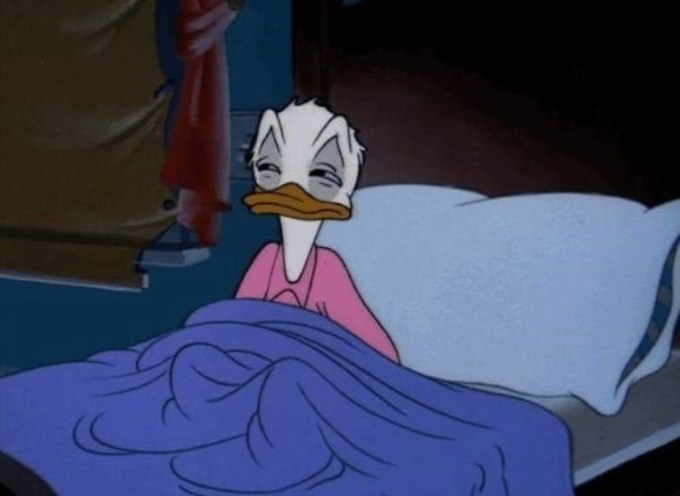
While I think we all felt that it was unlikely we’d wake up to an official result, it was nonetheless tough to wake up and see that it still wasn’t over. But worse, was that it could still go either way when I checked the news first thing. I saw this meme making the rounds on social media and it felt very relevant; I’m pretty sure that this was how my face looked.
It ended up being a long, anxious day of refreshing the various news sites, waiting for updates and not getting much done. I did manage to edit the personal essay and send it off but other than that, I just bounced between writing blog posts and working on my Masters essay without making much progress in either. I was just so anxious; I felt like I couldn’t breathe. I may not be American nor do I live in the US but I have friends and family who do and the political decisions made there have the potential to ripple so far out, affecting so many countries and so many people. So to say I was stressing would be a massive understatement.
Slowly though, the numbers did start to shift in favour of Biden more and more. It wasn’t a done deal by any means but it was going in the right direction. I was refreshing my phone relentlessly; I could barely concentrate for five minutes without having to check to see if there was an update.
In the evening, Mum and I had dinner and then went for one last swim before lockdown closed all the gyms. We tried to make it as safe as possible, going close to their closing time when it’s always quiet. Plus they keep all the doors open to help with the ventilation. I still almost fell apart in the changing room because the experience was so stressful – whether it would’ve been a meltdown or an anxiety attack, I don’t know. But the staff helped us out and the few people swimming were very obliging about making it possible to put as much distance between all of us as possible.
We had a really good swim, including some of the new hydrotherapy exercises, and by the time we got home, Biden only needed six electoral votes to win and Trump needed fifty six. I was so excited; I actually felt like I might throw up from the anticipation. Again, I found it very difficult to sleep.
THURSDAY
And so begins Lockdown 2.0…
I slept long and deep and when I did finally wake up, I didn’t get up for quite a while, going through the election coverage. The numbers hadn’t moved and it was making me edgy.
I got up, had breakfast and a shower, and got down to working on my essay. I’d only been working on it for about half an hour though when a friend called and we ended up talking for over an hour. It might not have been the way I’d planned my morning but it was really good to have that chat; I felt better for it.
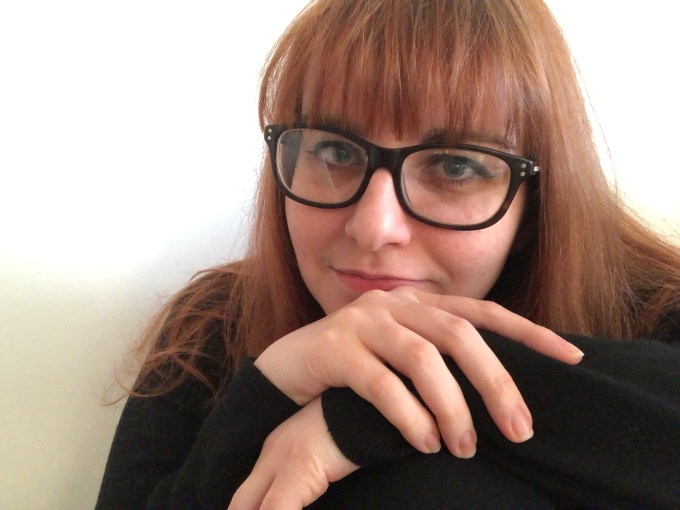
When we hung up, I managed to do a bit more work on my essay before getting myself made up to do some filming. It’s getting dark so early now that I couldn’t wait any longer or I’d lose the light. I set up my little corner (I’d love to have a more permanent space at some point) and filmed some bits and pieces for the ‘Honest’ single campaign. It was a bit of a struggle – cold and uncomfortable and the cats wouldn’t leave me alone – but eventually I got them all done, which was an important job to have ticked off my list.
That done, I went back to my uni work. I spent most of the afternoon working on one of my song assignments: a reimagination of one of my own songs. It’s weirdly hard: you spend so much time trying to make a song perfect and then you have to turn around and create something entirely new from it, bring out a different emotion or try it out in a different genre. I took this really big, fiesty pop song that had this whole ‘I don’t need you’ vibe and turned it into this quiet piano song that was based on the moment of that realisation when it’s still fragile and tentative. I worked on changing the chords and then recorded them but they were still just one chord per bar; I planned to take it to a friend who is a much better piano player than me to help me expand on it, breaking up the chords and changing it a little for each section to keep it engaging since it was just going to be piano and vocal.
I was just finishing and stretching out on the sofa to relax when the fireworks started going off. I hate Bonfire Night. If you’ve read this post, you’ll know why but the short version is that, not only do fireworks massively trigger the noise sensitivity associated with my ASD, I had a firework thrown at me when I was at the cinema as a teenager. So fireworks make me very anxious and the more there are, the more anxious I get.
I was doing okay: I’d done some blog writing, Mum and I had had dinner in front of Legally Blonde (a friend of mine has been trying to get me to watch it for ages, ever since I’d said that I’d never seen it), but then excruciatingly loud fireworks (that we later found out were being let off a few gardens down from ours) started going off. It could’ve been machine gun fire. The sound triggered one of the worst meltdowns I’ve ever had: I was shaking, hyperventilating, sobbing, screaming (apparently I was screaming ‘stop’ over and over but I never really remember meltdowns afterwards), pulling out my hair to the extent that I was drawing blood… I have no idea how long it went on for but it felt like it could’ve been an hour. Eventually it stopped but meltdowns – my meltdowns at least (I don’t want to speak for anyone else’s experience) – often take a while to settle. I’d barely started to relax when a few minutes later, it all stared again and re-triggered the meltdown. Even after they did finally stop, it was still a long time before I was responsive again, able to interact with my surroundings, able to talk again. It was horrific. It was absolutely horrific.
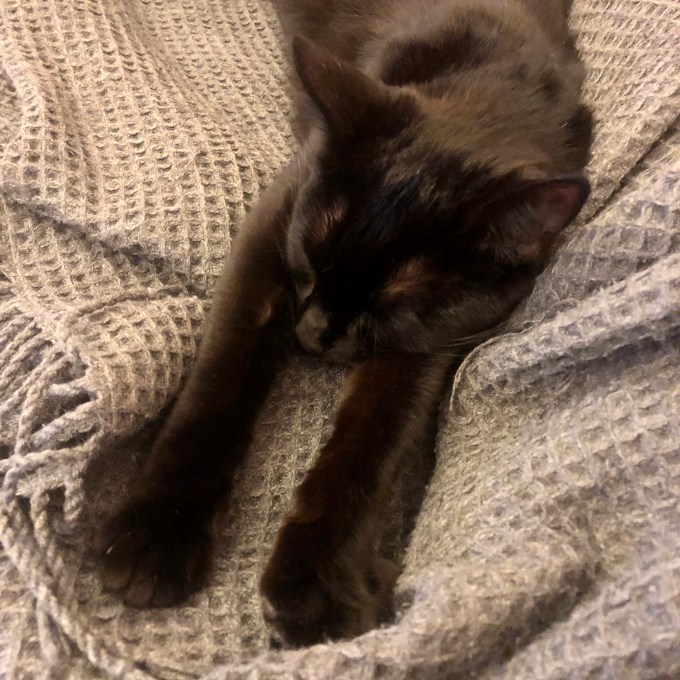
I have no idea how much time that ate up, just that I was absolutely drained afterwards and barely able to sit up on the sofa. We finished the movie (I liked it for the most part but there’s a really problematic scene where one of the lawyers tricks a gay man into outing himself in public, which is just not okay – I get that it was almost twenty years ago but that doesn’t make it comfortable to watch) and headed for bed. The one thing I will say about it being Bonfire Night was that one of my cats, Sooty (pictured below), stayed with me all evening, snuggled up nice and close. I don’t know if she understood my distress or whether she, herself, needed some comfort but it was very nice to have her with me all evening. Nothing really helps with the meltdowns but it did help before when it was the odd bang and after when I was a collapsed on the sofa. She was an excellent little companion.
Despite being so exhausted by the meltdown, I couldn’t sleep, no matter what I did. Maybe it was adrenaline, maybe it was fight or flight… I don’t know. But I couldn’t fully relax for hours, even with the help of a sleeping pill. I think I eventually went to sleep at some point between two thirty and three.
FRIDAY
I struggled up the next morning and after a while, decided to post about the experience. I’d seen #banthefireworks and similar hashtags trending on Twitter the night before, mainly to do with how traumatising they are for pets and for wildlife. It was, however, the first time I’d seen people with sensory issues and Autism mentioned as well though, which felt like quite a big deal. I’d been too out of it the night before to write anything at all but with my head a little clearer, I thought that maybe it could be a good idea and maybe raise some awareness about what the experience of Bonfire Night (and fireworks in general) is like as an autistic person. So I posted this on Twitter and on my Instagram stories:


I actually got a really lovely response with a handful of likes and kind, supportive comments.
I got up and got myself ready for the day and settled down to do some blog post writing. I was feeling very fragile after the meltdown(s) the night before so I put on one of the movies that I discovered during the first lockdown and ended up watching a lot because it just feels good. It’s called ‘Isn’t It Romantic’ with Rebel Wilson. I’m generally not a rom-com fan and I hadn’t seen Rebel Wilson in a role that didn’t make me cringe so I was initially wary when my friend recommended it but I ended up loving it. It’s just the ultimate feel good movie. So I had that on in the background as I tried to write (my thoughts always feel kind of fuzzy and not quite connected after a meltdown, sometimes for a few hours and sometimes for days – it can get really upsetting if I spend too much time thinking about it; feeling like your brain doesn’t work just feels so horrible and scary).
Mid afternoon, I had a session with my therapist. I haven’t ‘seen’ her for a while so we had quite a bit of catching up to do. We talked in depth about the night before, as I usually need to after an experience like that. I feel pretty lucky that I had a therapy session within less than twenty four hours, even if it was still very raw. But better that than in a week or two. The other main thing we talked about was how I’m struggling more than usual with my OCD: with the new semester of uni and the promotion of ‘Honest,’ it’s been really hard to find the time and emotional energy to keep up with my diary (for those unfamiliar, my OCD manifests as a compulsive need to write everything down. The overwhelming anxiety and pressure to keep up and do well in my Masters and what is effectively my job seems to be the only thing that can overpower my compulsive writing but then the anxiety around that only builds and builds until I feel like I can’t breathe, like my mind is coming apart and I’m no longer able to form coherent thought processes. We spent a while talking about that and about starting to tackle it as an issue, something we haven’t done because the pandemic has had such an impact on my mental health. It was an exhausting session but it was good to see her and hopefully, in therapy at least, I’m moving out of the frozen state I’ve been in since the pandemic hit the UK. I’m reluctant to commit to that as a statement but I’m cautiously optimistic.
I was pretty much done after that; I didn’t have any energy left. I posted a video to remind people about the new single but that was pretty much all I could manage for the rest of the day.
Since I was too tired to do anything, I ended up watching a new film, Inheritance. The trailer had looked good and while it wasn’t the best film ever, I thought the acting – especially the scenes that involved just Lily Collins and Simon Pegg in a room – was really good and I enjoyed the twists and turns. It was very dark though so I can definitely see it appealing to some and really not to others.
While the fireworks weren’t anywhere near as bad as the night before, people were still setting them off throughout the evening, which really heightened my anxiety. I could barely eat; it felt like my throat was closing up and swallowing was actively uncomfortable.
I spent the evening bouncing between trying to write blog posts and trying to write my diary, not achieving much with either. Again, I think I was just too tired. But it was still a bit too early to go to bed and I wanted to try and do something, even if it wasn’t much.
I FaceTimed with one of my parents before going to bed, which was really nice and then, during the call, I got an email saying that I’d got a ticket to Halsey’s upcoming livestream for the launch of her new poetry book, I Would Leave Me If I Could, which was really, really excited. And when I went to bed around eleven, Biden was very close to winning. So that was a good mental state to be going to bed with.
SATURDAY
I struggled up at nine thirty and got straight to work, recording vocals for the reimagination of my song before my session with Richard. That went pretty quickly and smoothly because I was fairly solid in the new melody. I think it’s pretty good, although I was a bit concerned that the rhythm of the melody wasn’t that different from the original. I didn’t have the time to rework it so I thought I’d take that to class and ask for advice, both in terms of whether they thought it was a problem and how I should go about changing it if it was.
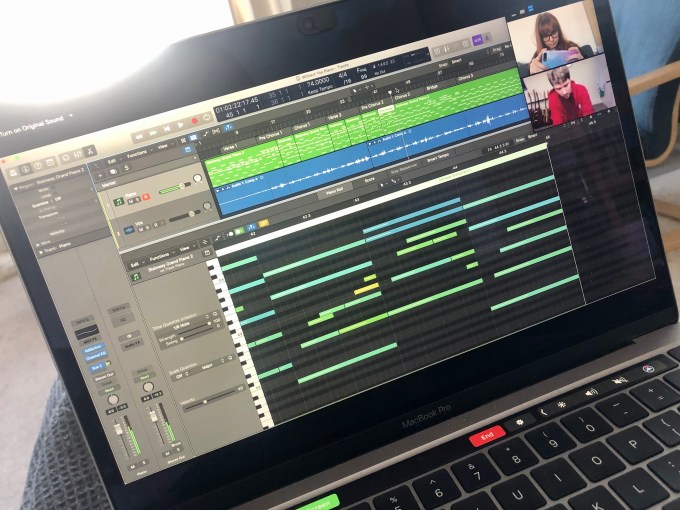
That done, I had a shower and breakfast, published my blog post about going back to the gym (pre this new lockdown), and then logged into Zoom for my session with Richard. We spent the next three hours working on the reimagination of my song and of the cover song. I found it quite frustrating since it was mainly arrangement and production based, so all I could do was offer direction and suggestions but Richard had to do all of the physical work, considering the Logic project was on his screen. This is one of the things I find hardest about collaboration via programs like Zoom: you can’t just take over from one another, swap chairs or instruments, or even point to things on the screen. Sometimes I end up finding it hard to engage and sometimes I just end up wanting to scream because I feel so limited. Most of the time it’s fine and I’ll gratefully accept the fact that we can work long distance at all but every now and then, the frustration just gets too much.
After hanging up, I put Friends on for background noise and spent a few hours working on upcoming blog posts.
I wasn’t refreshing the news as obsessively anymore so I didn’t discover it for myself. I got a text from Richard at 4:28pm with a screenshot of the BBC News announcement. I actually shrieked and shouted to Mum to tell her. I was positively giddy with relief: I laughed hysterically and then I just started crying because I was just so overwhelmed with so many emotions. It was like I could breathe again. And considering that’s how I felt when it isn’t my country or government, I can only imagine how everyone in America – those who had worked so hard to get Trump out and Biden in – were feeling.
The majority of people that I was seeing on social media were hysterical with joy and it being such a historic moment, I felt that I really wanted to add my own to mark the occasion…
We were just finishing dinner when the fireworks started going off. They weren’t bad enough to trigger a meltdown but they did make me anxious, cause me to flinch and lose my train of thought. I was going to be very pleased when those few nights of fireworks were over.
We had a quiet evening of TV (me and Mum are currently rewatching Hustle – it’s easy to watch but still such a good show) and I tried to do some gentle work on my Masters essay but I ended up in a state about all the musical theory language that I was supposed to be using but didn’t understand, being a self taught musician rather than having had lots of lessons or doing grades. So that was very stressful and I got very upset so I emailed my tutors to ask for some guidance.
I was still buzzing about the election news but it had been somewhat dampened (temporarily) by my uni anxiety so I went to bed just feeling like a complete mess. I was exhausted and overwhelmed and anxious and it was all just too much. By that point, I needed the emotional fresh start a new day would give me.
SUNDAY
It wasn’t easy but I managed to wake up around eight thirty. I got distracted from getting up when I checked my social media though, looking through all of the posts about Biden getting in. There were a few negative posts but on the whole, my feed was mostly filled with positive ones, which was a nice way to start the day. Obviously our social media isn’t an objective view of any subject so I wasn’t going to base my knowledge of the election outcome on the reactions I was seeing but seeing so much positivity and joy on my timeline was a real lift in a very difficult week.
Eventually I tore myself away, had a shower and breakfast, and got down to work. I spent the morning working on blog posts and doing some Christmas present planning and shopping. And then I dedicated the afternoon to preparing for the conference. It’s a conference about University and the Covid-19 pandemic and I’m on a panel discussing autistic students and coping with change. So I wrote down all my thoughts, organised and input them into the powerpoint we would be displaying. It took a couple of hours but I was pleased with the work I’d done. Now I just have to pull together my notes for when it’s my turn to speak but I didn’t want to do that until we’d all met again and signed off on the powerpoint as a group.
I had some chill time before one of my other parents arrived for our weekly evening together (she’s in our bubble and it seems that bubbles – those that bring a household and a single person together anyway – are still permitted during this lockdown). We’d decided, given that we were already in a bubble and none of us do anything out but the essentials, that we felt safe to continuing seeing each other.
We had a really good evening. She’s a music teacher (or at least that’s one of her hats) and has been for decades so she was able to help me out with my essay: we went through the harmonic, melodic, and rhythmic elements of every section of the song and it was kind of hilarious how consistent I’d been without being aware of it: almost every element built on the idea of tension and release, except the release never comes. Non-diatonic chords, uncommon intervals, irregular time signatures, syncopation for days… The song had been an experiment in the weird and it was certainly that.
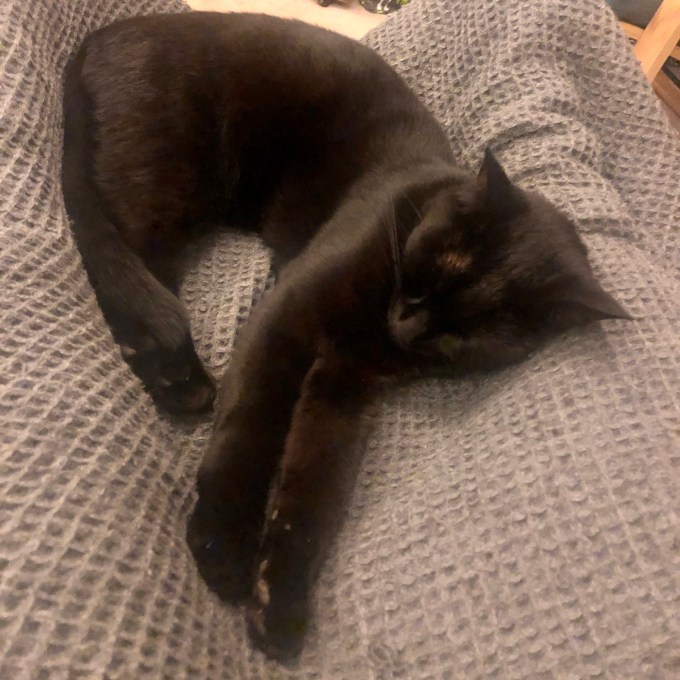
We had dinner with a movie (we missed the new episode of His Dark Materials because I got the time wrong – me and Mum made a note to watch it the next day) and while my parents were content to relax with the rest of the movie, I went back to blog writing. My brain struggles to sit still, to do one thing without getting distracted or bored. So I kept writing, with Sooty curled up between my knees. It seems to be her new favourite place.
Once it was just me and Mum again, we took our time winding down and then headed for bed. I checked my phone one last time and saw that, as promised if Biden won the election, Kalie Shorr had released a worktape of one of her unreleased songs, ‘Strawberry Blonde.’ It’s such a great song. Her lyric writing especially just blows my mind:
“…Sometimes I still get wasted
To stop thinking ‘bout the time I wasted
I started taking long walks again
And I started talking to God again
You’d hardly recognise me with my rose-coloured glasses gone
You might find it surprising I stopped taking shit from anyone
I got a new tattoo so you don’t know what I look like when my clothes are off
And I went strawberry blonde…”
I learn so much from her songs and I’d love to have the confidence she has in her writing style, in herself as an artist and as a person it seems. She is one of the people I want to write with most; I feel like it would just be so much fun and I’d learn so much. Plus I think we could write one badass song. She’s such an inspiration to me and has been ever since I met her and started following her career in 2016. I don’t know if she knows what an impact – what a positive impact – she’s had on my life.
My brain was going off like fireworks (ironic, I know, but it’s the only metaphor I’ve found that fits) after hearing that song, lyrics bursting into life behind my eyes, which of course I had to write down so as not to forget them. My brain is often at its most active and creative at night. So it took me a long time to get to sleep.
So it was a hell of a week. There was good, bad, really good, and really bad. I can’t say whether it was the week I expected or not because I had no idea what the week was going to look like, mostly due to the US election. Most of all it was exhausting. The new week felt daunting, going in so depleted, but it’s not the first time and it won’t be the last.
I hope this was interesting; I hope you enjoyed it. And I’ll see you in the next post.
 Finding Hope