 Finding Hope
Goals For 2022 (Part 1)
Posted on February 26, 2022
I had intended to set goals at the beginning of the year but honestly, I was feeling so terrible that I couldn’t even see twenty-four hours ahead, let alone six months or a year. So I decided to shelve the setting of goals until I felt a bit more… like myself, I guess. I’m not sure I’m ready to commit to anything too… much just yet, given that I’m barely back on my feet (something that still feels debatable some days). It’s hard to plan ahead. So, I thought I’d split this post into two this year: goals for the first six months and then goals for the second. Maybe. It does feel a bit like I’m just going through the motions but maybe that’s just what I need to do right now.
GET MY MENTAL HEALTH STABILISED – Between the pandemic stuff I was already carrying around, the burnout post-MA, the disaster that was the ADHD medication, and the anxiety induced breakdown I had at the end of January (plus having been unable to see my therapist pretty much since last May), I’m one big mess. I’ve started the Moclobemide but it still feels too early to say for sure whether or not it’s the right thing. I’m starting to write again though, which is a good sign. Hopefully I’ll be back at therapy in the not too distant future, plus there are some other options for support to consider. I just feel like, until I get my head sorted – or at least a bit more sorted – my life is on hold and I hate it. I can’t have a real life until there’s some resolution here.


GET BACK TO SWIMMING – I haven’t been very mobile at all over the last few months, given how bad my mental and physical health has been, and I’m definitely feeling it. My chronic pain over the last couple of weeks has been awful – back to the levels it was last summer – and now that I actually feel able to leave the house, I really want to get back to swimming and to my hydrotherapy exercises. I want to get fitter and I want to get stronger; the hope is that, the stronger my body is, the better my life with hEDS will be.
RELEASE NEW MUSIC – I’m so desperate (in a good way) to release new music. It’s been so long since the Honest EP came out and even longer since I wrote the songs. So much has changed since then, for me as person and as a songwriter. I am working on an album and that’s my real passion project but it is going to take time and I don’t want to keep anyone waiting that long. Hell, I don’t want to wait that long. So I am working on music to release before the album and while it’s taking a bit longer because of the last few months, it is happening and it is coming.

I don’t have an exact deadline for these goals, especially since mental and physical health don’t always adhere to any schedule you set for yourself. But I’m hoping that I can do these things – and perhaps more – within the first half of the year. Then, maybe, I can set a new series of goals that are a bit more exciting and ambitious once I’m feeling a bit more solid.
Migraines, Tooth Pain, And Blood Pressure Monitoring
Posted on June 5, 2021
So often in my life it seems, medical stuff is like waiting for a bus: weeks or months go by and then suddenly a whole slew of them show up. And that’s certainly been true of the last few months. Just as the final module of my Masters was starting, I was hit by a series of awful migraines, suffered with terrible tooth pain, and spent twenty four hours hooked up to a blood pressure monitor, a test ordered by a neurology unit in London. So it’s been a pretty hectic time…
MIGRAINES
At the time of writing this, I’ve lost approximately half of the last forty days to migraines.
I’ve had migraines before – maybe a handful a year, depending on my stress levels and the medication I’m taking – but they usually only last for a day or so before fading away. They’re not pleasant but they weren’t seriously impacting my life. But then I had one that lasted roughly four days and I ended up in A&E because, having fairly recently had the Astra Zeneca vaccine, my doctor was worried about the extremely rare side effect of a blood clot. I was sure it was a migraine but agreed to go and after most of the day there, I was released; the doctor agreed that it was most likely a bad migraine but told me to come back if it didn’t go away. And after another day or so, it did. While I was somewhat irritated about losing a day that should’ve been spent working on my end of semester assessment (despite the pain, I was pushing myself to work on it as I could, in the moments where the painkillers actually worked – I think that’s mainly why it went on so long personally), I am really grateful to all of the hospital staff. They were all great – warm, considerate, and personable – despite the somewhat alarming COVID precautions everywhere that weren’t exactly great for my anxiety. But they were really kind and gentle with me throughout my visit, making the whole experience a lot easier than it could’ve been.
I’d thought that that was it. But then, again and again, I was hit by migraine after migraine, all lasting unusually long periods of time (for me, at least). They were averaging out at about six days each time, sometimes more. That was extremely stressful, bearing in mind that I’m at the beginning of the homestretch of my Masters with this final module accounting for 60% of my final grade, and I was utterly miserable from the pain. I was also so light sensitive; at one point, even the darkest room in the house felt too bright and I dissolved onto the floor in tears, which only hurt my head more. It was awful. That was the first time we called 111 and they called paramedics. That time they determined it was, again, a severe migraine and recommended two other pain medications to try in the hope that they’d be more effective than Nurofen.
A couple of migraines later, with minimal help from the new painkillers, I had another really bad one, which had us calling 111 and they sent paramedics (both such lovely guys who fell in love with the cats and talked musicals with me while they did their tests). This migraine was slightly different: it had all of my normal migraine symptoms but I also had this almost blinding pain at the front and right side of my face. They thought it was probably a migraine but suggested talking to my doctor about having a CAT scan and/or whether there was something going on with my cranial nerves. They also had some practical, experience based advice around pain relief (one of them had personal experience with severe migraines). They said they could escort us to the hospital on the off chance that a doctor would do a CAT scan but did acknowledge that they might just take blood and keep me there while it was checked again, like my previous visit to A&E. So we chose the second option: Mum was going to go out and get the new medication option and call my GP ASAP.
TOOTH PAIN
That was the most recent migraine (at the time of writing this). As time passed, the pain in my head started to decrease, then my face, settling in my back-top-right teeth; every time they – and finally just one (after about a week) – knocked against the bottom teeth, the pain was so bad that my entire body would freeze up.
As soon as it had settled in my teeth, we’d called the dentist and they brought me in as an emergency (a few days wait rather than a few months). The dentist checked, took x-rays and saw some decay in the painful tooth, fairly close to the nerve root, and it already has a pretty big filling in it. At one point, somehow, the hEDS diagnosis came up (I was diagnosed since my last dental appointment) and the dentist said that she’s seen and heard about multiple people with a form of EDS (or who were later diagnosed with it) struggle with tooth decay, as well as being scolded by their dentists for not doing a good enough job with their dental hygiene even though they actually were; it was often the EDS causing problems, not necessarily their actions. This really is the diagnosis that keeps on giving (imagine a sarcastic snort at the end of that sentence).
Anyway, she diagnosed an abscess and gave me two treatment options: extraction or root canal therapy, which would involve multiple, multi-hour sessions that would be painful, ultimately might not work, and probably wouldn’t last into my late thirties. The whole thing felt pretty overwhelming and I ended up in tears. Extraction was the obvious choice as far as I was concerned and everyone else agreed; there seemed to be way too many downsides to the root canal option (plus it sounded horrendous and I find dental work, even fairly straightforward stuff, very distressing) and even if I was inclined to choose it, it’s the worst possible time given the end of my Masters. Even an extraction is going to be a significant disruption. I’m applying for extenuating circumstances, which both my supervisor and module leader have encouraged, so hopefully that’ll mean I end up with the same amount of time to do the work as everyone else.
So, I’ve been referred for an emergent extraction under general anaesthetic but I don’t know when that’s going to happen. They also prescribed me some antibiotics for the mean time. Now it’s a waiting game. But several days after the appointment, either the antibiotics are working or the nerve is dying or both because the pain is getting better and I feel more human. There are periods of time where I can actually ignore it, which is a huge deal considering how much pain I’d been in. So that’s definitely something to be grateful for.
BLOOD PRESSURE MONITORING
A couple of months ago, I had an appointment with a doctor from a neurology unit in London, which I believe I mentioned in this post. After spending most of the appointment vehemently telling me there was no point in getting any tests, he somewhat reluctantly offered to write to my GP, suggesting I have my blood pressure monitored for twenty four hours. It took forever to get a monitor from the hospital but finally test day came.
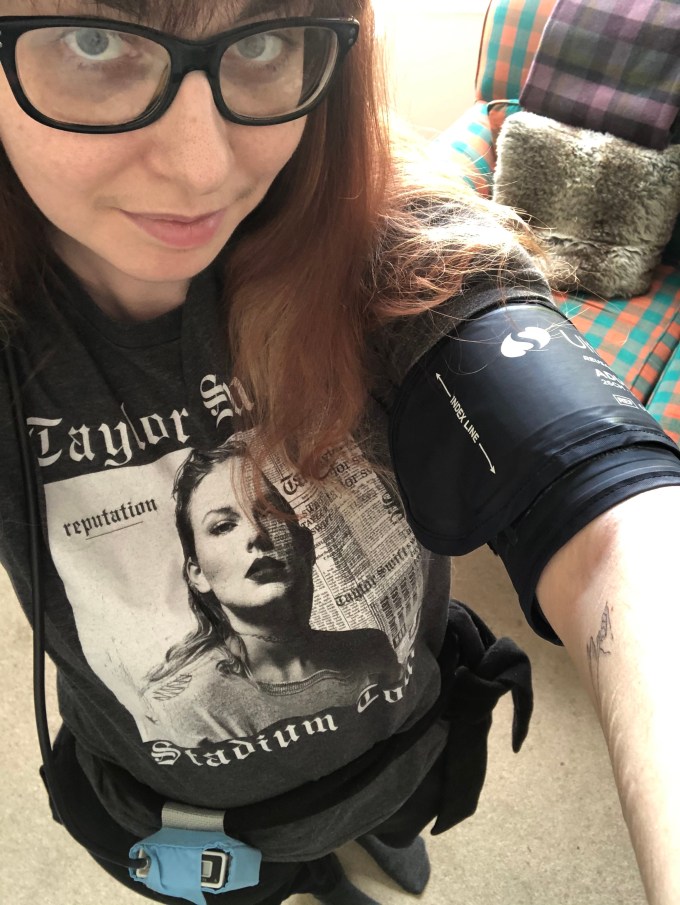
I had to go to the hospital where they fitted the monitor (found the right size for my arm, wrapped me up, made sure it was taking readings, looped the cable behind my neck, and used the tie from my coat to secure the monitor/data recorder around my waist) and gave me the instructions and paperwork to go along with the monitor. I wasn’t allowed to get it wet so I couldn’t have a shower while wearing it but since that’s when I usually get my blood pressure related symptoms, we devised a plan where I would go through the motions – with the shower on to create the heat and steam – so that it would still record whatever was happening to my blood pressure during a shower, as much as possible at least. The whole process was relatively stress free and the two women who sorted me out were great, warm and extremely competent but flexible to my needs. I’m really grateful to them for making it so easy.
All done, we headed home. It was a bit weird with the weight of the monitor, the too long cable getting caught on stuff, and so on but overall, it was fine. The cuff got very tight – tighter than I remembered them getting when you get a one off test – but it wasn’t a big deal and the rest of the day went on as normal. It was a bit of a struggle to get to sleep because I couldn’t get comfortable with the cuff on my arm but once I did get to sleep, the inflating and squeezing didn’t wake me up, something I’d expected to happen.
However, when I woke up, my arm was really sore. I felt like I’d been punched a hundred times in the same place, convinced the skin was bruised underneath the cuff (it wasn’t and no bruise ever emerged but damn, it was tender). I think the cuff had slipped in the night as well because I had several error readings on that second day.
I had my pretend shower and, as usual, felt shaky, dizzy, and lightheaded; having thought ahead, I’d timed things so that the monitor would be taking the reading right at the end of my fake shower. I’m intrigued to see what that reading says. That done, Mum helped me wash my hair, leant over the side of the bath; I had an online meeting and couldn’t bear the thought of doing that with unwashed hair. It wasn’t very dignified, especially with all the extra towels wrapped around me to keep the monitor dry, but it got the job done.
I wore it for the rest of the twenty four hours and then, with great relief, unwrapped the cuff. By the end, my arm felt really sore from the squeezing, plus it had started to pinch in various places at some point. There’s also that Autism-sensory-thing of wearing something constantly constricting, which starts causing anxiety after certain periods of time, like a long day in skinny jeans or wearing my retainer all day. Does that make sense? The anxiety had been building for the last few hours and it was wonderful to take it off.
Mum dropped it back at the hospital, so now I guess it’s another waiting game. I don’t know when we’ll find out the results and the conclusions drawn from them. I assume that they’ll let us know at some point, although it wouldn’t be the first time we’ve had to chase results. As I said, all we can do now is wait.
So, yeah, hectic. At a very inconvenient time. But that’s life and I’m determined not to let it spoil the last of my Masters and this project that I’ve been looking forward to for so long. I am going to make the most of every good day I have, take the extenuating circumstances gratefully, and continue working as hard as I can.
 Finding Hope