 Finding Hope
A Week In My Life (September 2023)
Posted on November 26, 2023
Somehow, getting a puppy has made my life both more and less busy. I’m constantly on the move – following her around, chasing her, playing with her – but my life is quieter – she’s so young and still getting settled so I don’t want to leave her – so I may have found a somewhat unusual way of doing less, out in the world at least. Having her around means that my day-to-day life ricochets from full on and exhausting to quiet and chilled out. It’s been a bit of an adjustment but I think it has given me a chance to recoup a bit. A bit. I’m still trying to get a lot done – I don’t think my relationship with productivity is particularly healthy – but Izzy comes first, especially while she’s so young, so this period of time with all of this change has been more than a little disconcerting. Izzy is, of course, worth it; it’s just taking me a while to adjust.
The week in this post started on Thursday 14th September 2023 and ended on Wednesday 20th September 2023.
THURSDAY
Since the arrival of Izzy, I’ve been brutally forced to become a morning person, having previously slept in until after nine (usually due to staying up far too late – Revenge Bedtime Procrastination is my nemesis). But Izzy is an early bird and takes great pleasure in waking me up at six thirty and trust me, if you’ve never had a young puppy, you need to get up and sort them out; she’s still learning to use the puppy pad and a few extra minutes with your eyes closed is not worth the potential clean up.
So I dragged myself up, took her downstairs, and gave her breakfast. I managed to inhale some fruit salad (my current hyperfixation food – something I’ve never experienced before) while she ate and then put down the cat food, removing myself and Izzy so that they could eat in peace: Izzy has a bad habit of bouncing up to them with great but apparently terrifying enthusiasm, which has them running for the cat flap; she’s desperate to play with them but I think they interpret that playful behaviour as scary and unpredictable so the bonding is going pretty slowly (one of the cats, our matriarch, does put her firmly in her place though – one down, four to go). Upstairs, I played with Izzy for a bit, letting her burn off some energy and then did my Duolingo practice and physiotherapy exercises.
Mum had taken Lucy to the vet for a check up post a small surgery she had a few weeks ago and she came back with a clean bill of health. We released her and then raced out of the door, got in the car, and headed for the hospital for my hydrotherapy appointment. The drive gave me the chance to just sit and reply to the various messages that needed responses; I feel like my brain has been so full recently that it’s been hard to focus on smaller tasks, like messages and emails. Maybe it’s an ADHD or Autism thing; given how close I’ve felt to burnout over the last few months, it wouldn’t surprise me.
I was a little late for the appointment because we couldn’t find anywhere to park, disabled space or not, until the last possible second and then, when we got in, we discovered that the towel was still at home, hanging on the radiator after swimming the night before. Fortunately, they were prepared for that eventuality. But apart from those few mishaps, it was a really good session. The exercises I got about eighteen months ago – between finding the right pool to work in and waiting for the follow up appointment, it’s taken this long to get to this point – have become easy so the hydrotherapist suggested a few ways to increase the resistance. Between those and the physiotherapy exercises, I’m working pretty much my whole body so we added a series of core exercises, given that that area of the body is a real weakness for people with Hypermobile Ehlers-Danlos Syndrome; it made sense to be putting extra work into those muscles. We ran through each of them in turn and the hydrotherapist (the same one I’d worked with last time) said how impressed she was at how hard I’d clearly been working, how committed I’ve been (apparently it’s not uncommon for people to just do the exercises a few times and then, unsurprisingly, not progress). That meant a lot to me because I have been working really hard over the last year, even when I didn’t want to. I obviously didn’t do it for the praise but it was really nice to have the work recognised and acknowledged by someone who knows what they’re talking about. With the new exercises under my belt, I feel really good about the work I’ve done so far and really motivated to keep going.


Back home, Izzy was delighted to see me, which was very sweet; she was positively trembling with joy. I let her out of her crate (we are attempting to crate-train her and she’s taking to it fairly well) and we played with various toys for a while before I crashed on the sofa and accidentally fell asleep; between the hydrotherapy and chasing after Izzy, I was exhausted.
I slept for a couple of hours and then dragged myself up for some food and caught the train to London. Barely a week earlier, I’d joined an online creative workshop run by the arts organisation, Magical Women (run by and for neurodivergent women and non-binary individuals). The atmosphere was really positive, everyone was really nice and supportive, and I felt really included, despite it being my first session. After that workshop, I got an invitation to the private view of the founder’s new exhibition, Biodiversity of Sites and Sounds by Elinor Rowlands. I didn’t have much experience of the organisation and the people involved but they felt like a group I wanted to be a part of so I rearranged my plans and hopped on a train to London.
The gallery was gorgeous. I love more abstract styles and pieces of art. I love how they’re completely open to your interpretation: what they are, what they mean, and what they make you feel. I really liked Elinor’s work and ended up pouring over the postcards, trying to not just buy one of each canvas.
I met some really lovely people too and it felt like a really safe space with pretty much everyone in attendance being neurodivergent. That was a nice ratio for a change. I was a little disorientated, having gotten lost on the way, and so I was struggling a bit with how to join in the socialising but fortunately everyone was really friendly and I was quickly included in multiple discussions. It was really, really nice and if I hadn’t had to catch a train back home, I would’ve liked to have joined them all in the pub after, most us having stayed until the exhibition closed.
And that was when it all went wrong (and becomes blurry, as meltdown and almost-meltdown experiences often become afterwards). I was standing at the lift with the last group of people when I realised I didn’t have my leather jacket, my favourite jacket and the one that I wear everywhere; it’s a deeply important and confidence-boosting piece of clothing. I retraced my steps and when I still couldn’t find it, I searched the whole floor, getting increasingly more panicked. Given how late it was, there was no one around and my group of people had already left so there was no one to ask. I called my Mum, sobbing and hyperventilating, and she tried to calm me down enough to make a plan, but then I was locked out of the building and I was overwhelmed with the feeling that my jacket was gone forever: I could’ve left it somewhere inside or on a wall during one of the many moments I’d stopped to check my map app. I was frozen: I couldn’t think and I was struggling to talk; I couldn’t take deep breaths so the hyperventilating continued; I couldn’t move but I was shaking; I felt completely overwhelmed by every light and every sound and every movement, like a car or a motorbike or a person, startled me, feeling so sudden and completely unpredictable and like I couldn’t keep track of them all; I felt extremely vulnerable; and I felt so ridiculous and stupid (I remember calling myself ‘a fucking idiot’ over and over again, for losing the jacket and for caring about it so much in the first place). I had to wait ages for a bus back to the station and despite the amount of people, no seemed to notice my trembling or hiccuping sobs.
Somehow I managed to get back to the station and catch a train home. Between the lack of jacket and the exhaustion of the almost-but-not-quite-meltdown, I was desperately tired and quickly got cold. The journey felt very long but eventually we pulled into the station and Mum was waiting for me at the barrier, Izzy bundled up in her blanket like a little puppy burrito. Despite everything, the picture brought a smile to my face.
Back home and snuggled up on the sofa with Izzy, I continued my New Tricks rewatch (an old favourite – although there are moments that would never have been written now) for an episode or so before going to bed; I just needed some time to decompress (and get warm) before I tried to sleep.
FRIDAY
I struggled up early and sorted out Izzy: she’s doing so well that I can’t really complain but I’m finding the aggressive shift from ‘late sleeper’ to ‘early bird’ pretty tough. Anyway, as I said, Izzy was really good, eating all of her breakfast out of her bowl (rather than refusing anything but hand-feeding) and using the puppy-pad perfectly. She’s such a good girl and she’s so adorable and happy when we praise her: she’s so pleased with herself.
I had a quick shower and then headed out for a meeting with a mentor I have as part of an organisation dedicated to supporting autistic individuals post-education. For a number of reasons, we’ve been very slow to get started but now we’re finally meeting on a regular basis. She’s really nice and because she’s neurodivergent with a lot of the same health problems as me, she understands me in ways that a lot of people don’t. I’m still not sure about how the sessions are supposed to help but we’re still getting to know each other and I guess it will become clear in time. This doesn’t really feel like the time or place to discuss the sessions, if only because we’re still so early in the process, but there was one thing I wanted to note: we’ve changed rooms and in this new room, there’s carpet on the wall – presumably for soundproofing – but it looks like grass, dark green and shag-like pile, and I was instantly compelled to touch it. There was just something so pleasing about it and when Mum picked me up at the end, I… expressed my desire to have a similar set up. Very enthusiastically. I do need to soundproof my space better to improve my vocal recordings after all… She’s unconvinced.
Back home, I briefly caught up with two of my parents over FaceTime before having a lie down on the sofa, Izzy curled up with me. I was completely exhausted and the gentle, repetitive stroking of her soft puppy fur almost put me to sleep. I’d hoped to get some writing done before my friend, Dan, arrived but apparently I was just too tired. And Izzy is deeply distracting (which I’m sure she knows and relishes). But such is life. Izzy was delighted to see Dan and Dan was delighted to see Izzy; he really loves her and she really loves him. It’s very cute. They were instantly playing and it was very enjoyable to watch.


We’d had vague plans to continue our Fringe rewatch etc, but we literally ended up playing with Izzy and chatting. I’m not complaining though; it was really, really nice. Something that I love about our friendship is how we can just talk and talk about pretty much anything – from the newest odd facts we’ve learned to how our week has been to some of the deepest stuff possible – for hours and hours and while we can be deeply serious, we also laugh a lot. It’s really lovely and I’m so grateful for this relationship that we’ve built.
So it ended up being a very chilled out day. We dropped Dan off at the station early evening and then came home and stretched out in the living room. I was really tired but it was much too early to go to bed so Mum and I continued our New Tricks rewatch and I finally posted about Izzy on social media…
We had a particularly good fish and chips for dinner and although I tried to do some writing, I really didn’t achieve much. I couldn’t concentrate and I just couldn’t get comfortable; it certainly doesn’t help that the desk I use when sitting on the sofa has all but collapsed and basically pins me to the sofa. I need to get a new one but I haven’t found any that have adjustable legs, which is kind of key in my experience. Hopefully one will pop up in my searches soon.
Izzy did interrupt the peace of the evening when she swiped the kitchen roll off the sofa and proceeded to unroll it all over the carpet. It was very funny – she was clearly having an absolute ball – but it took ages to persuade her to let go and tidy it all up. Again, I can’t really complain: it was so cute and Izzy is so excitable and, on the whole, it wasn’t a huge hassle. It’s hard not to be touched by her innocent wonder and pure excitement about the world. Everything is fun; everything is an adventure or a game.

She had a good ten minutes of zoomies, which is always very funny and very adorable. Having said that, it did then devolve into barking and nipping, which I was not pleased with, and I don’t enjoy telling her off, even though I know it’s what she needs to understand what she can and can’t do. I got ready for bed, letting her run and run and run – hopefully burning off the last of her energy (it’s not long until we can take her outside and to the park, thank goodness). I was in bed and finishing the last of my diary notes when she finally calmed down and came to me, asking to be lifted onto the bed. She wandered around for a little bit and then stretched out across my legs, falling sleep. Little weirdo. It looked so uncomfortable but she seemed perfectly content. Having her there was very comforting: I was feeling very overwhelmed and unprepared for everything coming up and her heartbeat, her breathing, and her warmth were very soothing. It didn’t solve anything – that would be a pretty big ask – but I did feel a little less panicked for her presence.


SATURDAY
Izzy got me up early, as is my new normal, and then we settled into the living room, where I threw toys for her for a little while. Then I got my new blog post up (Introducing Izzy!) and then had a shower and got dressed before taking Izzy out to the vet for her first vaccine. She handled it really well. The vet also advised that she get her microchip – in case she rushed out or got loose between the house and the car, for example – so we did that too. She wriggled a bit at that but it was a really big needle; it must’ve hurt! But she got lots of treats and attention and it wasn’t long before she’d recovered. They also weighed her and she’s only 1.4kg! She’s tiny! And with that, we headed out, buying her a new toy on our way: a dragon that may or may not be bigger than her.
Back home, I did some admin work, including posting about my upcoming gig, which I’m really excited about…
After a couple of hours, I had to stop and have a nap. I’m so tired at the moment that a middle-of-the-day nap is pretty vital in order to stay functional and, to be honest, I’ve been so tired that I don’t really have a choice in the matter. I can struggle to stay awake longer, not getting very much done, or I can surrender to sleep and hopefully wake up with a bit more energy to keep going. This started with Izzy’s arrival and I think the early mornings (and lack of change around going to bed late) has been catching up with me. I guess it’s fortunate that my life is generally flexible enough to accommodate that adjustment.
I spent the afternoon working on blog posts and then had an early dinner before signing in to the new Amanda Tapping livestream through The Companion – I’d like to write it up like I did the last one, but this post isn’t the place for that. It was as lovely an experience as it was last time: Amanda is such a warm, open person and such an engaging speaker, able to move seamlessly between funny and thoughtful. But most of all, she’s so honest and talks about really vulnerable moments and feelings, sharing them with such trust; it’s hard not to feel honoured and even a bit overwhelmed by that. The relationship she has managed to cultivate with her fans – over decades and through multiple different projects – feels so special and so sacred, one that she holds as much reverence for as we do. She and the host, Rebecca, talked for a while, about mental health and self care, Amanda sharing the story of her daughter leaving for university and her emotions around that, how much letting her friends be there for her has helped both her mental health and their friendships. She talked about crying a lot, mostly in positive terms, and how helpful it can be. But the thing she talked about that hit me hardest, that resonated most, was when she talked about self worth: she talked about how low her self worth had become and how she hadn’t felt worthy of taking care of herself, that she had had to work really hard to feel worthy of self care again. That made me very emotional: I hate the thought of her feeling like that but, again, I felt somewhat overwhelmed by the fact that she was sharing that experience with us. I feel very lucky to have found her all those years ago, to have such an amazing person to look up to.
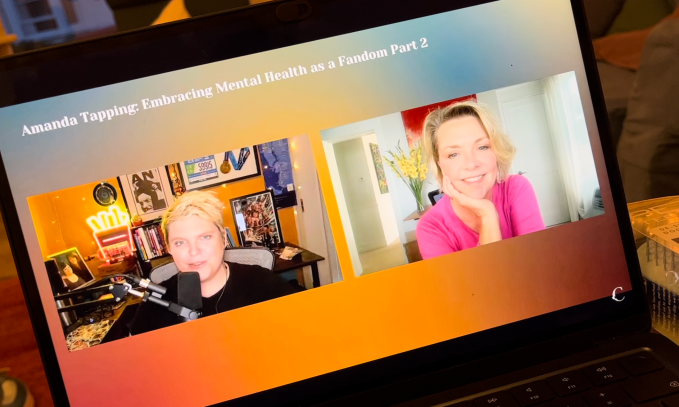
Then, in response to questions from people watching, she talked about various topics, including how she’s struggled with guilt as a mother, how she would – and sometimes still does – talk to her Mum as if they were talking on the phone when she misses her (she died in 2021), and how she practices self care. And then they were having to wrap things up. It went by so fast, everyone agreed – Amanda, Rebecca, and multiple people in the chat. But it was really lovely and really special and they’re planning to do another one soon-ish.
Having met Amanda pretty recently at London Film & Comic Con and having felt so buoyed by the experience, I couldn’t resist getting a meet and greet for after the livestream; the money was going to charity after all. So, after the livestream ended, everyone with a meet and greet (a short Zoom call with Amanda in groups of four) logged into Zoom to chat until our time slots. I’ve never done anything like that and I didn’t know how to make it work and I was starting to get really panicked about not being able to get into the call when I finally figured it out; once in, I had to just sit for a little while, trying to calm down and compose myself. I hadn’t known what to expect but (fortunately for my anxiety levels) it was really nice, everyone chatting and holding various pets up to the camera; there was something so communal and easy about it, all of us connected through our shared love of Amanda and her work. But then suddenly it was my group’s turn and I was overwhelmed by anxiety again. I didn’t know how it would work with four people, especially with so little time, and I didn’t want to ‘waste’ my opportunity to talk with her. I have such respect for her and she means so much to me that I really didn’t want to make a fool of myself or just say something completely forgettable. But fortunately, she always makes it so easy to be open, even though I was feeling so anxious and fragile; it’s the same on screen as it is in person. And having Izzy in my arms was both good for my anxiety and as a conversation starter: Amanda and I joked about the extremes of our dog owner experience, Amanda’s dog being a huge Bouvier mix and Izzy being a tiny Pomchi (Riley was apparently about 8.5kg at 8 weeks while Izzy was barely 1kg at the same age and likely won’t get bigger than 5.5kg). Very different experiences. We did talk about more than our dogs but I’m still turning the rest over in my mind. I don’t know how she does it but she manages to get everything else to fade away, making it so easy to talk to her, and it always feels like you have her complete attention, which is a bit overwhelming but also so moving and special. And then, all of a sudden, it was the next group’s turn. I knew the meet and greets weren’t long but it was pretty jarring, especially given the time it had taken me to get settled. But it doesn’t matter; I’m really grateful for the experience.
I have such intense anxiety when doing things like this that my adrenaline is sky high during the event and for a while after before crashing spectacularly. And even before that happened, I was exhausted. So I tried to be sensible and, instead of trying to keep working, I had some chill time in front of the TV and had a little scroll through social media. Having drastically reduced my time on it, I actually enjoy it more now, for the most part.
Given how tired I was, I actually went to bed fairly early – for me, at least. Izzy was clearly having her nighttime zoomies and, no matter what I did, she couldn’t seem to stop running circuits around the living room. It’s very cute and very funny – she seemed to be having a ball, pun kind of intended – so I left her to it and got ready for bed by myself. It wasn’t long until she joined me and snuggled up as close as she could get, another adorable habit of hers. Soft and warm, she’s lovely to cuddle up with.

Unfortunately, I couldn’t sleep and was still awake at two. I took a break from trying to sleep for a while, looking up poetry and writing challenges online for inspiration, and then eventually managed to drift off, dreading the early start.
SUNDAY
Izzy clearly hadn’t noticed my nighttime restlessness and was licking me awake just after seven. I struggled up and got her sorted with breakfast and a new puppy pad before we settled in the living room. We played for a while – she picked up ‘fetch’ so incredibly fast – and then she curled up for a snooze while I did my physio and Duolingo and other daily tasks before getting down to writing for a bit.
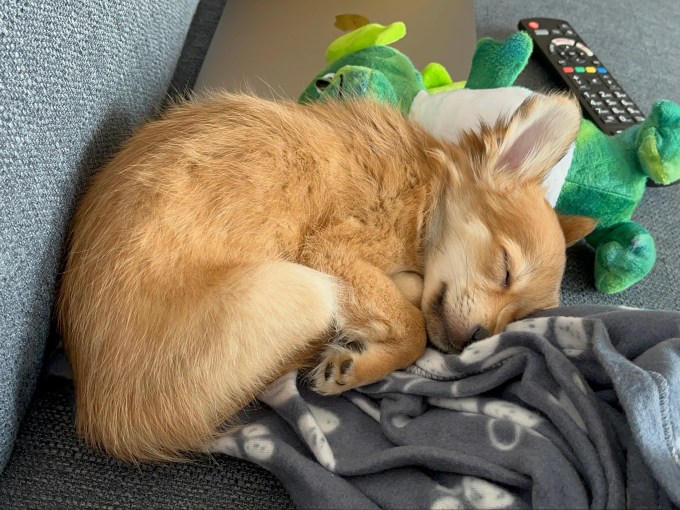
Me and Izzy spent most of the day like that, taking breaks for meals and playtime. It was a nice quiet day, which I appreciated after the short night.
Late-afternoon-early-evening, I headed to the pool for a swim. Without too much effort, I managed to swim a kilometre – the longest I’ve swum in years – and do the hydrotherapy exercises that are possible in that pool. That was really invigorating and I was really proud of myself, especially for the kilometre: it’s really clear evidence of how hard I’ve been working over the last eighteen months and what a difference that work has made. So, similarly to how I felt after the hydrotherapy appointment, I feel really good about what I’ve done so far and really motivated to keep going.
Izzy was practically vibrating with joy when we got in and I released her from a crate. She’s so funny: she does actually like it and often takes herself off to sleep in there but god forbid someone shuts her in. She gave me and then Mum a hero’s welcome – which is more than a little bit ridiculous but I’m always happy to cuddle with her – before busying herself with one of her toys and I settled down on the sofa again. I put on The Lincoln Lawyer – what a lovely show it is and one of my favourite background noise soundtracks – and did some more blog writing before spending the rest of my evening practicing for my show on Wednesday. I know I’m practicing more songs than I need but there are just so many that I want to play; I’m going to have to make some very reluctant editing of my setlist at some point.
I went to bed feeling exhausted and sore: my knee was hurting after the swim and I was somewhat concerned I’d been a bit overenthusiastic when doing my hydro exercises. My tailbone was also hurting, which is apparently a very common problem with hEDS (the gift that keeps on giving, she says sarcastically). So I took some painkillers and went to bed, feeling less than optimistic about the night ahead. Both of those pain issues have been known to wake me up throughout the night.
MONDAY
As predicated, I slept badly, the pain in my tailbone or one of my knees waking me up every time I moved or rolled over. It was miserable: trying to get back to sleep each time was miserable and waking up completely exhausted in the morning was miserable. The only not-miserable thing about it was that I woke up before Izzy and managed to get some snuggles in while she was still warm and soft and floppy; those moments with her are especially lovely.
Mum was up early and offered to do ‘the morning shift’ and I accidentally went back to sleep, getting another three hours or so, which I definitely appreciated. Izzy greeted me with great enthusiasm when I managed to get up, still sore, and tried to help me with my physio exercises (reduced due to the pain), which – unsurprisingly – wasn’t particularly helpful. But it is always very cute. Then, after some breakfast for me, we snuggled up together while I caught up on some emails and messages. Izzy was getting sleepy, ready for her mid-morning nap, and was beyond adorable, curled up at my elbow. It was very tempting to just abandon my to-do list and cuddle up with her. It wouldn’t be the first time. But I resisted the urge and actually got some work done.

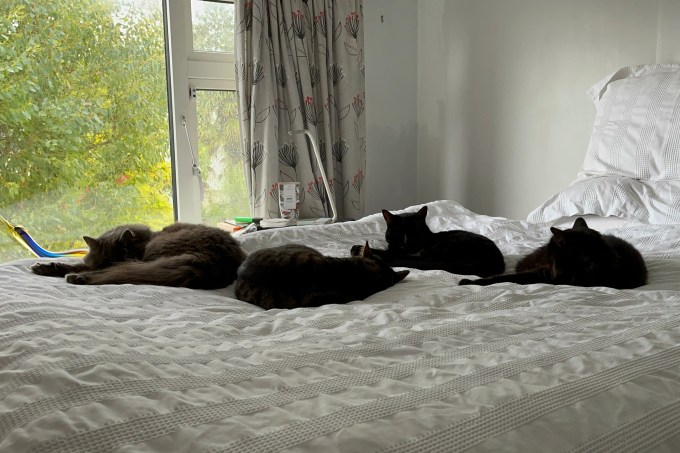
When I reached a good stopping point, I went to have a shower, sticking my head into my Mum’s room as I passed. Four of the five cats were curled up on Mum’s bed. They love the waffle of my Mum’s duvet but I’m pretty sure the biggest draw is that it’s one of the few comfy places that Izzy can’t reach and so they can chill out undisturbed. I know it’s a process and that they will all get used to each other but I do miss them since Izzy is currently glued to me and they’re avoiding her. I’m also struggling with the fact that she’s obviously creating stress in their otherwise blissfully stress-free lives, the result of a decision I made. I know that it’s super early – too early – to be stressing about whether they’ll ever get along but I can’t help it. I’m trying not to but it still creeps in.
Back in the living room, I logged into Zoom to attend a writing workshop, one of a series that I’ve been really enjoying lately. My absolute favourite workshop series ended a while back and I’m waiting for their next project to start but this one is really great too; it’s probably my second favourite of the ones I’ve done, certainly as a series of workshops (I’ve done some fun one off ones as well). These ones have more specific prompts but, if your writing wanders off in an unexpected direction that you’re really excited about, you’re encouraged to just go with it and see where it takes you. The overall prompt for this workshop was ‘door,’ which then became more specific after the opening exercises and free-writing. An idea came to me very quickly and the words just flowed so I just let the story happen. I feel like I’ve said this in another post recently but, as much as I love and feel connected to songwriting, I’ve been really enjoying dipping my toes in the fiction pond again.
When that finished, I had some lunch in front of The Lincoln Lawyer before moving to the piano. I spent several hours reworking an old song; everyone loves it and I do too but I just don’t think it’s saying what I want to say quite as well as it could. So I worked on refining it, making each line count and tie into the overall metaphor. I wrote the first draft several years ago now and I know I’m a better songwriter now; I’m confident that I can turn it into a stronger song.
My uni was hosting a songwriters’ circle that evening and although I really wanted to go – several people I really liked were playing – I just didn’t think I had it in me to go up to London again before the show on Wednesday; I needed to conserve my energy and chances were that the train journeys would trigger pain that I wouldn’t have recovered from in time. So I grudgingly gave up on that plan and stayed home, practicing my songs, eating dinner in front of Hijack with Mum, and snuggling with Izzy. She’d been quite hyper and destructive during the evening but when she finally calmed down, she was warm and soft and floppy in my arms. It was very cute and I couldn’t help laughing at the silly faces she made in her sleep…


I tried to get to bed while she was still sleepy but it didn’t work. She got the zoomies (plus she was biting a lot, which was exhausting) so I left her to it and did some diary writing while I waited for her to run out of energy and settle down for bed.
TUESDAY
I kept waking up throughout the night, my tailbone hurting every time I turned over. Every time, Izzy was snuggled up as close as possible, pressed into my neck, which was very cute. When I woke up for the final time, a little before my eight thirty alarm, she was still asleep and I was able to pull her into a sleepy cuddle, which was just too adorable for words. It was definitely a good way to start the day.
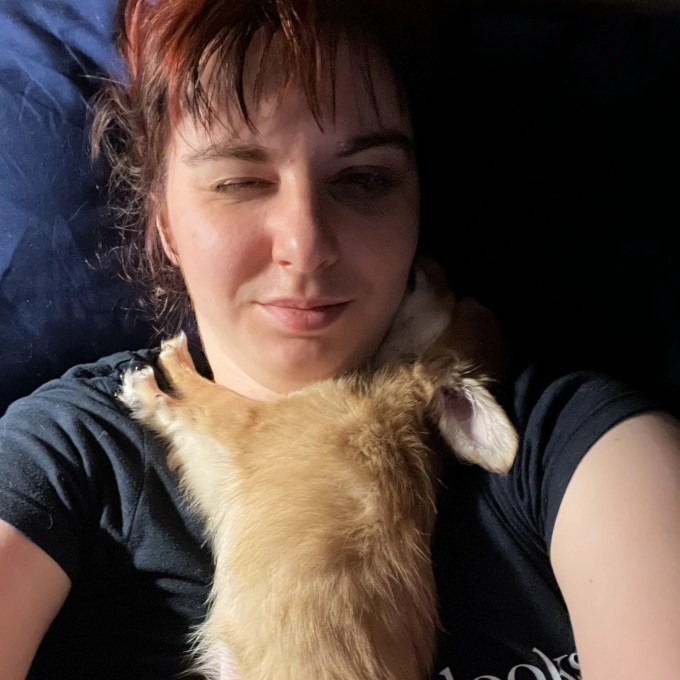
When Izzy woke up properly, we went downstairs as per our morning routine. Then I did some blog writing before having a shower and some breakfast. I had a physiotherapy session at twelve and we went through my current exercises, cutting some, adjusting others, and adding new ones. My physiotherapist is great and really understands hypermobility, which is so helpful; that knowledge makes for a much more productive and motivating experience.
When I got home, I found two of the cats – Sooty and Tiger – curled up together on a chair. I swear they were giving me some serious side-eye over Izzy. While I do feel bad about the stress she causes them, they do seem to have bonded more closely since she arrived, which is really lovely to see: they hang out together, they snuggle up together, they back each other up when Izzy appears, they check in with each other… It is really sweet. Hopefully things will settle and we’ll find a new normal soon.

I went to the pool mid afternoon and did my hydro exercises as well as managing a bit of a swim. I had a bit of a break when I got home, watching a film (Luckiest Girl Alive – I didn’t love it but I thought the performances from Mila Kunis and Chiara Aurelia were really good) and doing some blog post writing. Then, after an early dinner, I spent several hours practicing for the show and deciding which songs to play, which to hold in case there was time, and which to cut. I didn’t end up going to bed until after one; I’m very glad we don’t have neighbours on that side right now. But even that late, I couldn’t sleep; I think I eventually drifted off around three.
WEDNESDAY
Thank god for my Mum. She sorted out Izzy and let me sleep in (I’d texted her to let her know how much of a struggle it was to get to sleep and that it was making me anxious about managing the day and the gig) so that I would have enough energy for what was going to be a fairly strenuous day. I managed to sleep until almost eleven – which is unheard of these days – and I felt pretty good when I got up. I did some social media stuff and my morning habits and so on, trying to stay relaxed about getting to London and playing the gig – I was mostly excited but it’s also been a while since I’ve done a long set at a gig so I was nervous too. Finding the cats snuggled up together and having some time with them was a nice little break from everything….

I spent most of the day alternating between practicing and playing with Izzy. And sometimes I did both at the same time…
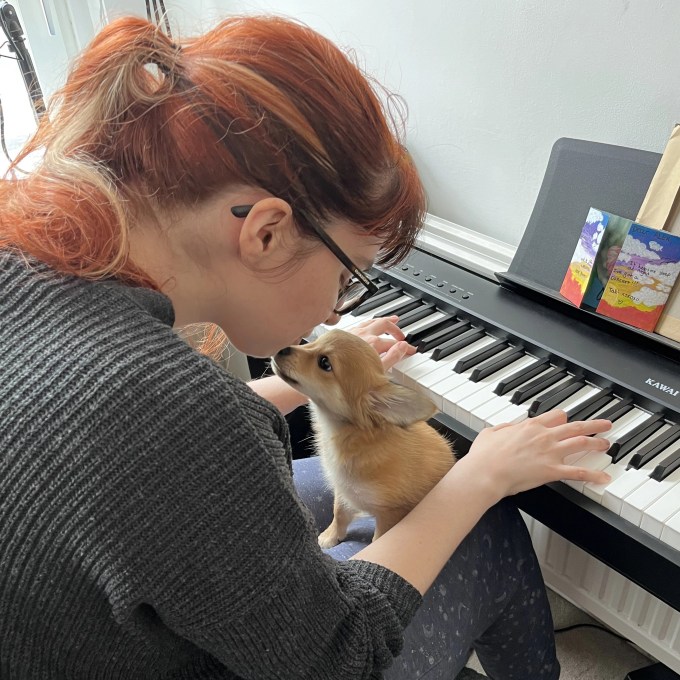
She’s so adorable in her confusion over musical instruments.
And I got ready, of course. I had a shower and did my hair and make up. Getting dressed was not as straightforward though: the outfit that I’d decided on suddenly felt wrong and I got very upset, feeling fat and ugly and unfit to be perceived by anyone. I tried various different outfits and different combinations but the damage was already done and it took more energy than I thought I had not to crawl under my duvet and never come out, to get dressed anyway, and leave the house. It was horrible and it wasn’t a bad thing that I had a long drive in which to wall off all of those thoughts. For the night at least.
The drive was long and slow. It had been pouring with rain for most of the day and it just kept raining and raining and raining. It slowed us down on the motorway and caused heavy traffic when we finally got into London. Door to door, it took over three hours – much longer than usual – and even with the buffer we’d built in, I was late for my soundcheck. Fortunately Luce, organiser of the event and my very good friend, had everything under control and made it work (she was a lot calmer than I was when I finally arrived). I got a quick soundcheck in and then people started filtering in. Given how horrendous the weather was, I wasn’t sure how many people would show up but I was almost overwhelmed with joy when so many friends, family, and family friends came. Having some of my closest friends there, including one friend who was moving abroad in mere days, made it so special; I cannot articulate how much it meant to me.
Cora played the first set and it was really cool to see her perform again, to hear the growth in her songwriting, having not seen her play for a couple of years (the last time was, somewhat bizarrely, a show where we were both on the same bill as well). Her songs are beautiful but there was one in particular that I just fell in love with; Cora hasn’t shared it yet and it’s her story to tell so I won’t spoil it but should she release it, I’ll be sharing it everywhere because it was absolutely stunning.
The show went really well and it was so, so special. I’d spent a lot of time thinking about the songs I was going to play and ended up with a mix of old favourites and new ones that I’m really excited about. I got to play the piano for one of them and we even had a fun little sing-a-long at the end, which was so lovely. It felt so, so good to perform again, especially with such an engaged and receptive audience.
Luce was a great host and we had some great conversations about the songs, the writing process, the inspiration, songwriting in general, and so on. I always love to talk about songwriting but I feel like our discussions between songs were really rich and we found ourselves in really interesting places – likely due to our friendship, the long conversations we’ve had, and the stories (both joyful and difficult) that we’ve shared with each other. It doesn’t feel like a stretch to say that much of the audience listening felt the same way, given the vulnerable and touching comments in the review notebook.
You can probably tell from this video how much I love talking about songwriting, as I said a moment ago…
It was over much too quickly and I lingered for a while, packing up and talking to people and hugging friends and family goodbye. But eventually I had to accept that the night was over and that it was time to go home, especially since my Mum was ever so kindly driving me home; it wouldn’t have been fair to make her wait any longer. So we piled into the car and headed home. I had promised to keep her entertained in the car but the adrenaline crash hit me pretty quickly and we’d barely gotten onto the motorway when I fell asleep. I woke up as we drove into Brighton and dragged myself into the house; Izzy was delighted to see us, which was very sweet. I barely had the energy to get my make up off before crawling into bed, Izzy curled up beside me.
What a week… There were some really intense highs and really intense lows and I’m completely and utterly exhausted. I’m going to need some quiet time now, just to decompress and recharge my emotional and social batteries, let alone my physical one (not that that ever seems to charge properly).
NOTE: Considering the dates of this week, I know I’m very late in posting this. I’ve just had no energy and getting it finished and tidied up for posting seemed to take forever. But it has several moments that I really wanted documented, the good and the bad: the good being the Amanda Tapping livestream and playing such a lovely show; the bad being the meltdown and the body image stuff; as well as the normal of living with pain and managing hEDS with hydrotherapy and physiotherapy. So I wanted to get it finished and posted and I’m very glad to have finally managed that.
Seeking Help For Chronic Pain (Year Two)
Posted on October 21, 2023
TW: Mentions of being suicidal.
Year two of dealing with chronic pain. Since it’s Bone and Joint Week, I thought it seemed timely to update this series, although hEDS isn’t bone related. But whatever. I needed to post this at some point and my joints hurt so this seemed as good a time as ever.
Unfortunately, very little changed during the second year. I was incredibly depressed, to the point where I was periods of being consistently suicidal, so I wasn’t capable of much. But we were also waiting for the Pain Clinic to get in touch as they’d promised to.
This post spans from April 2022 to March 2023.
OCTOBER 2022
After finally getting the referral to the NHS Hydrotherapy Department in December 2021, I tried to work that into my routine to get some exercise, strengthen my painful joints, and just improve my quality of living. It was pretty hit and miss for a while (as my post about it reflects) but around August, I found a pool that allowed me to do all of the assigned exercises and managed to work out a schedule. From that point on, I was going at least twice a week, if not more, and I could really feel the difference.

I wasn’t pain-free by any stretch of the imagination though; I was in enough pain to significantly disrupt my life at least 50% of the time (and a lot of the time it was still there, even if it wasn’t upsetting my day-to-day life). I was getting stronger, with more stability, but still with no word from the Pain Clinic on how to manage or, dear god, get rid of the pain.
Into 2023 and we still hadn’t heard anything. I was working hard at hydro and I could feel the difference – I was stronger and I enjoyed the exercise – but I was still in pain a lot of the time. We’d asked my GP to chase up the Pain Clinic but not heard anything from either of them.
 Finding Hope