 Finding Hope
Grateful 2023
Posted on December 25, 2023
TW: Mentions of depression and suicidal thoughts.
This has been a fucking hard year and there were multiple moments when I wasn’t sure I’d make it to this point; I’m not convinced I’m glad that I have. My anxiety and depression and chronic suicidal thoughts have been doing their best to swallow me whole; several people have suggested that I’m in autistic burnout and I wouldn’t be surprised but I don’t know how to be sure of that with the depression and CPTSD in play. I’m just putting one foot in front of the other, even when I’m not really sure why.
It’s somewhat confusing to still recognise the good things and be grateful for them in amongst all of that. While I never thought depression and suicidal ideation were simple, I never would’ve imagined that they could be this confusing and conflicted. But that’s a train of thought and discussion for another time. For now, these are some of the things I’ve felt grateful for this year…
Mum – I don’t know what else I can say about my Mum that I haven’t already said in my previous Grateful posts (2017, 2018, 2019, 2020, 2021, 2022) but, holy shit, am I grateful for her. Something I’ve thought a lot about over the course of the year is how she always seems to take things in stride. I know it’s not that simple: she’s human and so, of course, she has feelings about everything that happens but the way she handles things with such openness and grace blows me away.
Family and friends – Despite how hard this year has been and how desperately I’ve wanted to just hide away, I’ve managed to spend a surprising amount of time with my family and friends: over Zoom, at music events, at each others homes, even abroad. I honestly don’t know how I got so lucky to find and keep the friends I have but I am so deeply, deeply grateful. I look back at all of the bad things that have happened to me and I find that can’t hate them completely because, if they hadn’t, I wouldn’t have met and become friends with the people I have.
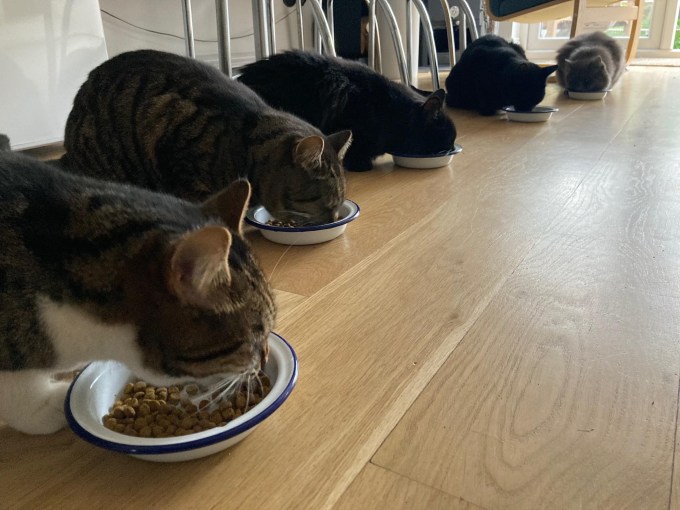
The cats – My gorgeous pride of cats. I love them all so dearly. We’ve had some health scares this year, which have been very scary but, fortunately, everyone has recovered and we’re celebrating Christmas as a healthy family. Izzy has thrown a spanner in the works to a certain degree and the peace of the house has been disturbed dramatically; we’re still finding a new normal and all of these new relationships are still evolving. On the whole, the cats are still avoiding Izzy because she gets so overexcited; she just wants to play but often, that either scares them or they don’t understand and so they take a swipe at her. It’s slow going and although progress is being made, I miss the cats being around and struggle with the frustration of just wanting everything to be okay and peaceful right now. I love them and I don’t like not seeing them as much.
My time and friends in Nashville – My trip to Nashville this year was a serious emotional rollercoaster. There was a school shooting in the city on the first full day we were there; I saw some of the most amazing Tin Pan South shows I’ve ever seen; I became a Madeline Edwards fan; I saw some of my lovely friends; I hung out with new friends; we weathered the edge of a tornado (and had a little party in the motel room we were sheltering in; I got to go to Song Suffragettes’ 9th anniversary show and catch up with the lovely Natalie Hemby; I struggled with some serious chronic pain… It was a lot to take in, a lot to process. It was a really tough trip but the good moments were really good and I am grateful for those.

My therapist (and the dogs that joined our sessions) – It’s been just over a year since I started seeing my new therapist and, if I’m honest, I’m still getting used to her and all the little differences. I saw my previous therapist for eight years and the loss of her from my life was a trauma so it’s not surprising to me that it’s been a really difficult adjustment; I still miss her and our sessions. My new therapist is good and I really like her and we’ve had some really productive sessions but it’s been a very different scenario: my mental health has never been so bad, the worst stuff so close to the surface. That makes therapy really fucking hard. It makes me feel triggered; it makes me feel like a frayed nerve; it makes me feel like I can’t breathe. It’s exhausting. But I know that nothing will change if I don’t go. Part of my experience of depression means that I don’t always want things to change but, as I said earlier, it’s such a confusing, messy, complicated well of feelings that it’s hard to articulate and this certainly isn’t the post to get into it, but it does provide some context as to why therapy is so hard. I can’t seem to clearly explain why I’m grateful for therapy and for my therapist, not with my headspace being the way it is right now, bit I know that I am. Sometimes I think that has to be enough.
The puppies – Over the summer, I got to spend a solid amount of time with a litter of four Pomchi puppies and it was glorious. One of them in particular, the only girl who was nicknamed ‘Skye,’ took to me straight away: it was like she saw me and went, “You. You’re my person.” It was adorable and I loved every second that I got to spend with her. I hadn’t thought I was ready to bond with another dog but Skye showed me that I was (and honestly, the name ‘Skye’ just felt like a sign – one of my biggest special interest characters, Daisy Johnson, having chosen that name for herself before she discovered who she was, who she was supposed to be) and it was such a joy. And then my heart was broken when I wasn’t able to keep her. I was devastated and the pain of it really shook me. I worried about her endlessly and although that has faded over time, it still hits me now and then; I hope she’s safe and happy and loved. And even though it ended in utter heartbreak and a lot of bad feeling, I wouldn’t take it back; it was a really special experience and showed me that I was ready to have a dog in my life again and ultimately lead to Izzy.

Writing songs again – Songwriting has been a difficult for a while now, as it usually is when my depression gets bad (and it’s been the worst it’s ever been). It feels like my creative brain goes into hibernation. Since I started taking Phenelzine again in March, things have gotten better in that regard. I’ve been writing again but it doesn’t feel as fast or as easy as it used to; like it takes actual physical effort to make my brain work when it used to come really easily. So it’s definitely not perfect but I’ve written some songs I’m really proud of and I’m grateful for that.
Getting to reunite with my friends from university – In the Spring, I went to Germany for the wedding of two of my friends and although there lots of stressful aspects to the week away, there were some truly joyful moments too and one of them was seeing some of my wonderful friends. Because we’re scattered around the world, we don’t often get to see each other and we rarely get to see each other altogether and, with COVID of course, it’s been an even longer time than planned so that was really special. It was really emotional too, more so than I’d expected, but then it was a very emotional week.

There’s five of us buried in this huddle.
Acceptance into the Service Dog program – A few years ago, we applied for the Autism service dog program but they didn’t have space for me. This year we applied again and I’ve been accepted! The process from being accepted to actually getting a dog is a long one but that’s okay: it gives me time to get used to it and to learn everything I need to know, with the assurance that support is coming. I’ve met quite a few people who are part of the organisation and they’ve all been so lovely and supportive and warm so I feel like I’m in good hands. I have my anxieties about it – it’s a big responsibility to take on a dog, particularly a specially trained one, and I’m aware that, by having one, I’m representing the organisation and, to a certain degree, disability and neurodivergence – but I think it would naïve and irresponsible not to. So I’m doing my best to prepare and to get into a healthy, balanced headspace about it.
Breathing Room – After years of loving the work known as ‘Breathing Room’ by Anna Berry, I finally got to see it. First in London and then in Croydon. Finally seeing it in real life was magical; it was utterly breathtaking. During each visit, I spent ages just sitting inside it, watching the cones flutter and listening to the gentle creak of the machinery. It was so calming; I could’ve sat there forever. And it had my mind spinning with new ideas for songs, both specifically about the piece and for other songs. I loved that. Both times, I had to all but be dragged out.
The London experience was also incredibly special because I got to help construct it before it opened to the public. It was a viciously hot, airless day (which resulted in a very stupid-looking sunburn, which unfortunately didn’t fade for months) and even with the gloves, I got some pretty nasty splinters that had my fingers stinging for days but I loved every second of it. I loved the repetitive movement, the soothing count, the intense concentration that had the rest of the world fading to nothing. I’d been in excruciating pain and I did struggle with my back during the session but I would’ve happily kept going; I only left because I had a prior commitment. I loved it and it was a really special thing to get to do. I also, by some magical serendipity, got to meet Anna herself and talk with her briefly about my love for the project and the idea of writing a song about it. She was really lovely and it was a very cool cherry on top to the day.


Discovering Maisie Peters – I’ve listened to Maisie a little, on and off, over the years but I think I just felt like I never quite had the brain space to really get into her music. But then I heard ‘Lost The Breakup’ and I was completely hooked. I played it on repeat until The Good Witch came out and then I was just obsessed; I didn’t listen to anything else for weeks and even when I did start listening to other stuff, I still often returned to it. I can’t quite explain what was so magical about it or why it resonated with me so strongly but it really did and I’m still completely obsessed with Maisie’s songwriting; I could talk about it for hours. I’d love to write with her. I also got to see her twice on tour and they were both really special shows: I saw her in Bristol on Halloween at the smallest venue of the tour and I saw her headline at Wembley, the biggest venue of the tour and a real milestone, at the end of the UK leg. She’s a fantastic performer and I absolutely loved the shows. I was also lucky enough to go to the VIP pre-show acoustic sessions and those were really, really special. I have a Week In My Life post half done about that week that I hope to get up soon where I talk more about that so I’ll come back and link it here – it was an exhausting week that took a long time to recover from but it was absolutely, 100% worth it. I saw her perform at the Communion Xmas Party too and got to talk to her briefly afterwards too, which was really lovely (her keys player, Tina, too). It was definitely my Maisie Peters season and long may it continue; I’m so glad to have her music in my life.

Listening to The Good Witch, making bracelets for the tour, dressing Izzy up as the song, ‘BSC,’ Maisie’s acoustic set in Bristol, the Halloween stop of The Good Witch Tour, the acoustic set at Wembley Arena, Maisie’s sold out show at Wembley Arena, Maisie performing at the Communion Xmas Party in London, and meeting her after she performed.
Getting a TENS machine – Given how bad my chronic pain has been this year, getting a TENS machine was a revelation. It has been so helpful and I’m so very grateful to have a way to reduce my pain when it’s really bad. I don’t know how I didn’t come across it sooner but I’m so thankful for the recommendation from my GP (who is an actual miracle worker).
Meeting Amanda Tapping at LFCC 2023 – Amanda Tapping is one of my favourite people in the world and has been since I was about fourteen. She’s played some incredible roles that have inspired me deeply and she is a truly wonderful human being. I met her several years ago and although I was almost paralysed by anxiety, she was so kind and open and it was a really special experience. This year she started doing livestreams with The Companion and it was so, so nice to see her again, regardless of the fact that she couldn’t see me. The livestream was great and I looked forward to the promised future ones. Then, in the summer, I went to my first Comic Con and got to meet her again in person. We had such a lovely conversation – as did she and my Mum, who was with me as my disability support person – and it’s a memory that I will always hold close and keep safe; it was a very special experience. And then, my third Amanda Tapping moment of the year was the second livestream, which was great on its own, but I also had a ‘backstage’ ticket and I was able to talk to her briefly afterwards. She’s so open to big, honest, vulnerable conversations and it feels like she really sees you and hears you when you talk and that’s such a powerful feeling; I remember thinking about that after I met her the first time and it was exactly the same this time. She, and the characters she’s played, have been a constant source of inspiration and strength for me and stumbling across her all those years ago was such a fluke but, my god, I’m so grateful I did.


Getting The ERAS Tour Tickets – Even though, it was incredibly, sickeningly stressful (and caused a fair amount of ableism-based trauma), I am very grateful to have gotten tickets to The Eras Tour in the summer – and not only one but multiple times, since several friends and groups of friends wanted to go and wanted to go with me. That felt very special and I’m both grateful that we were able to get the tickets and that I have been able to afford it, having been saving since The reputation Tour ended. I have a very complicated relationship with the future and with looking ahead but it was a huge relief to know that I wouldn’t have to watch the every show happening without being there even once. So I’m grateful for that. And, as always, I’m just grateful for Taylor herself: for her music, for being a person I can look up to, and for the inspiration and opportunities she has given me.
The Disability-Focussed Writing Workshop run by Sick Stories – I discovered this online workshop on Eventbrite and from the first one I attended, I had an absolute blast. Sophie, the host, is absolutely lovely and the prompts always led me down interesting rabbit roles. The first prompt Sophie suggested resulted in an idea for a novel that I would love to write at some point, my love of writing fiction returning that immediately. The fact that it was disability-focussed, along with Sophie’s excellent hosting, made it feel like a really safe and fun place to explore and share ideas that might’ve otherwise felt too personal and vulnerable, leaving all of the amazing pieces of writing I heard unwritten. I love a lot of the stuff I wrote in those sessions and although I don’t yet have anything to do with them, I hope that I will at some point find a way to share them.
Discovering Juneberry Red Bull – Among my family and friends, my Red Bull consumption is somewhat legendary, despite the fact that it seems to give my no caffeine hit whatsoever (I think I’m still living in denial that one day it will start helping again). But it had kind of waned… until I tried the new summer flavours. The other three didn’t do anything for me but this one has me in a chokehold: I love it so much. I would drink it all day if it wasn’t as unhealthy as Red Bull obviously is. But it’s a nice little treat that I’m very pleased they came up with.
Being able to afford a new laptop when my old one died – My laptop was dying a slow and painful death and, given that I use it for most of my work, that was a very stressful position to be in. But, thanks primarily to disability benefit, I was able to buy a new one and while that was obviously great for work reasons, it’s the first time I’ve had a brand new laptop in a long time so that was very exciting. I love shiny, new gadgets and, since they’re usually very expensive, I don’t get to do the whole “oh my god, a shiny, new gadget!” thing very often.
Nimona – Watching the film, Nimona, was a really emotional moment for me. I loved the story and the world and the animation style and the humour but the character of Nimona really resonated with me. I really related to her and saw a lot of myself in her: her feelings of otherness, her self loathing, her masking – there were so many parallels to being autistic. Seeing that was very moving. And I really, really related to her in her ‘monster’ form. *SPOILERS* The scene below is constantly on my mind and that scream has me in tears every single time: that is what it sounds like in my head, in my soul. That is what it feels like to be me. Being able to point at that and say to someone, “That’s how it feels,” has been so emotional. It’s hard to describe but I’m so, so grateful to have this film. It might mean more to me than any other film, specifically because of this sequence.
Swimming, hydrotherapy, and starting physiotherapy – For most of the year, I’ve kept to a pretty solid schedule with my swimming and hydrotherapy and then, halfway through the year, I met with an amazing physiotherapist and have been pretty consistently working at that too. Having now worked with both a hydrotherapist and physiotherapist who really understand hEDS, I can say with absolute confidence that it is a completely different experience; I’ve worked with good people before but that lack of understanding has always been a major obstacle and I’d find myself burning out and giving up. I’ve always loved to swim but I’ve found that I can really love hydrotherapy and physiotherapy (although I have had some periods of pain so bad that I had to take a break until it faded). We’ve found two really lovely pools to swim in, which makes it even more enjoyable, and I’ve made some real physical improvements. That’s been kind of mind blowing – to actually see that happen. And to the point where I was able to swim 5km for Mind! But more on that in a minute.


Izzy – I still can’t quite believe that I got a puppy this year, that I actually have a puppy now. That’s definitely not something I expected at the beginning of the year; it was probably the last thing I expected. But here we are and I’m madly in love with her. Izzy is a golden Pomchi (half Pomeranian half Chihuahua) and she’s utterly gorgeous: she’s soft and warm and snuggly and amazingly smart. The bond we’re building is already so strong and so special and that means so much to me, even though it’s kicked up some hard stuff. But I want nothing more to love and protect her and she seems to feel the same, guarding me at almost all times and trying to lick away my tears when I’m sad and looking to me when she’s distressed. My relationship with Lucky was incredibly special and always will be but, just as I learned after my first cat was put too sleep and we then got Lucy, I can love another animal and not feeling like the new relationship is replacing the old one. This relationship is new and special in its own ways and I feel lucky and honoured to have a puppy to pour all of that love into.


Getting to fundraise for Mind – Getting to fundraise for Mind felt really, really special, not just because we managed to raise so much more money than I’d expected (over £600 compared to my goal of £200) which was amazing, but because I was finally physically capable of doing it. I swam 5km for Mind, 1km a night over seven nights, partly due to managing my hEDS and partly do the logistics of pool time, but I was really proud of finding a way to make it work. I was exhausted and sore afterwards but it was absolutely worth it. I was so impressed and so touched by the generosity of everyone who donated it and I was so proud of myself for committing to it and competing it. I look forward to doing something similar at some point.
Spending my birthday with horses – My birthdays have been a source of stress for quite a long time now so I’ve taken to either ignoring it completely or trying to find something un-birthday-like but still special to do. And this year, I found myself going on a wellbeing course that centred around horses. I’ve always loved horses so, while the confidence building stuff was hard, it was so nice to spend time with these gorgeous animals again. It was a really cool, interesting way to spend the day.


The excellent books I’ve read this year – I worked really hard to get back into reading this year and I read a lot of really good books. The ones that have most moved and inspired me are Trista Mateer’s poetry, Blythe Baird’s poetry, The Anthropocene Reviewed by John Green, and Tomorrow and Tomorrow and Tomorrow by Gabrielle Zevin. All of these books had a really profound effect on me and they’ve all become so special, each a little piece of my personal creative and artistic mosaic. I don’t know why I picked them up when I did but I’m so thankful that I did.
A year of Duolingo – It’s hard to believe that I’ve now been learning Dutch for over a year. It’s hard to believe how far I’ve come. But I have and I have. It’s so strange to me: I hated learning languages at school but I’ve loved learning Dutch. There are plenty of obvious reasons for why I hated it at school but they’re not really worth dwelling on at this point but I had no idea when I started learning through Duolingo just how much I would love it, how restful I’d find it, how much fun I’d have. I had no idea that learning a language could be such an enjoyable experience – could be enjoyable at all – after my school experiences and it’s even inspired me to think about other languages. But one thing at a time. I love learning Dutch and I feel no need to change the way I’m currently doing things. I don’t know why I thought to download the app that day but I’m really glad I did and I’m proud of myself for opening it and practicing every day since.

As I’ve repeatedly said, to call my feelings a mess is the understatement of the year. I was re-reading my post from last year and I don’t know if I can describe gratitude amidst depression and suicidal thoughts any better than I did then: “When I feel like this, like I’m drowning in my depression with these near constant suicidal thoughts, things to be grateful for feel like a double edged sword. Sometimes they’re things that make me feel like I can keep hanging on, even if just for a little bit longer, and sometimes they feel like weights tied to my ankles, keeping me here when I desperately don’t want to be and I have to admit I resent them for that. So it’s anything but simple. It’s good and bad and hard and confusing; I can feel differently, ten different times in a day sometimes. But these are the objectively good things in my life and I can recognise that. I wanted to honour them for that.”
Continuing Bonds (National Grief Awareness Week 2023)
Posted on December 5, 2023
This week, from 2nd to 8th December, is National Grief Awareness Week 2023, run by The Good Grief Trust. The goal of the week is to create opportunities for people to discuss the loved ones they’ve lost and their experiences with grief in safe spaces and with people who’ve gone through similar events and emotions. After all, it is often easier to talk about difficult things with people who can relate. The organisation encourages people to put on events and arrange group meet ups during the week – online or in person – providing that safe space to talk.
For my part, I thought I’d share something that had a really big impact on my experience of grief, a line of thinking known as the Continuing Bonds Theory of Grief…
When I was thirteen, my Dad died very suddenly. He’d lived with a chronic illness for years but he developed pneumonia and quickly deteriorated (there’s a lot more to this story but I don’t think the post is big enough for all of it and it would distract from the point I want to make – maybe I’ll come back to that another time). Initially I scrambled for ways to remember him, still in a haze of shock and disbelief: I kept candles lit; I wrote letters to him; I bought the CDs of the music we listened to in the car. But after a while, that just hurt too much and I pushed all of those things away. And it was a combination of that, the lack of casual reminders (since I didn’t live with him and therefore didn’t have anything of his around me), and the fact that my family didn’t really know how to talk about what had happened, that resulted in a strange strange period of my life where… it wasn’t that we pretended he never existed; we just seemed to move around the metaphorical empty space with such focus that we didn’t even think about what we were dancing around. And that’s just how things were, from my perspective at least.
For a long time – for years – I didn’t talk about any of it: how much I missed him, how much it hurt, how disconnected I felt. I didn’t know how. I also avoided anything that reminded me of him. It wasn’t until I was in my early-to-mid twenties that I started to willingly – if cautiously – engage with the things that reminded me of him. I rewatched Hot Fuzz, a film we watched together (interesting choice, Dad); I reached out to a friend of his in the hope of getting answers to some of my long held questions; I even started to explore with the world of superheroes that he loved so much. I rewatched the Fantastic Four movies, the second of which we saw in the cinema together (plus there’s definitely a resemblance between Ioan Gruffudd, who plays Reed Richards, and my Dad so I do sometimes see Dad in some of the other characters he’s played, like Daniel Harrow in Harrow). I also watched Teen Titans from the beginning, an animated TV show that we had watched together on Saturdays and spent hours discussing, from the characters and their powers, to the storylines, to the silliest of jokes. All of those have remained special to me and after revisiting them, I moved further into that world. I watched films and TV shows that we most likely would’ve watched together and then endlessly discussed: I watched Supergirl (and I feel certain that he would’ve agreed with me that Season 1 was the strongest, when it was on CBS); we would’ve watched the new Fantastic Four movie and discussed the differences between it and the earlier ones; I would’ve nagged him until he watched Sanctuary with me and, when I inevitably adored Amanda Tapping (and he did too), we would’ve watched the entirety of Stargate SG-1 as well and he would’ve been the one to come to conventions with me (and I can absolutely imagine us dressing up); we would’ve gone to see Wonder Woman as soon as it came out in cinemas, her being my favourite DC character as a kid; we would’ve seen each of the Marvel movies and afterwards we would’ve compared favourite scenes before ultimately complaining how complicated the franchise was getting with every new film; and, most importantly to me, we would’ve watched Agents of SHIELD and Dad would’ve watched as the show, and specifically Daisy Johnson, became a new special interest that changed my life. I’ve always felt that superheroes, and the messages in their stories, are his legacy to me and that means a lot to me, even more so since it led me to Daisy. That’s something I will always be beyond grateful for.


Left collage: Teen Titans (top left), Hot Fuzz (top right), Fantastic Four (bottom left), and Justice League (bottom right).
Right collage: Sanctuary (top left), Black Widow (top right), Supergirl (bottom left), and Agents of SHIELD (bottom right).
Alongside this, I’d also started to write songs about what had happened, songs where I talked to him, songs where we had new experiences together. It took a long time to get to that place – I’d been writing songs for about five years before I felt able to do it – but once I did, writing those songs felt almost sacred, regardless of whether or not they were any good when I finished them. It is, of course, my job to put out music and, while there are multiple songs about my Dad that I’m very keen to release when the time is right, that’s never been something I even thought about when writing these songs: they have always been solely for me and my heart and my voice. That is true, to an extent of all my songwriting – I wouldn’t be writing the song in the first place if it wasn’t an expression of something I felt deeply – but there’s a… I’m hesitant to call it this because it’s such a hard feeling to define… a healing element to writing these songs that is just different to anything else I’ve experienced.
It wasn’t until a friend mentioned the theory of Continuing Bonds to me, a passing comment in the thick of university research projects, that I realised that that was exactly what I was doing. Both in engaging with superheroes and in writing songs about him, but especially the latter. From the first song I wrote, a song about feeling frozen by grief, my relationship with him actively continued, a new chapter in our story.
The Continuing Bonds Theory of Grief was developed by Klass, Silverman, and Nickman and laid out in their book, Continuing Bonds: New Understandings of Grief, in 1996. They questioned the existing models of grief that generally considered the process of grieving to be one where you eventually ‘let go’ of the person who has died, where any behaviour that encourages holding on is viewed as unhealthy and potentially harmful; they disagreed with this and proposed a new model where it’s normal and healthy for a person to hold on to and continue their bond with the person who has died, having observed many cases in their research where a continued bond had helped an individual to cope with loss.
Ask anyone who has any experience of grief and they’ll likely tell you that grief doesn’t just end. That’s a simplistic and frankly silly idea; just because a person is no longer physically there doesn’t mean that they no longer matter to you, that your relationship with them no longer impacts your life. Their death doesn’t cut your life into chapters of ‘with them’ and ‘without them.’ Many people consider grief to be a permanent entity but one that evolves, becoming more than just the pain of losing the person. We carry them with us and find ways to bring them into our present; the relationship – the bond – continues.
In my personal experience, it has been far healthier to engage with my memories of him and make art about my feelings than to try and ‘move on,’ to think of my Dad as belonging only to the first thirteen years of my life; I suffered more in the years when I didn’t think about him compared to the years since I started writing about him and to him. Before, there was only grief but now, even though the loss and the grief are still painful, that isn’t all there is. He might not be physically present in my life but he does have a presence: engaging with the things he loved, as well as the things I feel sure he would’ve loved, and writing the songs that keep him alive and here are, in general, really special experiences. As I said, I’d love to release these songs as a project at some point; I think that would be a really lovely way to honour him and could potentially – hopefully – also help other people to cope with their experiences of grief. Maybe it could inspire and encourage others to nurture that continuing bond rather than suppress it. I wonder what amazing, moving art could be made in the process…
Other than making art to connect with a lost loved one, there are many ways to honour that bond between you…
- Talking to your loved one as if they’re still there (Amanda Tapping has talked about how, before her Mum died, they’d have a catch up over the phone as she drove home from work and how, after she died, she continued talking to her Mum as she drove home even though her Mum wasn’t on the phone).
- Writing them a letter or keeping a diary of letters updating them about your life.
- Keeping a little alter dedicated to them with, for example, a photo and candle.
- Choosing a day, such as their birthday, to celebrate their life every year.
- Continue to share memories of them as you meet new people and make new friends.
- Listen to their favourite music, read their favourite books, and/or watch their favourite movies (or any of the former that you shared).
- Going to their favourite places or places you visited together.
- Research and write their memoir.
- Pick up one of their hobbies.
- Have a piece of personalised jewellery made to wear and keep them close.
- Make a memory box or jar.
- Keep something that belonged to them.
- Plant a tree or flowers in their memory.
- Reach out to their friends or family (if appropriate).
- Do something that they would’ve enjoyed had they still been here (like seeing a film they would’ve liked or an event they would’ve enjoyed).
I hope that this week hasn’t stirred up too much distress, not that grief only exists during one week of the year of course. For some people, it can be validating to see so many people talking about grief but I know that it can also be very upsetting to suddenly have your social media feeds flooded with such stark reminders. I hope that, as hard as it may be to think about, that this post has been helpful in some way. The theory of Continuing Bonds – including the practical aspects of it before I knew what I was doing – has had such a big impact on me and I hope that, if it’s something you want, this has given you some ideas for how you might stay connected to your loved one.
Falling Down In London…
Posted on December 2, 2023
An experience this week got me thinking a lot about distress and our reactions to it and I thought I’d share it here since it relates to disability and mental health and emotions and how these things are treated by society. So, here goes…
Earlier this week, I was walking along the Southbank in London when my hypermobile ankle collapsed under me – as it does semi-frequently – and I fell onto the concrete. I was with my parents and one of them turned just in time to see me go down; she said that I looked like a puppet whose strings had been cut because I fell so smoothly. That’s not a bad description, to be honest. Although I couldn’t see it, I have learned to fall in a way that avoids any serious injury. It still hurts, of course, but that feeling of my skeleton being shaken around inside my body just fades in a day or two. You can’t always control the way you fall but sometimes you can control the way you land.

I’m pretty sure I took this as I fell down…
Anyway, I went splat on the street and before I’d even done a full inventory to make sure I hadn’t seriously hurt myself, my parents were on either side of me. I assured them, and they reassured themselves, that I was fine and they pulled me up, making sure I was steady and unhurt before letting me stand on my own. This all took less than five minutes and in that time, at least five people stopped and asked if I was okay. It was really nice of them and I do really appreciate it – it also comforts me to know that, had I not had my parents with me, someone probably would’ve made sure I was alright, something that’s good to know as a chronically unstable person. But the experience got me thinking about how people react to different kinds of distress in public, in regards to strangers.
A while back, I almost had a meltdown at a bus stop, also in London. I was crying and shaking, my make up running down my face; I was clearly in serious distress and even though I was surrounded by at least fifteen people, no one asked if I was okay. Most of them got on the bus with me, keeping their heads down and their eyes averted. And it’s certainly not the first time that people have reacted that way. I honestly can’t say if I actually would’ve wanted to engage with someone when I was in that state but I did wonder afterwards why nobody did, why people are much more likely to help someone in physical distress rather than emotional distress. I don’t exclude myself from this: I feel much more confident helping someone with a physical issue – offering water to a coughing person, a helping hand to someone who’s tripped, chasing after dropped possessions – than I do approaching someone in tears. Maybe it’s the clear nature of a physical problem – the obvious problem and the obvious solution – and how easily solvable it is compared to whatever emotional turmoil has someone crying in public, something that we – in our culture – don’t like to do and so is likely serious if it’s reached that point. Maybe it’s the feeling that the asking crosses an implicit boundary, allowing a stranger into a space reserved for people we know. Wading into emotional distress is certainly more complicated than carrying out a practical solution.
I don’t have a clear explanation or solution. The experience – well, the two experiences – just got me thinking and I thought I’d share them, share the juxtaposition. If you have any thoughts, please feel free to leave a comment below.
 Finding Hope