 Finding Hope
An Assessment With A Difference
Posted on October 28, 2020
Over the summer, I received a letter from the local Neurobehavioral Unit. My GP had referred me to them for specialist support for pain (joint pain and pain in general) and I had an appointment with a psychiatrist there who specialises in and has done extensive research into hypermobility, pain, fatigue, and anxiety. I had no idea what to expect or what I was going to get out of it but I’m always willing (even if sometimes a little wary of) trying new things that might help.
My GP had recommended I have a full set of blood tests first so that we had the full, up to date picture before the appointment so I had that done at my local doctors’ surgery. I was a bit nervous about going – with the pandemic and all – but it was quick and easy. I was in and out in less than fifteen minutes. We got the results back a week later: for the most part they were good (my iron is back within the normal range, which was the problem last time) but my Vitamin D was seriously low, so low that I’ve been prescribed a ten week course of Vitamin D supplements.
And then this week, I had the actual appointment.
It was an online appointment but the conversation felt surprisingly easy and natural. Dr J (I’ve decided to refer to her this way to protect my privacy, even though doctor-patient records are, of course, confidential) introduced herself and we talked a bit about her work and what we could potentially get out of the session.
We talked about my Autism diagnosis and she had me do a series of movements with my hands and arms, all of which confirmed a diagnosis of hypermobility. As far as I’m aware it was in the notes from my Autism assessment but it hadn’t been officially diagnosed in its own right. She told me that people with a diagnosis of hypermobility are seven times more likely to have a form of Autism. Seven times! She asked me lots of questions about pain and fatigue (both of which I seriously struggle with) and went on to explain that hypermobile people have weak core muscles which often results in fatigue and pain in other areas as the body compensates. That makes so much sense. It’s all so fascinating to learn. The more I learn about the things I’ve been diagnosed with, the more I understand how they’re all part of a bigger picture, how they link together like the strands of a spider’s web or stars in a galaxy. It all gets clearer and I feel less overwhelmed and less lost; it feels like seeing order in things that used to look random and that is so incredibly helpful. All of the things I struggle with often make me feel broken and moments like this help me in the slow shift from ‘broken’ to… ‘incompatible,’ or something like that. Something less personal. Is it a program’s fault if it isn’t compatible with the computer? No. And with that in mind, it all becomes more about problem solving and work arounds and less about right and wrong. At least, that’s the concept I’m trying to work towards.
She said she would write to my GP and have me referred for pain management, specifically for hydrotherapy. I’ve just started swimming again – Mum and I finally managed to find a pool with a set up that feels safe, or as safe as is possible right now and safer than the others we’ve spoken to – so that would be perfect; I would love to do it, to get fitter and stronger through exercise I enjoy (and that doesn’t cause me ongoing physical pain). I don’t know if it’s available right now – with the pandemic and social distancing measures – but I can’t wait to do it whenever it is. But in the meantime, Dr J recommended some exercises to do in the pool, as well as some very gentle floor based core-strengthening pilates.
She also asked questions about sensitivities, allergies, hay fever, dizziness on standing, lightheadedness, and symptoms like that. I’ve definitely experienced all of those, although not all consistently. When I’d answered all of those questions, she recommended I have a heart rate test and a blood pressure check and said she’d include that recommendation in the notes she’d send to my GP. If they showed numbers within a specific range, given the other symptoms we’d talked about, that could apparently give us another area to explore, health wise.
We also talked about my anxiety and the medication I take for it. She suggested an alternative that might be better suited to my situation so that’s something we’ll discuss with my psychiatrist when I next speak to him.
So Mum and I learned a lot and we have plenty of avenues to explore…
- Continue swimming, adding in the exercises she suggested to strengthen my core muscles.
- Pursue the pain management route, particularly hydrotherapy (as available with the lockdown).
- Try gentle pilates exercises for core muscles.
- Get a heart rate test and a blood pressure check and see where that leads us.
- Talk to my regular psychiatrist about the other anxiety medication.
To be completely honest, it was a bit of a strange experience. I mean, it was really helpful and productive but it was odd for a very specific reason. It was easy. It was a conversation. She asked me things and I answered them. She believed me; she offered lots of advice and suggestions; she’s writing everything up and sending it to my GP. It wasn’t a fight… when up until now, it’s always been a fight. It was this beautiful, precious thing: to ask for help and have someone give it to me, with kindness and understanding and generosity. There will be more fights, I’m sure… more battles, but for now, I’m going to hold onto this feeling and memorise it so that I have it in my pocket like a touchstone for the next time I have to fight to get someone to stop and listen.
ME/CFS Research: Photo Diary (Pre Lockdown and During Lockdown)
Posted on September 26, 2020
Not long ago, I volunteered for a research study into ME/CFS (Myalgic Encephalomyelitis/Chronic Fatigue Syndrome) and part of it involved keeping a photo diary as a visual representation for how my life is affected by my CFS. Obviously my life before the pandemic and my life now are quite different and so the researcher asked me to include pre-pandemic photos as well, to ensure that both experiences were recorded for the study. The collection of photos (and descriptions) I sent her was very long but I thought I’d do an abridged version to post here because it was a really interesting exercise.
(It’s worth noting that this was put together before I started back at university, hence why there aren’t any current references to classes or assignments.)
PRE-LOCKDOWN

1. During my BA, I frequently took naps in quiet corners of my university between classes and then at my best friend’s flat when he moved onto the same street as the university. I found the commuting exhausting and the classes were long (some of them three hours) and took a lot of concentration. By the end of the semester, I was often really struggling to wake up to go back for the next class. A few times, I slept straight through both my alarm and my class. Fortunately that only happened a couple of times!

2. I’m currently doing a Masters Degree in songwriting part time and pre-lockdown, I’d go up to London usually once or twice a week for lectures, workshops, and cowriting sessions. This is an example of one of the assignments we had during the first module, which was called Creative Process.
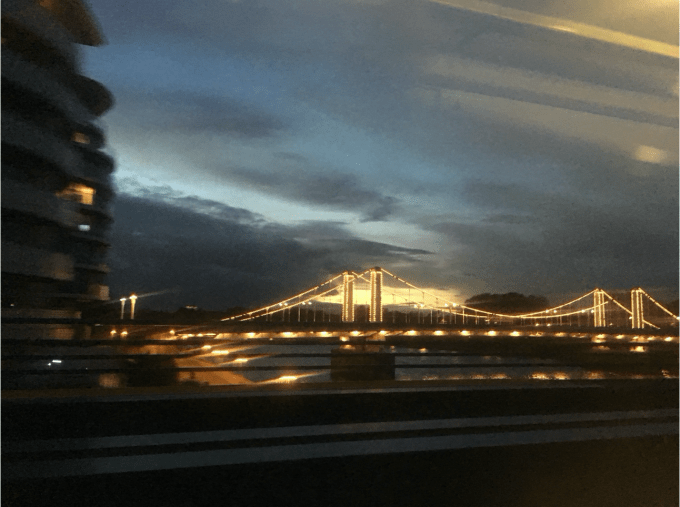
3. Because living alone would be too much for me – I wouldn’t have the energy to look after myself, let alone do anything more – I commute to university (pre-pandemic anyway), involving lots of underground travel and multiple train journeys a week, something that I find exhausting. This is one of the reasons I chose to do my Masters part time because it reduced the amount of travelling and therefore allowed me to spend more energy on the course/work rather than on travelling.
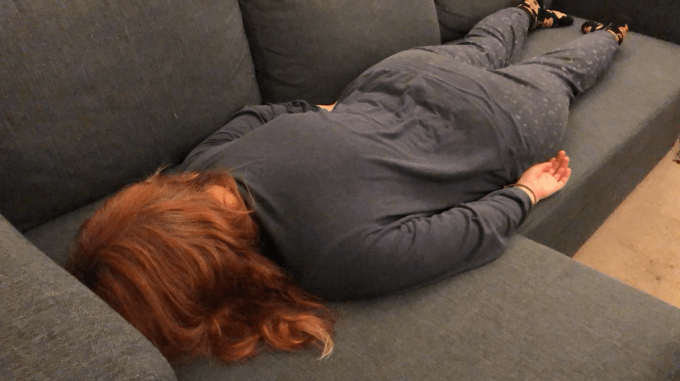
4. At the end of any day that involves hard work or anxiety, I’m utterly exhausted and usually end up horizontal on the sofa or going to bed as soon as I get home from wherever I am. In this instance, I’d just done the assessment presentation for the first module of my Masters – which I’d been incredibly anxious about – and was completely exhausted. Plus the day had involved practicing it in the morning as well as travelling to London and back. I was so tired that I could barely stay awake long enough to eat dinner before going to bed.
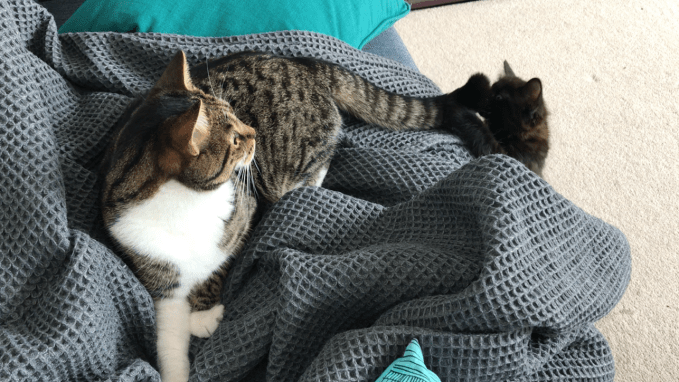
5. I spent most of my days out of uni on the sofa, working on music, my mental health blog, or catching up with my diary, a favourite movie or TV show on in the background because I work better with background noise. I’m usually joined by a cat or two.

6. As a singersongwriter, I try to perform as often as I can, both in terms of opportunity and having the energy (I once played three gigs in three days after which I could barely function for over a week because I’d just used up so much physical, mental, and emotional energy). That’s not a common problem – managing my energy around the amount of gigs – as there aren’t a huge number of opportunities with so many aspiring singers in the two cities I perform in, London and Brighton. I love performing. It’s the place I most feel myself, especially if I’m singing songs that I’ve written. I don’t feel any fatigue while I’m performing – I’m feeling so much joy that it’s like I’m flying – and I don’t feel any fatigue until the adrenaline wears off, anywhere between thirty minutes and several hours later.

7. Since getting an Autism Spectrum Disorder diagnosis, I’ve been able to get access to disabled seats at concerts, which does (in certain ways) improve my concert experience. It can be more stressful and it can make no difference at all but at the very least, it makes me feel better. I am in the disabled section and therefore no one can judge me or think that I don’t deserve to be at the show because I’m not dancing around, not ‘enjoying myself enough.’ That makes me feel more able to sit as I need to, which does make the concert experience easier on me and my body. Having said that, I’m not always so sensible out of sheer enthusiasm.
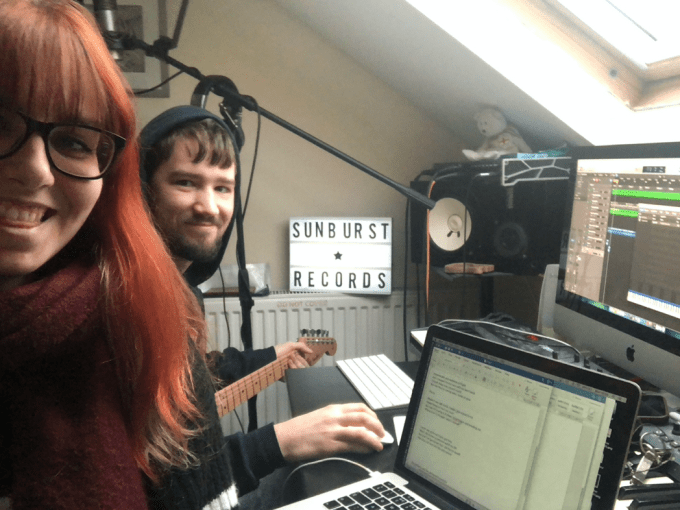
8. Before the pandemic, my best friend, Richard, and I had almost weekly writing and production sessions. My current EP was made almost entirely by the two of us in various rooms in the various places we’ve lived in over the last few years. These sessions are so fun and invigorating and even when it’s a struggle to find the right words or get the production to sound exactly how I want it to sound, it always feels right. I often feel very drained afterwards because it involves a lot of concentration and communication and we often work for four hours or more at a time. We have had sessions that last all day where I’m barely coherent by the end.
SINCE LOCKDOWN
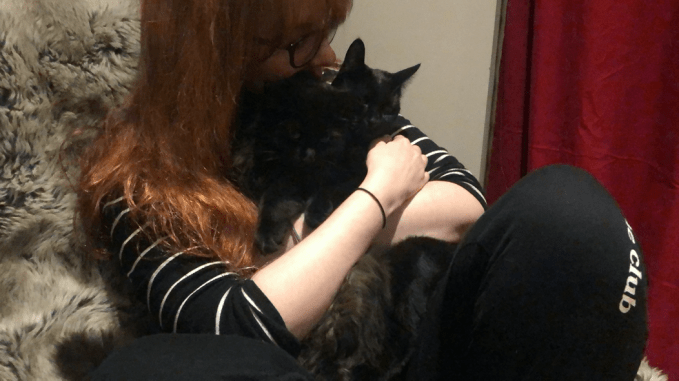
1. We have five cats in the house and I’ve been spending a lot of time with them. They’ve always been really good for my anxiety – probably because they are so mindful and live so fully in the moment – but they’ve been an extra comfort during these stressful times. I always try to get a good cuddle in the evenings since I get particularly anxious before bed because I’ve been sleeping so badly and having lots of nightmares during lockdown.

2. I generally drink at least two Red Bulls a day to keep myself awake and somewhat alert, although I don’t think they work as well as they used to. I’m sleepy all the time, but whether that’s from the CFS or the side effects of my anti-depressants or both, I don’t know. I hate feeling like I need to drink it and I worry about the effects on my health but it’s currently the only way I can stay awake for at least most of the day. My Mum and I are investigating other options, or we were until the pandemic brought everything to halt. We haven’t given up though.

3. This is my usual day-to-day view at the moment. I have a desk designed for bed or sofa use so that I can work from the sofa, which is more comfortable for me than working at my desk since I’ve been have problems with pain during lockdown (I’ve been referred to various hospital departments but I’m still waiting for the appointments). I’m usually working on my laptop – on my mental health blog, on my diary, on music stuff, etc – and there’s usually a cat draped over me.

4. I usually have the TV on in the background because I seem to be more productive with familiar background noise, like a familiar TV show or movie. But I’ve also been watching new things during lockdown, both to escape from all of the stress around the pandemic but also as inspiration for my music as not much is happening in my personal life to draw from for songs. This is the very last episode of Agents of Shield, my favourite TV show and I was hugely sad to see it end although the ending was as perfect as the end of something you love can be.
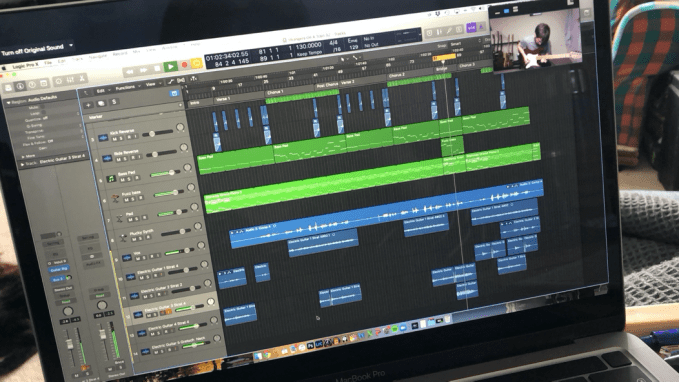
5. Since face-to-face writing sessions aren’t safe at this current time, I’ve been doing all of my writing sessions via Zoom. I’m currently doing about two a week, mostly with my writing partner, Richard. We alternate sessions: one on my songs and then one on his songs and so on. It’s harder work and not quite as fun or productive as a normal pre-pandemic session (who would’ve thought that not being able to point at something would trip up the creative process?) but it allows us to keep creating, which I’m grateful for. I’m always careful not to plan anything too difficult afterwards because these sessions are really draining and after about four hours, my ability to concentrate starts to fade.
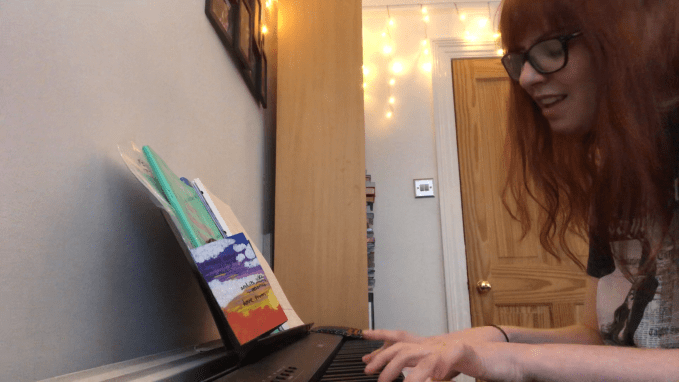
6. I’ve been playing a lot of piano during lockdown. It distracts me from all that’s going on, I want to improve my skills, and I just genuinely love playing, especially in the lower octaves. I find them very soothing. I can play for hours without noticing the passing time; it’s lovely. Playing and singing for hours is, of course, tiring but it’s worth it because I get so much enjoyment out of it.

7. Because of my fatigue, I spend a lot of time on the sofa, which can get boring and frustrating, but it’s not so bad when I have my Mum (she’s self-employed, primarily working from home – especially now) and the cats around.
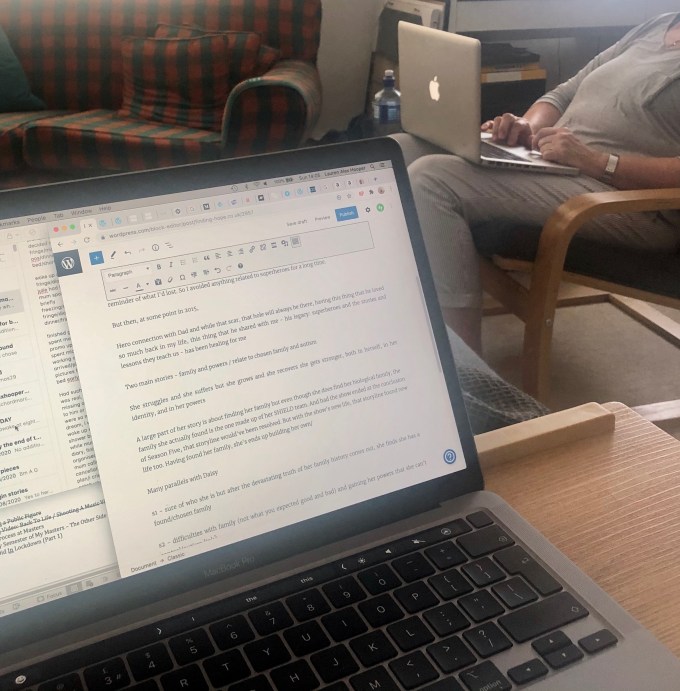
8. Most days consist of sitting on the sofa, working on my laptop. I’m writing a lot of posts for my mental health blog at the moment, preparing for when university starts again and I have less time to write. My Mum often does emails similarly, keeping me company even if we aren’t actively engaging with each other.
So that’s my condensed photo diary for the study. There are, of course, other areas of my life and other areas of my life that my CFS affects, like food and exercise but I don’t have any photos relating to those. For example, swimming is my main form of exercise but pre-pandemic I wouldn’t take my phone further than the locker room and since lockdown began, I’ve been struggling to find a way to swim that feels safe. I may have found one but I’m trying not to get too excited: I’ve missed it so much and I’m so desperate to get back to it, for my physical health, my mental health, and my relationship with my body. I was also reluctant to include other people; my exception was Richard because our work and social media presence are so intertwined. So there are obviously gaps but I tried my best to give an overview. Hopefully it will be a useful contribution to the research.
 Finding Hope