 Finding Hope
World Mental Health Day 2021
Posted on October 10, 2021
‘MENTAL HEALTH IN AN UNEQUAL WORLD’
As I’m sure many of you know, today is World Mental Health Day and the theme, chosen by the Mental Health Foundation, is ‘mental health in an unequal world.’ WHO seems to be building it around the pandemic, rather than as a problem of its own, but from what I’ve seen in the newsletters and on the social medias of many mental health charities and organisations, most seem to be following the lead of the Mental Health Foundation.
According to the Mental Health Foundation’s website: “2020 highlighted inequalities due to race and ethnicity, sexual orientation and gender identity, and the lack of respect for human rights in many countries, including for people living with mental health conditions. Such inequalities have an impact on people’s mental health. This theme, chosen for 2021, will highlight that access to mental health services remains unequal, with between 75% to 95% of people with mental disorders in low and middle-income countries unable to access mental health services at all, and access in high income countries is not much better.” It goes on to say: “Many people with a mental illness do not receive the treatment that they are entitled to and deserve and together with their families and carers continue to experience stigma and discrimination… The stigma and discrimination experienced by people who experience mental ill health not only affects that person’s physical and mental health, stigma also affects their educational opportunities, current and future earning and job prospects, and also affects their families and loved ones.”


Statistics provided by Mind (x)
I have my own experience with the mental health system – which I do want to touch on – and have heard from many others about their experiences but I wanted to read into the research around these inequalities further, both to get a better factual understanding and to put my own experience in context (beyond an anecdotal one). The research is sporadic at best but here are some of the statistics I found…
ACCESS TO MENTAL HEALTH CARE
- “NICE [The National Institute for Health and Care Excellence] recommends that people should be able to access services when they need them. However the proportion of people who felt they had definitely seen NHS mental health services enough for their needs reduced from 47% in 2014 to 43% in 2018.” (x)
- In 2020, it was reported that approximately 1 in 3 people who experience mental health problems are able to access the support they need. (x)
From these statistics, it’s clear that far too many people aren’t getting the support that they need.
INEQUALITIES IN ACCESS TO TREATMENT (x)
- For those with common mental health problems, 36.2% reported receiving treatment.
- Women are more likely than men to receive treatment for all mental health conditions, with 15% of women receiving treatment compared to 9% of men.
- Young people aged 16-24 were found to be less likely to receive mental health treatment than any other age group.
- White British people are more likely to receive mental health treatment (13.3%) compared to BAME groups (7%). The lowest percentage of people receiving treatment were those from black ethnic minority groups (6.2%).
These statistics clearly show the disparities in the availability of treatment, more supporting evidence for the statement that the Mental Health Foundation is making with the theme for this World Mental Health Day.
YOUNG PEOPLE
- “There is very little national information about mental health services for children and young people, and what information there is suggests quality is declining. [Research] indicates substantial cuts to services, increasing demand, increasing thresholds for treatment, very long waits (more than a year) for specialist services, and a resultant decline in accessibility.” (x)
- Approximately 1 in 3 children and young people with a diagnosable mental health condition get access to NHS care and treatment. (x)
- More than 338,000 children were referred to CAMHS in 2017, but less than a third received treatment within the year. (x)
- Around 75% of young people experiencing a mental health problem are forced to wait so long their condition gets worse or are unable to access any treatment at all. (x)
- In a YoungMinds survey, three-quarters (76%) of parents said that their child’s mental health had deteriorated while waiting for support from Child and Adolescent Mental Health Services (CAMHS). (x)
This research all indicates that young people in particular are being let down by the health care system.
SECONDARY [LONG TERM] CARE
- “Demand for secondary care (which generally treats people with severe mental health problems) is increasing, and there is evidence to suggest services are becoming less accessible… There is little information available on the outcomes that services achieve.” (x)
- “There is no high quality national information on waiting times for secondary mental health services. In a 2014 survey, 20% of people with severe mental illness who were offered talking therapy reported waiting more than a year to access it.” (x)
The statistics show not just that the need for mental health care is increasing but the need for long term mental health care is increasing but that it’s also very difficult to access.
HIDDEN WAITING LISTS (x)
“A study of 513 British adults diagnosed with a mental illness also reveals the damaging consequences that hidden waiting lists – the wait between referral and second appointments – have on the lives of patients living with severe or common mental illness.”
- “Of those on a hidden waiting list, nearly two thirds (64%) wait more than four weeks between their initial assessment and second appointment. One in four (23%) wait more than three months and one in nine (11%) wait longer than six months.”
- “Respondents living with severe mental illness – including eating disorders, bipolar disorder and PTSD – were left waiting up to two years for treatment. Others were left waiting up to four years for treatment for depression, anxiety and suicidal thoughts.”
- “Two-fifths (38%) reported that they, or someone on their behalf, had contacted emergency or crisis services while waiting for their second appointment, while 39% said that waiting led to a decline in their mental health.”
It’s clear that, beyond the difficulty of even getting into the mental health care system, once in it, the process of actually getting the support you need is much too slow – so slow in fact that it’s exacerbating the mental health problems that those waiting are seeking help for.
Now I want to look at my experience of getting support for my mental health…
- For more than two years, I was repeatedly dismissed and had my feelings and experiences invalidated by multiple doctors and services. No one took me seriously. Eventually, my Mum took me to a private psychiatrist and I was diagnosed with Generalized Anxiety Disorder, Social Anxiety Disorder, Depression, and OCD. Having had no idea what I was struggling with, I’d done a lot of research and asked about the quiet presentation of Borderline Personality Disorder, which my psychiatrist initially rejected but then reconsidered and diagnosed me with it after reading my research and personal notes (it has since been recommended to me multiple times – sometimes by doctors who don’t even know me – that I have this diagnosis removed from my file because “people might make assumptions”). Getting an NHS referral for an Autism Diagnostic Assessment was similarly difficult as he felt that I didn’t fit the classic presentation (I do apparently fit the classic FEMALE presentation though).
- There was no follow up after this diagnosis and we were told there was no support available so my Mum investigated private therapists. I tried CBT for a while but didn’t find it helpful so I tried DBT instead, which has been a much better fit.
- All of this private treatment is obviously not cheap and I am so beyond grateful that my family is fortunate enough to support me financially. I honestly don’t know where I’d be without it, whether I’d even be here. But the cost of it does cause me significant worry, only adding to the anxiety I already experience.
- With so many of my problems connected to my Autism, had this whole process been… easier, simpler, quicker, less traumatic, or something… so many of my health problems wouldn’t have deteriorated to the level that they have. Had I been diagnosed earlier – had even one medical professional believed me – things might’ve been so different. I try not to dwell on that because there’s no point wasting my energy on what might have been but it is the truth.
- Having said that, considering some of the stories that I’ve read or have had shared with me, my story isn’t that bad. I’m positively lucky compared to some and that’s a confusing, complicated thing to say, knowing how traumatic this has all been… and continues to be.
Since then, I’ve developed near constant chronic pain throughout my body – something that’s obviously had a big impact on my mental health – but over a year later, I’m still waiting for the NHS physiotherapy and hydrotherapy referrals to go through. I have started Occupational Therapy and with the Pain Clinic (both through the NHS) but with the end of my Masters, I had to take a break because they were too painful and/or upsetting to manage alongside all the work. I’m starting back this week. It still bothers me that no one’s ever even tried to find out why the pain started though.
Almost six years after my ASD diagnosis, the Neurobehavioural Clinic called to offer me an appointment, to do what I had no idea. But at the end of the two part session, I’d been diagnosed with Hypermobile Ehlers-Danlos Syndrome and ADHD – aged twenty six – both conditions having gone unnoticed because no one had ever taken my associated problems (problems that have been there my whole life) seriously. They’re both conditions that often occur alongside ASD. The hEDS diagnosis would, in theory, push my physiotherapy and hydrotherapy referrals but, as I said, I haven’t heard anything and almost a year later, my ADHD is still untreated. My psychiatrist was happy to ‘move’ that condition to his care but the consultant I saw didn’t want that, which is especially frustrating because she’s so difficult to get in contact with.
And finally, I may be getting answers to another ongoing medical problem: severe dizziness, light-headedness, nausea, physical weakness, and breathlessness when I stand up for too long. We’ve been trying to get support around this for so long that I can’t even remember when it started. This too may well be related to my Autism and I can’t help thinking that it’s another thing that should’ve been discovered sooner.
All of these things have had a profound impact on my mental health and going through the agonising process of diagnosis again and again has left me wary, fearful, and angry at medical professionals. It’s deeply ingrained in me to be polite and respectful but it doesn’t take much to send me flying off the handle; I walk into each appointment feeling like a tightly coiled spring. I leave pretty much every appointment in tears at best, raging at worst. Because I’m so. freaking. tired. of feeling like this. Of feeling like no one believes me, of being made to feel like I don’t know what I’m talking about, of being made to feel like I don’t know what I’m feeling. I feel so worn down by the constant let downs. At this point, I think I’m only going back because I don’t know what else to do.
I have no doubt that social media will be filled with nice words and encouraging quotes today. But we need more than that. World Mental Health Day is about more than that. Or it should be. It should be about pushing for change and improvement. The Mental Health Foundation is absolutely right that the inequalities in the mental health care system need to be addressed but looking at these statistics, it’s also clear that the standard of care needs to be better. For everyone’s sake. After all, there’s very little difference between not getting any support and being on a list waiting years for support.
The Fifth Semester of My Masters
Posted on September 19, 2021
The time has come to sum up the final semester of my Masters. I am done. That’s sort of unbelievable. Given everything that’s happened since I started the course in September 2019, the end of the Masters always felt so far away and although I have lots of plans, I do feel a bit lost now that all of the work is done. Maybe it’s because I haven’t received my final grade or because I haven’t actually graduated yet; maybe once those things happen, the experience will feel a bit more… finished. It was always going to be weird – I’ve been going to this uni on and off for the last seven years – but knowing something and actually feeling it are so different.
So, here is my final semester review.
The final semester of my Masters course involves a largely independent project called the Major Repertoire Project and as long as you’re developing your songwriting skills and knowledge in some way, you can pretty much do whatever you want. People have done projects exploring identity, exploring their heritage, writing song cycles or musicals, digging deeper into their own songwriting and pursuing an artist project like an album, experimenting with newer applications of songwriting (such as in various therapies), and so on. It’s a fascinating module because everyone ends up doing something so different and so interesting. And after a spending a year or two focussing on their craft, the songwriting is so incredible; the final works that I’ve heard are amazing. It would probably take a month but I would happily listen through everyone’s projects.
For my project, I chose to explore my experiences as an autistic woman through songwriting, attempting to translate those experiences both through the lyrics and storytelling and the execution of the song, from the structure to the arrangement to the production and so on. I wanted to write songs that autistic individuals would hopefully relate to and that neurotypical individuals would hopefully gain some insight from. But while the overall goal was to create a body of work, a large part of the project involved researching our chosen area – Autism, in my case – responding to the research (sometimes that was through practice and sometimes it inspired specific songs), and reflecting on my songwriting process and how it was evolving during the project.
The module officially began in the second week of May but I’d already started working on it: I’ve been thinking about this project ever since I applied for the Masters so I was super excited to finally start doing it. But I’d barely begun when I started getting debilitating migraines that lasted for days at a time and resulted in several ambulance visits because the pain was so bad. We eventually traced the source back to one of my teeth: the emergency dentist thought the nerve was dying and diagnosed an abscess. I was top priority for an extraction and given antibiotics (which I had to have a second round of when it flared up again midway through the semester). Fortunately my university granted me an extension – giving me back the time that I’d lost – but it was a flexible extension in case I suddenly got pulled in to have the tooth taken out and needed some recovery time. Due to the long waiting list (and bear in mind that this was the waiting list for emergencies), I still haven’t had the tooth taken out and while the antibiotics and some good painkillers have prevented any more similar episodes, I’ve still been dealing with some tooth pain and migraines. So that hasn’t been ideal.
We only had four classes over the semester but since everyone was researching something different, they weren’t exactly classes. They were more group discussions where we’d talk about how our research and writing was going, whether we were struggling in a particular area, what we could do if we felt like we weren’t fulfilling one or more of the overall objectives, and so on. We had individual supervisors for the more specific guidance and problems whereas this was more general and we were able to share with each other what we’d found helpful, etc. These classes were online but we were finally able to come into the building. With most of the other courses finished for the summer, it was pretty empty and I felt safe there; you had to test negative just to get in the building and with no one around (pre-COVID, it could be a bit of a crush at times), my pandemic anxiety was a lot lower than it usually is when I’m out in the world. Being there after so much time and getting to see some of my friends again made me positively giddy! And there were some friends that I was actually meeting in person for the first time, which was just wonderful! I’m really going to miss it; I mean, I’ll pop in now and then for events and stuff but I’m really going to miss it being part of my day-to-day, week-to-week life.
Anyway. My supervisor was truly awesome. We had fortnightly and then weekly sessions and she was fantastic, not only with the academic stuff but with helping me to manage my anxiety, the things that tripped up my neurodivergent brain, and so on. And while we worked together well, we also had a lot of fun: we went on some epic tangents and there were multiple conversations that we had to mentally bookmark for later in order to actually get our work done. We got on really well and our sessions were always fun and thought-provoking, as well as helpful. I hope that this isn’t the last time we get to work together.
I obviously know a lot about Autism already so, after finding sources for that information, I started writing songs about my experiences and researching Autism further. Having the foundation of knowledge that I did, I think allowed me to research both more deeply and down different avenues since I didn’t have to spend so much time on the basic knowledge. And some of that research, from academic papers to anecdotal stories to art made by autistic individuals, sparked some really interesting song ideas (for example, I ended up writing a love song after watching Love on the Spectrum, which I found both upsetting and deeply depressing as an autistic person).
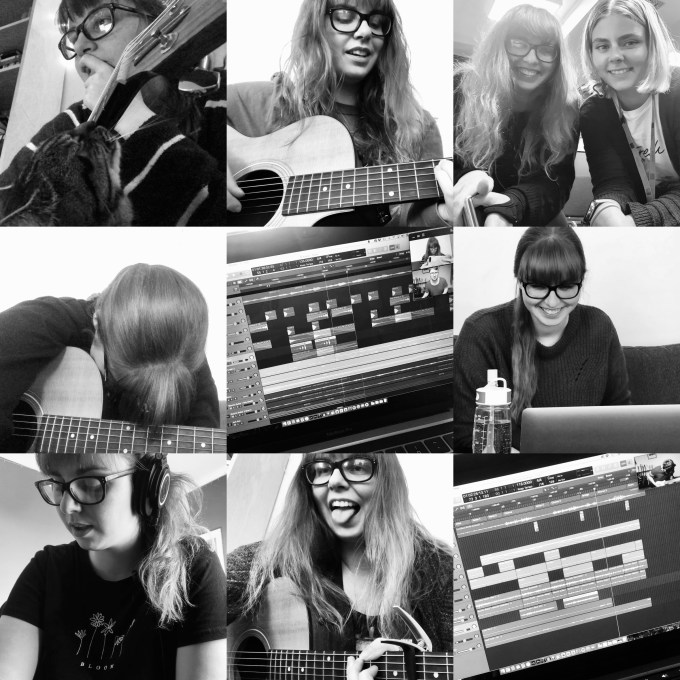
I don’t want to give too much away about the songs because I hope to release them but, over the semester, I wrote eighteen songs with a handful more that still need finishing. For the most part, I wrote alone – first because it was more convenient and then because I felt like my experiences were conveyed with more clarity that way – but I did work with a few different people, when I was struggling with a concept for example. I wrote with a couple of my friends – Richard and Luce (known as LUCE) – but I also wrote with new people that I’ve met during my time on the Masters – Luke (known as leadmetoland), Phill Vidler, and Katherine Moynihan – which was fun and exciting. It was nice to do both: I love cowriting and the back and forth of ideas but doing so much writing by myself really restored my confidence; I’ve spent so much time cowriting over the last two years and really not that much solo writing so I was nervous when I started to write alone again but after a while, it started to feel really good and that was really exciting.


But while I didn’t manage to write with Richard as much as I’d originally hoped to, we had many production sessions, mostly over Zoom. While I’d never considered the production unimportant, the project evolved to a place where the production was just as key to the representation of my autistic experiences and the emotions attached to them as the lyrics conveying the story or message. So the two of us spent a lot of time working on every little detail. While I’ve always been involved in the production choices of my songs, I’ve also always been aware that Richard knows a hell of alot more than me so I was happy to defer to his judgement. But with this project, for the first time really, I was taking the lead on production decisions – on occasion, I had the whole arrangement and production planned out before the session. But I felt more like a producer than I ever have: I was coming up with ideas that actually worked from idea to execution; I was able to pick out specific instrument, arrangement, and effect details in a way I haven’t been able to do up to now; and so on. Along with the songs themselves, that’s something I’d really proud of. I really feel like I grew as a musician and as a producer.
I absolutely loved working on my project. To be researching and writing songs about something I’m so passionate about was just so creatively invigorating. That’s not to say it wasn’t hard though. There were, of course, periods of doubt, insecurity, and anxiety over the academic elements and whether I’d be able to do as good a job as I desperately wanted to. Plus, some of the experiences I was digging into were pretty raw and writing those songs did get difficult, especially since I was suddenly doing the project without the support of my therapist, something I’d put in place to help me manage that. But apart from one bad bout of depression, my mental health was – somehow – reasonably stable (apart from my day-to-day, ongoing anxiety). As I said in my previous post, I think it was the constant creating (and creating things that I’m really proud of) that did it, that kept everything on a reasonably even keel.
Having said that, my chronic pain was almost constant, worse than it’s ever been. There were periods where my knee, for example, was so painful that I could barely walk and my back so painful that I could barely move. My Mum (once a massage therapist) said that it felt like I was storing rocks in my muscles. It certainly felt like they were made of concrete. Maybe it was my anxiety around the project, I don’t know, but the pain was keeping me up at night. I also struggled on and off with my hands and wrists, presumably from all of the typing, piano, and guitar playing I was doing. God, my various health issues are like freaking buses sometimes. I’m still waiting for physiotherapy and hydrotherapy, have been for months. I’ve just started with the Pain Clinic but one appointment was never going to change anything before the Masters ended. So all I had were various painkillers that were only sporadically helpful.
But my biggest ongoing obstacle was my difficulty concentrating, which I’m assuming is due to my (still untreated) ADHD. Staying focussed on my work was very difficult; I exhausted all of my energy trying. It felt like my concentration was so delicate that the smallest distraction would shatter it and then there was no way to know when it would come back; I felt like I was clinging onto it by my fingertips. So I couldn’t stop (really not healthy, I know). I couldn’t waste a second of it. That was super stressful and I often ended up sitting at my computer for hours and hours; there were multiple fourteen hour days, some successful, some not. People kept telling me to at least take a day off now and then but I just couldn’t. I was too scared of losing my concentration when my hold on it felt so tenuous.
During the semester, I also had a few other commitments; it was awkward timing but they were all great opportunities:
- As I mentioned in my post about the previous semester, I was part of the judging panel for a songwriting competition. That ended up being a lot of work but fortunately I managed to get it all done in time for this module to start. The end was pretty stressful because our deadline was suddenly brought forward but it was a great experience and I learned a lot from it; there were so many amazing songs and so many talented songwriters and they’re all still pretty young. I hope they keep writing; some of them I’d love to see pursue songwriting as a career. The final winners weren’t the ones I personally would’ve have chosen but I guess that’s what happens when you’re judging by committee and there are so many good songs to chose from.
- I also submitted work to a competition: three songs, two already written and one that I wrote as part of this project. I was supposed to find out whether I’d made it through the first round in August, I think, but, because they’re also an organisation and not just a competition, COVID has thrown a wrench in the plan and so the whole thing has been delayed until February. So I guess I won’t know anything for a while.
- One of my tutors is doing a research project on the many reasons why we write songs and I volunteered to share my thoughts. In mid July, a handful of students came together for a Q&A panel about our personal songwriting intentions, processes, and experiences. It was really interesting with a pretty wide range of reviews and even a couple of debates. Hopefully some of what we said was useful for the research.
- Also in July was the Taylor Swift focussed musicology conference I mentioned in my post about the previous semester and I presented my paper on some of Swift’s lyric writing techniques: her repeated use of certain imagery and the ongoing themes throughout her discography. I loved researching it (and hope to research it further in the future) and writing the paper – so much so that it ended up being over ten thousand words long and I had to do some major editing work. Presenting the paper – I ended up recording it and presenting it in video form because I was so nervous – was very nerve-wracking: everyone was lovely and very welcoming but I was just so aware of how inexperienced I was. But it went really well and I really enjoyed the whole conference; there were so many interesting papers. I hope it’s a conference that can happen again (not just because I have so many ideas that I’d love to research but because Taylor Swift is so fascinating on so many levels; there’s a lot that can be learned from her, not just around music but in business, in the development of pop culture, and so on).


In the last month, my approach reached a new level of intensity. I was working constantly, quickly when my concentration was good and agonisingly slowly when it was bad. But I didn’t stop. I even worked while I ate. I know that’s not a healthy way of doing things but I was just so terrified of getting a grade I wasn’t happy with, that made me feel like I was letting everyone down, myself included. If I wasn’t working, I felt guilty so I just kept working.
Finally it came time to try and distill all my work down to the most important points for the final presentation. My god, that was hard. Months of research, almost twenty songs, and a lot of reflection on my creative process all into an hour… Or, as I said, the most important points. But figuring what those important points were was a real struggle. Throughout the whole Masters, I felt like the module objectives were designed to trip me up – not me specifically, of course, but anyone reading them. Reading them felt like trying to interpret another language that you barely understand so I felt like I was just waiting to discover that I had it all wrong. Maybe it was my autistic brain, I don’t know. My supervisor was great regarding this anxiety but two years of feeling that way made it a hard feeling to exorcise. So I just did what I know how to do and worked through it, hoping it would be enough. And on the 6th September, I had my final assessment. Two tutors watched my presentation and then, after a brief discussion, they asked me a couple of questions, both of which were pretty straightforward to answer. And that was it. The project and the semester was over.
According to the usual rules, the results will be released in twenty working days, although I don’t know if that will apply given that my assessment was so much later than everyone else’s and they all received their results the day after I presented. So I’m just waiting to hear. I’m trying not to stress about my grade but, as I said in my previous post, I’m finding it hard. I’ve been working relentlessly – with so many obstacles to navigate – and the idea that that still wasn’t enough to get the Distinction I want so badly does upset me. I mean, I’d get over it in time but, yeah, it would be distressing. I just really hate the idea of thinking, “I could’ve gotten a distinction if I wasn’t autistic or had ADHD, etc.” I know that that’s not a healthy way to think but the standards and expectations I have for myself are somewhat warped, something that I think is due to the late ASD diagnosis and the clash between twenty-ish years with neurotypical standards and then having to adjust those expectations in accordance with what I now know is a neurodivergent brain. It’s a mess basically. But I’m waiting for the results – they should be out on the 6th October – and hoping desperately that it went as well as I hope it did.
While the ‘project-for-assessment’ is over, I definitely want to keep working on the songs, write some more on various elements of my autistic experience that I just didn’t manage in the timeframe, and then, hopefully, release it in some form. That’s the dream. I’m so proud of so many of these songs and I really, really want people to hear them and hopefully find strength or comfort in them. We’ll have to see because these projects are just so expensive to put together, from the production work to making music videos to all of the marketing.
And while this is a topic for another post, it should be acknowledged that the semester ended on a very sad note. I found out the morning after my presentation that my Granny had died. Between that news and an intense semester’s worth of work and my brain is just at overload. I can’t tell if I’m not feeling anything or feeling everything. I don’t really want to get too deeply into all of this, partly because I’m not ready and partly because, if only on my blog, I want to keep this semester and this project separate. I really just wanted to mention it in the context of all the emotions I’m dealing (or maybe not dealing) with right now.
So that was the final semester. But there’s still a couple more chapters in this story, so to speak. Graduation will hopefully go ahead as planned – in person – in November and then who knows? I guess we’ll have to wait and see.
My apologies if this post is a bit all over the place: everything’s really hitting me and I’m just exhausted but I wanted to get this out while it’s still fresh.
The DSA Process For My Masters Degree
Posted on September 12, 2020
Since the academic year is starting up again, I thought I’d write about my experience with getting support for my Masters Degree as a disabled student. The DSA (Disabled Student Allowance) process can be very difficult so, having been through it twice now, I thought I’d share my experience. I don’t know if I’ve had a good, bad, or typical experience but I thought that simply putting the experience out there might be helpful to anyone at the beginning of this process, to give them an idea of what may happen down the line. As I’ve already said, it’s difficult and tiring but that’s not to say that I would discourage someone from applying. I was just very naive going into it the first time and was blindsided by how complicated and stressful it was; I’m lucky to have had help going through this both times. Having support from sources such as DSA can be hugely beneficial but I wouldn’t want anyone going into the application process unaware so I thought I’d share my experience as I haven’t seen many accounts of the whole process…
I wrote about my first assessment in great detail here, so I suggest reading that but I’ll also sum it up here to make sure I’m sharing the full experience in one place. So… That first assessment was a complete disaster. The assessor was perfectly nice but when we got to discussing what support DSA was willing to offer me, it went downhill fast. They would offer me a laptop, but not one with an operating system required to run the programs I needed for my course because apparently that was a course specific need rather than a disability specific need despite the fact that I – a disabled student – needed them to do my course. They wouldn’t offer me any travel support towards commuting because I’d ‘chosen’ to live at home when I actually had to live at home because of my disabilities. And they have no direct contact with the universities themselves so they couldn’t offer any support through them. So, essentially, they weren’t going to offer me anything because my needs didn’t fit their guidelines, because my disability didn’t fit with their idea of disability. It was hugely frustrating and distressing and I left in tears. I felt completely let down and abandoned.
By the end of the assessment, I was so utterly distressed that the assessor told us that we could appeal, which we did. The second assessment was with a different person, a really lovely woman called Rebecca, and was much longer and in much more depth. We went through everything again in minute detail: from the necessary computer specifications to the exact details of an average university day’s travel. She went through all the possibilities and all the potential outcomes, as well as the potential roadblocks and the reasonings behind them. It was a lot of information but I did leave feeling more hopeful; I really felt like she was on the case, like she was really committed to helping me get as much support as possible. Her report went through several different people before reaching a senior SFE (Student Finance England). It was initially rejected but then, when we provided them with documentation proving I receive PIP (Personal Independence Payment), they changed their minds and granted me a new laptop, software and apps to help with my lectures, independent study, and mental health, and mentoring through the National Autistic Society (although it seems that, due to the pandemic, this service no longer exists). I didn’t get any support for the travel but I’m grateful for what I did get, plus the travel costs haven’t exactly been an issue over the last few months… From that second assessment, it was four months before I received the support I was awarded.
In my experience, the whole DSA process is very slow. It was slow when I went through it during my Bachelor’s Degree and it’s been even slower this time, presumably due to the pandemic. I started this process in January – much later than intended but my mental health was so bad that I couldn’t handle the in person assessment – and didn’t get the equipment until June. Then the laptop that arrived wasn’t the right one and so we had to spend another two weeks – and a somewhat ridiculous amount of emails proving that it was in fact the wrong one – organising the swap, insuring that I got the one that my DSA assessment had determined I needed. A couple of weeks later, the new laptop arrived but setting it up took much longer than it should have. This was due to how the people who’d previously worked on my laptop had set it up, making the transfer of all my files much more complicated and messy. It’s still not as sorted as I would like it to be but it is functional.
Factoring in all of this, had I been doing my Masters in one year rather than two, I would’ve had this equipment for less than a semester before I finished the course. Yes, this was affected by the pandemic, problems with the university Autism support person, and the late start in pursuing DSA but that was due to the reasons I was in need of support so it’s not the most efficient system in that regard: what happens if you’re too disabled by your disability to seek help?
The laptop and software that DSA have provided me with has been invaluable, especially since my laptop was dying a slow death around the time I received the new one. We didn’t get everything we were hoping for but it’s definitely better to have it than to not. So, having now been through this twice, I thought I’d offer some tips that would’ve been helpful to me before going through the process…
- If you disagree with part or all of the final assessment, ask to talk to someone else – It’s not something you’re necessarily made aware of when you have the assessment but I was so distressed by the end of the assessment that the assessor told us we could appeal. My second assessment yielded quite different results than the first one so it’s definitely worth asking if you feel that you haven’t been heard or fully supported.
- Ask what kind of documents act as proof of a need for support – The earlier you find out what paperwork might help your case, the quicker the process will go. We, unfortunately, didn’t know that the PIP documentation was helpful and the whole thing may not have taken so long if we had.
- Take someone with you as it can be overwhelming and tiring – These assessments can go on for hours and there’s a lot of information to both give and receive. Plus, it can be a pretty emotional experience so having someone with you can make the whole thing easier; you have someone to lean on and two pairs of ears to take everything in.
- Ask for everything that you would find helpful – You might not get it all but you definitely won’t get it if you don’t ask and hopefully you’ll get some of it. It’s also always worth asking what you’re potentially entitled to because there may be things you aren’t aware of that could be helpful.
- If you’re told something isn’t possible, ask why – The assessors can’t know every relevant question to ask and you can’t know every relevant piece of information to give so if they tell you something isn’t possible or available, it’s worth asking why because you may have some information or some paperwork that changes the situation and what support you can get.
I hope this post is helpful for anyone considering or going through the process. I hope I haven’t made it sound too scary. I really do recommend it but I wouldn’t want anyone to be unaware of how difficult and stressful it can be. You deserve to get the support you need and I only want to make that easier, if only by arming you with information and advice. So, if you’re going through it, I wish you the best of luck and I’m rooting for you.
 Finding Hope