 Finding Hope
10 Things That Are Helping My Mental Health in Lockdown
Posted on June 13, 2020
I think probably most of us can say that we are struggling mentally in lockdown. I certainly am. I seem to be swinging wildly between overwhelmed, depressed, and anxious with no warning as to when the ground I’m standing on is going to change. It’s exhausting and kind of makes me feel sick all of the time. So I’ve put together a short list of things that are, if not helping, then managing my mental health in this emotionally turbulent time.
- Talking about how I’m feeling – I’m in lockdown with my Mum and talking to her about my anxieties and how I’m struggling with my mental health has been helpful, even if it can, in the moment, be really hard and make the emotions feel more acute. But after all this time, my Mum is very skilled at helping me with my mental health so when I get into such a state that I can’t think properly, she’s very good at helping me through it.
- Keeping a diary – I always keep a diary but I’m finding it particularly useful at the moment. Emptying my brain and getting all of my thoughts down on paper lifts a little of the weight I feel like I’m carrying. It just makes me feel a little bit lighter, like I can breathe more easily, and that’s invaluable right now.
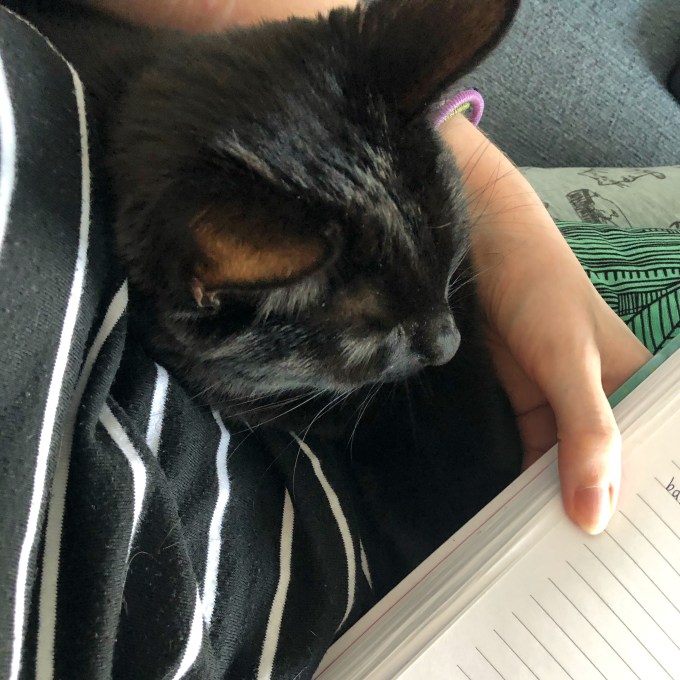
- My cats – Obviously my cats have no idea that we’re in the middle of a pandemic so they’re just continuing to do all of their cat things: playing together, chasing bugs in the garden, playing with their toys, and sleeping all snuggled up together. It’s a good distraction and a very mindful one. Everything they do is entirely in the moment and it’s hard not to smile when you look at them, something I’m finding hard at the moment.
- Favourite Films and TV Shows – While getting sucked into a new TV show is a great distraction, I find that I don’t always have the concentration to keep up with new characters in a new world with an unknown storyline so I’ve been watching a lot of my old favourites, especially ones from my childhood. They’re familiar and comforting and distracting, making everything feel just a little bit less scary.
- Video calls with friends and family – I hate not being able to see my family and friends in person, hate not being able to hug them and just hang out with them for no particular reason other than just being together, I’m very grateful for video calling. I’ve spent a lot of time talking and catching up with my favourite people and although I sometimes find it draining (I think, to an extent, the level of video call use just serves to be a reminder of how different everything is), I’m just really pleased to be able to see them at all. I miss hugging though. I really miss hugging.
- Reading Fanfiction – As I said with watching films and TV shows, I’m finding it really difficult to get into new books. I just don’t seem to have enough concentration to stick with new characters and settings and so on. But a technique I’ve used for a while when it comes to anxiety is reading Fanfiction. I love that you can get so many new stories but with familiar characters and overall themes and story arcs. If you’ve ever felt like a book, movie, or TV show didn’t do a good enough job with a story or that they left out something really important or you see the characters in a completely different scenario, then I highly suggest looking into Fanfiction.
- Playing an instrument – I’ve spent a lot of time at the piano over the last couple of weeks. It’s something I’d hoped to do during my empty semester but coincidentally, it’s been really good for my mental health. I love the sound of the piano (I find the lower octaves especially soothing) but I also find that playing takes up all of my brain. I often sit down to play a couple of songs and then realise that I’ve been there for over an hour. Learning new songs and figuring out new chords and progressions just pushes everything else out of my head. It’s a nice break from reality.
- Time away from social media – I’m definitely guilty of spending too much time on social media at the moment, terrified to miss out on important information (I absolutely do not trust the government to be giving us the full story, ever really but especially right now). But that’s leading to a lot of fear spirals so I’m trying my hardest to spend real time away from my phone and social media, checking it once a day at most. It’s complicated since part of my job involves the use of social media but with the disruption to the music industry at this time, I’m not too worried about that right now. My mental health has to be my priority.
- Decluttering – This is another thing I’d hoped to do during my empty semester and, depending on my mood, it’s not always possible but when I do feel up to it, I’m finding that going through my things and creating space in my room seems to create space in my life and my head too. I can’t do it for long periods because I start to experience decision fatigue and get really indecisive but creating order and having some control when I feel so out of control has been both satisfying and soothing.
- Preparing for my next university module – Something I was worried about before the pandemic was being prepared for this next module in my Masters degree, which involves a level of musical theory that I’m not sure I’m comfortable with at this point. So I’d wanted to do some work on that and my attempts at this have actually been good for my anxiety: focusing on a completely separate anxiety has been a good distraction and preparing for a future post-pandemic has been good for my mental health too. It helps me remember that this isn’t forever.
It’s also worth mentioning that I have an anti-anxiety medication that I take as needed, which is pretty much all the time right now. My psychiatrist is aware of this and supports it. This has been hugely helpful and has halted many a panic spiral for which I’m really grateful. Being constantly overwhelmed by anxiety is exhausting and only makes it harder to cope with everything going on.
As I said, I don’t know if these things are helping or just maintaining my mental state but honestly, I think the only thing that’s really going to help my mental health is life returning to somewhat normal: being able to continue our lives and do the things we love to do without a thick fear of being infected. I want to feel safe again. I want to hug people, go back to university, go back to the gym. Maybe I’ll write a post about all the things I want to do when it’s safe again.
Mental Health Awareness Week 2020 – #KindnessMatters
Posted on May 18, 2020
This week is Mental Health Awareness Week. Originally, this year’s theme was going to be sleep but with the impact of the pandemic on the world’s mental health, the Mental Health Foundation changed the theme to kindness:
“We think it could be the most important week we’ve hosted, not least because our own research shows that protecting our mental health is going to be central to us coping with and recovering from the coronavirus pandemic – with the psychological and social impacts likely to outlast the physical symptoms of the virus.”
Their website offers some really powerful insight into the importance of kindness:
“We have chosen kindness because of its singular ability to unlock our shared humanity. Kindness strengthens relationships, develops community and deepens solidarity. It is a cornerstone of our individual and collective mental health. Wisdom from every culture across history recognises that kindness is something that all human beings need to experience and practise to be fully alive.”
We all know about Captain Tom Moore’s incredible fundraiser and Dolly Parton’s massive donation towards researching a cure, as well as other wealthy and/or famous people giving money to various charities that support all kinds of people struggling during this time. These are all amazing acts of kindness but the foundation are encouraging people to share acts of kindness they’ve experienced so I thought I’d list some of mine:
- My street’s WhatsApp group – As many streets or communities do, my street has a WhatsApp group and the generosity displayed in it is really heartwarming. People are offering the use of various equipment, like ladders or gardening tools; people are offering to help those less able than themselves; people are giving things away for free, like packets of seeds, cooking ingredients, unwanted furniture, art that they’ve made, and so on. The sense of community has grown so much since the lockdown and that’s really nice to see.
- My neighbour helping us to rescue my cat – When one of the kittens went missing, the WhatsApp group helped locate her (which has caused her to become somewhat of a local celebrity) and the owner of the garden with the tree she was stuck in was so lovely about letting us in to retrieve her (we were social distancing, of course). When I tried to get her and couldn’t, my amazing neighbour climbed all the way to the top of the ladder, got his shirt off while perched up there, and used it to drag her off the branch she was clinging too. He handed her straight over to me for a cuddle but asked for a quick cuddle with her himself to apologise for squishing her a bit while getting her down. He told my Mum later that he’s actually terrified of heights but didn’t even think about it while helping us. That actually made me cry. I’m so, so grateful to him – especially with a fear of heights – for getting Sooty down because even with us standing below her, she seemed absolutely paralysed and unable to get down.
- The generosity of my neighbours – The family next door to us (the father was the guy who rescued Sooty) are just so lovely and have an allotment that they work super hard at. Whenever they bring vegetables back, they give us some and they often share cake or other gorgeous food that they’ve made. They’re honestly some of the most generous people I’ve ever met and I feel so lucky to have them as neighbours.
- The trumpet player on my street – There’s a guy who lives in the street who has offered, via the WhatsApp group, to come and play ‘Happy Birthday’ on his trumpet for anyone who has a birthday while we’re in lockdown. It’s kind of bizarre but then the world is truly bizarre right now and it’s a lovely, special gesture for a birthday that could otherwise feel very un-special.
- The handful of people helping my Granny – There are several people who have been helping my Mum’s Mum with her shopping and computer and series of electrical problems, as well as checking in with her (safely) to make sure she’s doing okay, and I’m so grateful. We speak frequently but we’re too far away to be helpful in the practical sense so I’m really thankful for the people making her life easier and safer.
- The support of my module leader and tutor during the assessment period – This was a while back but still in the lockdown period so I think it counts. I found this assessment really stressful and difficult, whether that’s because I’m still not used to the Masters standard of essay writing or my mental health I don’t know, but my tutor, Dan – who is also the leader of this module – was so helpful. He helped me with sourcing material and gave me really useful feedback. The Masters course is the first time in education where, as an autistic person, I’ve felt truly, 100% supported in my learning, rather than being made to feel like a hindrance, a hitch in the otherwise smoothly running classes. This means so much to me, more than I can possibly articulate. While no autistic person should ever be made to feel this way, it still happens far too often so to have tutors be so accommodating (in such a non-judgemental way) has meant the world to me and made the course possible.
- Kalie Shorr playing a song I’d requested during one of her livestreams – I said this multiple times but Kalie is one of my favourite musicians, Nashvillians, and people. I wouldn’t call us friends but we’ve met several times during my trips to the US and gotten on well (maybe one day we will be friends – that would be really nice). Since the lockdown began, she’s been playing a lot of livestreams, which has been really cool, and during one of those livestreams, she played a song that I’d requested. It’s an unreleased song, one that she posted a snippet of on her Instagram stories ages ago but I fell in love with it and had been desperate to hear more. So the fact that she actually played it meant a lot to me. And by some good fortune, that livestream took place when I was having a really hard week and it really lifted my spirits so I’m really grateful to Kalie for that.
- My friend sending me a Sara Bareilles CD – I’m not sure now whether this was just before the lockdown or just after the lockdown started (anyone else having major issues with judging the passing of time?), but a friend of mine was passing on some CDs, knew how much I love Sara Bareilles, and sent me a copy of Little Voice. As I have the money, I’m slowly collecting my favourite albums on CD or even vinyl, so I really appreciated him gifting it to me.
Another one of the focuses of this week is to think about how to build a kinder future. I can’t explain it any better than they do so, again, I’m gonna post what they’ve said:
“We have a once in a generation opportunity not only during but also following this pandemic for a reset and re-think about what kind of society we want to emerge from this crisis.
Our own reports and others such as Sir Michael Marmot’s 10 years On report reveal how inequality is rising in our society and its harmful effects on our health. Life expectancy is falling for the poorest for the first time in 100 years. As child poverty rises, children and young people in the poorest parts of our country are two to three times more likely to experience poor mental health than those in the richest. After the 2008 credit crunch it was the most vulnerable in our communities who experienced the severest consequences of austerity, with devastating effects on their mental and physical health. This not the hallmark of a kind society. We must not make the same mistakes after this pandemic.
Applied kindness could have a transformative impact on our schools, places of work, communities and families. As the former Governor of the Bank of England, Mark Carney, has said, now is a time to put values above valuations. We must seize this time to shape a society that tips the balance in favour of good mental health, for all of us, but especially for those who are most vulnerable.”
I have to hope that the kindness I’ve been seeing, the general community focussed behaviour and mindset will only continue after the lockdown ends, even though our lives will be busier, with work and school and so on. We’ll go back to our normal lives but that normal doesn’t have to be the same as the old normal. Hopefully we can build a new normal, one that’s kinder, more connected, more neighbourly, and more flexible, because of this experience with the pandemic and the lockdown. How beautiful would it be if we could create something so good out of such a difficult, distressing time? It won’t, of course, bring back the people who’ve died but perhaps it could be a tribute to all those who have suffered during this time. Maybe it’s naïve but I have to have hope.
I couldn’t make this post without acknowledging the incredible courage and strength and… kindness isn’t a big enough word by far… of the all the NHS staff, care workers, key workers, teachers (fuck the Daily Mail), and all those working unimaginably hard to protect us, keep us safe and healthy and moving forward despite everything going on. We can’t thank them enough. We’ll probably never be able to thank them enough. Someday, somehow, I’ll figure out a way to say a proper thank you, a way to give back and help people in their honour.
But coming back to Mental Health Awareness Week, the Mental Health Foundation are, as I said, encouraging people to share the acts of kindness they’ve experienced or witnessed, using the hashtags, #KindnessMatters and #MentalHealthAwarenessWeek on social media. You can find out more and access further resources through their website. And to quote them once more:
“No act of kindness is ever wasted.”

 Finding Hope