 Finding Hope
House on Fire – Out Now!
Posted on April 21, 2023
My brand new single, ‘House on Fire,’ is now available on all major music platforms! Finally!

laurenalexhooper: Please welcome to the world, ‘House on Fire,’ a song I wrote at the height of the pandemic. I was so scared that I could barely function but putting words to those fears is what ultimately helped me move forward.
Three years later though, the meaning of the song has evolved and when I listen to it now, I think of different fears: fears of our society spinning out of control, of feeling powerless against the rich and influential, of feeling helpless.
For me, my songs have always been a space where my voice can be heard too and I hope you feel yours is as well when you listen to them.
You can find the song through the link in my bio!
Thank you always to @richardmarcmusic / @rsandersonphoto for everything you do (including the production and the cover art), @josh_fielden_sproggletstudios and Luke for the gorgeous mixing and mastering, and @icmplondon for their help in making this all happen via The Accelerator Fund.
(x)
Click here to listen to the song!
New music has been a long time coming. I’ve wanted to release new songs pretty much since I finished releasing the Honest EP but between the pandemic, completing my Masters, and the time it takes to develop, write, record, and produce a project, it was always going to take a while. And then there was the disaster that was my medication and mental health situation over the last eighteen months, which obviously impacted my ability to create.
Now that my brain feels a little more like my own (and hopefully will continue to do so more and more), I have multiple projects in mind. The problem is going to be choosing which one to focus on first, which will be both fun and challenging. For now, at least, that’s something for all of us to look forward to.
I hope you enjoy the song and please let me know what you think and what it makes you feel, either on here or on social media.
The First Six Months of Hydrotherapy
Posted on August 13, 2022
When I was first diagnosed with Hypermobile Ehlers-Danlos Syndrome back in October 2020, hydrotherapy was recommended both for general fitness and muscle strength (which would, in theory, help with the back and leg pain I was struggling with) and to build up my core muscles, which are a notoriously weak area for hypermobile people. I was up for that since I’ve always enjoyed being in the water but COVID made the whole process very complicated and very slow.
As far as I can tell, with the way things currently are, it seems that the way to get a referral for hydrotherapy is to be referred for physiotherapy and then a physiotherapist assesses you and refers you on to the hydrotherapy department. I’d been referred for physio three times, I think, by three different doctors between May 2020 and when I finally got an appointment in November 2021. I find myself feeling a level of righteous indignation over waiting eighteen months for a simple referral, especially when I was in pain pretty much every day, but I know it was all more complicated than that. COVID was the obvious cause for the delay but the NHS waiting lists are also incredibly long anyway. But, as soon as it all started happening, it all happened at once.
At the beginning of November 2021, I met with a physiotherapist and he referred me on to the hydrotherapy department and at the end of the month, I had an appointment with them. I will admit that, after waiting eighteen months for an appointment, I was a bit appalled that the appointment consisted of just a half hour run-through of exercises to do without a huge amount of guidance. But this is how the system works and I’ll take what I can get.

While I continued swimming in my ‘normal’ pool, I struggled to find a pool that allowed me to do all of the exercises I’d been assigned: the height of the water needed to be within a certain range, I needed to be able to walk in the water, I needed a step of a specific height and width, and so on. And finding a pool that fitted all of the requirements was difficult, and that was without all of my COVID related anxieties being factored in. We finally found a pool just as Omicron started rearing its head and I had a meltdown leaving the first session; I was massively overstimulated and my anxiety was just overwhelming. Those weren’t exactly fond memories that I was keen to revisit but it wasn’t going to work anyway as the steps didn’t allow me to do the step related exercises and there are too many of those not to have access to the right kind of steps. I was managing a modified version of the exercises in my usual pool while we searched for another hydro-friendly pool but then Omicron hit in earnest and we all retreated inside to insure Christmas could go ahead as planned.
From December 2021 to early March 2022, I was incredibly unwell because of the ADHD medication I’d been trying, too unwell to swim at all. But, in that time, my Mum had found another pool. The first session went well (although it was really hard work after so little movement for a couple of months) and the set up of the pool meant I could do all of the suggested exercises. I got a few sessions in before I left for Nashville in late March.
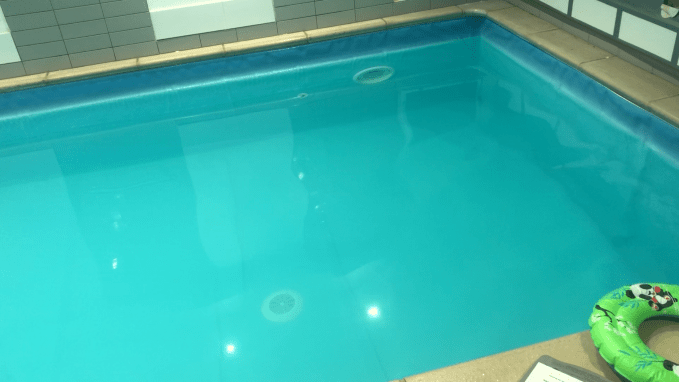
Back from Nashville and semi-recovered from the jet lag in late April, I got back in the pool, both to swim and to do my hydro exercises. It took a bit of work and scheduling but after a while, I managed to build in two sessions a week while I got used to the routine and started building up my strength and stamina after so little proper exercise for so long. I’ve had multiple conversations with multiple health professionals about my tendency to throw my all into stuff and how I need to take things slowly if it’s going to actually help so, even though it’s very frustrating, I am trying my best to push down that irritation and just focus on the exercises.
So, that was my first six months of hydrotherapy. There’s a few months between where this post finishes and where I am now but I thought those first six months were important to document. Since then, I had to stop using one pool and tried out another – which I love – despite difficulty actually getting out to swim because my mental health has been so bad.
Although it hasn’t been a priority (and still isn’t one really – one thing at a time), I do want to find a new all-round gym since the gym I used to go to closed down after the multiple lockdowns. I want to get fitter; I’m just having to take a longer route than I would’ve previously thought.
Mental Health Awareness Week 2022
Posted on May 14, 2022
I have to admit that I often struggle with Mental Health Awareness Week, particularly the flooding of social media with “it’s okay not to be okay” and “reach out to someone if you need help”; it makes me want to scream in frustration because we are so far past that. If we’re going to create better support for mental health, we need more than that. This year, the theme is loneliness, which is an apt one, two years and change into this pandemic. I’m certainly seeing a lot of loneliness around at the moment: those with mental health issues, disabled individuals, people who are still shielding and feeling abandoned by society because of the dropped mandates… I can’t imagine what it’s like to be in or from Ukraine right now…
All of these situations need to be talked about and since the Mental Health Foundation is encouraging everyone to share their experiences with loneliness for Mental Health Awareness Week, I thought I’d write about my experience, as a disabled person with mental health issues.
This is something I find kind of hard to talk about. I guess talking about it – and writing about it – makes me feel a little guilty because I’m not alone. I know I’m not alone. I have a great family and some really wonderful friends who have been there for me through some really tough stuff. They try so hard to make sure that I don’t feel alone. Fortunately, we – as people – don’t need to understand each other’s experiences point for point to find friendship and create those important, supportive bonds: I have a friend who has experienced very different trauma to me but there have been a lot of similarities throughout both of our journeys that have made it possible for us to relate to each other. I’m grateful for that, more than I can say.
But it’s also true that I do, often and increasingly, feel alone, feel lonely. And I think that that’s because no one – no one I’ve found at least – really understands what it’s like to be in my head, in my body, in my life, dealing with the problems that I have and the ripple effect that they can create. I’ve had multiple doctors and medical services simply stop helping me (or refuse to help me at all) because my case is “too complicated.” These are the professionals – the people who are supposed to really know and understand this stuff – and even they don’t know what to do with me (and those abandonments, plus other abandonments in my life, have left me with a lot of issues and fears that I have to work on every day). I think the issue is compounded by the fact that I have multiple diagnoses so, even though I may fit into the autistic community, I still don’t feel like I fit in because I also have OCD and BPD and so on; I can’t imagine there are many people who fit into the same community as me when the criteria is so narrow. I’m also not entirely convinced by the idea of community based on diagnosis either, to be honest, especially when the diagnosis covers such a range of symptoms, behaviours, and experiences, like Autism Spectrum Disorder. Anyway, my point is that I don’t feel like I fit in, even with the people that, on paper, I would likely get along with.
As I said, I’m not alone. Even though I’ve never felt like I quite fitted in, I have some great friends and friends from all areas of my life: school, sixth form, uni, Masters, as well as stuff outside education… But I can’t always keep up with my friends, with my peers, and I can’t always do the things I wish I could and I find that so hard. I always end up feeling like there’s a gap between me and everyone else and it’s lonely. Not being able to physically keep up with those around me means that I often feel left out – even if that’s nobody’s intention. And there’s a level of embarrassment and shame about being the one who can never keep up, the one who is always asking people to wait, always having to double check or change or cancel plans. I don’t know where that comes from – I know my friends would never want me to feel like that. But still, it’s there. It widens the gap and it makes that loneliness worse.
The older I get, the more I notice it – the gap. While I spend my time trying different medications, going to appointments for my physical and mental health, and resting after doing what I can manage to do, a lot of my friends are pursuing PhDs, establishing careers, living independently, and building lasting relationships. Our life experiences are just so different. And the longer it goes on, the bigger the disconnect feels. It just feels like the future is full of loneliness and I don’t know what to do with that.
I know this is kind of a depressing post. It’s a depressing truth, although it might have come out differently if I weren’t coming off my antidepressants; if I were in a better place mentally, I might have a more hopeful outlook. I don’t know.
I don’t think it’s a bad theme – loneliness can have a devastating impact on a person’s mental health – but the Mental Health Foundation’s website says that they want to “shatter the stigma around loneliness” and while I can’t say that there’s no stigma associated with loneliness, I can think of so many things that might have more impact as a theme, might make more of a difference, like access to mental health support or the impact of social media or… I don’t know, something more specific than loneliness or nature (last year’s theme). (I talked about this more in my Mass Observation Day post.) As I said at the beginning of this post, I find Mental Health Awareness Week difficult because I so often feel like the information being circulated is somewhat obvious, that we could – and should – be going deeper. I guess it all just feels a bit surface level but I don’t know how that changes, if anyone else even feels this way. It just doesn’t feel like enough. It’s one week a year and it doesn’t feel like enough.
 Finding Hope