
Self Care Week (2023)

This week – from Monday 13th to Sunday 19th November – is Self Care Week, a UK-wide awareness week established and run by the Self Care Forum, a charity that aims to spread understanding about the positive impact of self care and helping people to implement it into their everyday lives. This includes the benefits of good nutrition and exercise, of taking vitamins (like vitamin D, especially for those whose health means they spend all or most of their time inside), of managing our mental health; they also guide people in making more positive lifestyle choices (to no one’s surprise, ‘homelessness’ is not on their list – fuck you, Suella Braverman), go into schools to help improve health literacy, and support people in understanding how to manage both short and long term health conditions. All good things!

I can’t speak to their understanding of neurodivergent or Autism focussed self care – I haven’t been able to find anything on their website – although much of their advice applies to all of us as human beings with the same basic needs. I thought that, in recognition of this week and the importance of self care, I’d put together a list of strategies that I personally rely on, many of which I’ve developed to help me manage as a neurodivergent person.

Obviously not all of these will work for every person, the personal ones that is: the physical ones apply to all of us to a certain degree, depending on our individual circumstances and needs. But when it comes to the personal ones, it’s unlikely that all or even most will work for everyone. But hopefully, given how many I’ve included, there will be something that’s helpful – or just worth trying – to anyone who reads this…


PHYSICAL:

When I’m struggling, I know that I need to check in with my body. I’m really not very good at noticing my body’s signals – my interoception is pretty poor, something that isn’t unusual in neurodivergent individuals – so I often have to go through this list consciously to figure out what it is my body is asking for. Others are better at this but it’s always worth checking to make sure that there isn’t a straightforward way of understanding why you might be feeling the way you do and of improving both your physical and mental state…

  1. BREATHE – When I’m struggling, I often feel like I can’t take a deep breath, something that only makes me feel worse. Learning breathing techniques, like box breathing, have been really helpful but the most effective and my personal favourite way to regulate my breath is to sing: it’s something I love doing and something I can get lost in, focussing on the words and the melody, so I don’t even notice the breathwork. I find it much easier and much more soothing to concentrate on hitting each note, rather than on counting, for example.
  2. HYDRATE – We all know how important it is to stay hydrated and yet most of us are constantly battling some level of dehydration, finding it difficult to drink the recommended amount of water. I’ve been working on drinking more and I am doing better than I used to but I still find it really hard to actually drink as much as I should. I’ve found that reminders (or an app that reminds me), a bottle that I find pleasing, and consistently carrying that bottle with me all help.
  3. EAT – Sometimes making sure that our bodies are fuelled can feel like a massive task; I certainly struggle with it and when I’m struggling, it’s usually the first thing to get abandoned. Sometimes I only manage one meal a day, as I promised my first therapist, and I try to keep her words in mind: if a cupcake, for example, is all I can manage then that’s better than nothing. You can work up from there. And it’s so important to remember that, in this world where food can feel like such a minefield, it’s totally okay – and good for your mental health – to indulge in your favourite snack, your favourite meal, your favourite takeaway, just as long as you don’t end up living on it.
  4. REST – Living in a society that is constantly ‘encouraging’ us to do more (see: telling us that we’re never working, or even trying, hard enough), most of us are constantly tired. I know I am, especially when you throw in the neurodivergence and chronic fatigue. We all need more rest. Dr Saundra Dalton-Smith has broken rest down into seven categories – physical, mental, social, sensory, creative, emotional, and spiritual – and asserts that only by fulfilling all of these can we be truly rested. After reading this article, I’ve been inspired to think of rest as something more nuanced than just whether I’m getting enough sleep or not – although that is, of course, important too.
  5. EXERCISE (OR JUST MOVE YOUR BODY A LITTLE) – We’ve all been told countless times how important exercise is for our bodies and it is, of course, true. Having said that, it’s not going to be very useful as a self care strategy if you’re hating every second of it. Finding a way of exercising that is fun and empowering is so important, both in terms of self care and in terms of exercising regularly. Because of my chronic fatigue and chronic pain, I’ve long struggled with exercise because it put such strain on my body and because I suffered so much afterwards. But then I started swimming again and, apart from the lockdowns, I haven’t stopped since. It’s a great form of non-weight-bearing exercise and it feels amazing to exercise (or just move my body gently if I’m having a bad energy or pain day) without feeling so much distress. It makes me feel able and strong, both things I haven’t felt since I was a kid, and it always boosts my mood. Plus, if I go at quiet times or even have the pool to myself, I don’t feel such anxiety about how I look in a swimming costume. Other things I’ve found really helpful are both hydrotherapy and physiotherapy. In and out of the pool, I feel more confident knowing that I have the support and advice of a trained professional, especially given how unreliable my body can be.
  6. HYGIENE – Feeling clean always feels good so, aside from the obvious physical health benefits, it’s always good for your mental health to have a shower or a bath (or even just clean up in the sink if that’s all you can manage at that moment in time – I find just washing my face can help clear my head). A bath or shower can be as luxurious or as functional as you want: it’s your headspace so you should do what’s going to help you the most. Some people really enjoy a long bath with fun or relaxing products and a book to read, while some people find that too much and prefer a simple, straightforward wash in the shower. I’m the latter – one of the symptoms of POTS makes both the heat and the standing involved in taking a shower dizzying and strenuous – but that is enough to improve my mood, to make me feel decontaminated and renewed. Those may sound like strange words to use but it’s how I feel and those feelings do, for the most part, lift my mood.
  7. MEDICATION – This won’t apply to everyone but taking your prescribed medication, or any over the counter medications that you need, (all safely and as directed, of course) is obviously very important; not only has a (hopefully) knowledgeable and experienced professional recommended you take them to improve your quality of life but missing a dose or stopping the routine suddenly can have nasty side effects. So making sure that you’re up to date on any medication can be crucial to maintaining your physical and/or mental health.

PERSONAL:

Here is a short list of the things that help me to manage when I’m struggling, when I’m feeling overwhelmed and burned out, when my mental health isn’t great. It’s a constantly evolving list, depending on what’s going on in my life and what my needs are, but this is my current list of self care strategies, ones that are the most helpful at this point in time.

  1. REDUCE DEMANDS ON MYSELF – The first thing I do when I’m feeling overly stressed and at the end of my rope is reduce my commitments and plans, giving myself time and space for my energy levels – all of my energy levels – to recover. Sometimes there are things that I can’t miss and I just have to shoulder my way through, accepting that it will then take longer to recover. And sometimes it does just take longer than others anyway. But if I don’t immediately take time for my mental health, my mental health will force me to and for likely a lot longer than I would’ve originally needed.
  2. RETREAT TO MY BUBBLE – Not long after I moved into my current house, I discovered that a really good way to reduce my stress was to spend my time in what I quickly dubbed my ‘bubble’: the front room of the house that, with the sun and the outside world muted by the drawn, light-coloured curtains, was gentle on my senses, making it much easier to work and get things done. That discovery showed me how great the sensory demands that I was experiencing were and having a space where I could reduce those demands has been pretty life-changing.
  3. CREATE SOME ORGANISATION IN MY LIFE – If I’m feeling overwhelmed and/or burned out, it’s likely that I’m trying to do too much, or that that is at least part of the problem. So, after taking the time to recover, I try to adjust my approach going forward: what commitments I say yes to, how much time I build in between commitments, how much time I’m making for important things like swimming and physiotherapy, and so on. When my schedule is more intentional and less chaotic, I find that the balance in my life never tips too far in any direction.
  4. TIME FOR SPECIAL INTERESTSResearch has shown how important it is for autistic people and our wellbeing to engage in our special interests so, although we should be making time for them anyway, I would consider it self care to make additional, deadline-free time to just immerse myself in the things I love so much. Engaging with something that absorbs you so completely and triggers such a wealth of emotion is always going to be good for the soul, I think.
  5. TALK TO MY MUM – My Mum has seen me through everything, all of the highs and lows (and catastrophic lows), and always been so supportive, regardless of whether it’s my health, my creative ambitions, or my relentless dissecting of fictional stories and their characters. I can tell her anything and often talking things out with her helps me gain a clarity that I might struggle to find otherwise.
  6. TALK TO MY FRIENDS – Sometimes I just need some time and some space to recover my social battery but, for pretty much the first time in my life, I have an amazing group of friends that I feel like I can really rely on, that I can always talk to, and that I can trust with anything. That is kind of mind-blowing to me, in a good way. Being able to talk to them – long WhatsApp chats, afternoons spent on Zoom, texting silly memes back and forth, and so on – has been so lovely. I’m very grateful to have them in my life.
  7. TIME WITH MY PETS – Spending time with my cats and/or my new puppy, Izzy, is one of the most soothing experiences I know of. They’re so present, so unaware of everything going on in the world; it’s hard not to get sucked into that, even just for a little while. Sometimes you need a break from all of the terrifying things going on in the world and their little pocket of it is the perfect place to escape to.
  8. TAKE A BREAK FROM SOCIAL MEDIA – While there are parts of social media that I enjoy, I’ve found that taking a complete break from social media has the power to rebalance my mental state and give me space to breathe, a space I didn’t realise I needed until my mental health forced me to take a break. Since I’ve been back on the apps, I’ve found it easier to recognise when I’ve had enough, when it’s getting to me, and when I need to log off. Social media can provide us with unique inspiration and access to fantastic art that we wouldn’t otherwise have seen, as well as communities that can be harder to access in the real world, but sometimes the level of toxicity or just curation can get overwhelming, making it harder to maintain your balance and sense of identity. Taking a break can feel really hard – the fear of missing an important update or losing out on an opportunity are valid anxieties – but in my experience, taking a break can help you to recalibrate and figure out where you really want to be focussing your energies. You want to be making that choice, not the algorithms.
  9. BUY SOMETHING I NEED / SOMETHING SMALL THAT I WANT – Sometimes you just need something to look forward to, whether it’s a new planner, a necklace you’ve been waiting to go on sale, or a new toy for your pet. It really doesn’t have to be complicated or expensive: if it gives you a boost to get through a hard week or a scary appointment, then it may be worth it.
  10. WRITE IN MY DIARY – I’ve long found that the process of turning my thoughts into comprehensible sentences and getting them written down somewhere safe, whether that’s in a notebook or on my laptop, to be a great source of stress relief. Not only does it help me to make sense of my thoughts and feelings and experiences but it also takes the weight off my mind: it makes me feel like, having stored those thoughts in a safe place, I don’t have to consciously hold on to them for fear of them disappearing. Not unlike having a dramatic haircut, I feel much lighter for being able to offload everything in my head.
  11. CONTACT MY THERAPIST – At this moment in time, it’s never that long until I’ll be seeing my therapist next and I can talk to her about what I’m struggling with, or we can talk through everything that’s going on if the hard stuff is feeling somewhat nebulous. And if that feels too long, I can email her, if only to get my thoughts out of my head and allow her to get a head start on where my head is before I arrive at my next session. Therapy – with a therapist I feel safe with – is a really important space for me, with everything I’ve gone through and everything I live with on a day-to-day basis.It’s really hard a lot of the time but, for the most part, I’m better going than not.
  12. GO TO A SUPPORT GROUP – This year I’ve started to attend support groups for some of the conditions I live with and for some of the experiences I’ve had, online for the most part, and although the format and the social and emotional etiquette have taken a bit of getting used to, I’ve found the experiences to be really positive and validating. I don’t always feel the need to go but it helps to know they’re there if I need some extra support.
  13. CRAFT PROJECT – Sometimes I find that having something creative to do with my hands, something without any stakes, is really could for an anxious mind and body. Over the years, I’ve slowly filled a notebook with inspiring quotes, made cards out of spirograph designs, learned origami, made both thread and beaded friendship bracelets… The concentration it requires just shuts everything else out and gives my brain a break. These obviously aren’t the only options: whatever works for you is a good option.
  14. READ A BOOK – I recently got back into reading after a very long break and I’d forgotten how completely you can lose yourself in a book. I’ve been revisiting old favourites and working through my ‘To Read’ list and it’s been so lovely to be so absorbed in stories and worlds and characters again, in a way that has the rest of the world just fading away. I’m enjoying audiobooks too, although I still prefer physical books.
  15. WATCH A FAVOURITE FILM OR TV SHOW –  I’ve consistently found that both watching new films and TV shows and rewatching old favourites are a really good way to relax. Similarly to reading, I find them to be a great way to take a break from the emotions of the real world, plus I love exploring the characters and the storytelling and so on (to a point where it might be a special interest actually); it can really boost my creativity and my joy around creating. Getting sucked into something new is always exciting and watching something old is very comforting, both of which are – I think, at least – positive emotions to dig into when you’re struggling emotionally.

I’ve been working on my self care this year and there are times when I can really see the difference it’s made: I’m really enjoying exercise for the first time in my life; I’m drinking more water than I ever have; my relationship with social media is better than it’s ever been; I feel more confident in my friendships; and so on. There are still plenty of aspects to work on but I can see the positive effect it’s had on my life.

I’d love to know how you guys feel about all of this, about self care in general and on a personal level. What self care strategies do you use? Which ones do you find the most effective? Here’s a great list if you need more ideas.

Dopamine Land: A Multisensory Experience

Over the summer, I was able to go (twice!) to this cool, immersive exhibition called Dopamine Land: “Dopamine Land is a multisensory experience that combines media, technology and play in one place. It’s an interactive museum made up of colourful installations that channel the limitless imagination of your inner child into reality. Take a break from your everyday life, have some fun, take some photos and boost your happy emotions!” (x) It’s made up of, I think, eleven rooms, each with a different artistic and sensory-stimulating environment inside. Some of them I absolutely loved, some of them I simply enjoyed, and some that I actively struggled with. But I loved the experience, first with my Mum and then with a friend of mine who also has ADHD (something which I do think made it a slightly different experience, although I’m not sure I could clearly explain why).

Before you enter the exhibition, there are two signs on the wall, explaining what dopamine is and how their rooms boost it, which I found super interesting: “Here at Dopamine Land we aim to trigger a gentle release of Dopamine in each of the spaces in different ways as you travel through the gallery. But what is dopamine? Dopamine is a chemical released in the brain that makes you feel. It is responsible for allowing you to feel pleasure, satisfaction, and motivation. A dopamine ‘reward’ can be caused by many pleasant experiences, including eating nice food, feeling loved, winning a game, and earning money, and having the right amount of dopamine is important both for your body and your brain. When you feel good that you have achieved something, it’s because you have a surge of dopamine in the brain.” and “How do the spaces trigger dopamine? There are many different types of triggers for dopamine, across all your senses, and each individual will experience dopamine in different ways. Therefore we have designed the experience to go through a variety of types of spaces, from energetic, to nostalgic, to meditative rooms. You may feel joy in a childhood memory, or from a wonderful aroma. You may experience a warmth from visually satisfying images, or a creative moment may trigger your feel-good hormone. Or perhaps a mesmerising, calming environment is best for you to find your happy place.”

There will be major spoilers in this post so, if you want to go and want to be surprised by the experience, don’t read any further because I will be talking about the different rooms and the fun little details and basically the whole experience. However, if you’re interested, please read on…


The first room (I forgot to take a photo of its name and description) was deeply reminiscent of Yayoi Kusama’s Infinity Rooms, which I always completely adored so I loved that room and just wished I could’ve stayed longer (it was one of the few that had a time limit)…

As I said in my Week In My Life post a few weeks back, I can’t really explain why I love this environment so much. There’s just something about it that makes my brain feel so right and joyful, like a symphony finally in harmony (that metaphor just flowed out as I was writing and it really took me by surprise – it’s a very apt metaphor given that my brain often feels very noisy). It is deeply pleasing on a sensory level in a way that I rarely experience.

I also forgot to take a photo of the sign outside this room with the name and description of it but I’ll do my best to explain it. There were square panels in the floor throughout the room and when you stepped on one, it changed colour. It’s a bit disconcerting though because they look like there is just endless space below, like you could fall through it and just keep going. My friend and I had a good time though, trying to step on different ones and getting the colours to sync up. Yes, we’re actual children…
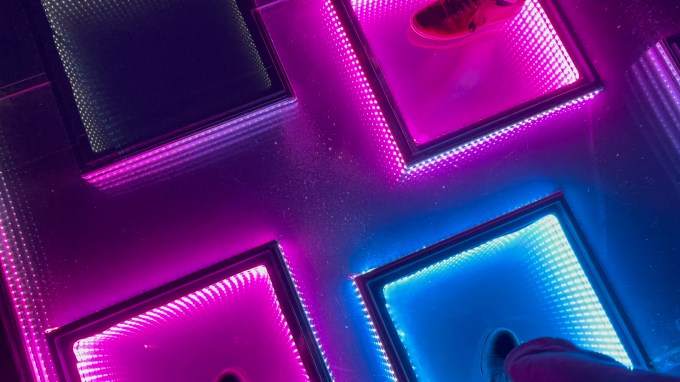
IMG_7601

Another of my favourites was called Lucid Dreams with a looping video of all these different visual effects with different colours, different sounds, and what looked like different textures. The explanation outside read: “Let your mind immerse you into an infinite dreamscape and allow your imagination to fly free. This space explores the concept of ASMR content (Auto Sensory Meridian Response): something that evokes light and pleasurable tingles, sparkles, fuzziness or waves of relaxation in the neck, spine, and body.” I’ve never been a huge fan of ASMR but I loved this room. It was definitely one of my favourites; I could’ve watched it all day. It was definitely the room I spent the most time in. It was just gorgeous and oddly compelling and as I said when I talked about it before, I didn’t just want to touch it – I wanted to live inside of it. I tried to find out who designed and created it but when I contacted Dopamine Land to ask, they said that they didn’t give out that information. It seems unfair to me, that the artists aren’t getting clear credit for the work that they’ve done.

I honestly couldn’t choose a favourite moment of it; I loved the whole thing.

The Writing Room wasn’t a favourite but I thought it was kind of cool, although I would’ve put it at the end for people to write about their Dopamine Land experiences if they wanted to: “Pause for reflection and give a moment for gratitude. Tell us what makes you full of lust, love, and laughter, tell us what you’re grateful for or what you dream of. Write a note to yourself, recalling a feel-good moment of joy, the warmth of love, or perhaps something a little more primal. Post it to yourself in one of the post boxes, or leave it for others to enjoy.”

These were my messages that I left tucked into various corners.

The next room, Creating Calm, was pretty nostalgic, with fridge magnet words to rearrange and lights for shadow puppets: “Let’s get busy and create something! Brash, bold, thoughtful, creative, artistic, or beautifully silly; all creations welcome here! A creative act can focus the mind due to its calming effects on the brain and body, releasing dopamine, a natural antidepressant. It is also thought that higher dopamine levels drive our motivation to explore and boost creativity. So let’s get making!”

IMG_7620 2

I find shadow puppets all but impossible to do but it was fun to watch other people try and I had fun with the fridge magnet words. I like how, when the word you want isn’t available, you have to take the sentence in a different direction, usually ending up with something you never expected. Sometimes it ends up being nonsense but sometimes it ends up being really cool.

The next room was the ball pit but I forgot to take a picture for the explanation. Having said that, I think it’s safe to say that a ball pit turns everyone into a kid; there’s something very nostalgic about them and I couldn’t help but laugh hysterically as I ended up flailing around like an idiot when I couldn’t get back up again. It wasn’t at the top of my favourites list but there’s something wonderfully childlike about flopping into a big container of plastic balls and burying yourself in them until not even your face is visible; it’s just so joyful.

That one was probably the hardest on my back though, when the pain was bad. The whole thing wasn’t great for my back pain but I was wearing a brace and the support was a life-saver. I wasn’t pain-free but between the brace and my industrial strength painkillers, I was just about coping (a favourite coming up was the perfect antidote to all the standing and throwing myself into the ball pit). As I said, the ball pit was the most painful and I did regret my enthusiasm a little afterwards; the strain it put on my back was just a bit too much.

Another of my absolute favourites was called Fire Lantern: “Give a moment to appreciate those around us, and those who are not, as you bask under our canopy of glimmering light. Dopamine plays a part in encoding and consolidating memories and fire lanterns hold an important role in many cultures social events and festivities, lighting the way for souls of the ancestors. Contemplate the beauty of these mesmeric lanterns and remember fondly those with whom you have parted ways.” I thought that was really beautiful and I was absolutely mesmerised by the space, by staring up at the lanterns as I lay on the big bean bags on the floor. The quiet – just the low voices of the other people talking as they lay on their own bean bags – was really soothing and I honestly could’ve stayed there all day. It would’ve been easily done too because time seemed to move differently in there. I’d love a space like that in my house, just to decompress in. I don’t think that’s gonna happen though.

IMG_4657 2

I was so excited to see it a second time and it was nice to start with but then two different families arrived with their kids, none of whom could’ve been older than ten, and they were running around the room and shouting and dragging the bean bags from place to place and it just completely ruined the gentle atmosphere. It was really disappointing.

The penultimate room, Keep Calm, looked like an abstract forest: “When dopamine is released it can produce a reaction where you feel calm yet also energised. Experience an immersive digital nature; a forest of the surreal! A natural space of great calm and beauty conjured through lights, mirrors, and the scent of natural wood, yet contrasted by hard lines, creating a shifting, shimmering, layered forest.” It was weird but beautiful and reminded me of wandering through the woods as a kid.

It wasn’t at the top of my list but I did really like it; it was very soothing. But then, again during my second visit, the families with kids ruined that. The kids were running around and shrieking and kicking up the wood chips covering the ground, sending them spraying in our direction. It was deeply frustrating, and more so that their parents didn’t seem to care that they were disrupting the experience for everyone else.

The final room, apart from the social space on the way out, was called Pillow Fight! and the explanation outside read: “The penultimate stop on our voyage. Release your inhibitions and dance in the eye of the storm! Euphoria will wash over you as the energy levels are raised. Take the pillows, giggle and release some tension as you return to your childhood, and settle some old scores in a friendly pillow fight.”

9448e1228f18b63bc4f07c311d6ceef5

(x)

It looked super cool and I liked the idea but the music was so loud – too loud. It was overwhelming. Even the people I went with, neither of whom are autistic, found it unbearably loud. It was just too much so we didn’t linger long in that room either time. That was a shame because it looked amazing and I loved the idea of a pillow fight. But I just couldn’t handle the noise.

The last space was The Bubble Bar where you could get drinks and snacks, named to fit the theme of the exhibition. Around the room, there were little corners with what were essentially cute photo opportunities.

Some of them were fun but we didn’t spend very long there. I can’t speak for anyone else but I was still holding the special moments close and didn’t really want to hang around, letting them dilute in a halfway space before leaving. I understand the appeal of finishing the exhibition with an opportunity to sit and eat and drink but it wasn’t for me.


Apart from the annoying kids during the second visit, both experiences were really cool and I really enjoyed it as an exhibition. So many of the rooms just made my dopamine-deprived brain really happy and that was really special. I think my only qualm was that we don’t get to know who created each room; I’d love to know what they go on to do.

Introducing Izzy!

This is Izzy, the newest addition to our family!

After months of searching and being heartbroken several times, we finally found our puppy. Our puppy!
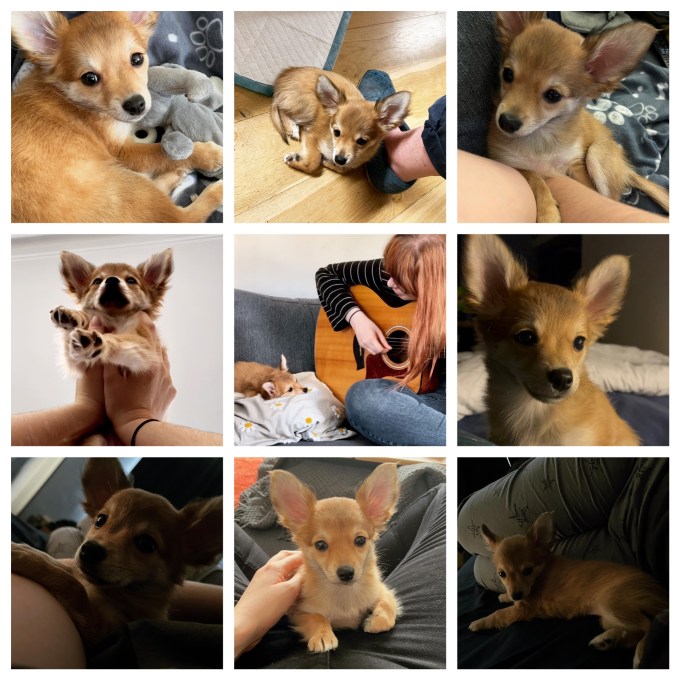
IMG_0992

She’s a gorgeous, three month old Pomchi (half Pomeranian and half Chihuahua) that we brought home a little over a week ago. She’s wonderfully soft, with the most fantastic ears I’ve ever seen, and she’s super snuggly: she’s already practically glued to me at all times and she hasn’t even known me two weeks. I absolutely adore her already and she seems to adore me. We’re probably going to have to work on her separation anxiety at some point but obviously we’re still bonding and still building our relationship. After all, she’s still such a baby and she went from being with her canine family and their owners to being with us so she’s never been alone. But that’s something she’ll learn and she has plenty of time to learn it. She’s still getting settled so we haven’t really left her alone much but as she gets used to her new environment and routine, we’ll leave her alone more and she’ll get used to it. And she’ll be fine. She’s ridiculously smart: she’s already coming when we call her name (which she’s only had for about four days), she’s very proficient with the puppy pad, and she’s taken to her crate really well. She’s still learning to sleep in her own bed and usually ends up in mine but she’s still so little and we’ve got plenty of time. She’ll get there. She’s so clever; she’s so clever that she’s going to be trouble – I’m not going to be able to hide anything from her. I think, because she’s so smart, it’s easy to forget how young she still is and how much time we have to work these things out.

She’s a gorgeous little thing. Everyone falls in love with her, even random strangers in the street. She can be a bit shy when first meeting someone but it’s never long before she’s bouncing around, ready to play. She just wants to be friends with everyone (most of all, I think, she wants to be friends with the cats who are still wholly unconvinced by her presence). It’s very cute. The only thing cuter is when she has to stop for a nap and she curls up against me, either pressed into my side or stretched out on my chest. It’s the most adorable thing. She’s a soft, warm little snuggler and I’m so grateful that we found her.

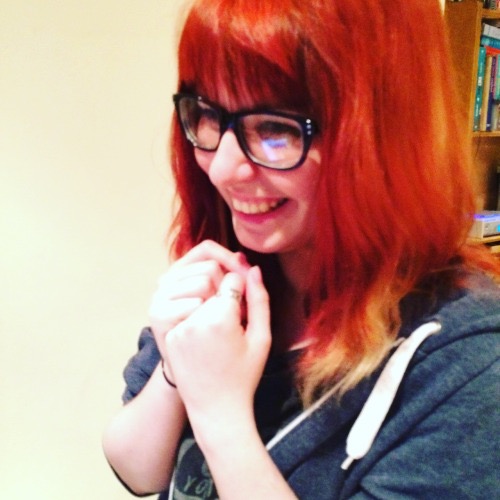
IMG_0750