 Finding Hope
#WelfareNotWarfare
Posted on June 30, 2025
During the last several elections, I’ve felt frustration that I couldn’t vote Labour and help to oust the Conservatives who’d been in power since before I could vote. Don’t get me wrong, I am proud to vote for The Green Party but there was a level of frustration in that I had to vote Green in order to avoid splitting the vote between Green and Labour and letting the Conservatives get in. Voting Green keeps The Green Party in, which I do absolutely want, but it was hard knowing that it never swayed the overall outcome and that was quite distressing. Having said that, in this recent election, never have I been so glad to have voted Green and not Labour…
Today is the final day of the government’s Pathways To Work consultation – nicknamed “consult-a-sham” – on the disability cuts bill and as much work has been done and pressure applied by disabled people’s grassroots groups and charities, as much as people have protested (in the streets and online), and as many emails have been sent to MPs, I’m still so scared that this bill will go through because I don’t think the government is listening; I don’t think many MPs care (again, I’m so fucking grateful that my MP is Sian Berry who does very much care). They don’t seem to care about any of the evidence and no argument will convince them that this bill will not get disabled people working and that it will, in fact, be completely devastating: disabled people will be pushed into poverty, their health will deteriorate, lives will be lost (and taken out of desperation). And yet so many among the government are focussed on the non-existant savings instead. You know how they could save money? By taxing the rich. And you know what? There are millionaires and billionaires ASKING the government to tax them over disabled people.
I am utterly terrified of what the upcoming cuts will mean, for the disabled community, for my disabled friends, and for myself. Many of us rely on these benefits to manage our conditions on a daily basis, whether working or not, because being disabled is inherently expensive. We will be losing thousands of pounds a year that we depend on for survival, forget living or thriving. Taking these funds away will be devastating and, as I said, will cost people their lives.
I struggle daily with multiple physical disabilities, multiple chronic illnesses, multiple neurodivergent conditions, and multiple mental health problems. I have spent the last three plus years struggling to survive, struggling to stay alive because I was and often am so depressed. I struggle everyday with the trauma of living like this, of living like this in a society that sees me as a burden. My needs are complex but there are individuals with far more complex needs than mine. Without adequate support, even day to day living can be impossible. I’ve never been able to work, having first gotten sick at twelve years old, but that does not mean that I haven’t relentlessly tried my best to become stronger, physically and mentally, to contribute wherever I can. Without PIP, none of my achievements would’ve been possible. Without PIP, that is all over. The support I’ve had to find and fund myself – through PIP – after being repeatedly let down by the NHS will be gone and, without it, I don’t know what will happen. I truly don’t know how I will survive.
These cuts are not in line with the core values of The Labour Party, the party this country voted in, the party that established the welfare state. If they really stood by these values, they would be trying to improve the lives of disabled people rather than following in the footsteps of the Conservatives, cutting benefits and support, and then taking it further than even the Conservatives were willing to go: they felt that £3 billion in cuts would make them look bad. Apparently Labour weren’t worried about this, almost doubling that figure. Those in support of this bill should be ashamed of themselves. They wouldn’t last a week on PIP. How dare they rip away our lifeline and then have the audacity to claim that they’re helping us. The cuts that Starmer is pushing for, while deliberately ignoring the obvious benefits of a wealth tax, has been declared a violation of our human rights by the UN. A. violation. of. human. rights. Let that sink in.
I don’t know how it can be legal to use to a manifesto supporting the disabled community, if only vaguely – their own concrete commitment was to “consult and coproduce disability policy with disabled people’s organisations” – to get voted in, only to do the complete opposite and put thousands and thousands of lives in jeopardy. How is this democracy? How can democracy ever be upheld when political parties can say whatever they want to get elected, only to do whatever they want, regardless of the promises they’ve made. Where are the consequences when they are the ones in power?
Labour have added concessions to the bill but I doubt they’ve been received as the government would’ve hoped; they most likely hoped that it would appease those protesting but many see it as a win, as a sign that putting pressure on the government is working and that we must continue to do so. There was an incredible protest in London today, for example, and although I was advised not to go on medical grounds, I did attend online and it was very inspiring. This community is amazing and I’m so proud to be a part of it, even if it is a community that none of chose to join.
The only way that I think the DWP can ever be truly effective is if it is run by disabled people, by those who truly understand what it is like – what support a person might need and how expensive it is – to be disabled. Labour’s promise of coproduction has been completely forgotten about but the system was far from perfect – a true understatement – before they came to power. Steve Topple wrote an excellent article about all of this for The Canary: it’s well worth a read. As he says, “If this bill passes, it will be in defiance of disabled people, not in partnership with them. That is the DWP’s legacy.”
I don’t know what’s going to happen, how the vote will go. I want to believe that there has been enough protest, enough letters, enough tragedy already to prove that it is a catastrophic, callous move but I still can’t help but fear that it will pass because not enough MPs care about disabled people. I am so grateful for the ones that have spoken up – like my MP, Sian Berry – but I worry that it won’t be enough, especially considering how many Labour MPs who once upon a time stood for improving the quality of living for disabled people have since changed their views, no doubt pandering to the right wing; seeing videos and quotes of their previous comments compared to their current ones makes me feel physically nauseous.
But with only hours left, I have to have hope because there’s nothing else to be done. On a personal level, I’ve gone to every protest I can manage, written letter after letter after letter, and signed every petition I could find. I’ve spent more time on social media than was probably good for my mental health. I hope that it’s been enough but either way, it was worth it. If I did everything I could do, then it wasn’t time wasted, regardless of the outcome. I just hope the outcome is the one that we want it to be.
Grateful 2024
Posted on December 31, 2024
TW: Mentions of therapy trauma and self harm.
I know I usually get this post up on Christmas Eve but I just haven’t been able to keep up with my old schedule this year; between the exhaustion from my erratic sleep schedule and my ADHD outdoing itself in fucking up my concentration, writing has been taking a lot of time and energy. I still love it but suddenly it’s just taking so much effort, in all forms, and that has massively slowed down my ability to finish anything. But there has been a lot to be grateful for this year and so I really wanted to get it down, no matter how long it took.
MUM – I know I specifically list my Mum on my ‘Grateful’ lists but it never becomes less true; I never become less grateful. I find more reasons with each year. The support she has given me this year, in good times and in bad, has been amazing: she made it possible for me to move through the Autism dog process, go to concerts, take up opportunities that I would never have been able to participate in otherwise. She’s supported me through meltdowns, the days that I couldn’t get out of bed, everything I’ve needed to make the music I’ve made this year, helping me to find the people who can support me in my mental and physical health… I couldn’t do any of this without her.
FAMILY – Not that I would ever call my family unsupportive but I feel like there have been specific instances this year that have felt new and different, in the context of the way they support me: help with applying for grants, help with getting my academic paper ready for publication, help with the Autism Dogs process, help with going to see Taylor Swift, help with finding a new therapist, even rescuing me when I’ve gotten stranded mid-meltdown… They listen to me; they know when to push me when I need it and let me stop when I need to stop; they remind me to rest (something I’m notoriously back at). My health, both physical and mental, has been so bad this year that I’ve really needed them and that change has created more change. The dynamic feels different than it has in the past and, for the most part, in a positive way; there’s room for growth.
THE FAMILY OF CATS – The cats have been a bit distant since we got Izzy. They find Izzy a pest at the best of times and so they’ve stayed away from her and therefore us as Izzy is usually with me and/or Mum. But over the last few months, they’ve started to stray from their ‘safe space’ in the kitchen and further into the house. They’re now sleeping in my room and the living room and even asking for attention, which feels like such a big win. They still avoid Izzy for the most part because she can be so excitable and unpredictable in her playfulness but we definitely have progress from the beginning of the year.
IZZY – Although she can be a little menace at times, I honestly don’t know what I’d do without Izzy in my life. I think she may well have saved my life when we got her last summer and somehow I love her even more than I did then. I love her more every day. She’s a constant presence – a constant soft, warm heartbeat – beside me and as bouncy and hyper and playful as she can be, she can be just as gentle and affectionate and sensitive; whenever I’m upset or even having a meltdown, she presses herself as close to me as possible and even licks away my tears. All she wants to do is make it better and even though it’s rarely something she can affect at all, her belief that she can and the effort she puts in can make me feel at least a little less awful.


AUTISM DOGS – While the process of working towards my Autism Assistance Dog, Daisy, and the anticipation (and, I will admit, anxiety) of waiting to see how it all plays out when she arrives, it’s also been really exciting and such a learning curve. Even though I swing backwards and forwards into various big doubts, the staff have been incredible at reassuring me and, if it’s a practical anxiety, showing me what to do to make me feel more confident. Daisy is utterly gorgeous and so eager to please and very sensitive to my needs already; I don’t know what I’m going to do if, mid-cry, I have two dogs launching themselves at me… Izzy and Daisy are getting on better but Izzy is still very possessive of me and I just have to hope that when they get to spend some significant time together (i.e. more than ninety minutes at a time), they’ll find it easier to figure out each other’s boundaries. So there’s a lot of joy there, even if there’s also a lot of anxiety. And getting to meet so many dogs has been so lovely – once there was even a litter of puppies!


OLD FRIENDS AND NEW FRIENDS – My friends and the love I have for them has been a consistent thread throughout this year. I’ve spent a lot of time, in real life and over the video calls if travel was tricky, with friends from all different periods of my life – something I feel so incredibly lucky to have. I’m still friends with my best friend from secondary school, from sixth form, from my BA, and my MA group of friends; it’s something that makes me so emotional, that we’ve managed to maintain these friendships over all of this time, despite everything that’s happened in our lives, and pick up – pretty much – as if no time has passed. Being able to share my life, hear about theirs, and hopefully support them as much as I’m able to through tough times is one of the greatest honours of my life and I can only hope that I’ve been clear enough about how much they mean to me. Their circles have broadened my circle too and that’s also been really lovely.
And due to the wedding of a friend from sixth form (she, Lois, animated a gorgeous music video for me and we’ve kept in touch sporadically over the years), I had the opportunity to see so many old friends from sixth form, many of whom I haven’t seen for years. Because of the pandemic, going to universities all over the country, traveling and moving abroad, we haven’t all been together for a really long time so I was positively giddy to see so many old friends. Life just gets so busy and with everyone scattered across the country and beyond, it hasn’t always been easy to stay in contact but, as I said, it was an absolute joy to see everyone again and I spent most of the evening hugging one person or another (apart from the solid twenty minutes of Taylor Swift music where I danced so hard that I nearly died at the end of it). There were so many exciting updates from everybody and it was just so nice to be together again. Hopefully it won’t be as long as last time before we can hang out together again.
I’ve also made a whole new group of friends, due to joining an online poetry group. What was such a casual decision has completely changed my life: my love of poetry and my creativity has grown exponentially but, more importantly, I adore the other members of the group. They’re all so kind and brave and creative and they make me feel understood and supported and safe. There’s a lot of overlap in mental illness, neurodivergence, disability, and chronic illness so we share a lot of experiences and common ground so we constantly support and ground and educate each other. Finding them was a complete fluke and now I miss our writing sessions if we go more than a week without one; they came into my life just when I needed them and I couldn’t be more grateful.


NASHVILLE FRIENDS – It was SO lovely to see my friends in Nashville when I was out there in late March-early April. And by some wonderful cosmic timing, I happened to be there the same week that my friend, Candi Carpenter, was releasing their debut album, Demonology (which is fantastic). And because they were also putting on a release show – and afterparty – lots of their friends and people who have become my friends online were all flocking to Nashville so I got to see loads of lovely people, some in person for the first time. If it hadn’t been for that, I’m not sure I would’ve seen my friend Kalie Shorr (who is also an incredible songwriter and artist) so I was very grateful for that and we had a blast at Candi’s release show and even managed to fit in a coffee and a catch up while we were both still in town. In some ways I got to see a lot of Candi – at their release show, at the afterparty, and then at another show they were playing later in the week – but they were obviously very focussed on getting the album out (completely understandably) so we really didn’t get much time at all to just hang out and catch up but it was so incredibly special to be at their show and celebrate the album and then be the super annoying fan whooping from the front row at the second gig. I truly would’ve been gutted to miss the release show: I’m pretty sure it was one of the best shows I’ve ever been to. So the time I did get to see Candi was very precious. And I also got to see Caylan, my very oldest Nashville friend, and we got to have a really lovely catch up and managed at least one Pancake Pantry outing. While my previous Nashville trips have been much more focussed on Tin Pan South, this trip ended up being much more focussed on my friends, although I did manage to get to see some of my Nashville faves, like Ingrid Andress.


ESCAPISM – While there were some really great days this year, there were still a lot of bad ones and still a lot of really, really terrible ones and I’m grateful for the escape that various activities have given me. I didn’t read much this year – my ADHD, brain fog, difficulty concentrating, etc was brutal this year – but diving into films and TV really got me through some of the tough times. Film wise, A Quiet Place: Day One was so much better than I thought it would be, considering how many times alien invasion films have been done and the fact that the main characters weren’t in it; I thought the lens through which they told the story was really moving. I also watched Fitting In and The Fallout and found both of those really powerful; they’re both the kinds of stories that we need to be telling and learning from because they dig into really big subjects and don’t always follow the storyline you expect them to, which often makes them much more true to real life. Oh, and I loved the most recent film from The Hunger Games franchise, The Ballad of Songbirds & Snakes (which I did actually also read). I really didn’t expect to like it because I really wasn’t interested in a story with Snow as the protagonist but I ended up finding it fascinating and enjoying it more than the original trilogy by far; Rachel Zegler and Viola Davies were, of course, also fantastic and I think it’s one of the most beautiful and visually interesting films I’ve seen in a really long time. (I also watched The Trap, which I recommend nobody watch ever – it’s actually amazing how terrible a film can be.) TV wise, I got back into Law & Order: Special Victims Unit, which was really nice because I love Olivia but was so bored of the storyline and Elliot features when I sort of tuned out; I’ve been enjoying the recent series a lot more. I also loved the new season of The Lincoln Lawyer and the new season of Criminal Minds: Evolution was better than I ever imagined possible: I’m honestly still obsessed with it – the character arcs, the acting, the greater plot, the strings left untied – and I can’t wait for the next one. I really got into Nobody Wants This, A Man on the Inside, and Black Doves (I’ve never seen Keira Knightly so good and I may never get over the relationship between her and Ben Whishaw’s characters) and I’m really excited that all three of them have been renewed for another season because I just want more! I also really enjoyed Red Eye – which was on ITV and I think was just a standalone series – with its amazing cast, acting, and storyline; it was really compelling right from the beginning and it was able to stay high stakes while still being clever and interesting and actually quite moving. And, of course, I found escape in music: I got really into both Beth McCarthy and Gracie Abrams because of their new releases this year; I was and still am, of course, obsessed with Taylor Swift’s The Tortured Poet’s Department; and one of my favourite people, Candi Carpenter, put out their debut album, Demonology, which I know will stay as one of my favourite albums forever. Both Candi and another of my favourite people, Kalie Shorr – both of whom I first met in Nashville – started Patreons to fund their sophomore albums and while the perks of subscribing are lovely, getting to see these two albums come together is so freaking cool and I feel like I’m learning so much about the album process, from writing to production to creative direction and so on. I highly recommend checking them out and supporting them if you can. Candi’s is here and Kalie’s is here.
AMANDA TAPPING AND THE COMPANION – I have always loved Amanda Tapping – she’s been a hero of mine for more than fifteen years now – and I was lucky enough to meet her again at Basingstoke Comic Con this year. It was a tough few days – the event was very chaotic and there was an awful heatwave – but I have so many special memories of the experience. The panels were really interesting and all of the guests were really open and good-humoured despite the heat and exhaustion. I was, as always, really excited to see Amanda and getting to see Richard Dean Anderson was really wonderful; I’d sort of forgotten how much I love him and Jack O’Neill. I was kind of disappointed that I hadn’t bought a pass to meet him but the queue was so long that people were missing other things and I think I would’ve passed out before meeting him (having said that, I did run into him in the hallway before one of his panels and although he was barely able to stop moving, he was really sweet). Talking to Amanda again was as lovely as it always is (she is one of the kindest people I’ve ever met) and, although the meet and greet wasn’t what was promised, it was still really special. I also got to meet the organisers and many members of The Companion, an organisation that celebrates sci-fi and fandom and one of their biggest projects has been Embracing Mental Health as a Fandom with Amanda Tapping; it was so freaking lovely to meet them all in person for the first time after having everything be online for so long. The Companion panel with Amanda was amazing and really moving and I felt so lucky to be there. I missed it all as soon as I got in the car to go home but it was so special and I can’t wait for the next event, whatever and whenever that may be.


WALKING AWAY FROM MY LAST THERAPIST – I wrote an incredibly long post about this earlier in the year but the short version is that, at the beginning of the year, my therapist of the last couple of years traumatised me, triggered a meltdown, and ultimately pushed me into a dissociative state. I couldn’t go back for over a month and while I tried to engage with her over a phased return (because I felt too traumatised to even go back into the room), she wouldn’t discuss it and then threatened to terminate therapy unless I came back. Honestly, I never wanted to see her again at this point but I wanted to understand why she’d apparently become a completely different person from when I’d first met her. That session was a complete disaster but in a way I’d never expected: she babbled like an idiot, unable to justify any of her decisions or reasons for terminating therapy (which she was doing, regardless of the previous manipulation of terminating unless I came back). She accused me of threatening her livelihood by missing sessions (although she’d been fully aware of the issue and she’d had notice for every session apart from one, when I’d thought I’d be able to get there and then couldn’t) and then referred to my six-ish weeks of trauma-induced dissociation due to her actions as ‘an extended holiday.’ I had such a physical reaction to that that I honestly thought I was having some kind of cardiac event: my heart rate had been so high throughout the session and I’d been shaking like a leaf, unable to take deep breaths. She asked if she could come and sit next to me and I honestly don’t know what I would have done if she had; I did not want her anywhere near me. But at some point during the session, something changed for me: it was like shedding my skin that I’d long needed to let go of and this new version of me had a new kind of strength, I guess… the emotional strength to push back rushed into my body like much-needed oxygen. For every lie, I had evidence against her; for every attempt to manipulate me, I called her out; for every time she tried to make it my fault, I was able to volley the accusation back. Maybe seeing her had triggered the fury I felt and as soon as I felt that, I was able to stand my ground and push back. Or maybe it was the absolute ridiculousness of her behaviour. I wasn’t going to let her get away with that. I did end up going to one final session, to give her a final chance to explain, but she was just as all over the place and halfway through the session, the air just went out of me and I left. I didn’t want anything to do with her for another minute and there was nothing she could say or do to change that. It was a very traumatic experience and I’m not grateful for that at all; I’m beyond sick of terrible therapists who hurt their clients more than they help them. But I’m really grateful for the new person I grew into as a result of it all, even if it took me a while to recognise it.
GETTING THE TATTOO BUG – After almost fifteen years of wanting tattoos but other things just getting in the way, I finally got my first tattoo… and my second… and my third… and at the time of writing this, I have six with plans for many more. I love having them and I love getting them, which is apparently not that unusual for people who have self harmed; I find it oddly therapeutic and I definitely get a rush from it. I have had one really bad experience with a tattoo artist discriminating against me and refusing me disability accommodations, which was traumatic and has been taking up a lot of my time and brain space to resolve. It’s not, as of yet, resolved but I’m still working on it and I hope that there will be some progress soon. But that incident aside, I’ve absolutely loved it and I’m looking forward to figuring out which tattoos I’ll be getting next…


AMAZING SHOWS, FROM BASEMENT BARS TO STADIUMS – I had a year of amazing concerts, from small songwriters’ circles (shout out to Stories in Song) to Taylor Swift’s almost four hour long epic, The Eras Tour, at Wembley Stadium (shout out to Electrolyte Fastchews for keeping me alive). I got to see multiple incredible songwriters at Tin Pan South in Nashville (including my long time fave, Ingrid Andress), as well as my beloved Kalie Shorr and Candi Carpenter – it was so special to be able to be in the room cheering for them, rather than stuck behind the screen on a livestream. I got to see Holly Humberstone for the first time. I got to see Bleachers twice, which I was particularly grateful for: the first time I ‘saw’ them, the accessibility team put me in the back row of the seating and, even though the seats were raised, everyone stood up and refused to sit down when told by security so I wasn’t able to see much of anything. I got to see Maisie Peters twice as well, first opening for Taylor Swift (which was awesome and so emotional that I cried through most of it) and then opening for Noah Kahan, who was also amazing. I got to see one of my tutors, Jonathan Whiskerd, play the launch gig of his stunning upcoming album, which was so special, even more so because I know how much time and effort and care has gone into it. I got to see Beth McCarthy headline Heaven, which was so much fun; I got to see Halsey play a surprise show at KOKO, performing a mix of songs from their previous albums and a few new ones, The Great Impersonator having not been released yet (that show was super emotional); and I got to see Kelsea Ballerini play an incredible one night only show at The Roundhouse. It was an amazing year for concerts and I’m not sure how 2025 could beat it but I do have a few very cool ones lined up.

TAYLOR SWIFT AND THE ERAS TOUR – Taylor Swift usually makes her way onto my grateful lists, for one reason or another, and this year I have so many reasons to be thankful for her. The paper that I wrote on her lyric writing and presented at what I believe was the first Taylor Swift centric conference, Taylor Swift Study Day 2021, is about to be published (I did an interview about it here), which is so exciting! She released her newest album, The Tortured Poets Department, which I love and feel like I’ve learned so much from, from a songwriting perspective; I love it so much that I got a tattoo of a lyric from ‘The Black Dog.’ I endlessly enjoyed following The Eras Tour online and discussing each night and each night’s mashup on Tumblr. And then getting to go… Getting to go to The Eras Tour was absolutely magical; I will never forget how special it felt to be there, to experience those shows with the wonderful people I got to go with. I was so lucky to be able to go multiple times but the most special part of that was the fact that I had so many friends who wanted to go and wanted to go with me, their resident Swiftie friend: as a teenager I was bullied and harassed relentlessly for loving Taylor so to have more friends wanting to go with me than there were shows in London (not that I went to every show in London) was so healing for my younger self. The show was beyond incredible, I had so much fun with my friends (and, of course, my Mum – we’ve been to many Taylor shows together), and I got to witness the most beautiful mashups and special guests, including Paramore as an opener, the live debut of ‘The Black Dog,’ the first Eras Tour performance of ‘I Did Something Bad,’ Maisie Peters as an opener, the mash up of ‘Change’ and ‘Long Live,’ Jack Antonoff as a special guest, and the first ever live performance of ‘Florida!!!’ WITH Florence + The Machine. I will honestly never get over the experiences I had. The effort it took to go to the shows required almost a month of recovery time and it took over a week before I was able to make coherent sentences but it was so completely worth it. I’m not sure there will ever be another concert experience like The Eras Tour but then this is Taylor Swift we’re talking about so who knows…


HALSEY – I’ve loved Halsey for years and I’ve always felt her music very deeply; there are multiple odd little parallels in our lives (we were actually born on the same day, only a few hours apart) that have always made her music feel like it’s deeply personal just to me, even though I know there is a thriving fandom out there who I’m sure feel the same way. I found it quite difficult to hear that they were going through really difficult health stuff, partly because I was also going through difficult health stuff, so it was a big relief when they started doing shows again. I was ridiculously lucky and managed to get a ticket to see them live at KOKO, just before The Great Impersonator came out, and it was just so magical to see them perform live again (I last saw Halsey live on The Manic Tour at The O2 Arena in 2020) and not just live but live at a super small, intimate venue. When they teared up, I could actually see the shine in their eyes because that’s how small the venue was; being at such a small show – just them and us – felt like a really special moment of reconnection. It was an incredible show, as I’ve always known Halsey shows to be, and see them so at ease onstage and so moved to be in front of a crowd (and a crowd of fans who were so thrilled to be there) was really moving (and, as I said, really reassuring). I got to hear songs I never thought I’d hear live due to the Love + Power Tour having been a US only tour: I was so excited when I realised that anything was up for grabs and it was a breathtaking experience to hear songs like ‘1121’ and ‘honey’ live. It was also one of the best gigs, accessibility wise, that I’ve ever been to, from the venue to the staff to the other fans; that meant a lot to me. And then, of course, there’s the new album, The Great Impersonator, which is incredible. It’s so raw, so moving and so powerful, and it’s been crafted so carefully and beautifully; the stories, within the greater story, that Halsey is telling are so detailed and delicate and the production is so varied and expressive. I’m just obsessed with it. But the rawness of it also makes it painful to listen to. Listening to it, I felt like so many of the songs could’ve been about me to a certain extent because I related to them so deeply; it’s a hard listen and it does feel like an excavation of every wound but I also felt so seen and so understood, which is so rare. All of the songs feel so precious to me (‘Life of the Spider (Draft)’ and the ‘Letter to God’ trio especially so) and it will always be an incredibly special album to me. I read one review that summed it up really well: “This is not an album designed to be a chart-topper; it’s a masterclass in the ways we use art to survive – which is to say, a masterclass in honesty.” I think this is so true, for the album, for Halsey as an artist, and for the way I feel about songwriting as an artist myself.


TRYING SOMATIC THERAPY – I needed a break after the traumatic end to my last relationship with a therapist but I still really needed help. I’ve reached a point where I don’t think talk therapy can do much for neurodivergence and trauma related issues (although I do think it can be helpful for working through certain things – I’m still in contact with a talk therapist I trust for when I do need that sort of support) so I started doing some research and ended up looking for a somatic therapist. I managed to find one really close by and I’ve had three sessions with her so far and I really like her; we get along really well and she just gets me. I can’t really explain it but I do think I feel different and I would recommend it to everyone, neurodivergent or neurotypical (I’ve already specifically suggested it to multiple people in my life, if only to get the short term relief I felt after the first session). We’re all carrying a lot of trauma these days, especially after the pandemic and with everything going on in the world, and the trauma of it all seems to be flying under the radar. I’m nervous to let my hopes get too high but I’m cautiously optimistic about how I might feel after more sessions in the new year.
NEW WORKING RELATIONSHIPS – This year I’ve met and worked with some truly amazing people that have made me so excited for my upcoming music releases. Up to this point, it’s pretty much been me, Richard Marc, and my Mum making things happen (and, of course, Josh of Sprogglet Studies who always does a fantastic job of mixing and mastering my tracks). But this year, I’ve met some wonderful people who really get me and get my music and, for the first time, I feel like I have music industry professionals (ones who I didn’t already know) who believe in me and who are passionate about what I’m passionate about and that means so much to me. I don’t want to say too much yet, since I haven’t made any official announcements about new music, but I’m so grateful to Tahnee and now Abi for everything they’ve done so far and for everything we have planned. I’ve also worked with some very cool photographers this year. In Nashville, I worked with Katie-Mac Photography and she had some ideas that, even now, I’m obsessed with; I only wish we’d had longer to explore them (and that the logistics hadn’t been so stressful). I did a shoot with Fraser MacKenzie, which was really fun; because we didn’t have a specific plan in mind, we were just able to improvise and see what worked and that was really cool. I’m learning so much through all of these experiences and so I’m really grateful for all of them. And then, of course, I finally got to work with Tom, who I’ve been chatting to for YEARS at this point: we’ve been talking about doing the artwork for this project ever since I came up with the idea and despite the pandemic and my health issues and our busy lives, we finally did it and it’s SO GOOD. I’m SO excited for people to see it; I’m absolutely obsessed. I also have to give Richard his own special shout out for all of the time and work and care that he’s poured into this project with me to make this new music; he has been my musical partner for over ten years now and I could not do it all without him. Making art with him is like making magic and our sessions together are some of my very favourite times. They, like our friendship, feel like anchors in my life and I can’t wait to create more stuff in the new year.
So I managed to finish it! It is still 2024. Just. I do want to get my unfinished 2024 (and 2023 – oops) posts up in time but I’ve been so hard on myself about it and that hasn’t gotten them finished or been good for me so I’m trying to just take my time and slowly get them done. Anyway. As I said, even though it’s been a tough year, there has been a lot to be grateful for and oh my god, do I feel grateful. I can’t imagine how any year could ever be like this year but who knows what next year will bring, good and bad.
World Mental Health Day 2023
Posted on October 10, 2023
If you’ve been following me for a while, you’ll know that I find awareness days, like World Mental Health Awareness Day and Mental Health Awareness Week, really hard. I find it really frustrating to watch so many people – businesses, celebrities, every man and his dog, etc – jump on the #MentalHealthAwareness bandwagon just to show that they really do care about mental health, to prove that they are socially engaged and empathetic (before reverting to their previous routine of never discussing the subject). I have absolutely no problem with people not making it their primary social cause; I do have a problem with people trying to claim social credit by talking about it for one day a year.
I also struggle with the consistently vague annual themes that many charities and organisations stand behind. This year, the World Federation for Mental Health announced that their theme for 2023 is ‘mental health is a universal right,’ to which my immediate reaction was, ‘No shit.’ What is that supposed to mean? That everyone deserves to have good mental health? That everyone should have access to mental health support? Isn’t this blatantly obvious? The problem is that we’re stuck with outdated medical education, out of touch care providers, no support services, and no money to fix any of it. So how does this vague statement help? What does it change? We need more. We need better. We need support and education and resources. We need a government that cares about the people it serves, that cares about the wellbeing of the people it serves. But instead, we have a group of entitled, morally-bankrupt, evil narcissists who only care about money and power.
I’m sick of feeling so angry and I’m sick of feeling so powerless. I doubt there’s anything that can truly change that, aside from massive institutional change. But it doesn’t seem like that’s coming from the government any time soon so I’m trying to channel my focus and my energy and my feelings into doing what I can as an individual. The proceeds from my single, ‘Invisible,’ go to YoungMinds of course but that’s in place and I want to do more. I want to do everything I can. So, this year, I decided to raise money for Mind (Charity Number: 219830) by swimming 5km. Because of my hEDS, I knew I wasn’t going to be able to swim more than a kilometre at a time without potentially aggravating my chronic fatigue and chronic pain so I planned to do the 5km over a series of nights, completing the 5km in time for World Mental Health Day on the 10th October. There’s a nagging voice in my head that keeps snarkily pointing out that I should’ve been doing this for years but I know logically that I couldn’t even have done it last year because of both my physical and mental health. So I’m trying not to beat myself up for not doing it sooner. I’m doing it now.
I really had no idea what to expect in terms of raising so I set it at £150. That seemed doable since most of my friends are still struggling financially post university and we are all in a cost of living crisis. While this also affects the more financially established people in my life, I knew that there were people who were more able to help me achieve this. That, I think, is a big part of why I didn’t set a super ambitious target; the cost of living crisis is hitting everyone hard (apart from the incredibly wealthy Tory politicians, it seems) so I felt that raising any money at all was an achievement; I was deeply appreciative of every donation, whatever the amount. I figured out the details and set up my JustGiving page:
“For World Mental Health Day 2023, I will be swimming 5km in aid of Mind (charity number: 219830), a charity that supports those struggling with their mental health. As a person with Ehlers-Danlos Syndrome who suffers from chronic pain and chronic fatigue, I will be swimming this distance over a week in order to avoid worsening these conditions. It has taken me over a year to reach this point, where I am physically fit and healthy enough to do this, and I want to celebrate this and honour World Mental Health Day by challenging myself with this swim and raising money to support a charity that helps those who are struggling with issues that I have struggled with myself.
I know that times are really tough and that we are all affected by the cost of living crisis but even a few pounds can make a difference. If you can’t afford to donate, please help me to reach more people by sharing this page on your social media.
Thank you for reading this post and for whatever help you can manage. I truly and deeply appreciate it.“
And then it was time to swim the thing!
SWIM 1
The first swim was at the longer, lane swimming pool that I go to, which meant swimming fifty lengths to achieve the first of the five kilometres. I had, in typical fashion, slipped off an uneven curb earlier in the day (right before my first ever sponsored 5k ever, of course); fortunately I was fine, if a little sore, because I wasn’t changing the plan for anything. I’d swum the distance a few times already and found it a challenge but a doable one; I expected the same for each of the five nights. But it was surprisingly smooth-going. I was tired at the end, my muscles a bit shaky, but I was excited and energised by it; I couldn’t wait to do the rest of them.


SWIM 2
For the second swim, I was in the smaller pool, the one that’s more suited to and where I usually do my hydrotherapy exercises. It’s short – only 8.5m – so the amount of times you have to turn in order to swim a kilometre can get a bit tedious but it’s a beautiful little pool. This kilometre was harder. Given that it was the second of two nights swimming a kilometre, I was tired before I started and my arm and leg were actually more painful than the night before, presumably because I hadn’t been able to rest them post fall. So it was a bit of a struggle but I made it! Two down, three to go!
SWIM 3
I had a night off and then I was swimming again, another kilometre in the small pool. Having had a break and some time to rest my sore arm and leg, I felt better and stronger in the face of the swim and, unsurprisingly, it was easier than both I’d done so far. That said, I was exhausted by the time I was done and fell asleep on the sofa when I got home. My body definitely isn’t used to this. But it was very exciting to have passed the halfway point! And I was at almost £500 with my fundraising when I hadn’t even expected to break £200!


SWIM 4
For the fourth of the five kilometres, I was back in the long pool. Despite having a few days off, this one felt really hard: it wasn’t that the lengths felt longer but more that my arms and legs were heavy and tired and it took more effort to pull myself through the water. I think I got tired faster too. But I managed it, even if only just in time before I had to get out of the pool. Four kilometres in a week! Even though I was exhausted with another kilometre to go, I still felt energised and excited about going to the pool. And so motivated to finish the 5k.
SWIM 5
Because I’m me and apparently really can’t go a week without falling over, tripping on something, or colliding with a door frame, I managed to trip in the street on my way back from the pool the night before (because I was so tired, I think). I twisted my ankle and landed on my knee and although I hadn’t done any serious damage – thank goodness – I did go into the last kilometre feeling sore and a little wobbly. But I was so excited to do it, both to complete the challenge and fulfil the promise I’d made to Mind and to all of the wonderful people who’d donated. I was so proud to be earning that money, the total having reached £500 that morning!

1km later and I’d done it! 5km! It felt so good. It hadn’t felt as hard as the night before either, maybe because I was back in the groove, maybe because I was so close to achieving the goal and was therefore more motivated and noticed my fatigue less. Whatever, it was done and I didn’t feel too exhausted to actually get out of the pool. The lifeguard was really nice about it when we realised we confused the time of our slot and even donated before we left!
By the end of the day, with the swim completed, the total donation sat at £510. I was very, very proud of that, having never thought I’d reach such a number. And I was really proud of myself: I’d done it. I’d completed the challenge I’d set for myself. I’d swum 5km when, just several months ago, I wouldn’t have been able to swim half that. It’s a big milestone in terms of my fitness.
It’s been a really positive experience, even if – at times – I was tired or sore or anxious that I wouldn’t raise the money. So much work has gone into the week, into these five kilometres; it’s taken so much time and effort to get physically healthy and fit enough (plus in a healthy enough mental state) to do this. I’m really, really proud of myself for getting to this point and I’m really, really proud of completing the 5k; I can’t think of a better way to celebrate all of that than by challenging myself with this swim and raising money to support a charity as important as Mind.
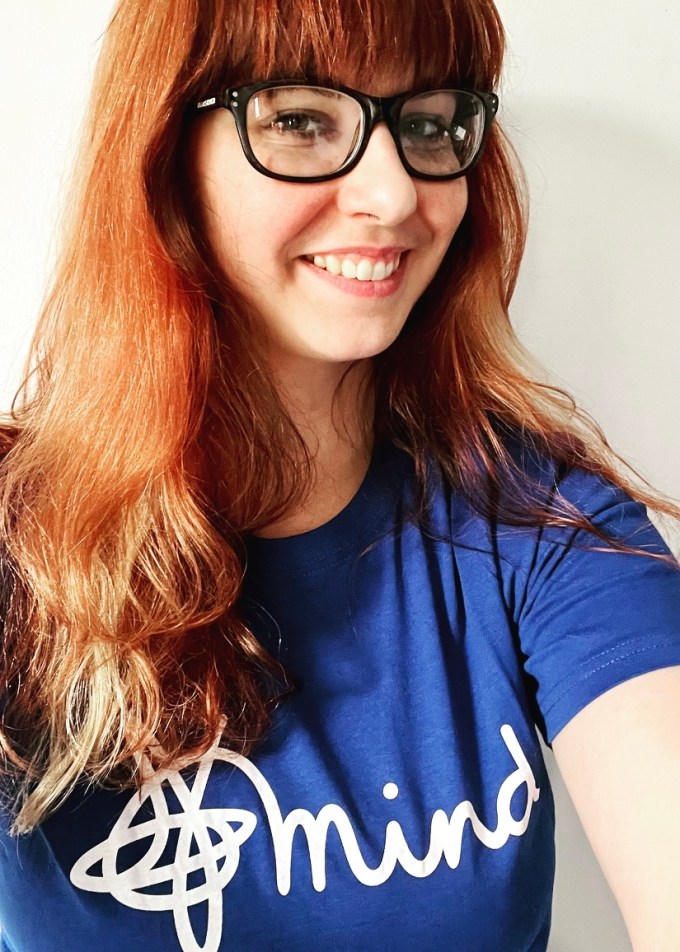
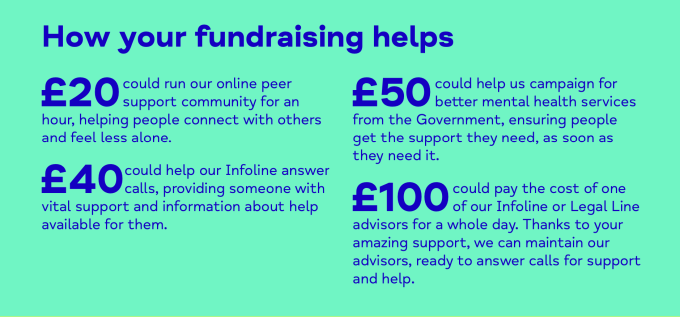
There is still time to donate – the page is here – but at the time of posting this blog, the total raised is £620. That is so incredible to me and I’m so moved by the generosity of human beings and their desire to support each other. Thank you so much to everyone who has donated and to those who weren’t able to but shared the link, helping this fundraiser to reach a wider audience. While I’m sure there are many, many things that this money can go towards, these are some of the ways that the money we’ve raised together will help people…
As I said, I’ve been struggling with awareness days like this one for the last several years, feeling powerless and frustrated. But this year has been different and that’s because of this fundraising challenge. Not only am I proud of completing the physical challenge and blowing the fundraising target out of the water (that pun was originally accidental but it’s too funny to me to take out), I feel like I’ve made a difference. It might be a small one in the grand scheme of things but it’ll be no small thing to the individual(s) Mind is able to help because of this donation. So, with that in mind, Happy World Health Awareness Day. We made a difference.
 Finding Hope