 Finding Hope
Dopamine Land: A Multisensory Experience
Posted on November 11, 2023
Over the summer, I was able to go (twice!) to this cool, immersive exhibition called Dopamine Land: “Dopamine Land is a multisensory experience that combines media, technology and play in one place. It’s an interactive museum made up of colourful installations that channel the limitless imagination of your inner child into reality. Take a break from your everyday life, have some fun, take some photos and boost your happy emotions!” (x) It’s made up of, I think, eleven rooms, each with a different artistic and sensory-stimulating environment inside. Some of them I absolutely loved, some of them I simply enjoyed, and some that I actively struggled with. But I loved the experience, first with my Mum and then with a friend of mine who also has ADHD (something which I do think made it a slightly different experience, although I’m not sure I could clearly explain why).
Before you enter the exhibition, there are two signs on the wall, explaining what dopamine is and how their rooms boost it, which I found super interesting: “Here at Dopamine Land we aim to trigger a gentle release of Dopamine in each of the spaces in different ways as you travel through the gallery. But what is dopamine? Dopamine is a chemical released in the brain that makes you feel. It is responsible for allowing you to feel pleasure, satisfaction, and motivation. A dopamine ‘reward’ can be caused by many pleasant experiences, including eating nice food, feeling loved, winning a game, and earning money, and having the right amount of dopamine is important both for your body and your brain. When you feel good that you have achieved something, it’s because you have a surge of dopamine in the brain.” and “How do the spaces trigger dopamine? There are many different types of triggers for dopamine, across all your senses, and each individual will experience dopamine in different ways. Therefore we have designed the experience to go through a variety of types of spaces, from energetic, to nostalgic, to meditative rooms. You may feel joy in a childhood memory, or from a wonderful aroma. You may experience a warmth from visually satisfying images, or a creative moment may trigger your feel-good hormone. Or perhaps a mesmerising, calming environment is best for you to find your happy place.”
There will be major spoilers in this post so, if you want to go and want to be surprised by the experience, don’t read any further because I will be talking about the different rooms and the fun little details and basically the whole experience. However, if you’re interested, please read on…
The first room (I forgot to take a photo of its name and description) was deeply reminiscent of Yayoi Kusama’s Infinity Rooms, which I always completely adored so I loved that room and just wished I could’ve stayed longer (it was one of the few that had a time limit)…


As I said in my Week In My Life post a few weeks back, I can’t really explain why I love this environment so much. There’s just something about it that makes my brain feel so right and joyful, like a symphony finally in harmony (that metaphor just flowed out as I was writing and it really took me by surprise – it’s a very apt metaphor given that my brain often feels very noisy). It is deeply pleasing on a sensory level in a way that I rarely experience.
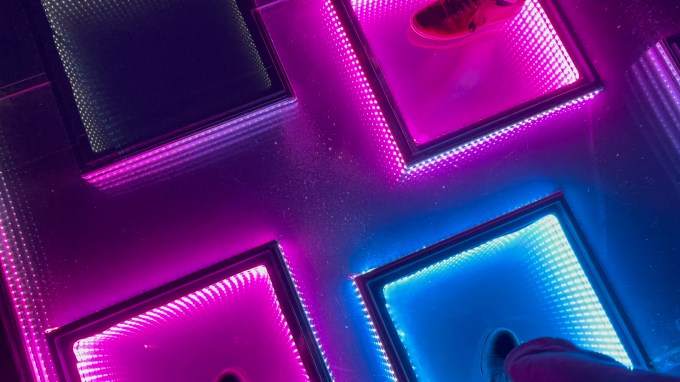
I also forgot to take a photo of the sign outside this room with the name and description of it but I’ll do my best to explain it. There were square panels in the floor throughout the room and when you stepped on one, it changed colour. It’s a bit disconcerting though because they look like there is just endless space below, like you could fall through it and just keep going. My friend and I had a good time though, trying to step on different ones and getting the colours to sync up. Yes, we’re actual children…
Another of my favourites was called Lucid Dreams with a looping video of all these different visual effects with different colours, different sounds, and what looked like different textures. The explanation outside read: “Let your mind immerse you into an infinite dreamscape and allow your imagination to fly free. This space explores the concept of ASMR content (Auto Sensory Meridian Response): something that evokes light and pleasurable tingles, sparkles, fuzziness or waves of relaxation in the neck, spine, and body.” I’ve never been a huge fan of ASMR but I loved this room. It was definitely one of my favourites; I could’ve watched it all day. It was definitely the room I spent the most time in. It was just gorgeous and oddly compelling and as I said when I talked about it before, I didn’t just want to touch it – I wanted to live inside of it. I tried to find out who designed and created it but when I contacted Dopamine Land to ask, they said that they didn’t give out that information. It seems unfair to me, that the artists aren’t getting clear credit for the work that they’ve done.


I honestly couldn’t choose a favourite moment of it; I loved the whole thing.
The Writing Room wasn’t a favourite but I thought it was kind of cool, although I would’ve put it at the end for people to write about their Dopamine Land experiences if they wanted to: “Pause for reflection and give a moment for gratitude. Tell us what makes you full of lust, love, and laughter, tell us what you’re grateful for or what you dream of. Write a note to yourself, recalling a feel-good moment of joy, the warmth of love, or perhaps something a little more primal. Post it to yourself in one of the post boxes, or leave it for others to enjoy.”


These were my messages that I left tucked into various corners.
The next room, Creating Calm, was pretty nostalgic, with fridge magnet words to rearrange and lights for shadow puppets: “Let’s get busy and create something! Brash, bold, thoughtful, creative, artistic, or beautifully silly; all creations welcome here! A creative act can focus the mind due to its calming effects on the brain and body, releasing dopamine, a natural antidepressant. It is also thought that higher dopamine levels drive our motivation to explore and boost creativity. So let’s get making!”

I find shadow puppets all but impossible to do but it was fun to watch other people try and I had fun with the fridge magnet words. I like how, when the word you want isn’t available, you have to take the sentence in a different direction, usually ending up with something you never expected. Sometimes it ends up being nonsense but sometimes it ends up being really cool.
The next room was the ball pit but I forgot to take a picture for the explanation. Having said that, I think it’s safe to say that a ball pit turns everyone into a kid; there’s something very nostalgic about them and I couldn’t help but laugh hysterically as I ended up flailing around like an idiot when I couldn’t get back up again. It wasn’t at the top of my favourites list but there’s something wonderfully childlike about flopping into a big container of plastic balls and burying yourself in them until not even your face is visible; it’s just so joyful.


That one was probably the hardest on my back though, when the pain was bad. The whole thing wasn’t great for my back pain but I was wearing a brace and the support was a life-saver. I wasn’t pain-free but between the brace and my industrial strength painkillers, I was just about coping (a favourite coming up was the perfect antidote to all the standing and throwing myself into the ball pit). As I said, the ball pit was the most painful and I did regret my enthusiasm a little afterwards; the strain it put on my back was just a bit too much.
Another of my absolute favourites was called Fire Lantern: “Give a moment to appreciate those around us, and those who are not, as you bask under our canopy of glimmering light. Dopamine plays a part in encoding and consolidating memories and fire lanterns hold an important role in many cultures social events and festivities, lighting the way for souls of the ancestors. Contemplate the beauty of these mesmeric lanterns and remember fondly those with whom you have parted ways.” I thought that was really beautiful and I was absolutely mesmerised by the space, by staring up at the lanterns as I lay on the big bean bags on the floor. The quiet – just the low voices of the other people talking as they lay on their own bean bags – was really soothing and I honestly could’ve stayed there all day. It would’ve been easily done too because time seemed to move differently in there. I’d love a space like that in my house, just to decompress in. I don’t think that’s gonna happen though.

I was so excited to see it a second time and it was nice to start with but then two different families arrived with their kids, none of whom could’ve been older than ten, and they were running around the room and shouting and dragging the bean bags from place to place and it just completely ruined the gentle atmosphere. It was really disappointing.
The penultimate room, Keep Calm, looked like an abstract forest: “When dopamine is released it can produce a reaction where you feel calm yet also energised. Experience an immersive digital nature; a forest of the surreal! A natural space of great calm and beauty conjured through lights, mirrors, and the scent of natural wood, yet contrasted by hard lines, creating a shifting, shimmering, layered forest.” It was weird but beautiful and reminded me of wandering through the woods as a kid.


It wasn’t at the top of my list but I did really like it; it was very soothing. But then, again during my second visit, the families with kids ruined that. The kids were running around and shrieking and kicking up the wood chips covering the ground, sending them spraying in our direction. It was deeply frustrating, and more so that their parents didn’t seem to care that they were disrupting the experience for everyone else.
The final room, apart from the social space on the way out, was called Pillow Fight! and the explanation outside read: “The penultimate stop on our voyage. Release your inhibitions and dance in the eye of the storm! Euphoria will wash over you as the energy levels are raised. Take the pillows, giggle and release some tension as you return to your childhood, and settle some old scores in a friendly pillow fight.”

(x)
It looked super cool and I liked the idea but the music was so loud – too loud. It was overwhelming. Even the people I went with, neither of whom are autistic, found it unbearably loud. It was just too much so we didn’t linger long in that room either time. That was a shame because it looked amazing and I loved the idea of a pillow fight. But I just couldn’t handle the noise.
The last space was The Bubble Bar where you could get drinks and snacks, named to fit the theme of the exhibition. Around the room, there were little corners with what were essentially cute photo opportunities.


Some of them were fun but we didn’t spend very long there. I can’t speak for anyone else but I was still holding the special moments close and didn’t really want to hang around, letting them dilute in a halfway space before leaving. I understand the appeal of finishing the exhibition with an opportunity to sit and eat and drink but it wasn’t for me.
Apart from the annoying kids during the second visit, both experiences were really cool and I really enjoyed it as an exhibition. So many of the rooms just made my dopamine-deprived brain really happy and that was really special. I think my only qualm was that we don’t get to know who created each room; I’d love to know what they go on to do.
BEHIND THE SONG: ‘Honest’
Posted on November 13, 2020
So today I posted a new video on YouTube, talking about the story behind ‘Honest,’ the long journey from idea to final song, and what it was like working on it with the amazing songwriters that are Lauren Aquilina, Richard Marc, and Jonathan Whiskerd. This is the title track and final single of the Honest EP and is a tribute to the honesty in the four songs that came before, as well as to being authentic and honest, even when it’s really hard.
If you haven’t listened to the song yet, you can find it here and the music video will be out soon! I hope you enjoy the song and I hope it’s interesting to hear some of the behind the scenes of the writing process.
As always, thank you for listening to my songs, watching my videos, and reading my posts. It means more than I can say.
 Finding Hope