 Finding Hope
Grateful 2025
Posted on January 1, 2026
TW: pet loss, pet death, depression.
I had hoped to get this up on Christmas Eve – like I used to – but given everything that’s been going on with my mental and physical health and the resulting fatigue, I’m not writing as quickly or as effortlessly as I have done in the past. But fast or slow, writing down my thoughts helps me to reflect and, considering how extreme the highs and lows of this year have been, some reflection – especially on the good things in my life – has helped me to feel more grounded as the year ends.
MY MUM – I’m always grateful for my Mum but I couldn’t have imagined the ups and downs of this year if I’d tried and I absolutely couldn’t have gotten through them without her. Between Daisy (my Autism Assistance Dog) moving in and getting settled, the difficulties and stress surrounding releasing new music, music and conference commitments, chronic pain and illness flare ups, a pinched nerve, a hospital visit, and a debilitating mystery illness (which, thankfully, has now been demystified and I’m starting to recover from), she has been an anchor, a touchstone, and a source of endless support. And considering the busy year she’s had, I’m so beyond grateful that I don’t know how to fully express it. I just know that there’s no way I could’ve survived this year without her.
MY PARENTS – With everything going on this year, I’m so grateful to have had the support and encouragement of my parents. Everyone’s had a lot to deal with – it’s certainly not been the easiest twelve months – but they’ve still been there for celebration and every challenge that this year has brought. They’ve been so supportive of everything I’ve taken on this year – and not just mine: they’ve been champions of my friends and their projects too, which I couldn’t love them more for.
THE TIME I HAD WITH LUCY – I still feel so deeply sad and the house feels so lonely without Lucy but I would never give up the time I had with Lucy; I will always be grateful for every moment I had with her, even at the end when it was so distressing – for all of us. She was with me through so much hard stuff, through so much growing up, and coming home to her was always so comforting. She was so special – so sweet and affectionate and sensitive – and she’ll always have a special place in my heart; I’ll always love her more than I can properly explain. Nothing I say feels like it’s enough. I miss her more than I know what to do with and I still feel more than a bit lost and untethered without her at the centre of the house.
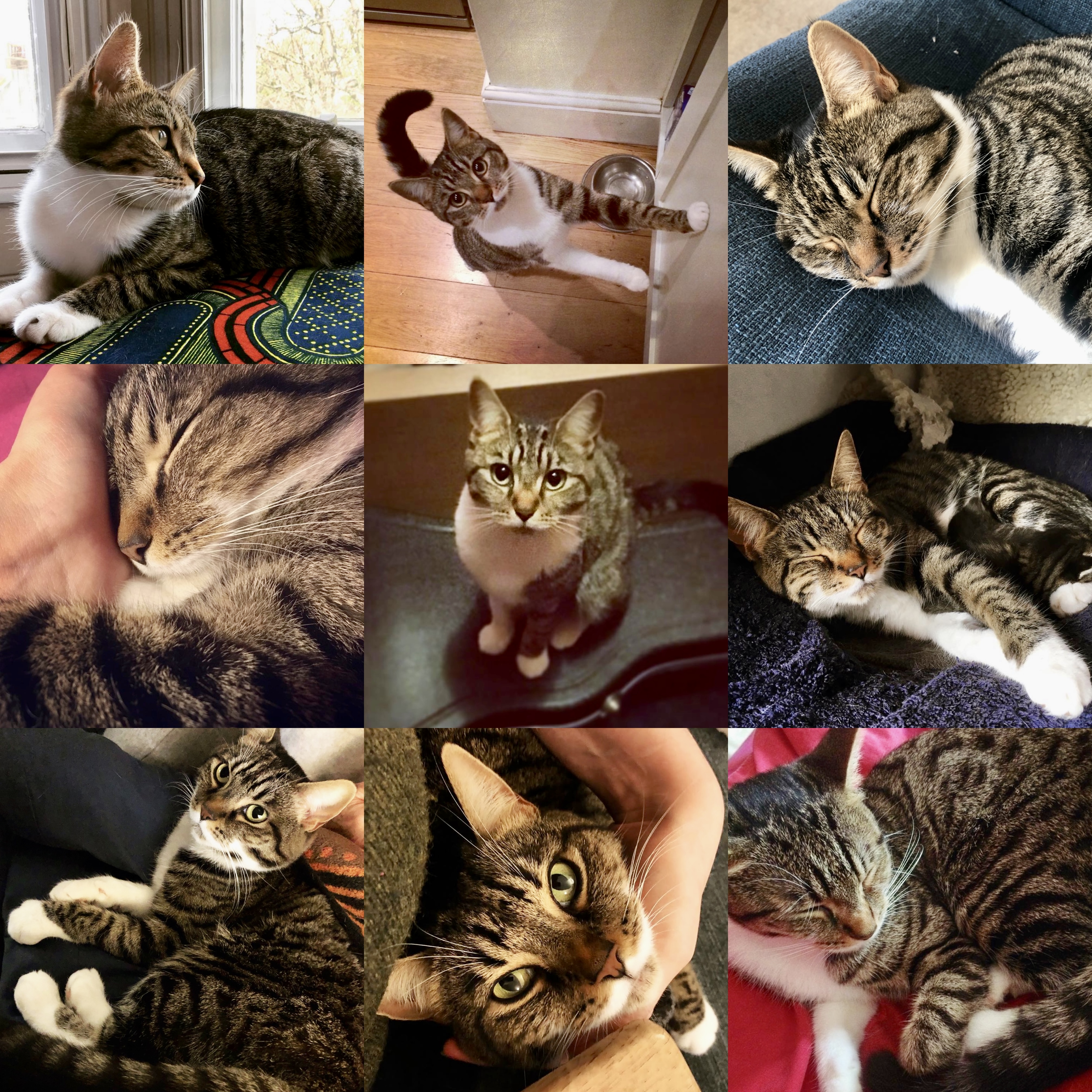
THE FAMILY OF CATS – Between the arrival of Daisy early in the year, the loss of Lucy, my health issues, and the summer months when they’re almost entirely in the garden, home has felt very much in flux and I haven’t seen as much of my little family of cats as I would’ve liked and that’s been really hard. It was also incredibly scary to find out that Sweep, one of the youngest generation, suddenly needed a really big surgery, especially so soon after Lucy had had to be put to sleep. But fortunately, it went really well and she recovered beautifully, if impatiently. Things are getting better: they’ve migrated back inside with the colder weather and they’re slowly becoming braver – or at least less likely to run – around Daisy. It’s not that she’s a danger to them in any way, she’s just deeply enthusiastic and bouncy, the unpredictability of which they are not fans of (plus she must seem huge to them, while Izzy has always been even smaller than they are). They’re getting used to her and she’s getting better about not bounding up to them every time she sees them. It’s been a big change for everyone and I’m honestly just so grateful that, even with Daisy’s arrival, they’ve never doubted where their home is. I’m so, so grateful for the time I have had with each of them this year – I don’t take a second of it for granted – and I’m hopeful that things will only improve and become more stable going forward.
IZZY – I’m so grateful to have this fluffy, little sock thief in my life. She’s a constant source of love and joy and hilarity. If she could, she’d spend every hour of the day in my lap and I can’t say I’d complain; she spends almost all day curled up against me on the sofa and then all night curled up against me on my bed. She’s so adorable, so sensitive and snuggly, and she’s so funny and playful. She has struggled a bit since Daisy moved in: she doesn’t like having to share me. She gets jealous of how Daisy supports me and tries to take over, tries to prove that she can do it just as well as Daisy can and, to her, Daisy is big and enthusiastic and unpredictable (and Izzy’s face is right at the height of Daisy’s furiously wagging tail, which has caused more than a few incidents between them). They’re getting there and, thankfully, Daisy is very patient with her; I couldn’t bear it if they were just fundamentally incompatible. My relationship with Izzy is so deeply special, both because of how it began and what it’s grown into, and she’s a constant comforting presence that I’m beyond grateful for.
DAISY, MY AUTISM ASSISTANCE DOG – At the beginning of the year, Daisy officially moved in and, a few months later, she was fully qualified as my Autism Assistance Dog. I’ve posted about almost all of the training process but I really need to write something about what it’s been like since she was qualified; I don’t think this post is the place to reflect on all of that because I have so many thoughts on it but this post would’ve been incomplete without her. It’s safe to say that it’s been a massive change and, as someone who’s not very good at change, it has been a hard year with a lot of anxiety. It takes time, after all, for any dog to settle into a new home, as does getting an Assistance Dog used to more and more situations and environments. She’s been doing so well and I don’t think I’ve been doing too badly either but it’s been slow going, especially as it’s been complicated by a chronic pain flare up, a pinched nerve, and months of stomach issues. So we haven’t done as much as I would’ve liked but I’m really proud of everything we’ve managed so far. Her relationships with Izzy and with the cats are still developing and their interactions don’t always go smoothly but they have and are making progress. It’s easy to spiral about them never truly getting on but I have to trust the progress they’ve made so far and that they can make more. She’s an amazing dog: sweet, smart, eager to please, always up to play or snuggle… She has such a gorgeous face and she gets so excited whenever I pick up her jacket: she’s so excited to do her job, which is just adorable and always makes me feel calmer about going out with her. It’s a long process, getting confident working as a team, but every step has been in the right direction and I’m really grateful for that. I’m also really grateful for the ongoing support from Autism Dogs. I wouldn’t have Daisy at all without them, of course, but their support this year – from accommodating me during the the final stages of Daisy’s training to the regular check ins – has been amazing and so appreciated. It’s been a huge undertaking, especially as a chronically ill and disabled person, but they’ve been so helpful and so encouraging. I’m not sure we could’ve done this without their consistent support.


(Left: Izzy // Right: Daisy, my Autism Assistance Dog)
MY THERAPIST – Having abandoned talk therapy and started somatic therapy for trauma release in 2024, this was the year that I really committed everything to it and although I’m not sure I can fully explain it, I can say that it has had a huge impact on my life. Without a doubt. I learned a lot in talk therapy but I think it can only do so much when it comes to neurodivergence and trauma (although that’s just my opinion based on my experience) and somatic therapy takes a very different approach. I’ve been working with my therapist on learning to regulate my nervous system and helping my brain and body to reconnect so that my brain is able to recognise the trauma that my body is holding onto and then strengthening it so that I can go on to process that trauma as my brain and body feel able to. For a long time, I’ve struggled to fully feel my feelings, like I can only feel so much before they get shut down and, over the last six months, that’s started to change, which is both amazing and kind of terrifying. There is a reason we shut down these feelings after all. But my therapist is brilliant. Right from the beginning, we’ve gotten along really well and I so appreciate how she’s adopted my special interests to help me make sense of aspects of somatic therapy and how to get the most out of it; she always meets me where I am and I’ve never felt alone in the process. Because somatic therapy focusses much more heavily on feeling (while talk therapy – in my experience, at least – focusses much more on thinking and reasoning), I feel like I often go into it very much on trust: I might not fully understand or feel whatever it is we’re working on in that moment or in that session but I trust my therapist and I trust her confidence in the process. It’s hard to define the progress I’ve made – trauma and safety and emotions aren’t easily measurable – but I know it’s there. I’m learning a lot and my body’s learning a lot and I know that, in time, I’ll see the proof of all of this learning.
MY FIRST HYDROTHERAPY POOL AND FINALLY GETTING BACK TO THE POOL – Early in the year, the gorgeous pool that I’ve been using to do my hydrotherapy since 2021 closed, much to my distress. Not only did it fit all of my needs and allow me to do my exercises without an audience, it was an important fixture when my mental health was particularly bad (from late 2021 to late 2022). I was very attached. I’m so grateful for the time I had there: I needed a safe space, physically and emotionally, to start building my strength back up and I couldn’t have asked for anywhere better. Finding a new pool has been really difficult but I have recently started going to a new one; it’s not the same but it has different advantages and it does allow me to get back to working in the pool, which I am very grateful for. The transition is hard but I’ve never been particularly good at change. It will just take time; it always does.
THE TATTOOS I GOT THIS YEAR – Spending less time in the pool meant that getting more tattoos wasn’t as logistically complicated as it had been previously and over the last twelve months, I’ve managed to get several new ones, including my tangle for the ten year anniversary of my Autism diagnosis and a tribute to my beloved Lucy. I had hoped to get more but with four months of the year getting swallowed up by a pinched nerve and a mystery illness, just getting out of the house has been a challenge, let alone going to a tattoo studio and sitting through a session (having said that, I do actually find being tattooed more relaxing than painful – so far at least). I’m pretty sure they weren’t necessarily the ones I thought I’d be getting when I imagined this year but I’m certainly not complaining! I love them all and I’m looking forward to getting more whenever the opportunity presents itself.


(Left: Two dragons by @valeries.tattoo // Right: Tangle by @gaiahart)
POETRY ORCHARD – I touched on this in last year’s Grateful post but, at the beginning of 2024, I joined an online poetry community called Poetry Orchard and it was, without doubt, one of the best decisions I’ve ever made. I’ve written so much poetry that I’m so proud of since I started going to their workshops, which are always fun and cathartic and inspiring; they’re always a highlight in my week. And I’ve met so many amazing people in this community: they’re all so lovely and thoughtful and such brilliant writers. There’s not one among them that shouldn’t be a published poet. We have the most interesting, moving discussions and I feel so seen and so understood (there’s a lot of overlapping experiences with mental health, neurodivergence, disability, chronic illness, and so on). I feel so lucky to have found this space and the friendships that have grown from it are so special to me.
MY FRIENDS – I’m so, so grateful for my friends, from the steadiness of my oldest friendships to the blossoming of the newer ones. Between working with Daisy and releasing new music in the first half of the year and my chronic pain and illness during the second half, I haven’t seen nearly enough of them but they’ve still been so supportive of me, of my music, as I’ve struggled with my health stuff… I feel so lucky to have such wonderful, kind, creative, and passionate people in my life; I’m inspired by them everyday and it’s an honour to play even the tiniest role in the incredible work they’re doing and putting out into the world, even if all I am is a witness and cheerleader. I see them changing the world, person by person, and I can’t be anything but thankful for the path that led me to each and every one of them.
RELEASING MUSIC AGAIN – This year, I finally, FINALLY, released new music and, not only that, but I released my beloved Autism centric project, Too Much And Not Enough, Vol. 1. I started working on this in 2021 but I’ve been thinking about it for even longer and now it’s finally out in the world and people are actually listening to it! I’ve had some amazing feedback on it and some of the stories people have shared with me upon hearing it have been so incredibly touching. I’m so grateful to everyone who has listened to it so far and I am so beyond grateful to everyone who helped me to make it what it is and then get it out in the world. Working with you all was an absolute joy and I could not have done this without you. It may have been the most stressful experience of my life but I have never been so proud of anything and I can’t wait to share what I have planned for 2026.

(Write This Out – Single, In The Mourning – Single, The Loneliest Whale – Single, Too Close And Not Enough, Vol. 1 – EP (top to bottom, left to right))
SO MANY GREAT SHOWS – Concert wise, I thought last year was probably unbeatable with so many incredible concerts – from the super special album release shows of my friends to the almost-four-hour-long epic that was Taylor Swift’s The Eras Tour – but this year was also deeply special in its own way. Several of my friends released new music and I got to see them perform those songs live at the launch parties. Cora Rebel released her second EP, Small Town Murder, which I love even more than her first EP, Room For Wonder. I’m not kidding: I’m still obsessed with every single song. Similarly, I’ve been a fan of Jaz Beeson’s music since we met at university and the EP she released this year, Aren’t You Cool, is so good and her live performance has only gotten better since I last saw her and her band perform. I also made friends with the wonderful Tygermylk this year and when they released their debut album, Local Girl, Always Tired, I got to see them play the whole album live in a beautiful church in London; it was such a special event. I feel so lucky to have so many creative friends putting such awesome work out in the world and I’m so excited for what I know is coming in the new year. I also got to see Maisie Peters at one of her two Before The Bloom shows, where she gave us a sneak peak at her new album while revisiting past songs that she felt reflected the same energy as the new music, which I thought was a really cool way of structuring a gig; I got to see Maren Morris blow the roof off The Roundhouse with one of my greatest friends (we’ve been going to her shows together since The Hero Tour in 2017); and Gracie Abrams just blew me away on The Secret of Us Tour to the degree that I bought a ticket to a second show because she was so good. And I can’t talk about amazing gigs without talking about Erin LeCount (although I want to talk about her more in a minute). I saw her first in May where she headlined Bush Hall in London and she was amazing. I wasn’t able to see her the next time she was in London (because the accessibility team at the venue were actually the worst I’ve ever encountered) but when I saw her in December when she sold out KOKO in London, she was absolutely incredible: she only released her second EP in April and she’s already such a compelling performer. That second show was one of the best I’ve ever been to and I was so moved when she played my favourite songs that I cried (something I’m rarely able to do in public after years of masking). It was a deeply special year of concerts, just like 2024 but in a very different way. I’m grateful for every single one.


(Left: Sarah Close, Cora Rebel, Gracie Abrams, Erin LeCount (clockwise) // Middle: Gracie Abrams, crybby, Maisie Peters, Jaz Beeson (clockwise) // Right: Maren Morris, Tygermylk, Erin LeCount, Erin LeCount (clockwise))
And while it wasn’t a show, I did get to go and fangirl my little heart out at Ascension, a new Stargate convention. I got to see so many of my friends from The Companion, which was so much fun and although Amanda Tapping, one of my biggest heroes, had to pull out of the event, I got to meet Richard Dean Anderson who is the most wonderful human being and it was such a special experience. And he’s such a dog person so he and Daisy had some absolutely gorgeous moments together. It was Daisy’s biggest outing so far but she did brilliantly and was absolutely adored by everyone from the moment I took her jacket off to the moment I put it back on again – everyone was so respectful when she was working, which made the experience so much easier for the both of us, and it was so lovely to see how happy she made all of the guests and attendees, especially when she was off duty and was allowed to interact with everyone. Richard Dean Anderson called her his favourite convention attendee, which still makes me smile so much. I can’t wait for Ascension 2 in 2026!
ERIN LECOUNT’S MUSIC – I found Erin LeCount in late 2024 and her music completely dominated my listening time over the last year. She put out her second EP, I Am Digital, I Am Divine, in April, which is a stunning, beautifully cohesive project: the concept, the themes, the lyrics, the vocals, the melodies, the production… they’re all incredible. When she released the EP, she described it as being “about feeling dysfunctional and like there is something inherently wrong with you, the ‘digital’ being this neurotic, obsessive, ‘cold’ and very analytical part of me that felt like a battling a part of me that’s very sensitive, the ‘divine’ and the big overwhelming feelings. They’re two sides of the same coin that I’m always finding how to balance, and these songs are all those many imbalances and highs and lows.” I relate to that statement so much and I relate to every song, although my favourites are ‘Marble Arch,’ ‘Sweet Fruit,’ and ‘Silver Spoon’ (I’ve written more about the individual songs in my upcoming Songs of 2025 post so I won’t double up by deep diving into them here), with lyrics like “I am hard to love / Not what you thought / Am I? Am I? Am I? / Is there a fault in my core? / Did I do something wrong? / Did I? Did I? Did I?” and “I need someone / To look through and see me, to rip out the weeds / Growing where my heart was” and “I split the good wine, I panicked / A disaster, a knee-jerk reaction / Then everyone around us starts laughing / Is that how it’s meant to happen?” and “You were sweet, I got mean / And when we fight, I refuse to eat.” She’s since released two more songs, ‘808 HYMN‘ and ‘MACHINE GHOST,’ both of which I love but ‘MACHINE GHOST’ instantly became my favourite song of this year and probably for a long time to come; I feel the theme of dissociation so deeply (especially as I do more and more somatic work and the connection between my brain and body gets stronger – I actually listen to this song during therapy because my therapist says my body is more receptive to releasing trauma compared to when I’m not listening to it) and the lyrics, like “It hurts to stand, it hurts to stand / It hurts to stand, it hurts to stand,” and “Lights come on and there’s nobody home / And all my love pushed my back against the wall / Can someone tell god I should be feeling this more? / I can’t love you like I am supposed to / Baby, you’re the machine and I’m the ghost,” and “‘Cause everything starts hurting when I see the world in colour / And I wanna turn it off,” and “I’m not at the party and I’m not in my body,” feel like they could’ve been written for me. I feel so seen and so validated by her music and watching her produce all of her music and then recreate some of these tracks live on stage is so inspiring to me, so much so that I’ve started learning more about production for my own creative process when making music. I’ve already talked about seeing her live and how special that has been, her recent show at KOKO being one of the best shows I’ve ever been to. I wish I’d found her sooner but I’m so grateful that I found her when I did because her music means so much to me and watching her creative process and live performance develop in real time is so, so beautiful.
There has been so much to be thankful for, despite how difficult this year has been. In my experience, the relationship between gratitude and depression can be a complicated one, given how depression distorts reality and dampens emotions, and it’s something I’ve been struggling with for several years now. Sometimes engaging with that tug of war is just too hard, especially when I’m already working so hard in therapy, so the only thing I can do is acknowledge that it’s there – that it is complicated – while honouring the things in my life that are objectively positive, the things that make my life better. Sometimes that’s all you can do and that’s got to be enough.
Parenting A Young Adult With Autism Spectrum Disorder: My Mum Interviews Me
Posted on April 1, 2021
When my Mum was answering my questions in the previous post, she was inspired and suggested she interview me in return, with similar questions. I was up for that so here goes: this is the mother of a young adult with Autism Spectrum Disorder interviewing her daughter with said Autism Spectrum Disorder…
Briefly, what has it been like for you to get a late diagnosis?
In some ways, it was such a relief. I’d been struggling for such a long time and not having a name or label caused me a lot of anxiety and made it difficult to get any support. So in that sense, it was great. It obviously hasn’t changed the fact that I struggle but I have more confidence – it had been going on for so long and had become so complex that I did worry I was making it up and actually causing my problems – and the support allows me to work on the areas I struggle with, managing them, decreasing the intensity, and creating solutions.
But I don’t want to imply that it’s been a hundred percent straightforward because it hasn’t. For twenty years, I operated under the assumption and expectations (from myself and others) that I was neurotypical and would go on to have a neurotypical life, meeting the usual milestones. I’d always held myself to a high standard and that wasn’t really a problem until I was finishing school: learning was something I was comfortable with and excelled at and my social issues were just assumed to be shyness. But then life started to get harder, with bigger and more serious demands, and I struggled more and more but still held myself to the same high standard. I still do. It’s very deeply ingrained. So it’s really, really hard to accept that my life is never going to look like what I expected or like the lives of my peers.
Having discussed how I’ve been your advocate at various times and in various situations, where did that need come from? How has that made you feel both pre and post diagnosis? Are there particular times where it has felt more necessary than others?
I’ve definitely lost count of how many appointments we had with various people where I would explain what I was going through and how much I was struggling only to be told things like, “All teenagers struggle,” and “Well, you’re showered and dressed so you’re clearly coping.” There’s so much I could say about those experiences alone but after a while, those appointments made me so anxious that I just couldn’t talk. At all. I needed someone who could tell my story for me when I wasn’t able to and since we had (and do) talk about everything, you were always able to give all of the information and spare me at least some of the anxiety involved in those appointments. Pre-diagnosis, you were the only one a hundred percent behind me and I honestly don’t know what I would’ve done without that. Best case scenario, I don’t think I would’ve gotten my diagnoses and the worst case scenario doesn’t bear thinking about. If I hadn’t had you in my corner, researching and reaching out and pushing for answers, I certainly wouldn’t have gotten this far. Post-diagnosis and in the time since, I think I’ve grown in confidence and have needed it less but there are still times that I’ve, at the very least, needed back up. There are many situations that I do now feel able to manage myself but in times of great stress or anxiety, having someone on my side, someone ready to step up and take over when I get overwhelmed or it all becomes too much, is just so important in moving life forward. I like to think that I get a bit further every time before needing you to take over but I am also aware that I may never be able to completely handle these kinds of situations when under great stress.
Having answered this question from my perspective, what about you? What would you would consider to be the positives and negatives of having Autism Spectrum Disorder?
I think I’ll start with the negatives first. That’s not a particularly optimistic start but the negatives do, at this point in time, feel more overwhelming and painful. The high levels of anxiety and overwhelming intensity of my emotions can make it really difficult to function day-to-day, plus both are incredibly exhausting. All of that is really hard. I also often feel very different from – and behind – my peers, which can feel extremely distressing. Not really in a competitive sense but because I really want to experience all the things they get to experience and often take for granted, knowing that I may never get to have those experiences.
Onto the positive things… Admittedly this perspective is harder because I am in a period of feeling that my ASD takes more from me than it gives back. Hopefully one day I won’t feel this way. But for now, positives… Although the strength of my emotions can be overwhelming, I definitely prefer it to the idea of ambivalence or apathy. And while the negative emotions are awful, the positive ones are like nothing else in life. I imagine it’s like going from grainy black and white to high definition colour: when I’m happy or passionate or excited, I feel like I’m glowing brighter than the sun. I don’t know if that makes sense but it’s how it feels. I can also get completely immersed myself in something: it doesn’t even feel like I’m focussing because I don’t feel like I’m in control, but I think people would call it deep focus. I can work on something for hours and fours. For example, I once started working on a song at eight in the morning and when I next looked up, it was dark and my hands were shaking because I hadn’t eaten for over fourteen hours. I hadn’t even noticed the time passing. And I guess another positive is how seriously I take things – my relationships, my commitments, my words, and so on. Nothing is flippant to me. I mean, I can be funny and silly but I take life seriously. Everything that I invest myself in matters so deeply to me and I never want to give anything less than my best. All of these things do have negative side effects if they go too far – which they often do – but overall, I consider them to be positives.
How do you think things would’ve been different if your ASD had been recognised when you were younger?
I mean, who knows? I don’t think we can ever really know the answers to questions like these, although I’m fascinated by the ways life might’ve turned out had this happened or that not happened. I’m not sure, to be honest; there would obviously be so many differences. But the biggest one that sticks out for me is that I wouldn’t feel so stuck between a neurotypical world and an autistic world, especially identity wise. I often feel like I have two sides to myself constantly pushing against one another and like I’m trying to find a place in the world where I don’t just have to be one part of myself, where I can be all of myself. I mean, I know everyone’s trying to find their place in the world and that most people don’t often get to be their whole selves but I feel very conscious of the two worlds that I don’t quite fit into and end up feeling like I don’t fit anywhere. So I think the obvious thing for me would be that I think my identity wouldn’t feel so fractured because growing up knowing I was autistic would’ve meant that my personality and my identity evolved with that already present, rather than trying to fit everything together later on, if that makes sense.
How do you feel about taking various medications and going to different forms of therapy for years now? How do you think those have affected you?
It’s an ongoing, exhausting part of my life and I do sometimes wonder whether any of it has made any difference. But then I think about it properly and despite all the awful medication experiences, there have been some really great ones: I wouldn’t have made it through my BA without the Phenelzine, wouldn’t have made it this far through my MA without it. And sometimes it feels like therapy only uncovers more problems but then I remember how many empowering conversations I’ve had with my therapist, how many strategies I’ve learned to help me manage not only my struggles but my life in general. There have been more ups and downs than I can count but I honestly don’t know where I’d be without them.
What do you think the hardest part of living with ASD is?
This is a really difficult question to answer. Part of me wants to answer with ‘living with ASD’ but that’s not helpful. There are so many things I could say: the anxiety; the fatigue; feeling like I blend in enough to fit in casually but feel too different to fit in on a deeper level; my limited ability to be independent; sensory sensitivities… The list goes on. But I think, overall, the hardest part is feeling like the life I want to have is never going to be possible for me and I don’t mean in the being-a-musician-is-a-risky-career-path way; I mean that, as an autistic person, I will not be able to do the things required of me to do music. It’s a terrifying prospect because I cannot imagine my life without music at the forefront. There seems no point to living otherwise. I know that sounds overdramatic but given the intense emotions I experience as part of being autistic, that is just how I feel. To an overwhelming degree.
How do you feel your life as an autistic person is different to those of your neurotypical peers?
I can absolutely recognise that we do go through a lot of the same things, albeit often in different ways and according to different time frames. But then there are definitely significant differences between my life and the lives of most of the neurotypical people around me. I feel like my life is smaller, limited. I’m sensitive to food, loud noise, large groups of people, and I struggle with low energy levels, which all make it difficult to keep up socially, so I often feel like I’m on the outside. I also find myself constantly comparing my level of independence to that of my friends: so many of them – if not all of them – have moved out (even if they’ve moved home during the pandemic), lived with friends or alone, have jobs, operate as independent adults. And I’m just not able to do that. Every day, I have to ration my energy down to the smallest sliver and it’s just not physically possible for me to do any of those things with the amount of energy I have to allocate out to all the tasks required in a day. And that’s as things are now, living at home, let alone if I was living alone and taking care of myself without any help. These things are some really big issues for me and I do find that I isolate myself sometimes so that I’m not being constantly reminded of them.
Are your relationships with your neurotypical friends different to your relationships with your autistic friends?
I think there probably are – to a certain degree, at least – but for the most part, I think it’s not that different to how we relate to each different social group we interact in. We connect with different people for different reasons so while the underlying connection to my university friends is music, the underlying connection to my autistic friends is based on our shared experiences as autistic women. But all of those connections are strengthened by other things, other commonalities and time spent together. So while I initially connected to my autistic friends because we are all autistic – and those similar emotions and experiences and struggles are an important part of our relationship because we can connect to and support each other in a very specific way – our friendship has grown a lot from there, just as every friendship grows.
How do you feel parents can be most supportive to a young adult with ASD?
I have a couple of things I’d like to include here, things that have been invaluable to me over the years:
- Really listen to what your child, teenager, or young adult is saying and I mean really listen and take seriously what they’re saying.
- Support them in the areas they struggle with as best you can without judgement or criticism. Chances are they don’t understand why they find it so hard either. You can do this by encouraging them to be honest about what they’re feeling, researching the particular issue (noise sensitivity, for example), and speaking to specialists. There are also therapies you can then pursue if you both/all feel it’s necessary or would be helpful.
- It’s good to have someone to push you to help you work through your struggles, particularly someone who loves you and only wants to see you succeed, but it’s also important as the parent to recognise when the child, teenager, or young adult is reaching their limits and that they need to take a break. Respect those limits and celebrate each victory.
- Advocate for them when necessary, with no judgement as to why they need you to in that moment.
So there we go. If you guys have any other questions for me or my Mum about living with and managing my ASD and mental health problems, please get in contact and we can always do another of these posts. I hope it was helpful!
The End of an Era
Posted on November 5, 2017
I did it. I graduated.
The last three years have been a whirlwind. As I said in my Instagram post on Thursday, “my degree was an endless mix of inspiring, exhausting, frustrating, ridiculous, exciting, stressful, and joyful.” That’s the short version. The long version is very long. I dealt with a lot of grief and disappointment. I struggled with my mental health, discovered I was Autistic, and started to untangle all the threads that come from that. And that’s outside of university. At uni, I wrote hundreds of songs, met some amazing people, got the opportunity to go to Nashville, and ultimately, became a better songwriter. There were classes I loved and classes I hated. It was a constant battle to keep the lid on my anxiety and sometimes I failed. But I wouldn’t change it. My experience is coloured massively by how good my third and last year was. There were moments where I hated it, where it made me incredibly anxious, where I had meltdowns so bad I thought I’d never recover. There were moments I thought I’d never get through, that I couldn’t do what I was being asked to do. But somehow I did. Somehow I’m here, with a first and two graduation ceremonies under my belt.
The first graduation was for UEL, The University of East London. My school, The Institute of Contemporary Musical Performance, is a specialist music college and while it operates independently, it’s officially part of UEL. So we were invited to one of their graduation ceremonies. My Mum and my Granny came to this one. It was very formal – it was caps and gowns. That was something I was looking forward to and something I was very let down by. I’d thought it would be fun but it became a very stressful experience. Maybe it didn’t fit properly, maybe that’s just how it is but my cape kept sliding back and strangling me and my cap kept falling off my head. It took seven bobby pins to keep it on my head. As someone who struggles with sensory stuff, which includes the way clothes feel, that was really hard and really ratcheted up my anxiety. Fortunately, spending time with my friends, messing around and laughing, helped to keep it at a bearable level.
The ceremony itself was a bit strange. Because I only went to UEL once, it kind of felt like I was intruding, like I didn’t belong there. All the talk of the ‘UEL community’ made me feel a bit disconnected from the whole thing but the speakers were very good. I’d like to share something Geoff Thompson, the chair of the governors, said in his speech: “You are strong. Don’t ever, ever forget that you are strong… Never, never, never, never, never, NEVER give up on your dreams. It is not an option. It is not a choice.” You know, that was just what I needed to hear, just as I’m leaving university and heading out into an uncertain world. It was inspiring. It was empowering.
And all of a sudden, we were lining up to walk across the stage to shake the chancellor’s hand. It was weird: I had tunnel vision. No one could have applauded me as I walked across the stage and I wouldn’t have noticed. I was completely focussed on walking towards the chancellor, shaking his hand, and walking down the steps. It’s funny how something that you usually don’t have to think about – like walking – suddenly seems to take a lot of effort. But I did it, I got back to my seat, and I cheered for my friends. We threw our caps and then it was over. Graduation one was done. I’d thought I’d stay for a drink with my coursemates but after all the anxiety, I was completely exhausted. So I (eagerly) returned my gown and headed home.


The second graduation was a couple of days later and much more fun. This was just our school so it felt a lot more personal. Even though I don’t have many friends outside my course, I recognised a lot of faces from the other courses and we’d all shared the same space. We’re all connected by that. We didn’t have to wear gowns but it was still formal. Everybody looked gorgeous; it was really fun to see everyone dressed up. All four of my parents came to this one, which was amazing. I’ve never had all of them at a school thing before so that made me very happy. I was positively giddy.

I really enjoyed the ceremony. The head of each course made a speech and then presented each of their students with the scroll. My favourite speech came from my programme leader, Jonathan. It was thoughtful and warm and inspiring. He even gave this blog a shout out, along with two other projects my friends have worked on. It was a very special moment. Another special moment was watching one of my best friends receive her scroll while her own song played. That was awesome.
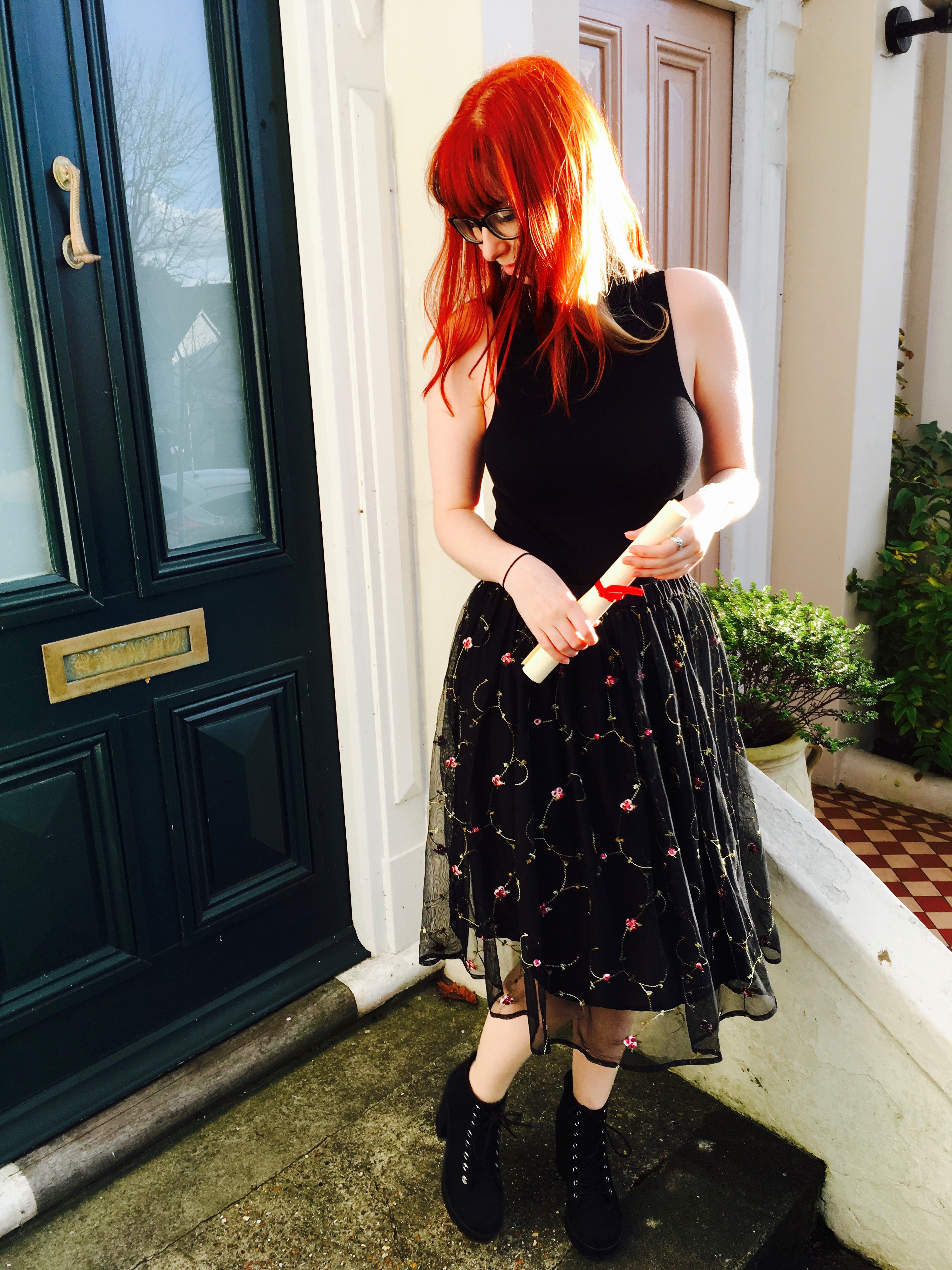
And suddenly, it was my turn and I was walking across the stage, giving Jonathan a hug, and accepting my scroll. We posed for the photo and then I was moving again. I was a bit more aware of what was going on this time. The UEL one was a good rehearsal in that regard. There wasn’t an opportunity to thank my parents so I made the best of what I had. I located them in the crowd and did this:


It was important to me to do that.
Everyone received their scrolls and then we gathered for the reception. It was lovely to celebrate with everyone, to catch up, to introduce my parents to all these people who have played such an important part of my life in the last three years.
And that was graduation. The only other thing to add is that, to celebrate, we headed out for drinks. It was my first experience being in a club and my first experience drinking cocktails, neither of which I would say I enjoyed but it felt very empowering to try those new things and not feel trapped by my anxiety. Major thanks to my friends for looking after me and making it such a positive experience.
I will write more about my experience at university at some point but it’s a pretty big task. I need to go through my diaries and pull together some stuff before I can write an accurate account of that time but I will manage it at some point. It was a crucial time in my life. It’s a big part of who I am.
 Finding Hope