 Finding Hope
My DSA Assessment
Posted on January 11, 2020
So, for those of you who don’t know, DSA stands for Disabled Student Allowance, something you can apply for as a disabled student to help you get support during your university experience. They can help you with technical support, in uni support like 1-to-1 sessions, and so on. You apply for an assessment and then, if you get one, you talk with the assessor about the support you need, discuss what DSA can provide you with, and then they make a recommendation.
I had an assessment during my undergrad degree and they were really good. They provided me with a load of useful tech, including a macbook, a handheld recorder, and several pieces of software to make doing my work easier. I was (and still am) really grateful, even though the laptop’s memory isn’t actually big enough to run all of the software. It was still a laptop and a much lighter one than the one I had, which made commuting a lot easier – I was coming home with bruises from the bag I was carrying because it was so heavy.
The at uni support was less helpful. The first person I saw acted like a therapist (which I’m not sure she was supposed to be doing) and I already had a therapist so that wasn’t helpful. I spent the hour answering questions about my mental health and my Autism that I’ve answered a hundred times before. So I didn’t continue with that. And the second person upset me so much that I left before the session finished.
So it was a mixed experience but I’m endlessly grateful for the laptop because the old one was causing me serious problems.
I had to redo the application process for my Masters as what they offer is different and today I finally had my assessment – between the disability coordinator being very unhelpful (an understatement) and the semester being incredibly stressful, we’d just kept postponing it. It was too much to manage. But recently we finally managed it and it was a complete nightmare.
The guy was nice and we discussed everything – the problems with the disability coordinator, my first semester, my general experience of life, what would make university easier – but when it came to talking about what support was possible, it was very disappointing and upsetting.
Technology wise:
- They will offer me a Windows laptop (which I would have to part pay for) but I can only run the software I need on an Apple computer.
- They will not offer me a (lighter) Apple computer.
This is despite the fact that I need a light laptop, due to the chronic fatigue and pain I struggle with and an Apple one to run the software I need for the course. But apparently this is because these are ‘course specific’ needs rather than disability needs, yet I – a disabled student – can’t do my course without them.
Travel wise:
- They will not cover or contribute to the train tickets to London.
- They will cover cabs to the station.
This is because, apparently, I choose to live at home rather than living in London like most students studying in London despite the fact that I am unable to live alone and look after myself because of my disabilities. Apparently, this would give me an advantage above other students, which is bullshit because in reality, it would simply put me on a level playing field because I am disadvantaged by my disability. And the amount of effort that would go in to justifying each cab trip to Student Finance when Mum usually takes me (because they won’t simply give you an allowance for it) would take more effort and energy than I have to spare on something used so rarely.
And uni support wise:
- They have no direct contact with the universities and so cannot offer any support through them.
So I will continue to have no specialist support at uni.
There was a moment during the discussion that I just realised that they weren’t going to help me and that I was going to be left unsupported, abandoned, again. And I just started crying. They’re not going to provide me with any support because my needs don’t fit their guidelines, because my disability doesn’t fit with their idea of disability. The assessor said it happens to a lot of people like me. I’m not sure why he told me this. Is it supposed to make me feel better? Because it doesn’t.
We’d run out of things to discuss so the assessor left the room to give us a few minutes to talk and I just started sobbing. I just feel so unsupported. I feel so let down. These are people who are supposed to help me. Their very job is to help me and they are… letting me down. There was nothing to talk about and I was moments away from a meltdown so Mum packed me up and we headed for the door.
I was passing through the door when I saw this:
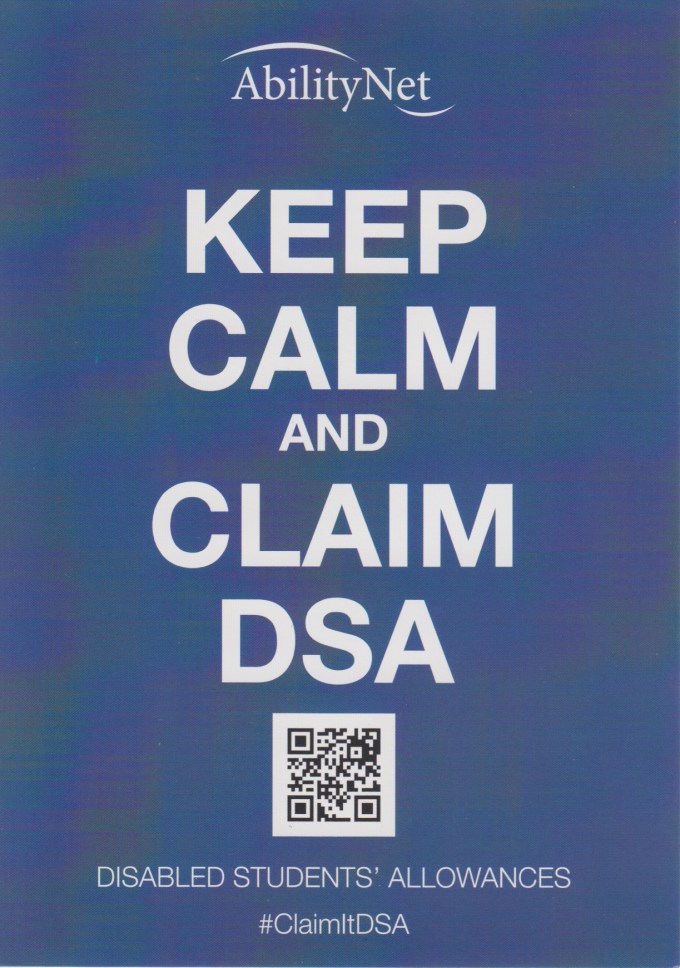
What a joke. What a fucking joke. I’d walked in there calm and was walking out feeling… I don’t even know how to explain it. Just devastated all over again, I guess. I’m so tired. I’m so tired of working so hard to prove to everyone that I need help only to be ignored time and time again. I’m tired of being dismissed and invalidated because I don’t fit someone else’s arbitrary concept of something they have no real idea of but that I live with and suffer with every day. I’m tired of nobody thinking that researching or training in the understanding of Autism is important. I’m so tired. Of all of this.
Mum pointed out to the assessor how ironic the flyer was. I think offensive or appalling are more appropriate given the previous hour and a half but whatever. I cried all the way home and for a long time afterwards. I don’t know what to do now.
Obviously this is just one person’s experience. I’m not sharing this because I want people to avoid applying for DSA. It helped me during my BA. But I just don’t want anyone going into it without knowing how hard, how upsetting, how traumatic it can be. Getting benefits of any kind can be a real struggle and this one is certainly no different.
19 for 2019 Reviewed
Posted on January 1, 2020
In January, I was inspired to try the 19 for 2019 challenge, setting myself nineteen goals to achieve by the end of the year. They didn’t have to be massive goals; they could be one off things to simply try. I was inspired so I came up with nineteen things and gave it a go. Unfortunately, I wasn’t aware of what a hell of a year I was about to experience.
- Stop pulling my hair out – Complicated. I’ve gone long stretches without pulling my hair out but then the stress induced habit has usually been replaced by another one. Right now I’m going through an incredibly stressful time and have recently started pulling again. Maybe next year’s the year.
- Read ten books – I read a handful of books early in the year but I didn’t really start to enjoy reading again until I read This Is Going To Hurt by Adam Kay. I devoured that: he has a beautifully personal writing style. Not long after that, I started my Masters Degree and I had an overly ambitious reading list so I read a lot. Plus, I had a phase of reading books from my childhood when I went through my bookshelf. So I definitely read more than ten books.
- Get a tattoo – I still haven’t managed to do this. I still like the thought of getting one and have multiple ideas but I really don’t like the way they blur over time. I don’t think I could bear to have a blurred tattoo on my body so I still haven’t gotten one.
- Continue swimming (or let it evolve) – There were periods of the year where I did manage this but sometimes the medication I was on meant I physically didn’t have the energy. And then when the kittens were born, I loved watching them in the early mornings, which was when I swam (before the gym got busy and stressful). Add in doing the Masters and what a drain on my energy that was, I haven’t been swimming half as much as I’d life. It’s definitely something I want to get back into in 2020.
- Write more songs – Given all the changes of medication (something that always seems to affect my songwriting) during the first six months or so of the year, I wasn’t able to write. I tried. I tried really hard and managed a few with the help of some wonderful cowriters. But now that I’m back on the Phenelzine, I am able to write again, alone and with others and I love it. For me, writing a song is the best feeling world; it’s feeling alive, it’s feeling connected to myself, to my soul, to the universe. It’s feeling real. So I’m writing again, as much as I’m able. And as I’ve started my MA, I’m writing for that too. I’m very aware of how much I’m learning and how much my songwriting is developing.
- Get my photo albums up to date – I did. And then they got out of date again. It was something I’d hoped to do over the Christmas break but I’ve literally been working on my assessments every single day. Fortunately my photos are well organised so when I have some time, it won’t be a terrifying task to attempt.
- Pursue the cause of my tiredness – I’ve tried. My god, I’ve tried. I’ve seen doctors and been to the Chronic Fatigue Clinic for a general session but that wasn’t at all helpful. I knew everything they told and have known for years and the other people there hadn’t been dealing with it for a fraction of the time I have been. So I didn’t feel very positive about that experience. I’m waiting for a follow up from them but I had no idea when that will be or how much it will help me.
- Improve my instrument skills – I barely did anything musical for a significant part of the year due to medication side effects and crushing depression so I’ve probably gone backwards in my instrumental skills. Having said that, I have been working on them since I started the Masters (particularly the piano so I didn’t have to carry a guitar up and down from London). So not a total loss. And hopefully this will continue as I continue with the Masters.
- Watch a meteor shower – In January actually, I did manage to catch a meteor shower and it was beautiful. I don’t think I’ll ever get over how magical meteors are; they’re just takes me breath away. And there was one huge one that streaked across the sky, like a knife cutting through the roof of a tent and letting in light. It was one of the most amazing things I’ve ever seen.
- Write more poetry – I did write a little poetry, but that was only during NaPoWriMo. Either my mental health was going down the drain or I was too busy writing songs for poetry. Why is there never enough time? Sometimes I feel like the world is moving really fast around me while I move at an ordinary speed.
- Finishing decorating and organising my room – I started to and then I somewhat undecorated it with the creation of the music video for my single, ‘Bad Night.’ While it’s mostly been returned to rights, there’s still some damage (a fist sized crack in the plaster that I haven’t gotten around to repairing). It’s just one of those things that’s always on the list but slips down to more urgent things. Hopefully I’ll get there at some point.
- Find an alcoholic drink I like – I’m now back on a medication that means I can’t really drink. The odd drink is fine but yeah, I can’t really drink. Before that though, I tried a lot of different types of alcohol and just really hated all of them. I also discovered that I’m allergic to limes, which are in a ridiculous amount of alcoholic drinks, including one that I actually did like. The one drink that I do enjoy is a passionfruit mojito even though it does contain lime extracts. So far, drinking them – and I’m not drinking them very often – doesn’t cause a reaction.
- Find a tea or coffee I like – Nope, they all still taste awful to me. I find it frustrating because drinking coffee is such a ‘normal’ thing and I feel like, having been denied so much by my Autism, it’s unfair that I don’t even get to be normal in this tiny way.
- Get invisible braces – Success! I was fitted for invisible braces and have received the first half of the set. I did really well at wearing them for a while but during the second half of the year, I haven’t done so well. It just felt like too much when I was struggling with serious anxiety. I’m hopeful that, with what seems like a less stressful semester starting January, I’ll be better at wearing them.
- Go rock climbing – Nope. I would’ve loved to but again, all the medication and energy stuff made that impossible. Another dream for another year.
- Participate in FAWM – I tried really, really hard to take part in February Album Writing Month but as it was (obviously) at the beginning of the year when I was trying different medications and therefore really struggling with my writing, I didn’t get far. I made several solid attempts and wrote several parts of songs but I didn’t manage to write even one full song.
- Participate in NaPoWriMo – Again, I tried and did write some poetry but nothing I was terribly enthused by. And I wasn’t particularly consistent and didn’t do it everyday but I tried. I tried.
- Donate blood again – I would’ve loved to have donated blood again but a lot of the medications made me ineligible to donate, which sucks because it’s something that’s really important me. So this is off the cards for the moment but as soon as it’s possible again, I’ll be back.
- Join the bone marrow register – Another one I’ve failed at. There’s just been too much health stuff and I’ve just been too unwell to think about it. Plus there were long stretches where I simply forgot. I want to do it so it will stay on the list until I manage it.
So it’s a pretty mixed bag and considering the year I had, I’m surprised I managed any of them at all. I’ve struggled throughout the year, especially recently, with how little I’m achieving and the frustration and anger and guilt that comes with that, that comes with living with mental health problems and a developmental disability. I’m trying to focus on the fact that, where I could, I tried. I tried to do as many of these things as possible.
Overall, an interesting challenge but I think I’ll try something different for 2020. I haven’t found the right kind of goal system yet so I’m just gonna have to keep looking and keep trying.
Insert Joke About Being Iron Woman
Posted on June 15, 2019
Several months ago, I had some blood tests done and they revealed that I was incredibly low in iron. Since I’ve had some pretty unpleasant experiences with supplements, my doctor recommended an infusion and set it up straight away at the local hospital. I was really impressed by the efficiency of it all: the speed at which the problem was identified and the treatment arranged. That was the last we saw of that.
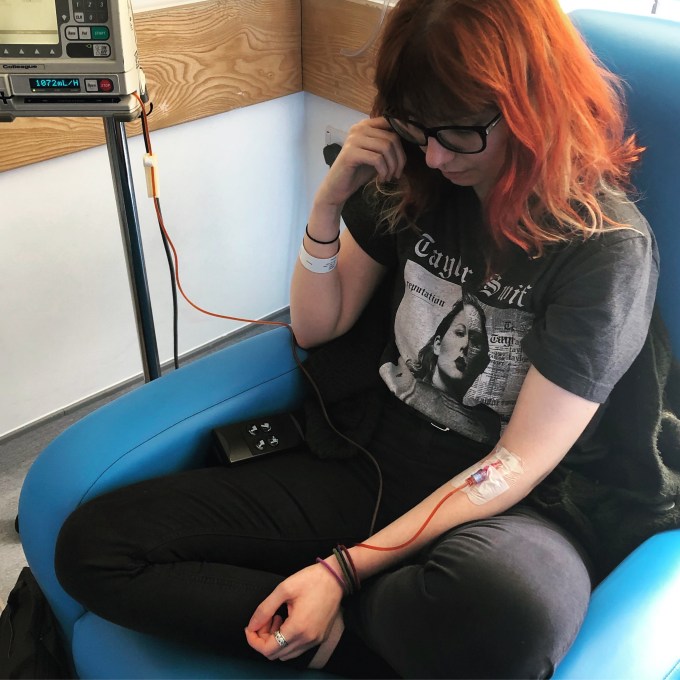
The actual hospital visit for the infusion took six hours. All was going smoothly: they’d taken my blood just to double check the iron levels but then we saw no sign of the doctor for over an hour. When someone eventually appeared, they told us that somehow they’d managed to test for everything but iron and were having to run the tests again. It took so long that I fell asleep in the chair.
Hours later, they finally had the infusion in. It was cold and made me feel kind of sick. It was a bit like when you get a general anaesthetic, if you’ve ever had one of those. But it was okay. It only lasted about fifteen minutes and then I had to stay for half an hour to make sure there weren’t any negative interactions. But then it was all over and I could go home. I thought I’d keep notes on how I reacted in case it would be useful to anyone else.
WEEK 1
I slept very late everyday (sometimes into the afternoon when I’m usually up around eight) and still struggled to get up. Despite all the sleep, I could still nap in the day and would start dozing off around ten. I had absolutely no energy. I tried to continue my routine of getting up early to swim but I could barely drag myself downstairs (or even out of bed); I couldn’t stand up long enough to shower and had to wash my hair in the bath, which I absolutely hate doing. I was very shaky and felt just generally unwell.
WEEK 2
At the beginning of the week, I also reduced two of my medications, Clomipramine and Flupentixol, as I’d previously planned with my Psychiatrist. The infusion came about so quickly that the plans collided with no time to adjust. I also went down with a migraine during the week so it’s hard to tell what caused what and how each thing affects the others.
Slowly, I started to wake up at my normal time again but I was still very tired and sleepy. Doing anything was a struggle but by the end of the week, I started to feel a bit better and a bit more like myself pre-infusion. I also started to feel like myself pre-Flupentixol: I had my first shower standing up in weeks and I walked around London without feeling like I was going to faint. It felt a bit like a fog was lifting.
WEEK 3
The week began with my first shower standing up and I was positively giddy about it. I had to lie down afterwards but it was amazing to be able to do something again that had been taken away. I was still physically exhausted but I no longer felt like I was going to faint if I stood up for too long.
Mentally and emotionally, I felt like I was declining. I felt depressed and restless; I didn’t know what to do with myself.
I did spend the second half of the week sick, feeling nauseous with a cold and sore throat. I don’t know whether that’s related to the infusion or the changing medications or whether it was a coincidence. Either way, I spent several days in bed feeling miserable.
WEEK 4
At the beginning of the fourth week, I reduced the Clomipramine again. I wish all of these things could’ve happened separately from each other so the effects could be clearly identified by unfortunately, that just wasn’t in the cards this time. The reduction of the Clomipramine, an antidepressant, no doubt had a real impact on my mood. I felt overwhelmed by feelings of depression and hopelessness and I just didn’t know what to do with myself. I couldn’t settle or concentrate so it was hard to distract myself from these feelings. My anxiety also increased, which was an added struggle.
Energy wise, I felt back to my ‘normal’ levels of tiredness: I couldn’t – can’t – stand or walk for very long, big events and big emotions require several days of recovery, I need a lot of sleep. But I’m a lot better. I’m swimming again and going up to London has been easier. So on that front, there has been improvement.
Everything has been fairly consistent since then and eight weeks after the infusion, I went back for a blood test to see if the infusion worked. The results were certainly interesting: by my maths, my iron levels have gone up 4000%. So, for the moment at least, it seems to have worked. In the medical sense anyway – I’m not seeing as much of an improvement as I would’ve hoped, energy wise. I’d hoped that this might explain the ongoing trouble I have with fatigue but if this is up to normal levels and I’m still struggling as much as I am, then it’s not the answer, or not the whole answer.
It’s not the end of the road. In three months, I’ll be going back for another blood test, this time to find out whether my body is holding onto and processing the iron properly. So that may yield more answers, more information. From there, I’m not sure what happens but it’s not the only route we’re pursuing. There’s got to be an answer and I’m not giving up yet.
 Finding Hope