 Finding Hope
World Mental Health Day 2023
Posted on October 10, 2023
If you’ve been following me for a while, you’ll know that I find awareness days, like World Mental Health Awareness Day and Mental Health Awareness Week, really hard. I find it really frustrating to watch so many people – businesses, celebrities, every man and his dog, etc – jump on the #MentalHealthAwareness bandwagon just to show that they really do care about mental health, to prove that they are socially engaged and empathetic (before reverting to their previous routine of never discussing the subject). I have absolutely no problem with people not making it their primary social cause; I do have a problem with people trying to claim social credit by talking about it for one day a year.
I also struggle with the consistently vague annual themes that many charities and organisations stand behind. This year, the World Federation for Mental Health announced that their theme for 2023 is ‘mental health is a universal right,’ to which my immediate reaction was, ‘No shit.’ What is that supposed to mean? That everyone deserves to have good mental health? That everyone should have access to mental health support? Isn’t this blatantly obvious? The problem is that we’re stuck with outdated medical education, out of touch care providers, no support services, and no money to fix any of it. So how does this vague statement help? What does it change? We need more. We need better. We need support and education and resources. We need a government that cares about the people it serves, that cares about the wellbeing of the people it serves. But instead, we have a group of entitled, morally-bankrupt, evil narcissists who only care about money and power.
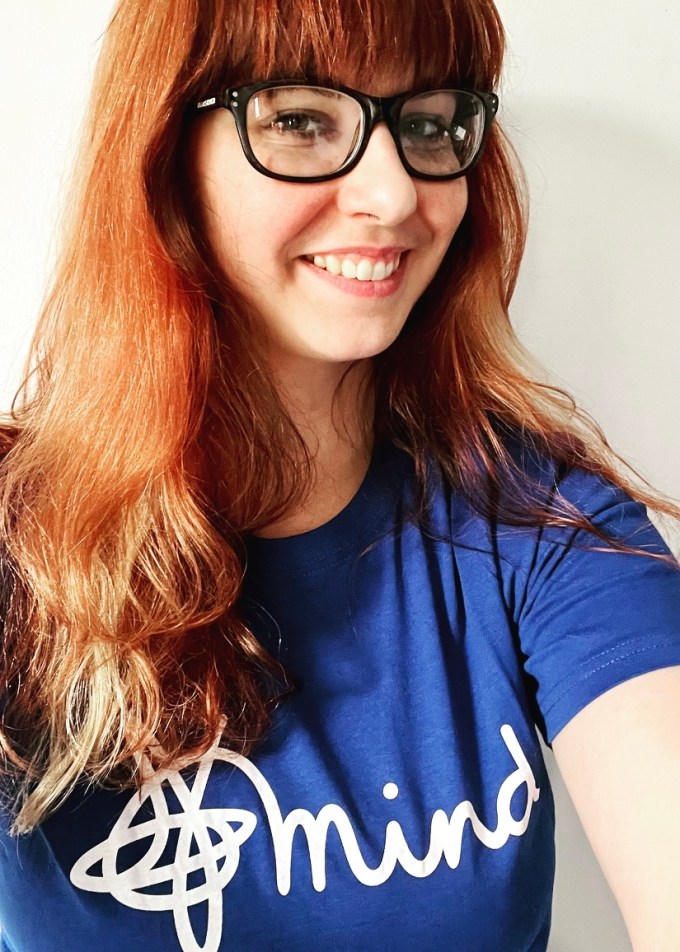
I’m sick of feeling so angry and I’m sick of feeling so powerless. I doubt there’s anything that can truly change that, aside from massive institutional change. But it doesn’t seem like that’s coming from the government any time soon so I’m trying to channel my focus and my energy and my feelings into doing what I can as an individual. The proceeds from my single, ‘Invisible,’ go to YoungMinds of course but that’s in place and I want to do more. I want to do everything I can. So, this year, I decided to raise money for Mind (Charity Number: 219830) by swimming 5km. Because of my hEDS, I knew I wasn’t going to be able to swim more than a kilometre at a time without potentially aggravating my chronic fatigue and chronic pain so I planned to do the 5km over a series of nights, completing the 5km in time for World Mental Health Day on the 10th October. There’s a nagging voice in my head that keeps snarkily pointing out that I should’ve been doing this for years but I know logically that I couldn’t even have done it last year because of both my physical and mental health. So I’m trying not to beat myself up for not doing it sooner. I’m doing it now.
I really had no idea what to expect in terms of raising so I set it at £150. That seemed doable since most of my friends are still struggling financially post university and we are all in a cost of living crisis. While this also affects the more financially established people in my life, I knew that there were people who were more able to help me achieve this. That, I think, is a big part of why I didn’t set a super ambitious target; the cost of living crisis is hitting everyone hard (apart from the incredibly wealthy Tory politicians, it seems) so I felt that raising any money at all was an achievement; I was deeply appreciative of every donation, whatever the amount. I figured out the details and set up my JustGiving page:
“For World Mental Health Day 2023, I will be swimming 5km in aid of Mind (charity number: 219830), a charity that supports those struggling with their mental health. As a person with Ehlers-Danlos Syndrome who suffers from chronic pain and chronic fatigue, I will be swimming this distance over a week in order to avoid worsening these conditions. It has taken me over a year to reach this point, where I am physically fit and healthy enough to do this, and I want to celebrate this and honour World Mental Health Day by challenging myself with this swim and raising money to support a charity that helps those who are struggling with issues that I have struggled with myself.
I know that times are really tough and that we are all affected by the cost of living crisis but even a few pounds can make a difference. If you can’t afford to donate, please help me to reach more people by sharing this page on your social media.
Thank you for reading this post and for whatever help you can manage. I truly and deeply appreciate it.“
And then it was time to swim the thing!
SWIM 1
The first swim was at the longer, lane swimming pool that I go to, which meant swimming fifty lengths to achieve the first of the five kilometres. I had, in typical fashion, slipped off an uneven curb earlier in the day (right before my first ever sponsored 5k ever, of course); fortunately I was fine, if a little sore, because I wasn’t changing the plan for anything. I’d swum the distance a few times already and found it a challenge but a doable one; I expected the same for each of the five nights. But it was surprisingly smooth-going. I was tired at the end, my muscles a bit shaky, but I was excited and energised by it; I couldn’t wait to do the rest of them.


SWIM 2
For the second swim, I was in the smaller pool, the one that’s more suited to and where I usually do my hydrotherapy exercises. It’s short – only 8.5m – so the amount of times you have to turn in order to swim a kilometre can get a bit tedious but it’s a beautiful little pool. This kilometre was harder. Given that it was the second of two nights swimming a kilometre, I was tired before I started and my arm and leg were actually more painful than the night before, presumably because I hadn’t been able to rest them post fall. So it was a bit of a struggle but I made it! Two down, three to go!
SWIM 3
I had a night off and then I was swimming again, another kilometre in the small pool. Having had a break and some time to rest my sore arm and leg, I felt better and stronger in the face of the swim and, unsurprisingly, it was easier than both I’d done so far. That said, I was exhausted by the time I was done and fell asleep on the sofa when I got home. My body definitely isn’t used to this. But it was very exciting to have passed the halfway point! And I was at almost £500 with my fundraising when I hadn’t even expected to break £200!


SWIM 4
For the fourth of the five kilometres, I was back in the long pool. Despite having a few days off, this one felt really hard: it wasn’t that the lengths felt longer but more that my arms and legs were heavy and tired and it took more effort to pull myself through the water. I think I got tired faster too. But I managed it, even if only just in time before I had to get out of the pool. Four kilometres in a week! Even though I was exhausted with another kilometre to go, I still felt energised and excited about going to the pool. And so motivated to finish the 5k.
SWIM 5
Because I’m me and apparently really can’t go a week without falling over, tripping on something, or colliding with a door frame, I managed to trip in the street on my way back from the pool the night before (because I was so tired, I think). I twisted my ankle and landed on my knee and although I hadn’t done any serious damage – thank goodness – I did go into the last kilometre feeling sore and a little wobbly. But I was so excited to do it, both to complete the challenge and fulfil the promise I’d made to Mind and to all of the wonderful people who’d donated. I was so proud to be earning that money, the total having reached £500 that morning!

1km later and I’d done it! 5km! It felt so good. It hadn’t felt as hard as the night before either, maybe because I was back in the groove, maybe because I was so close to achieving the goal and was therefore more motivated and noticed my fatigue less. Whatever, it was done and I didn’t feel too exhausted to actually get out of the pool. The lifeguard was really nice about it when we realised we confused the time of our slot and even donated before we left!
By the end of the day, with the swim completed, the total donation sat at £510. I was very, very proud of that, having never thought I’d reach such a number. And I was really proud of myself: I’d done it. I’d completed the challenge I’d set for myself. I’d swum 5km when, just several months ago, I wouldn’t have been able to swim half that. It’s a big milestone in terms of my fitness.
It’s been a really positive experience, even if – at times – I was tired or sore or anxious that I wouldn’t raise the money. So much work has gone into the week, into these five kilometres; it’s taken so much time and effort to get physically healthy and fit enough (plus in a healthy enough mental state) to do this. I’m really, really proud of myself for getting to this point and I’m really, really proud of completing the 5k; I can’t think of a better way to celebrate all of that than by challenging myself with this swim and raising money to support a charity as important as Mind.
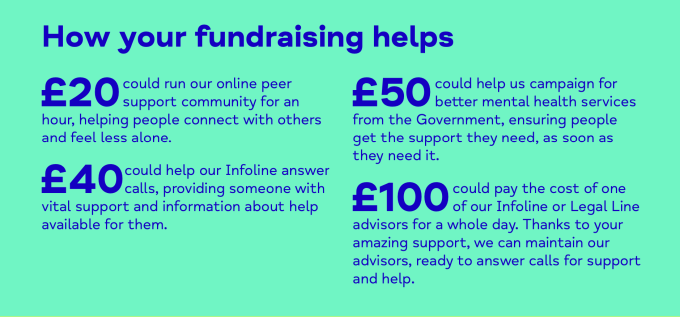
There is still time to donate – the page is here – but at the time of posting this blog, the total raised is £620. That is so incredible to me and I’m so moved by the generosity of human beings and their desire to support each other. Thank you so much to everyone who has donated and to those who weren’t able to but shared the link, helping this fundraiser to reach a wider audience. While I’m sure there are many, many things that this money can go towards, these are some of the ways that the money we’ve raised together will help people…
As I said, I’ve been struggling with awareness days like this one for the last several years, feeling powerless and frustrated. But this year has been different and that’s because of this fundraising challenge. Not only am I proud of completing the physical challenge and blowing the fundraising target out of the water (that pun was originally accidental but it’s too funny to me to take out), I feel like I’ve made a difference. It might be a small one in the grand scheme of things but it’ll be no small thing to the individual(s) Mind is able to help because of this donation. So, with that in mind, Happy World Health Awareness Day. We made a difference.
World Mental Health Day 2021
Posted on October 10, 2021
‘MENTAL HEALTH IN AN UNEQUAL WORLD’
As I’m sure many of you know, today is World Mental Health Day and the theme, chosen by the Mental Health Foundation, is ‘mental health in an unequal world.’ WHO seems to be building it around the pandemic, rather than as a problem of its own, but from what I’ve seen in the newsletters and on the social medias of many mental health charities and organisations, most seem to be following the lead of the Mental Health Foundation.
According to the Mental Health Foundation’s website: “2020 highlighted inequalities due to race and ethnicity, sexual orientation and gender identity, and the lack of respect for human rights in many countries, including for people living with mental health conditions. Such inequalities have an impact on people’s mental health. This theme, chosen for 2021, will highlight that access to mental health services remains unequal, with between 75% to 95% of people with mental disorders in low and middle-income countries unable to access mental health services at all, and access in high income countries is not much better.” It goes on to say: “Many people with a mental illness do not receive the treatment that they are entitled to and deserve and together with their families and carers continue to experience stigma and discrimination… The stigma and discrimination experienced by people who experience mental ill health not only affects that person’s physical and mental health, stigma also affects their educational opportunities, current and future earning and job prospects, and also affects their families and loved ones.”


Statistics provided by Mind (x)
I have my own experience with the mental health system – which I do want to touch on – and have heard from many others about their experiences but I wanted to read into the research around these inequalities further, both to get a better factual understanding and to put my own experience in context (beyond an anecdotal one). The research is sporadic at best but here are some of the statistics I found…
ACCESS TO MENTAL HEALTH CARE
- “NICE [The National Institute for Health and Care Excellence] recommends that people should be able to access services when they need them. However the proportion of people who felt they had definitely seen NHS mental health services enough for their needs reduced from 47% in 2014 to 43% in 2018.” (x)
- In 2020, it was reported that approximately 1 in 3 people who experience mental health problems are able to access the support they need. (x)
From these statistics, it’s clear that far too many people aren’t getting the support that they need.
INEQUALITIES IN ACCESS TO TREATMENT (x)
- For those with common mental health problems, 36.2% reported receiving treatment.
- Women are more likely than men to receive treatment for all mental health conditions, with 15% of women receiving treatment compared to 9% of men.
- Young people aged 16-24 were found to be less likely to receive mental health treatment than any other age group.
- White British people are more likely to receive mental health treatment (13.3%) compared to BAME groups (7%). The lowest percentage of people receiving treatment were those from black ethnic minority groups (6.2%).
These statistics clearly show the disparities in the availability of treatment, more supporting evidence for the statement that the Mental Health Foundation is making with the theme for this World Mental Health Day.
YOUNG PEOPLE
- “There is very little national information about mental health services for children and young people, and what information there is suggests quality is declining. [Research] indicates substantial cuts to services, increasing demand, increasing thresholds for treatment, very long waits (more than a year) for specialist services, and a resultant decline in accessibility.” (x)
- Approximately 1 in 3 children and young people with a diagnosable mental health condition get access to NHS care and treatment. (x)
- More than 338,000 children were referred to CAMHS in 2017, but less than a third received treatment within the year. (x)
- Around 75% of young people experiencing a mental health problem are forced to wait so long their condition gets worse or are unable to access any treatment at all. (x)
- In a YoungMinds survey, three-quarters (76%) of parents said that their child’s mental health had deteriorated while waiting for support from Child and Adolescent Mental Health Services (CAMHS). (x)
This research all indicates that young people in particular are being let down by the health care system.
SECONDARY [LONG TERM] CARE
- “Demand for secondary care (which generally treats people with severe mental health problems) is increasing, and there is evidence to suggest services are becoming less accessible… There is little information available on the outcomes that services achieve.” (x)
- “There is no high quality national information on waiting times for secondary mental health services. In a 2014 survey, 20% of people with severe mental illness who were offered talking therapy reported waiting more than a year to access it.” (x)
The statistics show not just that the need for mental health care is increasing but the need for long term mental health care is increasing but that it’s also very difficult to access.
HIDDEN WAITING LISTS (x)
“A study of 513 British adults diagnosed with a mental illness also reveals the damaging consequences that hidden waiting lists – the wait between referral and second appointments – have on the lives of patients living with severe or common mental illness.”
- “Of those on a hidden waiting list, nearly two thirds (64%) wait more than four weeks between their initial assessment and second appointment. One in four (23%) wait more than three months and one in nine (11%) wait longer than six months.”
- “Respondents living with severe mental illness – including eating disorders, bipolar disorder and PTSD – were left waiting up to two years for treatment. Others were left waiting up to four years for treatment for depression, anxiety and suicidal thoughts.”
- “Two-fifths (38%) reported that they, or someone on their behalf, had contacted emergency or crisis services while waiting for their second appointment, while 39% said that waiting led to a decline in their mental health.”
It’s clear that, beyond the difficulty of even getting into the mental health care system, once in it, the process of actually getting the support you need is much too slow – so slow in fact that it’s exacerbating the mental health problems that those waiting are seeking help for.
Now I want to look at my experience of getting support for my mental health…
- For more than two years, I was repeatedly dismissed and had my feelings and experiences invalidated by multiple doctors and services. No one took me seriously. Eventually, my Mum took me to a private psychiatrist and I was diagnosed with Generalized Anxiety Disorder, Social Anxiety Disorder, Depression, and OCD. Having had no idea what I was struggling with, I’d done a lot of research and asked about the quiet presentation of Borderline Personality Disorder, which my psychiatrist initially rejected but then reconsidered and diagnosed me with it after reading my research and personal notes (it has since been recommended to me multiple times – sometimes by doctors who don’t even know me – that I have this diagnosis removed from my file because “people might make assumptions”). Getting an NHS referral for an Autism Diagnostic Assessment was similarly difficult as he felt that I didn’t fit the classic presentation (I do apparently fit the classic FEMALE presentation though).
- There was no follow up after this diagnosis and we were told there was no support available so my Mum investigated private therapists. I tried CBT for a while but didn’t find it helpful so I tried DBT instead, which has been a much better fit.
- All of this private treatment is obviously not cheap and I am so beyond grateful that my family is fortunate enough to support me financially. I honestly don’t know where I’d be without it, whether I’d even be here. But the cost of it does cause me significant worry, only adding to the anxiety I already experience.
- With so many of my problems connected to my Autism, had this whole process been… easier, simpler, quicker, less traumatic, or something… so many of my health problems wouldn’t have deteriorated to the level that they have. Had I been diagnosed earlier – had even one medical professional believed me – things might’ve been so different. I try not to dwell on that because there’s no point wasting my energy on what might have been but it is the truth.
- Having said that, considering some of the stories that I’ve read or have had shared with me, my story isn’t that bad. I’m positively lucky compared to some and that’s a confusing, complicated thing to say, knowing how traumatic this has all been… and continues to be.
Since then, I’ve developed near constant chronic pain throughout my body – something that’s obviously had a big impact on my mental health – but over a year later, I’m still waiting for the NHS physiotherapy and hydrotherapy referrals to go through. I have started Occupational Therapy and with the Pain Clinic (both through the NHS) but with the end of my Masters, I had to take a break because they were too painful and/or upsetting to manage alongside all the work. I’m starting back this week. It still bothers me that no one’s ever even tried to find out why the pain started though.
Almost six years after my ASD diagnosis, the Neurobehavioural Clinic called to offer me an appointment, to do what I had no idea. But at the end of the two part session, I’d been diagnosed with Hypermobile Ehlers-Danlos Syndrome and ADHD – aged twenty six – both conditions having gone unnoticed because no one had ever taken my associated problems (problems that have been there my whole life) seriously. They’re both conditions that often occur alongside ASD. The hEDS diagnosis would, in theory, push my physiotherapy and hydrotherapy referrals but, as I said, I haven’t heard anything and almost a year later, my ADHD is still untreated. My psychiatrist was happy to ‘move’ that condition to his care but the consultant I saw didn’t want that, which is especially frustrating because she’s so difficult to get in contact with.
And finally, I may be getting answers to another ongoing medical problem: severe dizziness, light-headedness, nausea, physical weakness, and breathlessness when I stand up for too long. We’ve been trying to get support around this for so long that I can’t even remember when it started. This too may well be related to my Autism and I can’t help thinking that it’s another thing that should’ve been discovered sooner.
All of these things have had a profound impact on my mental health and going through the agonising process of diagnosis again and again has left me wary, fearful, and angry at medical professionals. It’s deeply ingrained in me to be polite and respectful but it doesn’t take much to send me flying off the handle; I walk into each appointment feeling like a tightly coiled spring. I leave pretty much every appointment in tears at best, raging at worst. Because I’m so. freaking. tired. of feeling like this. Of feeling like no one believes me, of being made to feel like I don’t know what I’m talking about, of being made to feel like I don’t know what I’m feeling. I feel so worn down by the constant let downs. At this point, I think I’m only going back because I don’t know what else to do.
I have no doubt that social media will be filled with nice words and encouraging quotes today. But we need more than that. World Mental Health Day is about more than that. Or it should be. It should be about pushing for change and improvement. The Mental Health Foundation is absolutely right that the inequalities in the mental health care system need to be addressed but looking at these statistics, it’s also clear that the standard of care needs to be better. For everyone’s sake. After all, there’s very little difference between not getting any support and being on a list waiting years for support.
So I Wrote A Thing For World Mental Health Day
Posted on October 10, 2018
(Trigger warning for self harm.)
Today is World Mental Health Day.
If I’m honest, I’m not really sure what to say. I’m in the middle of the worst depression I’ve ever experienced and I’m very aware that my perspective, my opinions, my hopes are distorted by that. If this was a video, I might just sit and cry. But this day is important so I’m trying to pull myself together and put something out into the world that is (hopefully) positive (and maybe helpful).
This year’s theme is the mental health of young people. When it comes to things like this, I’ve never felt comfortable talking about anyone’s experience but my own. So that’s what I’m going to do. I hope that’s okay with you guys.
My experience at secondary school was a very mixed one. I spent the first three years dealing with some complicated health problems but by the time I reached Years 10 and 11 (ages fifteen and sixteen for those of you who don’t know the education system in England), I felt really settled. I loved learning, particularly English, Maths, History, Psychology, and Philosophy (real shout out to my teachers in all of those subjects). I got real satisfaction from working hard and that was reflected in my grades. I came out of secondary school with not unimpressive grades, especially when you consider I missed most of the first three years. So I felt pretty good about going into Sixth Form (A Levels/ages seventeen and eighteen).
But that was when it all started to unravel. I really, really struggled. I’d gone from completing the work with ease to barely scraping by. I couldn’t understand it: I was trying so hard and it didn’t seem to make any difference. And I couldn’t see it at the time, but my anxiety was getting worse and worse and what I now know to be depression was creeping in. But I didn’t know it was happening so I just kept pushing forwards. I spoke to a couple of people about the high anxiety I was experiencing but each one told me that anxiety is normal and that was the end of the conversation.
It all came to a head when I failed an exam, something that had never happened before. I’d been told I was all set for an A* and I came out with a U. I was absolutely devastated. I know now that our worth as human beings has nothing to do with grades but I was eighteen years old: I had only ever been valued based on my grades. It’s no one person’s fault but that’s how the education system in this country works. It needs changing.
But back to this little story. I don’t remember much after I opened the envelope and saw that U but I ended up in one of the less used college toilets, self harming repeatedly with a broken paperclip. I don’t know how long I was there (long enough that the automatic lights went off and I was plunged into a very appropriate darkness) but at some point, my friends tracked me down and coaxed me out of the stall. I still remember seeing my reflection: my make up all down my face, my hands shaking, and the scratches barely hidden by my long sleeves. One friend took me to a nearby café, bought me a hot chocolate, and just talked to me. And eventually I told her what I’d done. Her kindness and gentleness was so healing, not for the whole problem but for that very difficult day. I will never forget it and I don’t think I’ll ever be able to repay it.
After that, I dropped out of that course and clawed my way out with two A Levels and an Extended Project, far less than I and everyone had expected of me. I went straight into a music course but had to drop out two days in because my anxiety was so bad that I just couldn’t cope. I spent a year grappling with the anxiety and depression, trying the first of many antidepressants (so many) and trying to retake some of the exams in the hope that I could improve my A Levels (I didn’t end up opening the results of those until after I finished my degree, three years later, but that’s another story). During that year, I tried desperately to get help from the NHS to no avail: my anxiety was so bad that talking to people I didn’t know was practically impossible and they refused to help me if I wouldn’t talk. Eventually we were forced to go private, something that I’m endlessly, endlessly grateful has been possible. And I only managed to get my diagnoses when my university said they weren’t able to help me if I didn’t have an official diagnosis.
It still upsets me to talk about. I asked and asked and asked for help but no one either seemed able or willing to help me. I would not be as twisted up now had that not been the case. The information and support was not available to me, it wasn’t available to my family, and it wasn’t available or deemed important enough (I’m not sure which is worse) to the medical professionals I saw. That has to change. It is not acceptable.
Now that I’ve told my story, I want to include some other important, relevant stuff.
The first thing is that I want to link you to Hannah Jane Parkinson’s recent article in The Guardian. She makes the very important distinction between mental health and mental illness. And this is where, I think, physical health and mental health are most comparable: your mental health is something you take care of (or don’t) everyday, by eating and sleeping well, exercising, talking through your emotions, and so on. Mental illnesses, similarly to physical illnesses, can be caused by not taking care of your mental health but there can also be genetic factors, environmental factors, and just hard stuff going on in your life.
WAYS TO HELP YOUR MENTAL HEALTH:
- Talk – Talk through your feelings with someone you trust.
- Keep a journal – This way you can air your thoughts and feelings in private.
- Keep in contact with friends – It’s really easy to get busy and fall out of touch but spending time with people you love and feeling connected to other people is so important.
- Exercise – This doesn’t mean every or any kind of exercise will help. On a personal level some types of exercise can potentially hurt your mental health. You just need to find the one that does help and then it will really help. I always recommend swimming because it’s non-weightbearing and therefore causes less strain on your body when you’re potentially already struggling with physical symptoms, like fatigue.
- Eat well/drink sensibly – Everything we put into our bodies affects our minds.
- Be mindful of your commitments – Yes, social interaction can be really helpful but if you’re taking on too much, it will take more from you than it gives you. And then you won’t be able to cope as well with whatever else is thrown at you.
- Ask for help if you start to feel mentally and emotionally overwhelmed – Fortunately it’s starting to become easier to access support and counselling but even if it’s a struggle, it is a struggle worth going through.
- Spend time with animals – It’s scientifically proven that being with animals is good for your health!
WAYS TO HELP YOUR MENTAL ILLNESS:
- Work with a medical professional/therapist that respects and understands what you’re struggling with – Finding one can be the mission of a lifetime but having that presence in your life whose sole purpose is to help you through your struggles is incredible.
- Medication – If you’re prescribed medication, take it diligently.
- Try to keep track of your triggers – Knowing what they are doesn’t always prevent them from sending you into a complete spiral but even one spiral avoided is progress.
- Create a support system – This isn’t something you can necessarily do without help but, over time and with the help of people who care about you, building a circle of trusted people who will support you through whatever it is you’re going through is so special and helpful.
- Take time off if you need it – This is one I think we all struggle with. It’s a learning curve for a lot of us but it is important and can prevent small problems from becoming big problems.
- Find a stress reliever – Whether it’s reading, or watching every episode of your favourite TV show, or doing something artsy like watercolouring, taking a break from all the stuff in your head is well worth doing.
- Create a safe space for yourself – Living with a mental illness is exhausting and so having somewhere where you can just exist without thinking or masking is so important.
And of course, there is overlap between these two lists.
Where we go from here, I’m not sure. The information about mental health and mental illness is spreading and spreading and more and more people are speaking up. Now we need the right systems to support it: doctors, treatment, government officials who advocate for positive change. For now, that’s all I know. For now, I’m just trying to manage one day at a time.
(And a gentle reminder, my debut single, ‘Invisible,’ which I wrote about my experiences with my mental health is available on iTunes and Spotify and all those places and all proceeds go to Young Minds, a charity that supports young people in their mental health.)
 Finding Hope