 Finding Hope
World Suicide Prevention Day 2023
Posted on September 10, 2023
TW: Discussions of suicidal thoughts, suicidal urges, self harm, and irrational thinking. PLEASE think carefully before reading further if these things may trigger you or cause you distress. Please always put yourself and your mental health first.
This, I think, is the first time I’ve written directly about my experience with suicidal thoughts and urges. I’ve mentioned it in relation to the side effects of medication and written around the edges of it but I don’t think I’ve ever talked about it in such detail. I have omitted certain moments and details since it’s been proven that sharing about plans and methods can lead to further suicides but this is as honest as I can manage, even though it terrifies me. But as hard as it is, I’m sharing these experiences because I think it’s so deeply important for people to understand what it’s like to feel this way, to live in so much pain, to feel so desperate. Keeping these stories in the dark only increases the shame and stigma so, even though it’s difficult and uncomfortable and scary, we need to talk about them. It’s the only way the world will get better at supporting people who are struggling.
I’ve experienced suicidal thoughts on and off since I was a teenager but for a long time, they were passive. Walking to school, I’d cross the road and, dreading the day ahead, I’d imagine getting hit by a car. But the thought would leave as quickly as it arrived. I thought it was normal. To quote Ned Vizzini, “Who hasn’t thought about killing themselves, as a kid? How can you grow up in this world and not think about it?” (I may have hated that book but that line really resonated with me.) This was before I was diagnosed as autistic* and I thought everyone felt as overwhelmed by their emotions, by their anxieties, as I did – as I do – but were just better at managing it.
*Autistic individuals, especially autistic women, are at a much higher risk of suicide than the general population; the factors include mental health problems (especially if they go untreated), the impact of a late diagnosis, challenging life events such as bullying and ableism, the burden of masking, isolation, and cognitive inflexibility, which can lead to difficulty in seeing any option but suicide. (x)


(Left: During secondary school // Right: During sixth form college)
I continued to experience passive suicidal thoughts and then, during my second year of sixth form college, I started to struggle with depression and my ever-present anxiety reached all-new heights (although, in comparison to what I experience now, I’d happily go back to it). Almost a decade, multiple diagnoses, and more than twenty medications later, my depression is the worst it’s ever been and I’ve been actively suicidal for almost two years. There have been short periods over the years (always in concert with the times I tried medications other than Phenelzine) where I’ve struggled with suicidal thoughts but, for the last two years, they have been almost constant.
They began in earnest when I started taking Xaggatin for my ADHD (and had to stop taking Phenelzine because my ADHD clinician was insistent that the side effects were unsustainable – I disagreed for multiple reasons but this isn’t the post for that story). I thought the intensity of the thoughts – and their slow, scary manifestation into urges and intentions and plans – was a side effect but it wasn’t long before my depression crept back in, sucking me down. Between that and the other awful side effects, my psychiatrist switched me to another medication, Bupropion, an antidepressant that’s supposed to help with ADHD but it only made things worse: I was so anxious, depressed, and suicidal that I couldn’t function. I tried a few more antidepressants, was traumatised by several more doctors, and had the crisis team called out (although they didn’t do anything, including the things they’d said they’d do). I quit treatment entirely for a while, unable to mentally handle it; I basically retreated to my bed and stayed there. I couldn’t engage with the world: it just hurt too much. But without treatment (I didn’t even have a therapist at this point, another thing that had spun my life out of control), the claws of my depression dug deeper and deeper. I remember one day where I had the sickening realisation that I wasn’t doing anything worthwhile with my life, that I had wasted my time and my education, that I was a complete waste of space. There was another day when I realised that something had broken inside me, something that could never be fixed, and I was no longer the person I had been and would only ever be a defective, inferior version of her. I avoided mirrors for months. On New Year’s Eve of 2021, I stared at the fairy lights in my living room and thought about how I had no desire to survive even the next 365 days. It wasn’t a resolution but I felt it with a quiet certainty. I thought about it everyday but then somehow that dreaded day arrived and I was still here, despite that certainty, despite my plans. I hated myself for it, feeling like a pathetic, weak-willed coward. It was a terrible night, not that I remember much of it given the distress I was in.
Somehow I ended up on Phenelzine again, despite my revulsion at the thought; I still don’t really know how it happened and I still find myself so angry about it that it feels like it might consume me. But, for a while, the chronic suicidality was relocated to the side burner: it was all still there but it wasn’t the only thing in my brain anymore. I could ignore it for sometimes days at a time. But after a while, my depression seemed to billow back in, like ink in water. The suicidal thoughts and urges became – and still are – the constant undertow to my thoughts and sometimes it’s all so overwhelming that I can barely breathe. Self harming has long stopped being an effective coping strategy as it just makes me feel pathetic for not doing more damage. I don’t know why I haven’t acted on these thoughts. I don’t know why I’m still here. If asked, I’d probably say, “because I’m a coward,” even though I know that I’d likely get a verbal thrashing from anyone I voiced that feeling too. I can practically hear my therapist (yes, I’m back in therapy) encouraging me to dissect that feeling. I know it’s not a healthy, rational thought but it is a real one. It’s a weird state to live in and the conflict of planning for a future I don’t particularly want to exist in is disorientating and miserable. It’s exhausting. But I know what my fate is, whether it comes sooner or later, and I have for years.
Following a slightly different train of thought, it’s very strange to me that people can’t seem to tell, just because it’s such an overwhelming experience for me. I feel like I have a massive neon sign over my head: “SUICIDAL.” But then I wouldn’t be surprised if people just don’t comment because they don’t know what to say. The last time I self-harmed, I cut my face because I needed to look as broken as I felt (or inasmuch as I could physically manage, which wasn’t enough – more shame and self-hatred) and almost nobody even mentioned it. (Not that that was the point but it did surprise me. Most of the time I avoided the question. I only lied once: I was in a weird headspace already and the question took me off guard and I just didn’t have the emotional energy to explain.) The cut got infected and took weeks to heal. I’m glad it left a scar but I resent it for not being bigger: the disfigurement doesn’t accurately reflect the feelings, not by a long shot.


(Left: The dressing on my face after I self harmed // Right: The scar after it finally healed, having got infected.)
In some ways, I feel like I’m already disappearing: I struggle to make sense of my face in the mirror and, while I don’t know about this year, there are fewer than ten photos of me in 2022; my autistic masking is so ingrained that the real, brutally honest me who is struggling and suffering (who so desperately needs to be seen) gets locked away so tightly that she might as well not exist, while a socially acceptable and palatable projection of me – the only version of me that people could want, says the voice in my head – takes over my body, acting almost without my permission; I feel like no one knows the real me any more, not after months in bed, besieged by suicidal thoughts and impulses. I feel permanently damaged by it but people are still treating me as who I used to be and not who I am now (not that I think it’s their fault – while the damage feels so deeply clear to me, I know that it’s not visible to anyone else). I remember the old me. I remember the person who could be proud of being different and who advocated for acceptance, even though she still felt broken. It was a balancing act but there was balance. Now the broken feeling has broken the scale. I feel unrecognisable. I noted down somewhere – last year at some point, I think – that feeling like this feels like one elongated near death experience. Almost every day for more than eighteen months, I’ve been so close to death that I can feel it’s presence in the air when I breathe in; I can feel it in my lungs. One decision – one split second – away. Maybe it’s just dying in slow motion. Feeling this way… I don’t know how it doesn’t change you.
I was reading various articles as I both researched and procrastinated this post and, in one of them, the author had written this: “Because depression, as we all know, is almost always treatable.” The statistics vary, depending on where you look, but a high percentage of people (this page claims between 80% and 90%) do eventually respond well to treatment. After ten years, over twenty medications, and more hours in multiple therapies than I can count, I’ve only ever managed periods of being mentally well. The longest period was, I think, two and a half years at the most. Only one medication actually helps and I’ve run out of new ones to try. The other options, according to a consultant in another very distressing appointment, would be the Ketamine trials or Electroconvulsive Therapy, neither of which doctors fully understand (the same could be said for antidepressants). Given how abnormally I respond to multiple medications, I’m terrified of how these treatments might affect me. I’m terrified of how Phenelzine is affecting me. With all of that in mind, I can’t help but wonder – and have wondered for a long time – if I’m included in that small percentage that doesn’t respond to treatment. And if that’s the case, it means that this is forever and that is an unbearable thought.
I’ve spent a lot of time talking with my therapist about this – and no doubt this post will spark multiple new discussions – and we did talk briefly about what I could write for this post, what would feel actually helpful to someone reading (I never figured that out, by the way, so I have no idea if this is helpful or not). She said that the most important thing is to talk about it and that it’s much more dangerous not to talk about it. I agree with the latter part but I’m not convinced that talking about it is helping me; I often feel like I’m just going around in circles and exhausting myself. She asked me what I would say to someone I loved if they expressed all of this to me and the truth is that I honestly don’t know. I don’t know because I’ve never heard anything that’s helped me. I think we all have the knee-jerk reaction to say, “Please stay. I love you and I’d miss you.” It’s true and it’s heartfelt but is it fair to ask someone to live in agony, in unbearable misery, because you’d miss them? We want to say, “Things will get better.” But we don’t know that. We can’t promise that. We want to say, “How can I help?” But it’s unlikely that there’s any one thing a person can do to help, although that one is more specific to the individual person. If someone asked me that, I couldn’t give them an answer because there is nothing they can do to help. It’s so much bigger than one person, than them or than me. Maybe these help some people. For me, none of these things change the reasons I’m suicidal and they’ve only added unhelpful pressure and stress. I’d hate to do that to someone else. I’m not saying the right words aren’t out there. I’ve just never heard them. Or discovered them.
Obviously I haven’t shared everything. As I said, I didn’t want to share things that have been proven to push people passed their limits (although I hope everyone read the warning and acted accordingly and prioritised their mental health) but there are also certain things that are too hard to share, too raw, too loaded. But I wanted to share my experience today, not just because it’s an overwhelming aspect of my life, but because sharing our experiences and our feelings is, as I said in my introduction, one of the few ways (and possibly the most powerful way) that the world gets better at helping people. People can only do that if they understand the battles being fought and the support that’s needed. I hope that sharing my story can help with that, even if it’s just a drop in the ocean.
RESOURCES:
Rare Birds, The New Neurodivergent Clothing Line – Review
Posted on August 12, 2023
Several months ago, I got an email with a survey for a new clothing line that prioritises neurodivergent people, known as Rare Birds. They already had plans to make the clothes soft, seamless, without labels, and so on, all things that neurodivergent individuals often struggle with; problems like these can trigger anything from difficulty concentration to full-blown meltdowns. This definitely appealed to me, having struggled with clothing and fabric issues all my life, and I eagerly filled out the first and then the second survey with my preferences, what a clothing line would ideally provide me with. Then, back in July I think, they launched the line and I bought a handful of items, hopeful that I’d find things I loved but also just curious about what they did with the survey results and how that data has translated into the actual clothes.
So here are my thoughts on my order, on the clothes that I bought.
My first impression when I unpacked them (apart from the overwhelming smell of plastic that plumed out of the box – it was so strong it actually gave me a headache and I knew I’d have to wash whatever I kept a handful of times before I could wear them) was that the fabric wasn’t what I’d been hoping for. I’m a 100% cotton girl and the clothes felt more lycra-like, more stretchy and slippery, which didn’t thrill me. But I wasn’t going to be put off just by that; I felt like I had to give them a real chance. First impressions and all that…
So, because I wanted to get a real sense of what the line was like, I’d bought several things (which ended up being pretty expensive but I’ll come back to that later):
Everyday Short-Sleeve T-Shirt (in black) – This big, loose t-shirt is described as “gentle on the skin and super soft to the touch” and in their ThermoSoft range, made of 68% Bamboo, 28% Organic Cotton, and 4% Elastane. It’s reported to be stretchy, durable, super soft, breathable, and thermo-regulating (the bamboo helps to regulate your body temperature, making sure you stay cool when it’s hot and warm when it’s cold). It was comfortable, if not my fabric preference, but not more comfortable than most of the t-shirts I already own and I wouldn’t wear it out; it’s a bit shapeless and I felt kind of frumpy in it.
Everyday Long-Sleeve T-Shirt (in black) – Part of the CloudComfort collection, this soft long-sleeve top is made from 95% Modal (made from beech trees and considered more eco-friendly than cotton) and 5% Elastane. They describe it as ultra soft, durable, lightweight, and breathable. The last part is what I liked most about it: it felt very light and airy, even if the fabric isn’t quite my preference. I think it would be good for summer, especially since I’ve semi-recently developed the compulsive urge to be covered up at all times. It’s a nicer shape than the short-sleeve t-shirt too. It was probably my favourite of the things we bought, although I’m still not sure how comfortable I’d feel wearing it outside the house; it’s not as flattering as I would have liked (and I don’t mean tight – I wouldn’t want it to be tight – I mean in regards to its shape).
Everyday Leggings (in black) – Made of 86% Organic Cotton and 14% Elastane, these leggings from the FlexSoft range (described as blending “the softness of Organic Cotton with the stretchiness of Elastane to create a fabric that maintains its shape with ease while being gentle on the skin”) are supposed to be soft and comfortable (even for the very sensitive skin), stretchy but strong, lightweight, and will retain their shape despite frequent wash and wear. They were strong and supportive but I’m not completely convinced by the shaping of them: the waistband was uncomfortably tight at a strange point of my torso, which was particularly unpleasant when sitting.
Everyday Joggers (in black) – Also in the ThermoSoft range, these thin sweatpants are made of 68% Bamboo, 28% Organic Cotton, and 4% Elastane: stretchy, durable, super soft, breathable, and thermo-regulating. I found them light and thin (not heavy, like the fabric of some sweatpants) and I think they’d be particularly good in the summer but they’re far too like pyjamas to ever wear out. And while I know sweatpants are about comfort and not about looking good, I felt actively unattractive in them, which I think I would struggle with long term. (The idea of Dopamine Dressing is something that I’m intrigued by and want to test out at some point to see if it does improve my mood and confidence and motivation).
DreamSeam Socks (in black) – They were beautifully soft, I have to give them that, made of 75% Bamboo, 23% Polyester, and 2% Elastane, and I love that they don’t have seams (I’ve been wearing my socks inside out for years in order to avoid them) but I couldn’t even bear to open them when I saw how expensive they were (£10 for one pair of socks – when I’d made the order, Mum and I had been talking about it, she’d done it on her laptop, and either she didn’t mention the pricing to me or I missed her telling me). That’s just too expensive (especially in the case of the socks when you can just turn them inside out).
And that was something I wanted to talk about in general. A significant percentage of the neurodivergent population are unemployed for various reasons and so to charge so much for basic items makes them, as far as I can tell, pretty unavailable to the people they’re making them for. I want to support them and I can understand many of the reasons why they may need to cost what they do but I certainly can’t afford it as a general practice. It’s all too expensive for me to base my wardrobe around; they are simple, basic pieces after all and not fashion or statement pieces for which you’d expect to spend more. I want to support them but while they’re this expensive, there’s a limit to what I could buy.
Another general issue that I noticed is that none of the clothes have sizes bigger than XL. Other than excluding anyone who wears sizes bigger than this, it’s not uncommon for neurodivergent people to want their clothes loose to avoid feeling uncomfortable or overstimulated; while it’s true that most of these clothes are roomy, I’d imagine that anyone who’s size L or above and looking for baggy clothes will struggle without bigger sizes. Maybe this is something they’ll introduce over time but I have noticed it while perusing their website.
And on a personal note, I didn’t feel good in pretty much any of it: I felt unattractive and like, to others, as if I hadn’t put any effort into my appearance. I know they’re meant to be the basics but still, they didn’t make me feel good about how I looked or confident in my appearance, which we know is really important when it comes to our mental health, our confidence, our relationships… As I mentioned earlier, the idea of Dopamine Dressing – dressing in a way that boosts your mood, your productivity, your confidence – is real, even if the evidence is still largely anecdotal in the neurodivergent population: if I’m excited about the clothes I’m wearing and how I look, I’m likely to feel more confident and social and motivated because I feel good in myself. I can’t believe I’m the only person who feels this way. That is something I think is lacking here and hopefully will be addressed in the future.
Although I didn’t have a hugely positive experience this time, I think that overall, it’s a really positive thing. Different people want different things so I can hardly be annoyed that it’s not everything I wanted right off the bat; I guess I just hoped that I’d like it more than I do. But as I said, I think it’s a really great venture that I am excited about and will continue to support. It’s brand new and you’ve got to start somewhere; there are so many avenues that they can explore from this point. I’ll be keeping an eye on it to see what they go on to release and whether that is more my thing.
World Cat Day 2023 – The Benefits of Cats
Posted on August 8, 2023
Happy World Cat Day! I am both deeply a cat person and a dog person, even though I don’t have a dog right now, and my cats are one of the great loves of my life so, for World Cat Day, I thought I’d research and share why cats are so incredibly good for us. But before I get started with that, I wanted to share my favourite fact: we know that our relationship with cats goes back thousands of years but some research shows that cats essentially domesticated themselves in South Asia, befriending humans for a ‘mutually beneficial relationship’ (although, let’s face it, it probably started out as an easy way of getting food). (x) And clearly, we’ve always been obsessed with them: in 889 CE (also known as AD), twenty-two year old Japanese Emperor Uda described his new cat with familiar passion: “the colour of the fur is peerless,” “when it stands, its cry expresses profound loneliness, like a black dragon floating above the clouds,” and “I am convinced it is superior to all other cats.” (x) Who of us cat owners have not described our cats in similar ways and with similar pride?
IN THERAPY
- According to the Human Animal Bond Research Institute (HABRI), pet therapy sessions have proven to decrease isolation and loneliness, increase social functioning, and improve independence in autistic individuals.
- Cats are being used in animal-supported therapy more and more, commonly used to treat anxiety disorders, depression and Post Traumatic Stress Disorder (PTSD), as well as Attention Deficit Hyperactivity Disorder (ADHD) in children as they often help to keep them calm and focussed.
- Cats (and animals in general) act as a good ice-breaker, both at the beginning of the session or if the session becomes difficult and the patient needs a moment to breathe; they serve as a positive, calming topic of conversation, a good release valve, before getting back to work.
- Cats are a reassuring presence, good for reducing anxiety.
EFFECTS ON THE BRAIN
- A positive bond with your pet can increase your dopamine, serotonin, and oxytocin levels, the hormones known as the ‘happiness hormones.’
- Researchers have discovered that the human brain releases endorphins when stroking a cat and when listening to a cat purring, lowering our stress levels.
- The brain also responds to a cat’s purring by releasing serotonin.
- Playing with your cat can raise your levels of serotonin and dopamine, relaxing the nervous system, and the ‘happiness hormones’ are stimulated when we smile or laugh or talk to our cat.
- Studies show that the bond between a person and their pet is linked to several mental health benefits, including reduced feelings of loneliness, reduced anxiety, and reduce symptoms of PTSD.
- According to HABRI, 74% of pet owners say that owning a pet has improved their mental health. Studies have shown that the bond between human and animal increases oxytocin levels in the brain, resulting in feelings of calm and focus.
- Research by the Mental Health Foundation and Cats Protection, in a study of over 600 cat owners, found that 87% felt that having a cat had a ‘positive impact’ on their wellbeing and 76% reported that they felt they could cope better with their lives because of the presence and relationship with their cat.
- It has been reported that people with pets experience less anxiety than those without. Studies have also shown that cats are beneficial in reducing anxiety, especially in certain groups such as students and autistic children.
- Spending even twenty to thirty minutes with a pet can trigger chemical changes in the body that reduce stress, including the increase of serotonin and dopamine levels in the brain and reducing anxiety.
EFFECT ON EMOTIONS
- Our pets love us unconditionally which is very comforting when we’re struggling or feeling lonely.
- Animals are so present that they encourage us to do the same, to be present and mindful.
- Researchers in 2008 found that 44% of cat owners felt ‘a sense of safety’ when with their cats.
- Caring for someone or something other than ourselves, that relies on us, can create a sense of accomplishment, fulfilment, and confidence. And the more confidence we have in ourselves, the better we tend to feel about ourselves.
- Polish researcher Elzbieta Budzinska-Wrzesien and her colleagues concluded that when you have a close relationship with your pet – who shows you unconditional affection and doesn’t judge you – that relationship can boost your sense of wellbeing and self esteem. This bond can relieve stress, increase social interaction, and create healthy habits.
- The love of and for a pet can often motivate a depressed person to keep going because they know they have their pet relying on them.
EFFECTS ON THE BODY
- Studies have shown that the bond between a person and their pet can result in many health benefits, including decreased blood pressure and cholesterol levels.
- Multiple studies show that cats have a calming effect on us, reducing our stress to the point that we are approximately 30% (different studies show slightly different numbers) less likely to experience heart disease. Even watching videos of cats of have shown to reduce our stress.
- Another study showed that cat owners have fewer strokes than non-cat owners.
- Stroking and cuddling your cat can reduce the cortisol, the stress hormone, in your body, which leads to decreased heart rate, blood pressure, and anxiety.
- Some studies have shown that having your cat close by at night results in better sleep. Cat-owners who let their cat sleep on their bed or in their bedroom said they found it easier to both fall asleep and stay asleep. Compared to dog owners and those without pets, cat owners specifically indicated waking up fewer times during the night, as well as less restlessness and fatigue.
- A cat purring has therapeutic effects both on them and on us. Studies show that purring falls between 25 – 240Hz, the frequency known to speed up the healing of injuries, including broken bones, damaged tendons, and injured joints. Some people have even reported the purring of their cat easing their migraines too.
EFFECTS ON LIFESTYLE
- Looking after a pet requires the ability to create and stick to a routine, time management skills, organisation, and multitasking. These skills are difficult for many people, especially individuals with ADHD, so caring for a pet can aid in building and strengthening these skills, motivated by the knowledge that your pet needs your care and attention; tasks involving them can’t be procrastinated or skipped. Over time, these skills can be harnessed for non-pet related tasks.
- Caring for a pet can also help to build a better sense of self-esteem and can improve how pet-owners, especially those with ADHD, feel about themselves in a neurotypical society.
- ADHD pet owners have reported feeling great pride in managing to take care of their pets, especially on their own. Sometimes it’s the first time they’ve managed to build and keep a daily schedule. This builds confidence, which goes on to affect other areas of their lives. Some reported that getting a pet is what forced them to learn and improve these skills, which resulted in them taking better care of themselves as well.
I found an excellent story during my research…
“I have a cat and I couldn’t manage without him. Yes, he provides comfort and unconditional love, but he also keeps me on track. I used to work with chimps and sign language, so when I got a kitten, I placed a very high priority on his communication skills and on shaping gestures he used naturally. I also used food puzzles and other things to keep his mind active. He knows what time I need to be up for work in the morning. Unless I tell him the night before that we can sleep in, he pokes me awake 3 or 4 minutes before the alarm. If I space out cuddling with him, he gives me a minute or so, and then he stands up and uses his limited gestures to say firmly, ‘You. GO,’ and waits to make sure I’m up before he leaves the room. He knows how long it takes me to wash and dress. If I dawdle too long deciding what to wear, he’s in the doorway checking to see what’s taking so long. If I leave something in the oven and forget about it, or leave a burner on after I’ve taken a pot off it, he lets me know. Sometimes I assume he’s just looking for attention and scold him for making a ruckus when I’m trying to focus, but if it’s a safety issue, he won’t stop until I give up and say, ‘FINE! SHOW me what’s wrong,’ and then he leads me to the stove, or wherever the issue is. He’s most certainly the grown-up in the relationship.” (x)
MY CATS
If you’ve followed this blog for a while, you’ll know that I have five cats, all related to each other. Lucy came first and then we kept her second litter of kittens, Tiger and Mouse, and then – to even the vet’s surprise – Mouse suddenly had two kittens, Sooty and Sweep, that – for a number of reasons, including the pandemic – we ended up keeping. I love them all dearly and it’s sweet how, not only have they all developed different relationships with each other, they’ve developed different relationships with me.
Lucy is my anchor. She’s always there, curled up next to me or snoozing somewhere in the same room. She doesn’t want to be cuddled all of the time but she always wants to be nearby; she likes to know what’s happening and what I’m doing. It’s very sweet. And she probably looks after me more than I look after her: she regularly checks in with me, she follows me around, she gets anxious if she can’t be in a room with me, she’s always really pleased to see me when I reappear from behind the shower curtain, she tries to usher me to bed when it gets really late and then sits with me to make sure I don’t get up again, and so on. It’s adorable. She’s the queen of the house though and she absolutely knows it.


Tiger is my snuggle buddy. Up until recently, she’d come for a cuddle now and then but she was usually too busy exploring the garden or playing with the other cats (plus she does have a favourite spot for snoozing). But after I went to the US and then Germany, it’s almost like she realised that she really doesn’t like it when I go away – I think all five cats got very comfortable with my Mum and I being home all the time since the pandemic began. As soon as I got home, she was all over me and ever since, she’s been coming to me for long cuddle sessions multiple times a day. It’s very cute, especially given how independent she was before. I’m certainly not turning her down, even if her tail is a weapon of mass disruption.
Mouse and Sweep are my floofs. Sweep has always been Mouse’s baby and they are definitely a bonded pair, which is a gorgeous thing to witness: they are curled up together all the time and even in the summer heat, they lie as close together as possible without touching (although Sweep often reaches out with her paw to touch Mouse, like she’s reassuring herself that she’s still there). Sweep frequently runs to Mouse for reassurance after something traumatic happens (the most traumatic thing to ever happen to her is the unexpected appearance of the window cleaner’s brush) or runs into the room, calling for her. It’s so cute how much she loves. She’ll rush up to Mouse and flop down on top of her, getting as close as possible, something that I’m not sure Mouse always appreciates. Mouse has always been the most skittish of the pride but she’s getting more affectionate and playful as she gets older, which is lovely. And we’ve started trying to teach them all tricks, mainly for our own entertainment, and Mouse has definitely been the fastest to pick them up. And Sweep is the complete opposite. I’ve started referring to her as ‘my little neurodivergent baby.’ I don’t know if there’s any proof that neurodiversity exists in any species other than humans but it seems unlikely that it’s just us; I wouldn’t be surprised if it’s only so obvious in humans because neurodivergent individuals are forced to live in a neurotypical society, something that animals don’t seem to have, certainly not in the same way. If those pressures aren’t there, then maybe neurodivergence doesn’t manifest in the same way. Anyway. I think of Sweep as neurodivergent because she seems to think and process completely differently to the other four, like they think in words and she thinks in pictures – or the cat equivalent. She still struggles with the cat flap, she doesn’t seem to understand how doing tricks works at all, she likes to hide away from everyone but has her special bond with Mouse, she seems to experience a lot more anxiety than the rest of them… I don’t know. She’s just very different to the others, not that we love her any less.
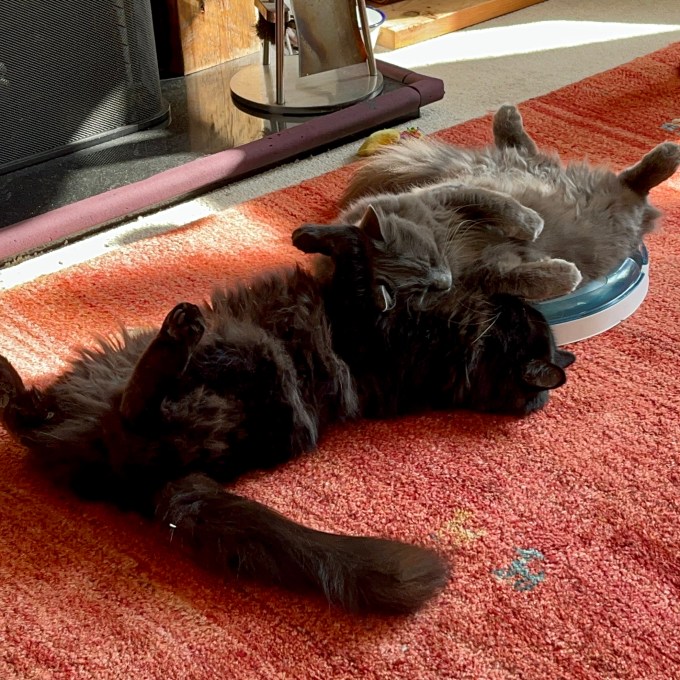
Sooty is my baby. She’s always seemed to think of me as her mother, even when she was a teeny tiny kitten. I wonder if that’s because Sweep and Mouse are always so entangled but whatever the reason, it’s adorable and I’m not turning down her affections. She always wants to sit on the sofa with me, demanding that I stretch out my legs so that she can stretch out between them; it’s her favourite spot. She’s also very playful and she and Lucy are a particularly playful pair, although she’ll play with anyone who will engage with her. She still feels very much a baby, Sweep too, even though they’re four now (which seems unbelievable to me but then I guess the pandemic really screwed with our perception of time) and that’s very sweet. I kind of hope she always will; I think she’ll probably always be my baby (although, to a degree, they’re all my babies).

APRIDEOFCATS
To avoid overwhelming people with cat pictures on my Instagram, which is focussed on me as a singersongwriter, I created a new account, aprideofcats, so that I could post as many as I wanted. It’s as much as for my own entertainment as anything else. I stopped using it for a while – when I was struggling with social media in general – but I’ve recently started posting on it and having a great time, trying to choose between the ridiculous amount of cute pictures that I have of them.
So there you have it: concrete evidence that cats are amazing. I’m just kidding, although I do love cats and my cats in particular. I think it’s fascinating that just spending time with animals – and in this case, cats – can have such dramatic effects on us and our health, physical and mental. I hope this has been interesting and fun and if you liked the cute little faces of my cats, please do follow my cat instagram: there will be plenty more photos of them going up.
(1) (2) (3) (4) (5) (6) (7) (8) (9) (10) (11) (12) (13) (14)
 Finding Hope