 Finding Hope
A Letter Under The Floorboards
Posted on April 16, 2019
Today is exactly a year since we moved house. That was a terrible day. It was stressful and upsetting and exhausting. I had a meltdown when we finally collapsed in the new house (surrounded by boxes and carefully balanced furniture) and neither me nor my Mum slept that night. It was all just too much.
It’s better now. I’m still adjusting, but then I had spent most of my life in that house so I didn’t expect a quick recovery. I’m getting there. My room almost feels like my room.
Since we moved out, we’ve actually learned quite a bit about the history of the house and the people who lived there. Our favourites are two women who lived and worked together their whole lives, the first head and deputy head of Varndean School. We even found pictures of them, which is really cool. We were all weirdly moved to learn these stories.
When we moved out, I wasn’t thinking about the history of the house and our part in it. I was just trying to figure out a way to say goodbye. So I wrote a letter and tucked it under the loose floorboard in my room. It was a letter to any and all future occupants, asking them to look after the house for us, for me. We’re part of the house’s history now and perhaps, one day, someone will find this letter and feel the same way about us as we feel about these two women. And since we live in a technological age and the first step of investigation is to google something, I thought I’d put this out into the internet. Maybe one day they’ll find me.
To whoever finds this,
This has been my bedroom, on and off, for about seventeen years. That’s most of my life. That’s a surreal thought, one that I’m trying not to obsess over. It took a long time to feel okay about moving and I’m scared that thinking too hard about all of it will be the wind that blows me back into that storm. I didn’t think I’d survive it the first time. I don’t want to leave but I don’t want leaving to be a life altering tragedy. I’m trying to remember that I don’t need this room to be me, even if it feels like that sometimes.
A lot has happened in this room, in this house. I grew up here, watched thunderstorms, brought friends over for dinner, celebrated birthdays and Christmases. I wrote stories and songs and my brother learned lines and turned the flickers of ideas into masterpieces. I said a last goodbye to my cat of fifteen years, learned that I could love another one, and then raised two litters of kittens with her. I taught my dog to sit, sneaked him onto the sofa when no one was home, and sang to him while emptying the dishwasher. I studied for GCSEs, A Levels, and my degree. I graduated with a first and I found out in this room. I had my heart broken. I struggled with my health and my mental health. I found out that my Dad had died.
I worry that leaving this room, this house, means leaving all of those things behind and that I’ll lose myself because of that. It may not be rational but it’s how I feel. I hope that I’ve managed to box all of that up with my belongings but I guess I’ll see when I get to the new house. There’s a little voice in my head that says that the rooms feel empty because we’ve packed all the memories and emotions but I’m scared to believe it.
Maybe this is all too flowery and fluffy for you. That’s fine. A room can be just a room. A house can be just a house. But regardless of whether you see it as four walls or a time capsule, please take care of it for me. For us. We have loved it dearly and hope that you will do the same. Fill it with life (and extra radiators because, as you’ll soon find out, it’s practically impossible to keep it warm). I hope you will feel as safe here as I have.
Look after this place. I’m trusting that you will.
LAH
16/04/18
What Women With Autism Want You To Know
Posted on December 8, 2018
The other day, I was just browsing through YouTube (probably procrastinating something) when I came across this video.
“Autism is not a disease, it is a developmental disability. It’s about living our best possible lives with this condition.”
I am ridiculously excited that this video exists. Even a few years ago, when I was looking into Autism as an explanation for my struggles, I was still being told that women don’t have Autism or being dismissed because I didn’t fit into the stereotype for Autism (which has come from autistic boys and men). So the fact that this video even exists shows that some progress has been made. At this moment in time, it has just short of a million views. A million! That means that potentially a million people now have a better understanding of Autism in women. That’s completely amazing!
There’s so much good stuff in this video – you really should watch the whole thing. But here are some of main points and some quotes that stuck out to me:
1. Autism covers a wide spectrum.
- “Autism is an internal thing, not an external thing. No one looks autistic.”
- “Autism isn’t a linear spectrum of high or low. It’s a whole bunch of different traits that are on their own spectrums. It’s kind of a 3D, weird mess.”
- “Autism is simply a different way of thinking, seeing, and interacting with one’s world.”
2. We have emotions.
- “I would definitely disagree with the idea that we’re not emotional. I think we’re actually highly emotional. I think that we just… many times we don’t express it the way people expect… We’re feeling it. It’s there. But it just might not come out. And then, at other times, it might be overly expressed.”
- “We can’t filter them out because we feel them so strongly so we shut down as a way of processing all those emotions.”
3. Social interactions can be challenging.
- “It takes a lot of effort to appear [like anybody else, like someone not on the spectrum]. Like, it takes a lot of conscious awareness. Social skills are like a muscle for us.”
- “It’s very, very draining. Even with people that I care for and enjoy being around, I have to psych myself up to be around them.”
- “All the little things that everyone does unconsciously, autistic people do manually. So that adds up. What I’m doing with every part of my body, I am to some degree aware of and trying to do.”
4. Diagnoses can happen at any age.
- “A lot of women, women that I know who are autistic, are not diagnosed until their twenties, thirties, or even beyond. A large part of this is because the way that we diagnose Autism is by using criteria that were created by observing boys and Autism looks different in girls and women than it does in boys.”
- “I feel like, ‘okay, I know why I’m this way, I know why other people are the way they are, so I can bridge this gap.'”
5. The nuances of dating can be challenging… but we do have sex lives.
- “We just may need more support in order to learn how to make [relationships and sex] happen. We don’t naturally understand the nuances that are involved and there are a lot of nuances.”
- “People on the Autism spectrum, especially women, are more likely to experience sexual assault or some sort of violent incident than the neurotypical, non autistic population. We are very vulnerable. We definitely can be more trusting because we are very honest and upfront people so we don’t think that other people might not be so honest and might be trying to hurt us.”
- “One of the traits of Autism is not reading between the lines in social interactions and so much of dating and sexually is supposed to be indirect and subtle and that it’s inappropriate to talk about sex in a direct way, even when you’re teaching it as sex ed.”
- “No one is teaching the social aspects [of dating and sex]. And honestly, this is where autistic people are the canaries in the coal mine. Teaching the social aspects of sexuality would help everyone. Autistic people need it but it also benefits everyone.”
6. We have lots of different interests.
- “There is a stereotype that everyone with Autism is into science and math and stuff, like Rain Man. But a lot of people with Autism… women actually, especially… a lot of us are into the arts.”
- “In my experience, autistic girls are also just as obsessive autistic boys. They’re just obsessed with, you know, fantasy novels or their favourite band or whatever. Not planes, trains, and automobiles.”
7. Bullying sucks.
- “You know, it’s like somebody making fun of a blind person only in this case you’re blind socially.”
- “We all start from somewhere but that isn’t necessarily where we’re going to end up and you have to believe that there is going to be a future.”
- “There’s enough misfits in the world, like, people who got picked on. There’s so many of us. So you do find your tribe.”
8. It’s getting better.
- “I think things are going to be a lot better for the next generation.”
- “You know, your kid might be behind their peers but it doesn’t mean they’re gonna be behind forever. Your kid is a full human being who will grow and change just like everyone else.”
As I said, it’s amazing that this video exists and that autistic women are being seen and that people are finally understanding that autism in women looks different than it does in men, and that it can look different from woman to woman. I agree with all of these points but there’s still so much to it, to living with this everyday. So, in addition to these points, this is what I, as an autistic woman, want you to know:
- I have no idea either – Just because these behaviours and reactions are coming out of my brain and my body, that doesn’t mean I necessarily understand them. I’ve done a lot of reading about Autism and mental health but it’s just different in real life. I’m learning everyday and I hope that you’ll keep learning with me.
- It’s exhausting – As these women said, it’s draining, even when it comes to things that you enjoy. It’s like you have to consciously process everything you do, everything around you, and that takes up so much energy. I cannot manage as much as everyone else and I find that so difficult to get my head around.
- I’m doing my best – I promise.
The Last Few Weeks…
Posted on December 1, 2018
I’m not quite sure how to describe the last few weeks. Intense, maybe. There’s been a lot going on and I’ve done things and felt things that I’ve wanted to write about but couldn’t figure out how. So I’m writing this, with the good, the bad, and the weird of the last few weeks.
So first, I got to take part in a research study for the Centre for Research in Autism and Education at University College London. I’ve written about my experience with research studies before (here) so I won’t ramble on but I love doing them. It often feels like Autism takes opportunities away from me but this allows me to do something I’d never expected and that’s really exciting. I got to put the EEG cap back on and have my brain waves monitored while I did some computer tasks. It was investigating perceptual capacity in Autism (which I’ve written more about here) and it was really fun, like a Windows computer game from the nineties. And apart from trying to get the saline gel out of my hair, it was a really great experience.

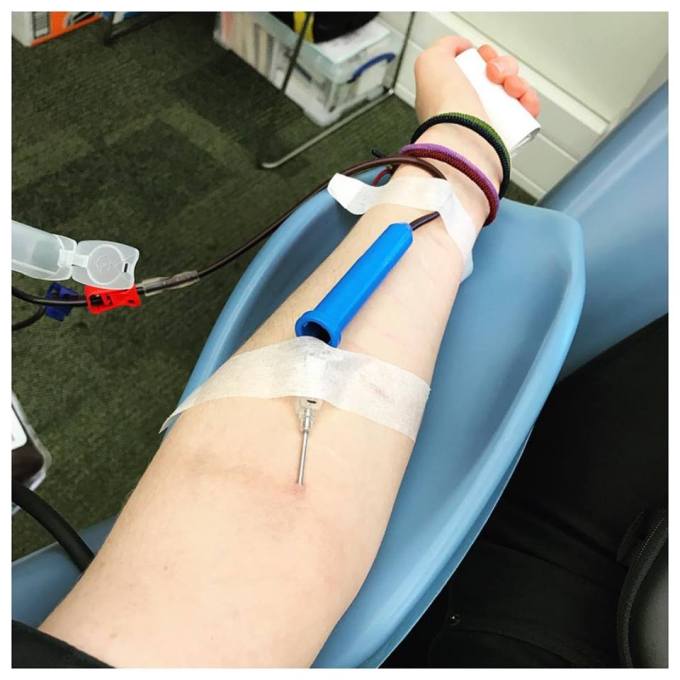
I also went and gave blood for the first time. That was very exciting! I’ve wanted to give blood for years but up until now I haven’t been well enough or I was on medication that disqualified me. So getting to do it was really exciting and a really cool experience. Everyone was really lovely and I’ve since had a text telling me where my donated blood has gone. So the whole thing was really special and I will definitely do it again.
Despite these cool and inspiring experiences, my mental health has been pretty bad: I reached a new low with my depression. I feel like I’m always saying that the current period of depression is the worst it’s ever been but for me, there are real differences: new thought patterns, new emotional states, new lines, new fears. Each period of depression has a different colour. Anyway. It’s been really bad and really hard and I’ve had some desperate moments.
Medication wise, it’s been a rollercoaster. As per usual. I got myself all but off the Amitriptyline a while ago but I just wasn’t ready to try another medication straight away. It’s a tough process and I just needed some time to feel steady, even if that was steadily bad. Maybe not the most logical decision I’ve made but it made sense to me at the time. And ultimately it doesn’t matter now. I’ve started the Clomipramine, which is what everyone wanted me to do. Finding the right medication and the right dosage can be pretty gruelling and I just needed to be in the right mental headspace. I’m not sure how I feel about the Clomipramine but it’s still early days.
And on this last Monday, I went to see Maren Morris play an amazing, intimate show at OMEARA in London. The staff were great about making it accessible and I was let in without having to queue and there was a chair reserved for me – I really, really miss the days where I could stand for hours without a problem. And the show was fantastic. Maren is one of my all time favourite artists/songwriters and it was one of the best shows I’ve ever been to.


“When this wonderful world gets heavy and I need to find my escape… yeah, I guess that’s my church.” // @marenmorris was a complete dream tonight. Beautiful, beautiful songs, singing, and stories. My little songwriter soul is so happy. (x)
It might be blurry but I love this photo of me and @richardmarcmusic after the @marenmorris show tonight. We had SUCH a good time. We’re constantly listening to her music, whether we’re in a songwriting session or just chilling out and playing Mariokart. So we were two happy beans tonight. (x)
And now it’s December. Most of my family have birthdays in December and January and of course there’s Christmas and New Year. So that’s a lot of fun things but it also means a lot of high emotion and stress. It’s a tricky time. I’ve found Christmas difficult for the last few years so I’m going to have to be careful to manage my physical and mental health throughout this period. I’m going back to the post I wrote last year about managing Christmas with anxiety and Autism – if that sounds like it might be helpful, you can find it here.
 Finding Hope