 Finding Hope
My Personal Warning Signs of Depression
Posted on January 26, 2019
In a recent therapy session, my therapist and I were talking about this latest depressive episode and what I’ve learned from it. Because I’ve learned A LOT. I’m not ‘un-depressed’ yet but coming out of it a bit has given me a new perspective on it, on my depression and how it affects me. Hopefully that perspective will be helpful to me in the future. Because depression can creep in very slowly, you don’t always notice the signs but in hindsight, there are a handful of things that should be red flags in my mind. Maybe being aware of these things can help me prevent the depression getting as bad as it did this time.
- Unable to write songs – I don’t mean a bit stuck. I mean a continued inability to reach the level of functioning necessary to write songs. Songwriters, do you know what I mean? I know exactly the feeling I mean when I write this and although it does sometimes come out of nowhere, it is the biggest sign that depression is creeping in again. It’s very distressing to be unable to do the thing I love the most.
- Losing my excitement – This was something I didn’t realise was gone until it returned. I’d get excited about things in theory but I assumed the dampened emotional response was just part of the depression numbness. But since I’ve started to feel better, my excitement has resurfaced about as dramatically as a volcano. It’s fun but a bit disconcerting. So, in future, if my excitement seems to have gone AWOL, I know that it’s a potential sign of depression.
- Overwhelming anxiety about the future – I am always anxious about the future so this is a tricky one but when it becomes overwhelming and it feels like more than I can cope with, than I could ever cope with, and it goes on for an extended period of time, it’s a symptom of my depression.
- Feeling hopeless – Similar to the previous one, feeling overwhelmed by hopelessness is a real sign of a depressive episode. It feels like everything inside me has stilled, like there’s a new, sharp clarity to everything. Everything becomes very simple and really pointless. We all feel hopeless now and then but when this feeling doesn’t pass, I know I’m in a depressive episode.
- Increased suicidal thoughts – This one is the final straw, the most telling sign. I’ve always felt very strongly against suicide so when these thoughts start to filter into my everyday thinking, I know I’m in trouble.
There are symptoms common in everyone – like low mood, fatigue, low self-esteem, and so on – but these are my personal warning signs. Do you know what yours are? Are they similar or different?

The Next Chapter in the Medication Chronicles
Posted on January 19, 2019
Just over two months ago, I finally stopped taking Amitriptyline and started taking the new medication I’d been prescribed, Clomipramine. I’d had the prescription for over a month but I just hadn’t felt able to start taking it: I felt so drained and so worn down by what felt like an endless train of medications that made me feel worse instead of better. And on the off chance that it worked, I didn’t feel ready to feel ‘better.’ It’s hard to explain but it felt like I’d physically feel better – chemically happier – but still have all these ‘depressed’ thoughts, a juxtaposition that I did not feel strong enough to cope with.
But on this particular night, I felt a little more steady and so I took advantage of that: I stopped taking the Amitriptyline and started the Clomipramine. I felt different almost straight away; it took less than a week. I felt physically lighter, like a fog had lifted, a fog that I hadn’t felt settle. It was disconcerting – I felt a little bit like I might just float away – but it felt good too. It felt cathartic.
Suddenly, I was excited again. I was excited about pretty much everything, from swimming and playing with the cats to bigger things like future writing sessions and far away holidays. I hadn’t realised that that was something that had disappeared. I’d been excited about things in theory, in the way I thought about things – I could recognise that something was exciting. But I wasn’t actually feeling it. So to have it back was exciting in itself. It was amazing and I savour the feeling every single time it appears.
The most exciting thing is that my creative brain woke up and started firing again. It’s like my depression completely suppressed my creative brain and so I was physically unable to write songs, to function at the cognitive level necessary to write songs. I wrote about this in a post a few weeks ago. I’ve got several writing sessions coming up which I’m really, really excited about so I’ll keep you guys updated as to how they go.
I’ve also been taking Pregabalin – for several months now – to manage my anxiety. It has reduced my anxiety to a degree but I’m still dealing with A LOT of anxiety, so I need to talk to my psychiatrist. But it has helped. Unfortunately, it hasn’t been side effect free: I’ve been experiencing muscle twitches, mostly in my legs but sometimes in other parts of my body too. And it’s gotten worse as I’ve increased the dosage. That can feel quite scary, to not be in control of your body… I’m in the process of trying a new anti-anxiety, Flupentixol. It doesn’t seem to have had much of an effect so far but I’m trying not to lose hope.
The excitement and the giddiness have faded a bit since the initial boost. I’ve had a pretty bad week: my depression got overwhelming for a moment there. I’m coming out of it but it was pretty scary and I still feel quite shaken by it.
So that’s an update on the medication front. As per usual, it’s been a bumpy road but things are better than they were and for that, I’m really grateful.
Situation Specific Mutism
Posted on January 12, 2019
I first found myself unable to speak when I went to see the doctor for my anxiety and depression, although I didn’t know that that was what it was at the time. I’d been referred to the ‘Wellbeing Service’ by my GP (who I’d been seeing since childhood). I have always struggled with anxiety and so my Mum – my hero – came with me to provide support and any extra relevant information I might forget in the moment.
But the anxiety built and built. I walked into the room and sat down and in that moment, I stopped being able to function. I felt like I had this massive weight on my shoulders, so heavy that I physically couldn’t lift my head. I stared into my lap, unable to move. I couldn’t even move my eyes. And even if I could have, sustained eye contact felt impossible. That’s something I still struggle with (there’s a blog post about that here). The meeting of eyes feels so incredibly personal, like they’ll see all of me or I’ll see all of them.
And I couldn’t speak. I knew what I wanted to say – I could just about hear my own voice in my head above all the anxiety – but I couldn’t physically say them. My throat felt painfully tight and my tongue refused to cooperate. I was trying to speak, trying to function, but I just couldn’t.
I was told that, if I wouldn’t talk, they couldn’t help me. That still upsets me all these years later because, to me, it seems so obvious that I was struggling with real, difficult anxiety. We walked out and suddenly the words exploded out of me and I was standing in the street outside, screaming and swearing and sobbing. I felt so abandoned.
From there, I went to a series of doctors and therapists but was unable to speak. My Mum spoke for me: we would discuss it all in detail before the appointments so she knew what I would say if I could. It was difficult and traumatic and I felt like I was getting sucked further inside myself with every experience of being unable to talk.
Eventually I ended up seeing an EMDR therapist called Mark. We sat on chairs in the middle of a big empty room that had a glorious view of London at night. Sometimes we sat on the floor and played dominoes. I couldn’t speak and I couldn’t look at him but after a while, we started using a white board and pen. Writing has always come to me more naturally than speaking. So he asked questions and I replied, filling the board with scribbles.
But in the end it wasn’t to be. Maybe it wasn’t the right thing, maybe it wasn’t the right time. We’ll never know. I ended up taking a break from all types of therapy. I just needed some space. And then, in the summer of 2014, I went to see a psychiatrist and I knew things had to be different. I couldn’t do it again. I needed to talk.
I don’t want to give the impression that selective mutism is a choice. It’s not. I didn’t simply decide to start speaking again in these highly stressful situations; it’s so much bigger than that. There was a shift inside me, an unconscious realisation that talking was the only way to create change. One of my parents describes it as “a leap for survival” and she’s not wrong. It was about survival, although I wasn’t conscious of that at the time. At the time, it was just another step in a long line of steps.
What I’ve learned throughout all of this is that everything changes. It’s like shaking a box full of puzzle pieces, trying to get all the pieces to land in their respective places. With every shake, it lands in a different arrangement and life looks different. Different things are possible. Sometimes it’s even enough to see what the picture is.
Somehow I was able to talk. I couldn’t tell you how. My psychiatrist has told me since that he didn’t initially believe that I struggled with social anxiety, and anxiety in general, because that first impression of me was so confident and articulate. He understands now that it was a matter of survival, desperation making once impossible things possible.
It’s been several years since I found myself unable to speak. Even though I continue to struggle with anxiety, it’s never again manifested in that form. But even now, I hate the phrase ‘selective mutism.’ It implies that there’s some element of choice, like I was (and others still are) choosing not to speak. If I could rename it, I would call it Situation Specific Mutism. I think that fits better.
I wish I could offer some wise words or some quietly brilliant advice to those still unable to speak. But I think the most important thing is finding someone who gets it and not giving up until you find that person. If it doesn’t feel right, it isn’t right. The right person – the person that will get you and make it work for you – is out there.
Somebody once told me the story of a boy who was only able to participate in therapy when the lights were off but up until that point, all the medical professionals in his life had refused to do that because it wasn’t how things were done. Sometimes it’s ridiculously simple but for whatever reason, people don’t want to make those adjustments. But there are people out there who will, whether that’s having someone with you, whether you need to write rather than speak, or use another medium to communicate. In my experience at least, sometimes you have to treat the anxiety in order to make communicating easier.
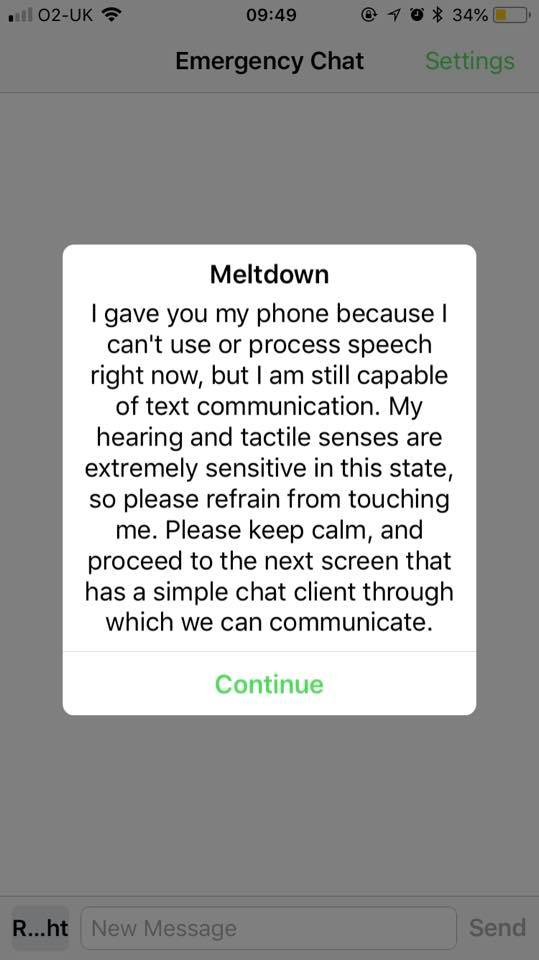
The last thing I want to leave you with is an app that might be useful. It’s called Emergency Chat and it’s designed for communication when speaking is difficult. You hand it over to someone and it shows a message that you can personalise to what you’re going through so that the other person can understand it better and then you can type back and forth, or not. The message itself may be enough.
I hope this has been helpful. And if you’re going through something similar, know that I’m thinking of you and sending good thoughts.

 Finding Hope