 Finding Hope
Quotes That Helped Me (Validation Edition – Part 2)
Posted on May 25, 2019
Of course, there are always more quotes! I had too many quotes on this subject to fit into one post so here are some more quotes that will hopefully validate some of your harder, more complicated feelings.
“I think my life is of great importance, but I also think it is meaningless.” – Albert Camus
“I don’t want to believe, I want to know.” – Carl Sagan
“I cannot understand why the world is arranged as it is.” – Fyodor Dostoyevsky
“God, I just want to be important. I just want to be someone real.” – Ritapa Neogi
“As far as I could see, life demanded skills I didn’t have.” – Susanna Kaysen
“I know too much and not enough.” – Allen Ginsberg
“I feel very small. I don’t understand. I have so much courage, fire, energy, for many things, yet I get so hurt, so wounded by the small things.” – Anais Nin
“The world changes too fast. You take your eyes off something that’s always been there, and the next minute it’s just a memory.” – Michel Faber
“Memories do not always soften with time; some grow edges like knives.” – Barbara Kingsolver
“It was because I was scared. Scared of standing out, scared of being invisible. Scared of seeming too big, scared of being too small.” – Malorie Blackman
“I don’t know where the strength went, I don’t remember losing it. I think that over time it got chipped away, bit by bit, by life, by the living of it.” – Paula Hawkins
“I am afraid I will be like this forever.” – Sierra Demulder
“For the first time in my life I understood how someone could consciously decided to commit suicide. Not because they were deranged, not because they were nuts, but because they’d been to the top of the mountain, and they just knew in their heart they’d never get there again. It was never gonna get, never gonna be that way ever again.” – Joe Biden
“The difference between how you look and how you see yourself is enough to kill most people.” – Chuck Palahniuk
“Sometimes suffering is just suffering. It doesn’t make you stronger. It doesn’t build character. It only hurts.” – Kate Jacobs
“I’m sick to death of this particular self. I want another.” – Virginia Woolf
“I’ve spent half my life not knowing the difference between killing myself and fighting back.” – Andrea Gibson
“I was horrified by life, at what a man had to do simply in order to eat, sleep, and keep himself clothed.” – Charles Bukowski
“You never forget. It must be somewhere inside you. Even if the brain has forgotten, perhaps the teeth remember. Or the fingers.” – Neil Gaiman
“There are times when I am convinced I am unfit for any human relationship.” – Franz Kafka
“Sometimes, I feel the past and the future pressing so hard on either side that there’s no room for the present at all.” – Evelyn Waugh
“Too much emotion, too much damage, too much everything.” – Ernest Hemingway
“It all ends in tears anyway.” – Jack Kerouac
Why I’m Not Writing About Body Image For Mental Health Awareness Week
Posted on May 18, 2019
For those of you who don’t know, this week is Mental Health Awareness Week and the theme for this year is body image. I’ve spent the whole week reading articles and looking at social media posts and wondering what on earth I should write, what I could say that’s worth adding to this movement. Body image is not something I’ve ever really written about and that’s because it’s something I find really hard to talk about. I haven’t even talked about it with my therapist. I just find it impossible to get the words out.
This afternoon, I was scrolling through the #BeBodyKind tag on Instagram and it made my soul really happy to see so many people working to embrace their bodies, even when they’re dealing with really difficult stuff. How wonderful and brave is that? But I’m just not there yet. My relationship with my body has always been difficult. I’ve never liked how I looked; I’ve always felt uncomfortable in my skin. And if I’m being honest, I haven’t been body kind. In fact, I’ve been really unkind. I’ve hurt my body, starved it, pushed it too hard, not pushed it hard enough. I’ve hated it. Most of the time I still do.
I’ve got a lot of shit to deal with at the moment but I’m trying. I’m not there yet but I’m trying. And that has to be okay. For now, at least.
‘Invisible’ Music Video – Out Now!
Posted on May 14, 2019
I’m so excited to announce that the ‘Invisible’ music video is finally out. This time last year, I put this very special single out and although I’d planned to put the video out straight away, life and mental health got in the way. But now it’s Mental Health Awareness Week again and I thought it was time this video saw the light of day. I would love it if you’d watch and I really hope you like it. It’s so, so special to me.
Almost two years ago now, I got together with Rosie Powell (my incredible director and videographer) and we planned this video. I really wanted to focus on the lyrics and the story behind the song so we came up with the idea of painting the lyrics on a wall (shout out to one of my parents for letting me paint all over my old bedroom wall). I was super excited. But having never been ‘in’ a music video before, I was also really nervous about being on camera. I felt really self conscious and worried about how my issues with eye contact would affect the video. Autism problems, am I right?
Day one was painting day. We set up in my childhood bedroom (and by that I mean, we lugged all the furniture out – which I then fell over multiple times) and got to work painting the lyrics on the wall.


It was really fun but weirdly, really hard work: it was very physical and I was exhausted by the end of it. It was also really cathartic to physically put those words out into the world. I’m not very artistic – I’ve never been very good at drawing or painting – so this was all new to me: seeing what I’d imagined in my head out in the real world. It was very satisfying to see this…
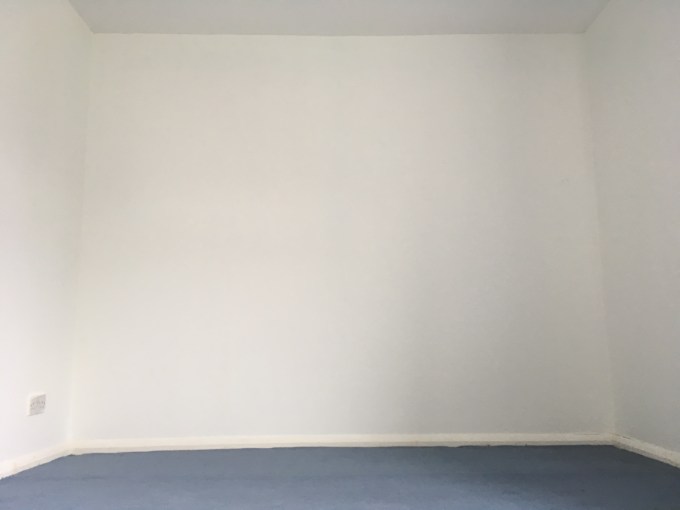
… turn into this:
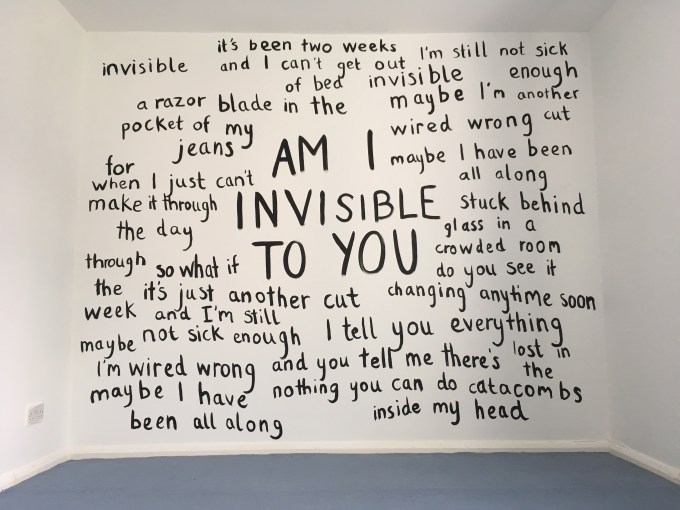
It was a really good day and I’m really proud of the work we did.
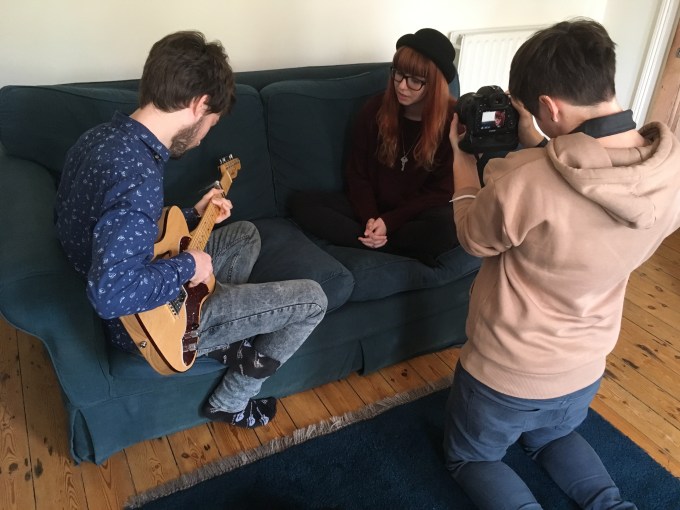
Day two had Richard (my writing partner and general partner in crime) coming down to Brighton and we shot the ‘performance’ section of the video. I felt very self conscious with the camera on my face so much but both Rosie and Richard are so lovely that I felt very safe. Again, it was exhausting – that might be my issues with fatigue coming into play – but really satisfying and fun.
I had a lot of plans for this single and the video but alas, they weren’t to be. Life happened and my mental health took a lot of hits (if you’ve been following this blog, you’ll be aware of some of them). My depression has been brutal and made doing anything musical almost impossible. It’s been a long, hard road but I’m so, so glad this video is out in the world. I’m so proud of it and I’m so grateful to have worked on it with such lovely people. I wouldn’t have wanted my first music video to have come to life any differently.

 Finding Hope