 Finding Hope
Surviving Is Better Than Not Surviving
Posted on March 19, 2018
Trigger warning for self harm. Please don’t read this if it’s something that will upset you or trigger you. I only want this to be helpful, never harmful. I also want to add that, while I’m not promoting or endorsing it, I’m never going to say, “Just don’t do it.” It’s just not that simple. My hope is that more openness on this subject will make it easier for people to access support and therefore not feel the need to do it.
It’s been on my to do list to write more about self harm ever since I posted the first piece. It’s one of those things that I will never get tired of talking about, never get tired of raising awareness for. There are so many misconceptions around it. I mean, I get it: there’s something inherently un-understandable about wanting to hurt yourself, unless you’ve gone through it. And even then, it’s massively complicated. Feelings are weird and pain is weird; it’s not surprising that people struggle to make sense of it. But I’d like to think that things will get better, hopefully sooner rather than later.
I was inspired to write this post after watching a YouTube video, ‘Living With Self Harm Scars’ by Claudia Boleyn. I’ve been watching her videos for more than a year now and I particularly love her videos about mental health. Borderline Personality Disorder (BPD) and self harm still aren’t commonly talked about so to find someone describing their experience, both positive and negative, and giving advice is invaluable. And to find someone so thoughtful and eloquent is even better. I really relate to a lot of what she says.
She’d posted a video in which she wore a short sleeve shirt that exposed some scars from self harming and had received several messages about how validating it was to see someone with visible self harm scars, without shame or drama. So, as a response, she’d decided to make a video discussing the importance of living with these types of scars, which I found both interesting and useful, even as someone with ten years of experience with self harm. She put into words so many emotions that I’ve felt but for a long time couldn’t vocalize. Had I had something like this when I was younger, life would’ve been very different.
The video isn’t necessary for the rest of the post to make sense but I really recommend watching it:
(EDIT: The video has now been made private but as I said, it’s not necessary for the rest of the post. I’ll update if this changes.)
Some of the things she says are so true it’s painful.
One of the biggest things about self harm is the release you get from doing it. My emotions get so strong sometimes that I feel like there isn’t space for anything else in my body, in my brain. There isn’t the space for my lungs to expand; I can’t breathe. It almost feels like the emotion is crushing me and the only way to survive is to open up my skin so that it can escape. It’s like a pressure valve. Once I’ve done it, I feel like everything stabilises and I can think more clearly. If there’s a problem, I can deal with it and if there isn’t and it’s just an overload of emotion, I can take care of myself a little better than I could if I hadn’t. As heavy as it sounds, Claudia describes it as ‘a way of not killing herself,’ which is a feeling I can empathise with. I’m sure many others can too. I’m not saying it’s a good thing and I’m not encouraging it. It is NOT a healthy coping mechanism. But that logic isn’t very persuasive when you’re dealing with such overwhelming emotions. Claudia also talks about this: “It’s not good for you in any sense… but it’s something. It felt like doing that at least proved that there was something there… And it just felt like this huge build up of feelings and I had to do something to get rid of it and doing that… was something.” I can completely relate to that and I think that’s a feeling that is often exacerbated by how difficult it is to get a diagnosis because having something is better than having nothing.
In my experience at least, trying to cut myself off cold from the only thing that helps me get through doesn’t help; it just makes the need worse and then there’s potential for me to do more damage. So I do my best to be safe while working on my issues in therapy so that one day, I can stop because I’m okay and not because I’m suppressing the urge. Because if that’s the case, I’ll always come back to it. To quote Claudia: “If you’re a self harmer then I think it’s always in the back of your mind as, like, a coping mechanism… The problem is: it’s always there so you always have to avoid it and avoid triggering it.” To give up self harming is a really big ask, and an even bigger one if you’re trying to do it without support. And if it’s too much for you, or for you to do all at once, that’s okay. I don’t feel ready to stop but one step at a time. The fact that my therapist supports this is a huge deal to me and it’s one of the things that told me that she was the right person. This has greatly lessened the pressure on me and has helped both me and my family to work through it a bit. I used to feel so guilty that I was hurting or upsetting them so I hid it and that was doing it’s own kind of damage. But now that we have a plan, now that we’re moving in a forwards-like direction even if it isn’t always easy, everyone seems to be coping with it better. I can’t imagine what it’s like for them to see me in that place but you can’t put that on top of the emotion that makes you want to do it; it will eat you alive. I think the only way forward is to try and talk about it with someone and do what you can to avoid it if possible.
I don’t have quite the same experience as Claudia does. That’s fine. Every response to self harm is a valid response. However you feel about it is okay; it’s your struggle. She talks about feeling annoyed and upset about having self harmed and wishes she hadn’t done it whereas I’m not (yet?) in that place. She talks about how it releases all that feeling but then you wake up the next day and feel like you’ve let yourself down. But, while that is quite a negative response, the way she talks to herself is very positive: “I’m just taking it as a stepping stone and saying, ‘Okay, you took a step backwards but you can take five hundred more steps forward. It’s fine.’” She talks about having a certain pride about them because they’re proof that she got through a really tough time. She can look at them and feel compassion and forgiveness for the version of herself in those moments: “It’s a part of me and it’s a part of my past and that’s okay. And I wouldn’t erase it and in a way, I wouldn’t want to because I’ve learned so much going forward.”
For me, self harm is usually a survival strategy. It’s getting through a moment that I feel like I can’t possibly get through. Maybe it’s the worst possible way to get through it but it’s better than not. So when I look at the mark the next day, or the next month, or the next year, I remember that moment: I remember getting through. I remember feeling like I can’t survive another second and then I remember the calm afterwards. I remember that I did what I had to do to survive. I wouldn’t say I’m proud of that – or proud of the scars – but I’m certainly not ashamed of it. Maybe one day I’ll find something that gives me that feeling without doing any damage to myself. How wild and glorious would that be?! But that’s the end goal, not the next step.
My other use for self harm is to mark a traumatic event. I think one of the hardest things about struggling with your mental health is the fact that people often can’t see what you’re going through and I needed it to be seen. I felt so traumatised by the strength of the emotions and by the meltdowns and I just couldn’t process that without a physical, identifiable injury to associate it with. Again, I’m not saying that this is a good method of coping but it was all I had at the time. Now, I have other things to try. I haven’t yet found anything that works but what’s important is that I’m trying, even if I don’t want to sometimes. This is a whole other issue that I do want to talk about at some point: to someone who hasn’t ever self harmed, the idea of not wanting to stop doing something that is so bad for you is weird, but is a feeling that is often associated with self harm. That feeling can be very isolating because many people don’t understand it, and many more react badly to begin with. And feeling misunderstood can really exacerbate the feelings that lead a person to self harming. I think that discussing self harm and learning about it can only help with that. There will be people who say that bringing awareness to it will encourage people to self harm and while that may be true to a certain extent, the amount of people it could help would massively outnumber that.
People do ask about the scars. I’ve personally never had an unkind response to them; it’s usually just awkward. Even if someone doesn’t actually bring them up, I see them notice and it can get really uncomfortable because no one knows how to handle it. Claudia mentions being embarrassed about people seeing them and talks about how she has tried in the past to cover them up. Sometimes that’s just easier. It’s so complicated and it’s hard when people don’t get it or jump to conclusions. There’s the typical, “You’re asking for attention,” which has always frustrated me no end. I’m not sure when asking for attention became such a negative thing. Of course, there will always be people who abuse the compassion of others, but I would hope that our first reaction would still always be to try and help. If someone is asking for attention in some way, they probably need it, even if the reason why isn’t immediately apparent. I never tried particularly hard to hide what I was doing because I think that, subconsciously, I wanted someone to draw attention to it and see what I was going through. But at the same time I didn’t feel able to talk about it.
Sometimes people see the scars and assume that you’re ‘showing them off’ when you don’t cover them up, which is weird to me. I’m not sure why you’d want to ‘show off’ or ‘flaunt’ the evidence of a moment where you’d gotten so low that you had to physically take it out on your body. When you think about the lengths people go to to hide their scars – wearing long sleeves in a heat wave, making endless excuses as to why you can’t go swimming, hiding them with make up or bracelets or tattoos, spending every second thinking about your scars and how you’re going to make sure that no one sees them – it’s clearly not a straightforward issue. And as Claudia says, it’s not showing off; it’s a form of body positivity, of learning to be comfortable in your skin, regardless of what that skin looks like. That is a hard thing; it’s something that should be supported, not torn down.
There’s obviously a lot more to talk about when it comes to self harm but this is already a lot longer than I’d originally intended it to be! This is something that makes me really emotional and fired up so I could probably write a book on it. It’s so important to talk about and talk about openly and honestly. I wish I’d found someone writing about it or recording YouTube videos about it when I’d started struggling with all the things I talk about on this blog. Had I, and the people around me, had more knowledge and awareness about all of this stuff, my ‘mental health journey’ would’ve been very different.
Hello and Goodbye to Lithium
Posted on March 7, 2018
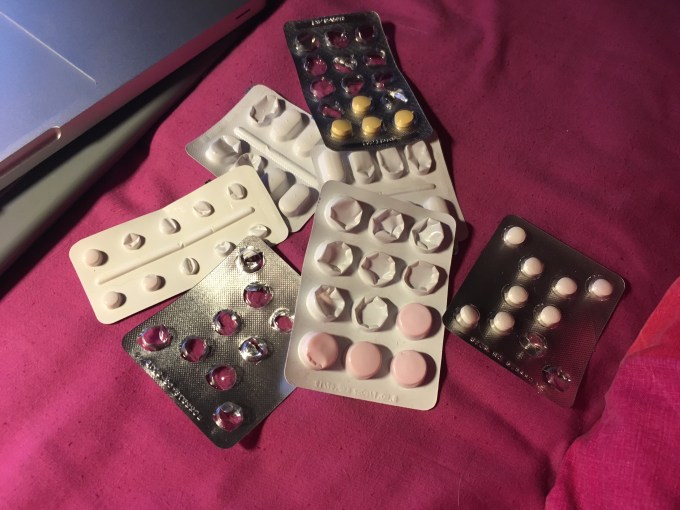
About a month ago, I went back to my psychiatrist. We discussed the Venlafaxine and since it hasn’t had the effect we’d hoped for, it was time to think about what to do next. The most obvious option, the one most likely to work in the shortest amount of time, was to add an ‘augmenting agent’ and so I started taking Lithium. I’m aware of the perception of Lithium but it didn’t worry me, not any more than any other medication anyway. I’m always hopeful that a new medication will work, and if that comes with the opportunity to defy expectations then it’s even better. So I was feeling optimistic and, as I did with the Venlafaxine, I took notes so that I could track any progress and/or side effects.
FIRST NIGHT AND NEXT DAY
As the first night and then day was pretty interesting, I thought I’d write this one up separately. I slept restlessly and woke up multiple times with night sweats. The first time I woke up was very surreal: I was overwhelmed by the physical sensations in my body. I remember thinking, “I can really feel my hands. I really have hands.” It was very strange. I struggled to get back to sleep and when I got up in the morning, I felt very nauseous. I had a headache all day and by the evening, I felt very spaced out and tired.
WEEK 1
The restless sleep and night sweats continued, joined by complicated and busy dreams. I found it very difficult to wake up and I was so sleepy that I was falling asleep multiple times during the day. When I was awake, I was tired and weak, like there was no strength stored in my body. It was frustrating and upsetting to struggle to do everything I would normally do. I was spaced out and nauseous and shaky; if I stood up for more than about thirty seconds, I got dizzy and nauseous and my vision went white. It was horrible.
WEEK 2
I was still having difficulty sleeping and was struggling with sleepiness during the day. I continued to struggle with nausea and feeling spaced out but I also felt low; I think I would’ve felt depressed if I was able to really feel anything. The shakiness and weakness also continued.
WEEK 3
And we STILL have difficulty sleeping. It was taking me hours to get to sleep and hours to wake up and in the few hours between, I slept very restlessly. Then when I was awake, I was very sleepy. The shakiness, weakness, and nausea combination was still around. I also started to struggle with almost constant anxiety; there were stressful things going on but I couldn’t seem to shake it off once I’d done those things so it was around all the time.
WEEK 4
Continued difficulty sleeping, especially staying asleep and then I was so tired that I fell asleep during the day. Those short sleeps were actually the best I’ve had in months, much better than the hours I got at night. I was also still struggling with the shakiness, dizziness, and nausea, as well as the anxiety.
WEEK 5
The restless sleep continued, as did the struggling to wake up. On several occasions, I fought to wake up only to fall asleep again; I also fell asleep during the day multiple times. I was constantly tired. The nausea and dizziness also continued, as did the anxiety.
I did not like taking Lithium. It didn’t actually help my depression – I’m still feeling very emotionally numb and the fatigue has only gotten worse – and the side effects were constant and actually got worse over time: the difficulty sleeping, the shakiness/dizziness/nausea combination as well as all of those as separate symptoms… I was struggling so much that I had multiple doctors’ appointments to make sure that nothing else was going on. I had blood tests and blood pressure tests and even an ECG. They didn’t show anything outside the normal ranges but the fact that it was bad enough to warrant those tests meant that I booked an appointment with my psychiatrist for as soon as possible to look at my medication.
I have now had that appointment and we’ve decided to stop the Lithium; he was surprised and impressed, I think, that I’d stuck with it so long considering how bad the side effects were. Since the Venlafaxine hasn’t done much for me, I’d like to try something else but given how much is happening in the next couple of months, I’m reluctant to put myself through the ordeal of getting off it, the period of no medication, and then getting onto something new. So for now, I’m trying a new augmenting agent and I guess we’ll see how that goes. I think the emotional numbness is preventing me from getting too low about anything but regardless of that, I’m still optimistic about medication, even with all the bad experiences I’ve had recently. I fully believe that it was Phenelzine that made going to university possible and even now, years later, I still remember so clearly how good I felt when I started taking it. It felt like I was flying. It was amazing. Searching for that will always be better than letting the depression take over, even if I have to let it take over to remember that.
Holding On And Letting Go
Posted on January 28, 2018
A while back, a friend shared this article on Facebook and I couldn’t not share it here. I’m currently in the process of going through everything I own in preparation to move house and so I’m coming across a lot of things that I have previously loved. I’m being constantly faced with the decision to hold onto something or to let it go. So I resonated with this piece very strongly.
I thoroughly recommend reading it but here’s a summary. The author describes feeling sympathy for inanimate objects, from “the guitar that doesn’t get played anymore” to “the once loved camera that has now been displaced by a newer one.” And the thought of an object being discarded causes great anxiety and sadness.
I’ve struggled with this all my life. As a child, all my toys had personalities and thoughts and emotions but that hasn’t faded as I’ve grown up even though I no longer play with them. They’re all still in my cupboard, neatly stored in boxes and bags. I feel guilty about that, that it must be uncomfortable and claustrophobic, but it’s better than throwing them away. That would be the ultimate betrayal. Imagining them in a bin or landfill fills me with such overwhelming anxiety and guilt that I can’t think properly. But it’s not just toys; it’s everything. I have a draw full of my old phones (how can I go from carrying them around twenty four seven to throwing them away?), a box of broken Christmas ornaments (it would be so callous to throw them out just because they’re not perfect anymore), my old school jumper, and so on and so on and so on.
Throwing things away is hard for me. I have this anxiety about letting things go, like I’ll lose parts of myself. Anything that has some meaning to me, I have to keep. It’s similar to how I write everything down and take a million photos. It goes with my difficulties around identity, a big part of BPD, and feeling like I have no idea who I really am. So I’m probably assigning aspects of my identity to physical objects in response to that. It certainly doesn’t help with all of this. And I wouldn’t be surprised if there’s a link to the difficulty I have in managing the strength of my emotions. I’ve talked about this before: how strongly I feel emotions and how I sometimes feel other people’s emotions. I’d always assumed that it was another facet of that.
The article discusses some other potential causes:
“There is some evidence to suggest that OCD and Synaesthesia are possible causes. Put simply, Synaesthesia is a neurological condition where the senses are confused. So someone with it, may smell a taste, or see a particular colour when thinking of a specific number. Some people have a form of Synaesthesia known as Personification. This is when a personality or emotion is attributed to an object. It would appear that there is a higher tendency for those on the autistic spectrum to have Synaesthesia in one form or another.”
The link to Synaesthesia is an interesting one. I do have some Synaesthesia-like experiences: with some sounds, I experience specific tastes or sounds. The sound of 7 chords leaves a metallic taste in my mouth so strong that I avoid those chords as much as possible and working on the production of my songs can be a bit of a minefield: high frequencies, like cymbals, are yellow while lower frequencies are dark colours (different depending on the instrument) and the colours in the song need to be balanced for me to be happy with them. It’s hard work and often leaves me with a debilitating headache.
I don’t know what the answer is or whether there is one. But I think the more we talk about this stuff and the more normal it becomes, the less we struggle against it. That takes up so much energy and emotion when living with these things is hard enough. That’s kind of why I started writing all of this stuff down, to feel less alone and hopefully make other people feel less alone too.


(Left: me and my toys when I was about eleven. Right: confetti that I kept from an amazing concert.)
 Finding Hope