 Finding Hope
Things I’d Tell My Younger Self
Posted on September 29, 2018
Have you seen the book where various different celebrities or famous people write letters to their younger selves? Some of them write pages and pages and some of them write a sentence, maybe two. But the majority of them reveal very little about their lives because they believe that the journey to the major events is as important as those major events. I don’t disagree with that but considering my levels of anxiety, it wouldn’t be the worst thing in the world for my younger self to have a little more certainty. Most of my stresses, then and now, are about the future so this would’ve been the perfect thing to calm younger me. Obviously this is a hypothetical exercise since we haven’t actually invented time travel and therefore don’t have to worry about causing a paradox that dramatically alters human history. We’ve all seen enough sci fi to know that that always ends badly.
- Your grades are only important for the next step. I know everyone keeps talking about how universities and jobs all look at your GCSE results and maybe in some fields – like medicine or if you wanted to be an astronaut (yes, I know, there’s a little bit of you that really does want to be an astronaut but, spoiler alert, that hasn’t happened yet) – that’s true but for the most part, your GCSEs only matter until you have A Levels and then your A Levels only matter until you’ve got a degree. Hopefully, you get my point. Try not to stress too much. If you get a grade that wasn’t as good as you wanted, feel it, process it, and let it go. Move on to the next thing. It will be okay. There’s always more than one way to get somewhere.
- Try not to worry about fitting in. I know you wish that you could be like the beautiful girls who all seem to have it so together but it won’t always be like that. The years will pass and you’ll be glad that you have your life and not theirs, not because there’s anything wrong with their lives but because you are where you’re supposed to be. I hope.
- You will get to Nashville. I know how much you want it. I’m not going to tell you how it happens because that journey is important but I promise you that you’ll get there and it will be worth the wait and the effort. I know it’s stressful and you’re terrified that you’ll never get there but you will. And it will be magical. Take it from someone who knows.
- Don’t let people treat you badly. You don’t deserve to be treated that way. There will always be people who think it makes them superior (*cough* or a better teacher *cough*) but it doesn’t. I know it’s really emotionally overwhelming but you are strong enough to stand up for yourself. I promise you, you are.
- It’s okay if you feel like you’re never going to get through something or if you feel like things are never going to get better. People will tell you that you will and you won’t believe them but that’s okay. There are things in life that you can’t know until you’ve experienced them. You can’t take pathways in your brain that you haven’t forged yet. So, when people tell you that time heals everything, try not to despair. They can say that because they have had that experience. It’s okay that you don’t yet. So keep going, keep living, and try to remember that everything you do and everything you experience is shaping you into the person you have the potential to be. And, chances are, a person who knows that time heals and a person who will annoy the shit out of a younger person by saying that time heals.
- You are so much stronger and can endure so much more than you think you can. I know that that’s not always a blessing but we have to believe it is, you and me. You’re gonna go through the wringer and it will feel really unfair but you’ll get through it. At the very least you’ll make it to twenty-four.
- There’s a reason you’re feeling the way you are. This is the point I’ve thought about most, about whether or not I should include it, but my gut says that I should. You’re autistic. I know that seems like a weird idea but you’ve always felt like your brain works differently to everyone else’s and this is why. Your only experience of Autism is the boy who was always being told off for being disruptive in primary school and most of the time, it’s really different for girls. You’ll figure it out, you’ll create a relationship with it, and what you learn will help other people.
Ultimately, there’s not much to be gained from wishing you could change the past and while there are things I wish had been different, I don’t think I’d change almost any of the things I had control over: the people, the pursuits, the loves… I’d choose them all over again.


A First Attempt at Bullet Journalling
Posted on September 15, 2018
As you guys have probably guessed, I’m a stationary enthusiast and over the years, I’ve gone through many, many notebooks and diaries and planners. I’m pretty picky about the kind of books I like and that’s probably why I’ve never found a planner that really works for me. The layout didn’t work or the writing spaces weren’t big enough and so on. So I was always on the lookout for the right one.
I started looking into bullet journaling after seeing photos and videos of bullet journal ‘spreads’ on social media: pages to track spending, sleep, mood… As well as monthly and weekly logs to keep track of what they were doing. It seemed to be a way of creating a very personal, tailored planner and that appealed to me, although I’m definitely not artistic enough to compete with the ones I’ve seen on Instagram and YouTube. But since it seemed to work for so many people, I thought I’d give it a try.
A lot of thought went into the bullet journal format (the official website is very informative) but in short, it’s a flexible system to “track the past, organise the present, and plan for the future.” Most people seem to use dotted notebooks (like the ones that Leuchtturm make) and dedicate pages to calendars (future log, monthly log, daily log) and trackers (habits, sleep patterns). I’ve found this incredibly helpful so I thought I’d share how I use it. Maybe this would be more easily done in video format but here we are.
At the beginning of the year, I bought a Leuchtturm notebook (dotted, navy blue, A5 – available here) and got to work. I looked at photos on Instagram and watched a tonne of videos on YouTube (AmandaRachLee is my favourite) and that really helped me to figure out what bullet journalling could be for me. I set up the index at the front and created several general spreads, including my new years resolutions, all the birthdays in the year, books to read, and things to watch. Carrying all of this around is so helpful and it has definitely made me more organised. And motivated.


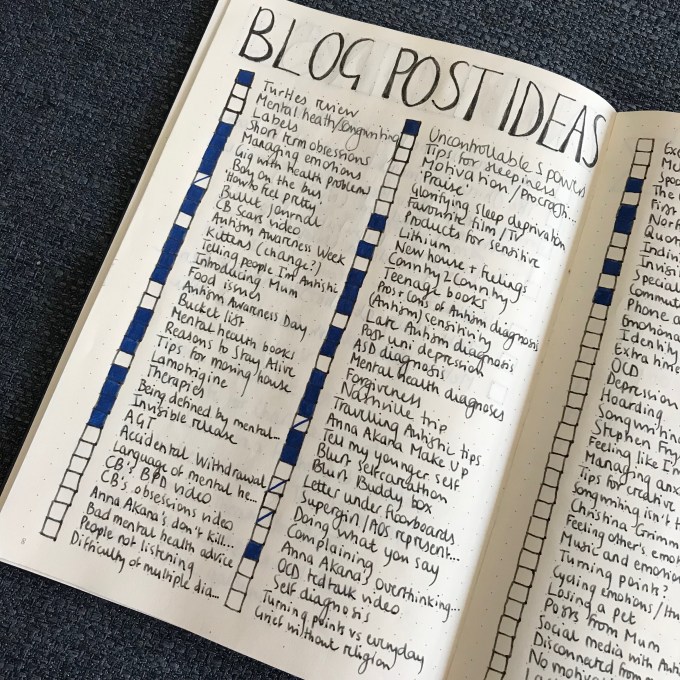
One of my favourite spreads is the one for blog post ideas (and it actually spilled over into a second spread because I ran out of space). I find it so inspiring and motivating to look at. I’ve always been a list maker and I LOVE being able to tick things off a list; I’m always more motivated and productive when I’m working from a list. Having all of these ideas in one place has made blog writing much more efficient.
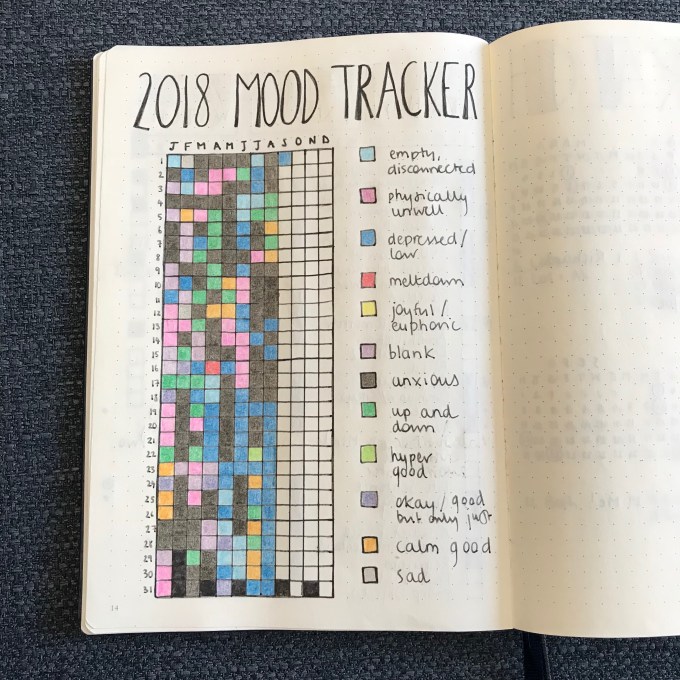
Many people do a monthly mood tracker but I did one for the whole year because I thought it would be easier to detect any trends in my mood and compare month to month. If I could do it again, there would be less categories. It took a while to figure out how broad each emotion had to be and as someone who feels emotions (and their subtleties) very strongly, it was very easy to create more categories than I necessarily needed. And I think a smaller spectrum of colours would make the whole thing clearer.
I found this particularly helpful when trying to judge my reaction to a medication: I could literally track my mood through each dose increase and assess how helpful it was. Sometimes it’s easy to get lost in one side effect or judge it based on the most recent feelings rather than the overall experience. So it was really helpful in regards to that.
Now to the month-to-month, week-to-week stuff.
It’s pretty standard to do a monthly log: a month at a glance of sorts so that you can see everything you’re doing during that period of time.


One thing that I love about bullet journalling is that you can refine your style and system as you go, to make it more useful to you. I went through several different layouts before I found the one that really works for me, at the moment at least. And you can be as creative as you want or feel capable of being. I’m not very artistic – in the drawing/painting sense of the word – but it’s been fun (and oddly empowering) to try my hand at something I don’t usually do.
Again, it took me a while to find a weekly set up that I liked. But I really like the one I’m using at the moment. It’s simple and quick to fill out and not overwhelming to look at.
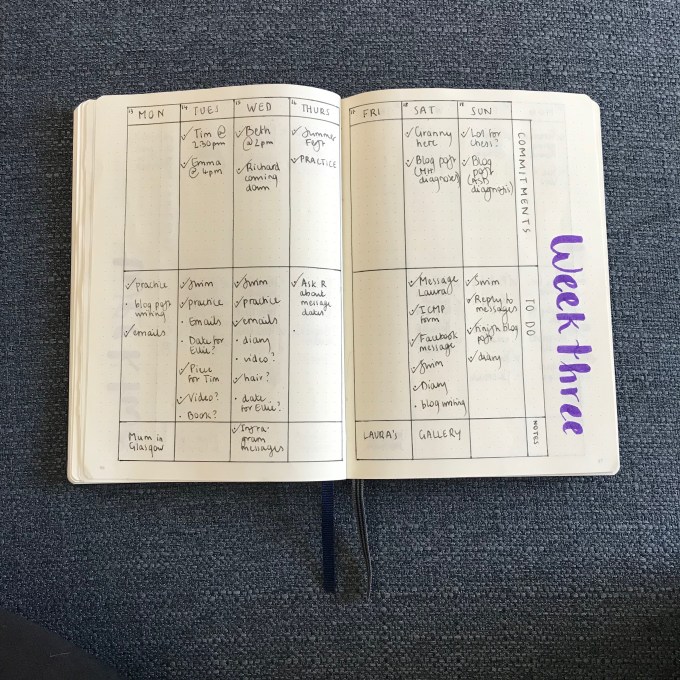
The official bullet journalling style involves a system of categorising all the information (tasks, events, appointments, etc), checking off tasks, ‘migrating’ them to a later date… Personally I found it overcomplicated and just not necessary. I know that there are people who like it, people who don’t, and people who have either simplified the official key or created their own version. But this is what’s great about this whole format: you can tailor it to what you need.
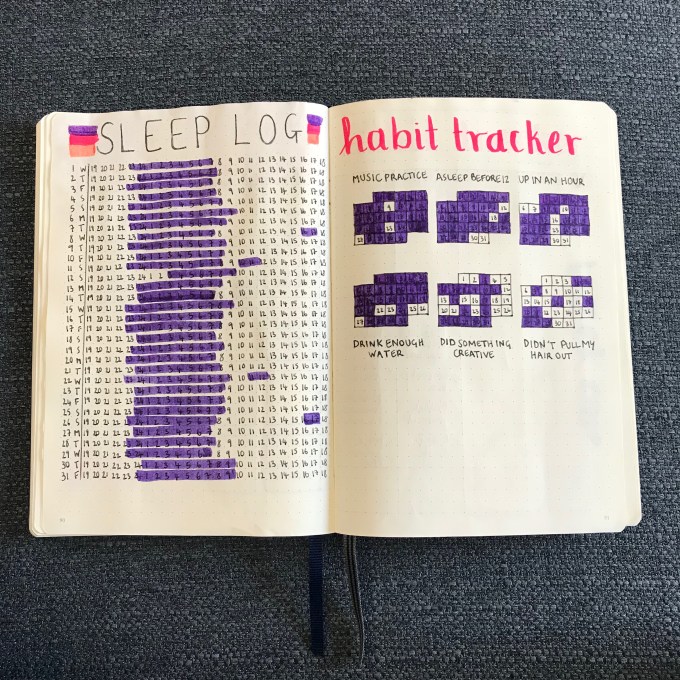
And lastly, I’ve recently started using trackers as part of my monthly set up. I kept the list of tracked things short so that it was actually doable and I ended up finding it really useful. Having that list of things written down made it easier to remember to do them and to build the habit. And as I said, I love ticking things off a list so the idea of filling in the boxes at the end of the day was really motivating.
So I hope this was interesting. If any of you guys use bullet journalling or any other system for organising your life, let me know what works for you!
Remembering Claire Wineland
Posted on September 8, 2018
I couldn’t not acknowledge that Claire Wineland died on Sunday. I still don’t really know what to say; my emotions are all over the place. But I did want to say this: I might not have known her in the traditional sense – we never met and our relationship consisted of a few interactions on Twitter – but she deeply inspired me and therefore meant a lot to me. I will miss her tremendously and my thoughts are with her friends and family. She was so, so special and her impact is on-going, like the ripples you see when you throw a pebble into a pond.
So, with all of that said, I wanted to share one of her TED talks. She talks about living with Cystic Fibrosis, how hard it is, and how living with an illness can affect your perspective, as well as how people treat you. She’s an amazing speaker.
“You can have a painful life, you can suffer, you can experience what it feels like to be a human being – all those messy and gross emotions – and yet you can make a life for yourself that you are very, very proud of.”
“I wanted to share the fact that you can suffer and be okay. You can suffer and still make something. That the quality of your life isn’t determined by whether you’re healthy or sick or rich or poor. Not at all. It’s determined by what you make out of your experience as a human being, out of the embarrassing moments and the painful moments. It’s what you make and what you give from that place.”
She talks about reading a book by Stephen Hawking as a young teenager and learning about space and suns and black holes. Her enthusiasm makes me laugh out loud (and then cry). And that led her to learning about Stephen Hawking himself and the disease he lived with and all that he contributed to society anyway. He was her first role model.
She talks about how she questioned why she had to work so hard just to stay alive and how she was desperately looking for something to contribute, something to give her life meaning. She wanted more than just surviving. And then, at thirteen, she almost died and went into a coma that no one thought she’d come out of. But she did and she was just blown away by all the support she received. That made her realise that that is not the case in many families living with Cystic Fibrosis and so she created her foundation, The Claire’s Place Foundation, to assist those families.
Six years on, she was struck with the realisation that she’d become the person that she had been looking for, someone to look up to who was sick and still contributing to the world. She was using her experience to give something and she was living a life she was proud of, that thirteen year old her would be proud of.
“And that’s all that we can have in life. Because the truth is, it’s not about being happy, right? Life isn’t about just trying to be happy. Honestly, happiness is a Dopamine in the brain. If I was to sit here and tell you all to just be happy, I’d just tell you all to go smoke a joint and listen to Bob Marley and just call it a day. We don’t need any of this TEDx stuff, you know? Life isn’t about being happy. Life is a rollercoaster of crazy emotions: one second you’re fine and the next second you feel lonely and despair and like nothing’s ever gonna be okay again. It’s not about emotions; it’s not about how you feel second to second. It’s about what you’re making of your life and whether you can find a deep pride in who you are and what you’ve given because that’s so much more impactful, so much deeper than whether you’re happy, or content, or joyful. It’s okay to feel pain. In fact, if you can actually experience it without judgement, without, you know, trying to fix anything. Nothing’s wrong with any of you. Nothing’s wrong with me. I don’t care that I’m sick. At all. Genuinely. If a cure came tomorrow, I wouldn’t care. Because that has not determined the quality of my life. I’m not trying to fix myself. My suffering has given me so much, and I’ve been able to make something and give something to people from it.”
In some ways, it’s hard to watch because it’s devastating to see her so engaged and dynamic and thoughtful and funny and know she’s not here anymore. It’s hard to watch her talk about surviving the odds, surviving the coma she was in at thirteen, knowing that she didn’t survive the odds this time. But at the same time, this video is a tiny piece of proof amongst all the noise that she WAS here, that she WAS so engaged and dynamic and thoughtful and funny.
As I said, I will miss Claire immensely but I’m incredibly grateful to have videos like these to watch on the hardest days.
 Finding Hope