 Finding Hope
The DSA Process For My Masters Degree
Posted on September 12, 2020
Since the academic year is starting up again, I thought I’d write about my experience with getting support for my Masters Degree as a disabled student. The DSA (Disabled Student Allowance) process can be very difficult so, having been through it twice now, I thought I’d share my experience. I don’t know if I’ve had a good, bad, or typical experience but I thought that simply putting the experience out there might be helpful to anyone at the beginning of this process, to give them an idea of what may happen down the line. As I’ve already said, it’s difficult and tiring but that’s not to say that I would discourage someone from applying. I was just very naive going into it the first time and was blindsided by how complicated and stressful it was; I’m lucky to have had help going through this both times. Having support from sources such as DSA can be hugely beneficial but I wouldn’t want anyone going into the application process unaware so I thought I’d share my experience as I haven’t seen many accounts of the whole process…
I wrote about my first assessment in great detail here, so I suggest reading that but I’ll also sum it up here to make sure I’m sharing the full experience in one place. So… That first assessment was a complete disaster. The assessor was perfectly nice but when we got to discussing what support DSA was willing to offer me, it went downhill fast. They would offer me a laptop, but not one with an operating system required to run the programs I needed for my course because apparently that was a course specific need rather than a disability specific need despite the fact that I – a disabled student – needed them to do my course. They wouldn’t offer me any travel support towards commuting because I’d ‘chosen’ to live at home when I actually had to live at home because of my disabilities. And they have no direct contact with the universities themselves so they couldn’t offer any support through them. So, essentially, they weren’t going to offer me anything because my needs didn’t fit their guidelines, because my disability didn’t fit with their idea of disability. It was hugely frustrating and distressing and I left in tears. I felt completely let down and abandoned.
By the end of the assessment, I was so utterly distressed that the assessor told us that we could appeal, which we did. The second assessment was with a different person, a really lovely woman called Rebecca, and was much longer and in much more depth. We went through everything again in minute detail: from the necessary computer specifications to the exact details of an average university day’s travel. She went through all the possibilities and all the potential outcomes, as well as the potential roadblocks and the reasonings behind them. It was a lot of information but I did leave feeling more hopeful; I really felt like she was on the case, like she was really committed to helping me get as much support as possible. Her report went through several different people before reaching a senior SFE (Student Finance England). It was initially rejected but then, when we provided them with documentation proving I receive PIP (Personal Independence Payment), they changed their minds and granted me a new laptop, software and apps to help with my lectures, independent study, and mental health, and mentoring through the National Autistic Society (although it seems that, due to the pandemic, this service no longer exists). I didn’t get any support for the travel but I’m grateful for what I did get, plus the travel costs haven’t exactly been an issue over the last few months… From that second assessment, it was four months before I received the support I was awarded.
In my experience, the whole DSA process is very slow. It was slow when I went through it during my Bachelor’s Degree and it’s been even slower this time, presumably due to the pandemic. I started this process in January – much later than intended but my mental health was so bad that I couldn’t handle the in person assessment – and didn’t get the equipment until June. Then the laptop that arrived wasn’t the right one and so we had to spend another two weeks – and a somewhat ridiculous amount of emails proving that it was in fact the wrong one – organising the swap, insuring that I got the one that my DSA assessment had determined I needed. A couple of weeks later, the new laptop arrived but setting it up took much longer than it should have. This was due to how the people who’d previously worked on my laptop had set it up, making the transfer of all my files much more complicated and messy. It’s still not as sorted as I would like it to be but it is functional.
Factoring in all of this, had I been doing my Masters in one year rather than two, I would’ve had this equipment for less than a semester before I finished the course. Yes, this was affected by the pandemic, problems with the university Autism support person, and the late start in pursuing DSA but that was due to the reasons I was in need of support so it’s not the most efficient system in that regard: what happens if you’re too disabled by your disability to seek help?
The laptop and software that DSA have provided me with has been invaluable, especially since my laptop was dying a slow death around the time I received the new one. We didn’t get everything we were hoping for but it’s definitely better to have it than to not. So, having now been through this twice, I thought I’d offer some tips that would’ve been helpful to me before going through the process…
- If you disagree with part or all of the final assessment, ask to talk to someone else – It’s not something you’re necessarily made aware of when you have the assessment but I was so distressed by the end of the assessment that the assessor told us we could appeal. My second assessment yielded quite different results than the first one so it’s definitely worth asking if you feel that you haven’t been heard or fully supported.
- Ask what kind of documents act as proof of a need for support – The earlier you find out what paperwork might help your case, the quicker the process will go. We, unfortunately, didn’t know that the PIP documentation was helpful and the whole thing may not have taken so long if we had.
- Take someone with you as it can be overwhelming and tiring – These assessments can go on for hours and there’s a lot of information to both give and receive. Plus, it can be a pretty emotional experience so having someone with you can make the whole thing easier; you have someone to lean on and two pairs of ears to take everything in.
- Ask for everything that you would find helpful – You might not get it all but you definitely won’t get it if you don’t ask and hopefully you’ll get some of it. It’s also always worth asking what you’re potentially entitled to because there may be things you aren’t aware of that could be helpful.
- If you’re told something isn’t possible, ask why – The assessors can’t know every relevant question to ask and you can’t know every relevant piece of information to give so if they tell you something isn’t possible or available, it’s worth asking why because you may have some information or some paperwork that changes the situation and what support you can get.
I hope this post is helpful for anyone considering or going through the process. I hope I haven’t made it sound too scary. I really do recommend it but I wouldn’t want anyone to be unaware of how difficult and stressful it can be. You deserve to get the support you need and I only want to make that easier, if only by arming you with information and advice. So, if you’re going through it, I wish you the best of luck and I’m rooting for you.
‘Invisible’ Music Video – Out Now!
Posted on May 14, 2019
I’m so excited to announce that the ‘Invisible’ music video is finally out. This time last year, I put this very special single out and although I’d planned to put the video out straight away, life and mental health got in the way. But now it’s Mental Health Awareness Week again and I thought it was time this video saw the light of day. I would love it if you’d watch and I really hope you like it. It’s so, so special to me.
Almost two years ago now, I got together with Rosie Powell (my incredible director and videographer) and we planned this video. I really wanted to focus on the lyrics and the story behind the song so we came up with the idea of painting the lyrics on a wall (shout out to one of my parents for letting me paint all over my old bedroom wall). I was super excited. But having never been ‘in’ a music video before, I was also really nervous about being on camera. I felt really self conscious and worried about how my issues with eye contact would affect the video. Autism problems, am I right?
Day one was painting day. We set up in my childhood bedroom (and by that I mean, we lugged all the furniture out – which I then fell over multiple times) and got to work painting the lyrics on the wall.


It was really fun but weirdly, really hard work: it was very physical and I was exhausted by the end of it. It was also really cathartic to physically put those words out into the world. I’m not very artistic – I’ve never been very good at drawing or painting – so this was all new to me: seeing what I’d imagined in my head out in the real world. It was very satisfying to see this…
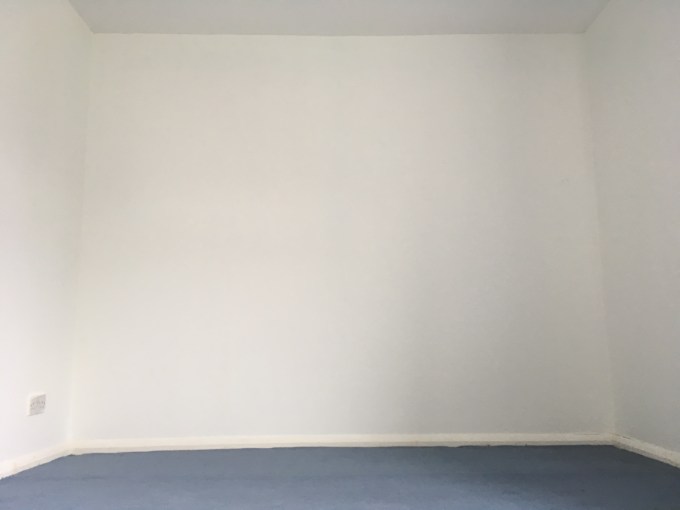
… turn into this:
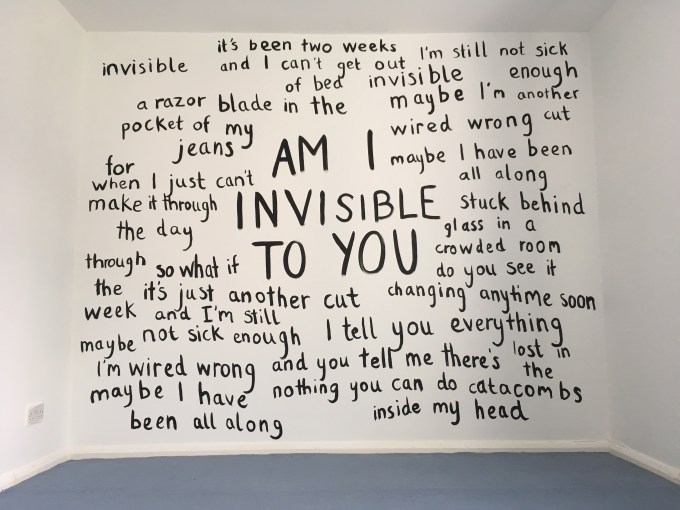
It was a really good day and I’m really proud of the work we did.
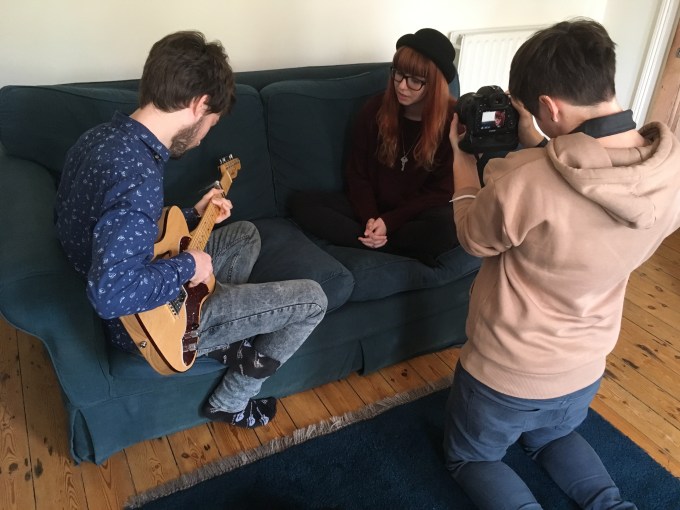
Day two had Richard (my writing partner and general partner in crime) coming down to Brighton and we shot the ‘performance’ section of the video. I felt very self conscious with the camera on my face so much but both Rosie and Richard are so lovely that I felt very safe. Again, it was exhausting – that might be my issues with fatigue coming into play – but really satisfying and fun.
I had a lot of plans for this single and the video but alas, they weren’t to be. Life happened and my mental health took a lot of hits (if you’ve been following this blog, you’ll be aware of some of them). My depression has been brutal and made doing anything musical almost impossible. It’s been a long, hard road but I’m so, so glad this video is out in the world. I’m so proud of it and I’m so grateful to have worked on it with such lovely people. I wouldn’t have wanted my first music video to have come to life any differently.

Invisible – Out Now!
Posted on May 16, 2018
I can’t quite believe that I’m actually posting this but dreams do sometimes come true and my first single is out now! It’s called ‘Invisible,’ and it’s all about my experience with mental health, with trying to get support. I felt like I was drowning and yet the people who were supposed to help me couldn’t see it; I felt invisible. And that’s where this song came from. I wrote it with one of my best friends, Richard Sanderson, and now that it’s out in the world, all the proceeds are going to Young Minds, the mental health charity for young people in the UK. So please go and buy/stream/share it. I hope it will mean as much to you guys as it does to me.
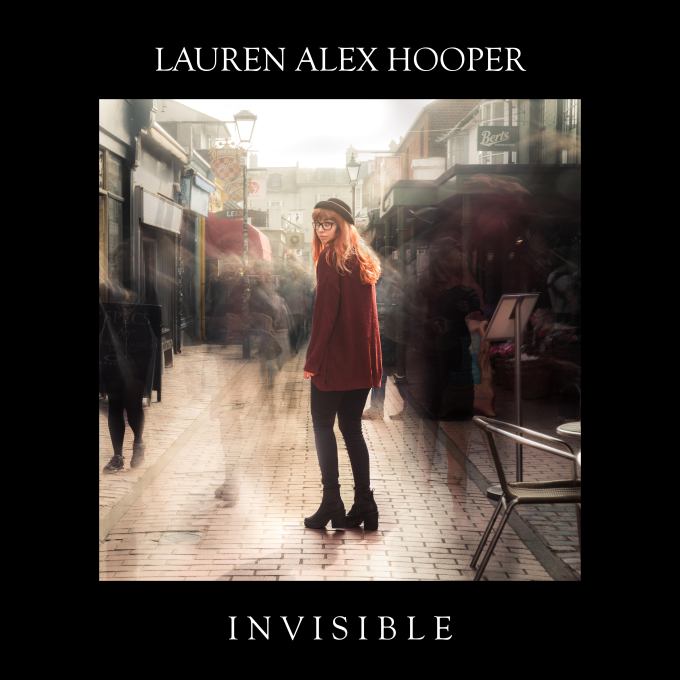
There’s more to say and more content to come, stuff that I’m really excited about, but I just wanted to announce that it’s out! This song, and this project, means so much to me and I’m both excited and scared to see where it goes. Please check it out; you can find it here.
 Finding Hope