 Finding Hope
The First Six Months of Hydrotherapy
Posted on August 13, 2022
When I was first diagnosed with Hypermobile Ehlers-Danlos Syndrome back in October 2020, hydrotherapy was recommended both for general fitness and muscle strength (which would, in theory, help with the back and leg pain I was struggling with) and to build up my core muscles, which are a notoriously weak area for hypermobile people. I was up for that since I’ve always enjoyed being in the water but COVID made the whole process very complicated and very slow.
As far as I can tell, with the way things currently are, it seems that the way to get a referral for hydrotherapy is to be referred for physiotherapy and then a physiotherapist assesses you and refers you on to the hydrotherapy department. I’d been referred for physio three times, I think, by three different doctors between May 2020 and when I finally got an appointment in November 2021. I find myself feeling a level of righteous indignation over waiting eighteen months for a simple referral, especially when I was in pain pretty much every day, but I know it was all more complicated than that. COVID was the obvious cause for the delay but the NHS waiting lists are also incredibly long anyway. But, as soon as it all started happening, it all happened at once.
At the beginning of November 2021, I met with a physiotherapist and he referred me on to the hydrotherapy department and at the end of the month, I had an appointment with them. I will admit that, after waiting eighteen months for an appointment, I was a bit appalled that the appointment consisted of just a half hour run-through of exercises to do without a huge amount of guidance. But this is how the system works and I’ll take what I can get.

While I continued swimming in my ‘normal’ pool, I struggled to find a pool that allowed me to do all of the exercises I’d been assigned: the height of the water needed to be within a certain range, I needed to be able to walk in the water, I needed a step of a specific height and width, and so on. And finding a pool that fitted all of the requirements was difficult, and that was without all of my COVID related anxieties being factored in. We finally found a pool just as Omicron started rearing its head and I had a meltdown leaving the first session; I was massively overstimulated and my anxiety was just overwhelming. Those weren’t exactly fond memories that I was keen to revisit but it wasn’t going to work anyway as the steps didn’t allow me to do the step related exercises and there are too many of those not to have access to the right kind of steps. I was managing a modified version of the exercises in my usual pool while we searched for another hydro-friendly pool but then Omicron hit in earnest and we all retreated inside to insure Christmas could go ahead as planned.
From December 2021 to early March 2022, I was incredibly unwell because of the ADHD medication I’d been trying, too unwell to swim at all. But, in that time, my Mum had found another pool. The first session went well (although it was really hard work after so little movement for a couple of months) and the set up of the pool meant I could do all of the suggested exercises. I got a few sessions in before I left for Nashville in late March.
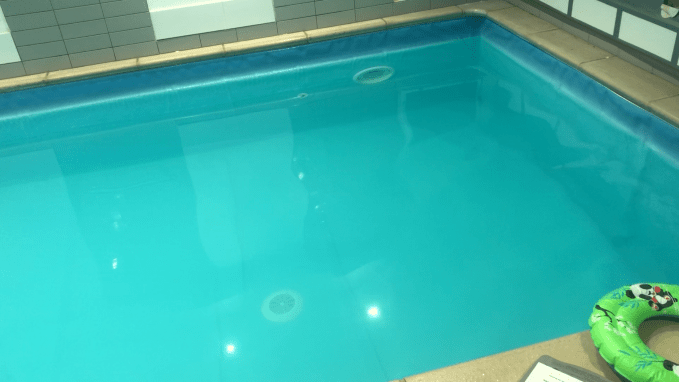
Back from Nashville and semi-recovered from the jet lag in late April, I got back in the pool, both to swim and to do my hydro exercises. It took a bit of work and scheduling but after a while, I managed to build in two sessions a week while I got used to the routine and started building up my strength and stamina after so little proper exercise for so long. I’ve had multiple conversations with multiple health professionals about my tendency to throw my all into stuff and how I need to take things slowly if it’s going to actually help so, even though it’s very frustrating, I am trying my best to push down that irritation and just focus on the exercises.
So, that was my first six months of hydrotherapy. There’s a few months between where this post finishes and where I am now but I thought those first six months were important to document. Since then, I had to stop using one pool and tried out another – which I love – despite difficulty actually getting out to swim because my mental health has been so bad.
Although it hasn’t been a priority (and still isn’t one really – one thing at a time), I do want to find a new all-round gym since the gym I used to go to closed down after the multiple lockdowns. I want to get fitter; I’m just having to take a longer route than I would’ve previously thought.
Another Autistic Summer
Posted on August 1, 2022
Summer as an autistic person can be really difficult. There are a lot of changes and some of them can feel quite extreme, quite overwhelming: the heat, the humidity, the general increase of people out and about… It can feel like a lot to deal with. I don’t pretend to know everything – not by any means – but I thought I’d share some of my thoughts and strategies for dealing with some of the big summer stresses…
SENSORY ISSUES
- Too bright – While bright skies are a sensory issue year-round, the summer months are hard in their own way: the light feels like it has a different intensity, it reflects back at me differently, it’s a different colour, it’s present for more hours of the day… It’s hard work on my eyes. I like working in my living room because it has white curtains, allowing for some light but without the glare (although anti-glare glasses are a good option to explore if you’re struggling inside). Outside, sunglasses are the obvious protective measure, but polarised sunglasses are better if you can get them.
- Too noisy – I find noisy environments very stressful and my anxiety only increases the longer I am in that noisy environment. The sensory overload is just too much and I become less and less able to function. And with more people around in the summer, the noisier it tends to be and therefore, the more stressed out I can get. I’ve found that the most effective coping mechanism is noise-cancelling headphones but playing music or audiobooks/podcasts through headphones and earplugs (if you find them helpful, you can have ones specially made – relatively inexpensively – to fit your ears, making them more effective) also work.
- Too hot – I’ve always found the heat of the summer very difficult and have been using open windows, fans, damp flannels and so on for years. But over the years, I’ve found the noise that regular fans make more and more anxiety-provoking so I finally invested in a Dyson silent fan. It was expensive (note: they are less expensive outside the summer months) but it was one of the best investments I ever made in managing my day to day health; it’s the most effective fan I’ve ever had and I use it year round. It’s more than made up for the expense. It’s also important to remember to drink as much water as you can – this is especially important for those with hEDS as well as dehydration makes the symptoms worse. Carrying a water bottle with you, having an app that reminds you to drink regularly, and so on can help you to remember and help you to build it into your routine.
- Different clothes – Following on from problems with heat, that often demands an entirely different wardrobe, which can be a less than comfortable change, literally and figuratively. It can involve different, uncomfortable fabrics or less fabric altogether, which can result in chafing or just feeling really exposed when people look at you. Finding specific fabrics – like cotton or linen – that aren’t irritating can be helpful. Layering, so that you can stay covered up as much as you need to to be comfortable, with thin fabrics can allow you to balance the need to keep cool and the need to be covered. And if you find a piece of clothing that really works for you, I recommend getting several to avoid the repeated stress of trying to find comfortable clothes.
- Crowds – As we know, in the summer, there are more people out and about and the world just feels more crowded. Public places are busier and that can be really stressful. Especially with the anxiety around COVID-19, crowds and crowded places can feel overwhelming which can cause anxiety attacks or meltdowns. The obvious advice is to avoid busy places at peak times but we all know that that’s not always possible. We all have our own strategies for managing anxiety but the ones I find most helpful in this situation are having someone I trust with me, giving myself plenty of time so that I don’t have that additional pressure, and I’ve also found the sunflower lanyard useful in certain places.
CHANGES IN ROUTINE
- Day to day changes – For some of us, our routines change regularly with the seasons but that doesn’t make it any less stressful. As someone who finds change very stressful, I try to make these changes slowly so that I have time to adjust and don’t end up feeling overwhelmed. It requires planning but it can really reduce anxiety.
- Loss of structure – While this isn’t, of course, applicable to everyone, the summer is often when people have time off from their usual occupation or go away on holiday. And with these things, we often find ourselves without structure. A lack of externally imposed structure can lead to a lot of aimlessness and/or anxiety so learning to build our own structures is a good skill; you don’t have to fill your schedule from opening your eyes in the morning to closing them at night but giving yourself things to do and think about (beyond their inherent value) keeps you moving and feeling and living. I do struggle with this but I’ve found it really helpful to have my family prompt me when I get stuck in a rut.
- Seeing less of some people and more of others – As I talked about in my BPD Awareness Month post, I get very anxious about my relationships and fearful that I’ll mess them up or that my issues will be too much for people. So a big change in my routine of seeing friends makes me very anxious. Living with such limited energy, socialising is something I find stressful because it requires so much energy, even though I enjoy that actual spending time with people. I’m lucky that my good friends are really lovely and really understanding but I still worry. I haven’t really figured out a good way of dealing with this anxiety but I do try to be as honest as I can with my friends and family so at least we all always know what the situation is.
ANXIETY
- Trying to do too much – When I have free time, I often end up struggling with a lot of anxiety, usually about whether or not I’m using the time in the best way (partly due to the fear that if I say no to too many things, people will think I don’t care and eventually want nothing to do with me). This can result in trying to do too much, more than my health – my sensory issues, my energy levels, and so on – really allow me to, which can lead to meltdowns or feelings of burn out. Over the years, I have gotten better at judging what I can and can’t manage and what’s really important to me but I still find it difficult and stressful and sometimes upsetting. I think it comes down to practice and self-compassion but that’s easier said than done. (I know that I also have issues about being as productive as possible but I also have a lot of anxiety about time running out in general, in multiple aspects of my life, which means I often end up pushing myself too hard. But I can’t say I know what to do about those issues at this moment in time.)
- The stress of holidays – While there are fun things about holidays and travelling, there are a lot of really stressful aspects, from the actual travel like flying to all the new-ness to being cut off from all of the normal coping mechanisms. There’s also a weird expectation to have fun on holiday that can create added pressure. Personally, I’ve found that the absolute best thing I can do in these situations is just talk to whoever I’m with and try to be realistic about what I can manage, although it’s still a learning curve. It doesn’t always feel like enough but I’m still learning to adjust my expectations to fit with my physical ability; I struggle with feeling guilty about ‘wasting opportunities’ too but, as I said, learning to let that go is a process and requires practice and self-compassion.
- Anxiety around what comes next – This is the first year where I haven’t been in education (or had education on the very near horizon) so I can only really speak to the experience of being in education and how it can, at times, feel like an endless hamster wheel. Every year, there’s the freedom of the summer holidays but there’s anxiety too. I always had this anxiety in the back of my mind about what the next year would bring, having finally gotten comfortable in the patterns of the year just gone. After all this time and all these years, the new academic year still stressed me out to an almost unbearable level so I don’t really know how we, as (disabled/neurodivergent/struggling) students, are supposed to manage that stress. I think a big part of it is on the schools and how they handle the roll out of the new year and talking to the school about it can help but, personally, I haven’t had much experience with that making things better. But I have to hope that they will eventually improve.
I know it’s been a while since my last post. A lot has happened and I’ve been having a really, really hard time. Some of that is stuff that I would like to write about at some point but I still feel like I’m stuck in the middle of it. Plus, I’ve been really struggling to write – with even being able to string a sentence together – which hasn’t been helping anything. Things still aren’t great – which may be the biggest understatement of my life – but I miss writing and I miss writing for this blog so I’m trying to push through. I wrote most of this a while ago and, given how hot it’s been recently, I wanted to get it up while it might still be helpful. I hope it is.
On Feelings Of Abandonment (BPD Awareness Month 2022)
Posted on May 29, 2022
I’d hoped to write and post more for Borderline Personality Awareness Month but between my depression and changing medications, I’ve been struggling to write; I’ve started a handful of posts but been unable to finish them. But, of the symptoms of BPD, my fears around abandonment have been particularly oppressive recently and so I’ve been thinking about that a lot. I thought I’d write done some of my thoughts; it’s the best I can do right now.
Fear of abandonment is a significant aspect of Borderline Personality Disorder and it’s something that I’ve personally struggled with for most of my life. I was diagnosed with BPD when I was twenty and the consensus was – and still is – that it was due to the difficult and frustrating process of being diagnosed with Autism Spectrum Disorder, where I was repeatedly ignored and invalidated by medical professionals when I expressed how much I was struggling. I guess those could be interpreted as abandonments. But I’d been abandoned in the more traditional sense multiple times before that, so the ‘foundation’ – I guess you could call it – for a fear of abandonment was already there (I’m not sure if it works like that but I noticed the pattern as I thought back): most of my friends stopped hanging out with me when I was eleven and then my one remaining friend moved abroad about a year later so I started secondary school with basically no friends; my Dad died suddenly when I was thirteen; and then, when I was nineteen, a very important figure in my life just cut me off without warning. Each one reinforced the fear and the fear just kept building exponentially. So I think it’s fair to say that I was well on my way to developing a complex about being abandoned by the time I was diagnosed with BPD.
It didn’t stop there – and there were a couple of painful ones – but, on the whole, life has been relatively stable until recently. Over the last few months though, I’ve been dealing with a lot of feelings of abandonment. Some of the actions that have caused these feelings were intentional, some not; some of these feelings are based in reality and some are based on anxiety. People who’d been consistent in my life for a long time left suddenly for work or family stuff, people not being who I thought they were, people drifting away… I don’t want to write about them specifically because the point of this is not to ‘name and shame’ – it’s just felt like one after another after another lately and it’s been really tough. And, again, I’m not trying to say that these people are deliberately, intentionally abandoning me; BPD has just made me particularly sensitive to situations that could be perceived as abandonments, especially when they seem to be happening a lot. Sometimes it’s on me for overthinking or overreacting, sometimes it’s on them for doing or not doing something, and sometimes nobody did anything but it still feels awful. We’re all human beings just doing our best (most of the time, at least). I guess the point I’m making here is that it’s a feature of BPD that I have to live with and have to navigate on a daily basis and this is a part of that.
I don’t think it’s a great leap to assume there’s a link to low self esteem. I find it hard to see why other people would want to be friends with me, which has only been exacerbated by all of my health problems: I feel like a burden (something I wrote about in this year’s MHAW post).
I remember seeing this on Instagram and relating to it to a painful degree…
Now I don’t even feel capable of being useful.
I feel like I’m always the one who can’t keep up, the one letting people down. I feel like, between me and my problems, I’m just too much for most people. Both too much and not enough at the same. And I can’t help but feel that if someone doesn’t think that yet, then it’s just a matter of time until they realise it. I know that these are my thoughts and not necessarily what other people think but it’s a hard thought pattern to shift; it’s pretty deeply ingrained at this point. It’s something I need to work on in therapy but I haven’t had access to therapy recently. Hopefully soon, although there’s a lot that’s happened over the last year that I need to work though.
I don’t know what I think about this post. I find writing about anything BPD related very difficult. It always feels much more personal and revealing to write about, compared to writing about Autism, for example. I’m not sure why. Maybe it’s because a lot of the symptoms of BPD correspond with issues that we’re conditioned to feel shame for and around: fear of abandonment can be portrayed as ‘clingy’ or ‘manipulative’; an unstable sense of self sounds scary to a casual ear; self-destructive behaviour can be interpreted as not wanting to be helped; and so on and so forth. Plus there’s a lot of stigma around BPD, even amongst the people who should really know better.
To learn more about BPD, you can find good information here and here, and here is a post I wrote about my experience with BPD in 2019. I hope this has been helpful or thought-provoking or something along those lines. I do want to write more about BPD because there needs to be more understanding around it as a disorder; it was just unfortunate that BPD Awareness Month – when I had planned to write a handful of posts about it – coincided with a period where writing felt really difficult. Combine that with a topic that I find hard to write about anyway and I’m kind of surprised that I even managed this, given how I’ve been feeling recently.
 Finding Hope