 Finding Hope
World Suicide Prevention Day 2023
Posted on September 10, 2023
TW: Discussions of suicidal thoughts, suicidal urges, self harm, and irrational thinking. PLEASE think carefully before reading further if these things may trigger you or cause you distress. Please always put yourself and your mental health first.
This, I think, is the first time I’ve written directly about my experience with suicidal thoughts and urges. I’ve mentioned it in relation to the side effects of medication and written around the edges of it but I don’t think I’ve ever talked about it in such detail. I have omitted certain moments and details since it’s been proven that sharing about plans and methods can lead to further suicides but this is as honest as I can manage, even though it terrifies me. But as hard as it is, I’m sharing these experiences because I think it’s so deeply important for people to understand what it’s like to feel this way, to live in so much pain, to feel so desperate. Keeping these stories in the dark only increases the shame and stigma so, even though it’s difficult and uncomfortable and scary, we need to talk about them. It’s the only way the world will get better at supporting people who are struggling.
I’ve experienced suicidal thoughts on and off since I was a teenager but for a long time, they were passive. Walking to school, I’d cross the road and, dreading the day ahead, I’d imagine getting hit by a car. But the thought would leave as quickly as it arrived. I thought it was normal. To quote Ned Vizzini, “Who hasn’t thought about killing themselves, as a kid? How can you grow up in this world and not think about it?” (I may have hated that book but that line really resonated with me.) This was before I was diagnosed as autistic* and I thought everyone felt as overwhelmed by their emotions, by their anxieties, as I did – as I do – but were just better at managing it.
*Autistic individuals, especially autistic women, are at a much higher risk of suicide than the general population; the factors include mental health problems (especially if they go untreated), the impact of a late diagnosis, challenging life events such as bullying and ableism, the burden of masking, isolation, and cognitive inflexibility, which can lead to difficulty in seeing any option but suicide. (x)


(Left: During secondary school // Right: During sixth form college)
I continued to experience passive suicidal thoughts and then, during my second year of sixth form college, I started to struggle with depression and my ever-present anxiety reached all-new heights (although, in comparison to what I experience now, I’d happily go back to it). Almost a decade, multiple diagnoses, and more than twenty medications later, my depression is the worst it’s ever been and I’ve been actively suicidal for almost two years. There have been short periods over the years (always in concert with the times I tried medications other than Phenelzine) where I’ve struggled with suicidal thoughts but, for the last two years, they have been almost constant.
They began in earnest when I started taking Xaggatin for my ADHD (and had to stop taking Phenelzine because my ADHD clinician was insistent that the side effects were unsustainable – I disagreed for multiple reasons but this isn’t the post for that story). I thought the intensity of the thoughts – and their slow, scary manifestation into urges and intentions and plans – was a side effect but it wasn’t long before my depression crept back in, sucking me down. Between that and the other awful side effects, my psychiatrist switched me to another medication, Bupropion, an antidepressant that’s supposed to help with ADHD but it only made things worse: I was so anxious, depressed, and suicidal that I couldn’t function. I tried a few more antidepressants, was traumatised by several more doctors, and had the crisis team called out (although they didn’t do anything, including the things they’d said they’d do). I quit treatment entirely for a while, unable to mentally handle it; I basically retreated to my bed and stayed there. I couldn’t engage with the world: it just hurt too much. But without treatment (I didn’t even have a therapist at this point, another thing that had spun my life out of control), the claws of my depression dug deeper and deeper. I remember one day where I had the sickening realisation that I wasn’t doing anything worthwhile with my life, that I had wasted my time and my education, that I was a complete waste of space. There was another day when I realised that something had broken inside me, something that could never be fixed, and I was no longer the person I had been and would only ever be a defective, inferior version of her. I avoided mirrors for months. On New Year’s Eve of 2021, I stared at the fairy lights in my living room and thought about how I had no desire to survive even the next 365 days. It wasn’t a resolution but I felt it with a quiet certainty. I thought about it everyday but then somehow that dreaded day arrived and I was still here, despite that certainty, despite my plans. I hated myself for it, feeling like a pathetic, weak-willed coward. It was a terrible night, not that I remember much of it given the distress I was in.
Somehow I ended up on Phenelzine again, despite my revulsion at the thought; I still don’t really know how it happened and I still find myself so angry about it that it feels like it might consume me. But, for a while, the chronic suicidality was relocated to the side burner: it was all still there but it wasn’t the only thing in my brain anymore. I could ignore it for sometimes days at a time. But after a while, my depression seemed to billow back in, like ink in water. The suicidal thoughts and urges became – and still are – the constant undertow to my thoughts and sometimes it’s all so overwhelming that I can barely breathe. Self harming has long stopped being an effective coping strategy as it just makes me feel pathetic for not doing more damage. I don’t know why I haven’t acted on these thoughts. I don’t know why I’m still here. If asked, I’d probably say, “because I’m a coward,” even though I know that I’d likely get a verbal thrashing from anyone I voiced that feeling too. I can practically hear my therapist (yes, I’m back in therapy) encouraging me to dissect that feeling. I know it’s not a healthy, rational thought but it is a real one. It’s a weird state to live in and the conflict of planning for a future I don’t particularly want to exist in is disorientating and miserable. It’s exhausting. But I know what my fate is, whether it comes sooner or later, and I have for years.
Following a slightly different train of thought, it’s very strange to me that people can’t seem to tell, just because it’s such an overwhelming experience for me. I feel like I have a massive neon sign over my head: “SUICIDAL.” But then I wouldn’t be surprised if people just don’t comment because they don’t know what to say. The last time I self-harmed, I cut my face because I needed to look as broken as I felt (or inasmuch as I could physically manage, which wasn’t enough – more shame and self-hatred) and almost nobody even mentioned it. (Not that that was the point but it did surprise me. Most of the time I avoided the question. I only lied once: I was in a weird headspace already and the question took me off guard and I just didn’t have the emotional energy to explain.) The cut got infected and took weeks to heal. I’m glad it left a scar but I resent it for not being bigger: the disfigurement doesn’t accurately reflect the feelings, not by a long shot.


(Left: The dressing on my face after I self harmed // Right: The scar after it finally healed, having got infected.)
In some ways, I feel like I’m already disappearing: I struggle to make sense of my face in the mirror and, while I don’t know about this year, there are fewer than ten photos of me in 2022; my autistic masking is so ingrained that the real, brutally honest me who is struggling and suffering (who so desperately needs to be seen) gets locked away so tightly that she might as well not exist, while a socially acceptable and palatable projection of me – the only version of me that people could want, says the voice in my head – takes over my body, acting almost without my permission; I feel like no one knows the real me any more, not after months in bed, besieged by suicidal thoughts and impulses. I feel permanently damaged by it but people are still treating me as who I used to be and not who I am now (not that I think it’s their fault – while the damage feels so deeply clear to me, I know that it’s not visible to anyone else). I remember the old me. I remember the person who could be proud of being different and who advocated for acceptance, even though she still felt broken. It was a balancing act but there was balance. Now the broken feeling has broken the scale. I feel unrecognisable. I noted down somewhere – last year at some point, I think – that feeling like this feels like one elongated near death experience. Almost every day for more than eighteen months, I’ve been so close to death that I can feel it’s presence in the air when I breathe in; I can feel it in my lungs. One decision – one split second – away. Maybe it’s just dying in slow motion. Feeling this way… I don’t know how it doesn’t change you.
I was reading various articles as I both researched and procrastinated this post and, in one of them, the author had written this: “Because depression, as we all know, is almost always treatable.” The statistics vary, depending on where you look, but a high percentage of people (this page claims between 80% and 90%) do eventually respond well to treatment. After ten years, over twenty medications, and more hours in multiple therapies than I can count, I’ve only ever managed periods of being mentally well. The longest period was, I think, two and a half years at the most. Only one medication actually helps and I’ve run out of new ones to try. The other options, according to a consultant in another very distressing appointment, would be the Ketamine trials or Electroconvulsive Therapy, neither of which doctors fully understand (the same could be said for antidepressants). Given how abnormally I respond to multiple medications, I’m terrified of how these treatments might affect me. I’m terrified of how Phenelzine is affecting me. With all of that in mind, I can’t help but wonder – and have wondered for a long time – if I’m included in that small percentage that doesn’t respond to treatment. And if that’s the case, it means that this is forever and that is an unbearable thought.
I’ve spent a lot of time talking with my therapist about this – and no doubt this post will spark multiple new discussions – and we did talk briefly about what I could write for this post, what would feel actually helpful to someone reading (I never figured that out, by the way, so I have no idea if this is helpful or not). She said that the most important thing is to talk about it and that it’s much more dangerous not to talk about it. I agree with the latter part but I’m not convinced that talking about it is helping me; I often feel like I’m just going around in circles and exhausting myself. She asked me what I would say to someone I loved if they expressed all of this to me and the truth is that I honestly don’t know. I don’t know because I’ve never heard anything that’s helped me. I think we all have the knee-jerk reaction to say, “Please stay. I love you and I’d miss you.” It’s true and it’s heartfelt but is it fair to ask someone to live in agony, in unbearable misery, because you’d miss them? We want to say, “Things will get better.” But we don’t know that. We can’t promise that. We want to say, “How can I help?” But it’s unlikely that there’s any one thing a person can do to help, although that one is more specific to the individual person. If someone asked me that, I couldn’t give them an answer because there is nothing they can do to help. It’s so much bigger than one person, than them or than me. Maybe these help some people. For me, none of these things change the reasons I’m suicidal and they’ve only added unhelpful pressure and stress. I’d hate to do that to someone else. I’m not saying the right words aren’t out there. I’ve just never heard them. Or discovered them.
Obviously I haven’t shared everything. As I said, I didn’t want to share things that have been proven to push people passed their limits (although I hope everyone read the warning and acted accordingly and prioritised their mental health) but there are also certain things that are too hard to share, too raw, too loaded. But I wanted to share my experience today, not just because it’s an overwhelming aspect of my life, but because sharing our experiences and our feelings is, as I said in my introduction, one of the few ways (and possibly the most powerful way) that the world gets better at helping people. People can only do that if they understand the battles being fought and the support that’s needed. I hope that sharing my story can help with that, even if it’s just a drop in the ocean.
RESOURCES:
A Fibromyalgia Diagnosis Was Not On My 2023 Bingo Card…
Posted on September 9, 2023
I’ve been trying to write this post for a couple of weeks now but I’ve been finding it difficult to accurately describe my feelings about the whole experience. To cut a long story short, I have been diagnosed with Fibromyalgia (on top of the Hypermobile Ehlers-Danlos Syndrome and Chronic Fatigue Syndrome) but, given my traumatic history with doctors and the medical system, it’s left me feeling shaken up and vulnerable…
Several weeks ago, I went to the hospital for an appointment with the Rheumatology Department. It was my annual follow up, post my diagnosis and then confirmation of Hypermobile Ehlers-Danlos Syndrome, despite it being a different hospital, a different doctor, and having had no support for it since the diagnosis. I was, let’s say, perplexed by the purpose of the appointment, given the lack of contact with them but apparently the appointment was important to insure that I wasn’t discharged from the system; I’m not entirely sure how being in the system is helpful (given the lack of contact and support) but I wearily (and warily – I’ve had so many traumatic experiences at the hands of medical professional that just walking through the door can trigger a panic attack or a meltdown) agreed to go.
I’m not sure the doctor knew exactly what the purpose of the appointment was either because he meandered through a series of questions without an apparent destination. But when he asked about pain and I described the ebb and flow of the chronic pain I live with day-to-day, he started talking about Fibromyalgia, whether I’d heard of it, and whether I’d ever been assessed for it. I told him that I had been and wasn’t found to have it, a snarky comment – “I thought doctors didn’t believe in Fibromyalgia” – slipping out. Over the last decade or so, my apprehension (read: trauma response and resulting severe anxiety) in medical situations tends to manifest either as becoming non-verbal or triggers a snarky, provocative attitude (depending, I think, on whether I’m more upset or angry – what determines that, I’m not really sure). That day, apparently, the snark was winning out. I don’t particularly like this about myself but the emotions are always so overwhelming that I feel about as in control of it as I do the non-verbal periods – as in, not at all. My therapist and I are talking about it but sixteen years of traumatic experiences aren’t going to be solved in a handful of sessions. Fortunately the doctor didn’t seem offended.
He asked me to fill out a couple of questionnaires and I scored ridiculously high on both of them, indicating Fibromyalgia. He asked me a few more questions and then had me lie on the gurney, pressing on the Fibromyalgia Tender Points and rotating various joints. To his credit, he told me exactly what he was going to do before he did it – with the explicit option to say no – and he was as careful and gentle as was probably possible while still learning was he needed to. Usually an appointment that involves a medical professional touching me ends in emotional disaster (panic attacks, meltdowns, etc) and while there’s no world in which I could describe myself as relaxed during the exam, it didn’t end in tears, literally or figuratively. He also carefully examined my hands, given how much pain I have in them. He couldn’t find anything specific but acknowledged that that didn’t mean there wasn’t a problem and said he’d arrange an ultrasound to be sure. That surprised me; in my experience, most doctors stop at not finding a problem. I don’t think I’ve ever had a doctor run tests ‘to be sure.’
He diagnosed me with Fibromyalgia (my thoughts on that in a moment) and ran through the (limited) available options. He listed various medications to manage the pain, none of which I can take due to previous bad reactions or because they’re contraindicated with my anti-depressants; he said he’d look into some funding for more hydrotherapy since the NHS only gives you maximum two, although I’d be very surprised if he managed that; and he said he’d refer me to an inpatient centre that specifically takes people with hEDS (but just the thought of the inpatient format makes me very anxious, unsurprising as an autistic person who finds change difficult to say the least). So I don’t feel particularly convinced by any of that but I have to give him credit for trying; I don’t usually get even that.
So, according to at least five different doctors, I have Chronic Fatigue Syndrome, Chronic Pain, Hypermobile Ehlers-Danlos Syndrome, and now Fibromyalgia. These conditions can and do exist together but I remain unconvinced that I have all of these conditions when so many of the same symptoms occur in all or multiple conditions, such as pain (in both joints and muscle), muscle stiffness and/or weakness, severe fatigue, difficulty sleeping, difficulty with concentration and memory, headaches, heart rate irregularities, dizziness, and low mood. I feel reasonably sure about the hEDS – given the joint hypermobility and instability, as well as the autonomic dysfunction, the postural tachycardia (and the connection with neurodiversity makes for an even stronger case) – and I definitely struggle with something or some things that involve severe pain and severe fatigue, but I don’t know how to be sure which diagnosis or diagnoses those fall under. In an ideal world, I’d be able to trust these doctors and the diagnoses they bestow upon me, even if the number of them and the overlap of symptoms feels unlikely (to my admittedly untrained eye). But my experience and the trauma I live with as a result of how medical professionals have treated me, reinforced by the all but unanimous lack of support, has left me unable to trust them and trust them with something as precious and fragile as my health, physical and mental. So I find it very, very hard to take any of them at their word and then to believe that they’ll do what they say they’ll do; I’ve long stopped having expectations.
Even though I remain skeptical about the Fibromyalgia diagnosis and the options I’ve been presented with, I was reassured a little when the doctor asked if I’d mind having a series of blood tests done (including ones for thyroid function, liver function, and cortisol) and more so when he was happy to include a couple more – ones relating to my ADHD – that I’d been waiting to ask my GP about; I was more than a little taken aback that he was listening and willing to help, even though it wasn’t a part of his job. I was surprised again when he rang to check whether there were any problems because he was still waiting on the results (I’d had to postpone the tests when I was felled by an ear infection); that’s a diligence I’ve seen so rarely that I could probably count the occasions on one hand. So I am grateful for that, even though I find it unsettling, even though the whole thing was very stressful.
A new diagnosis (and yet more time in medical establishments with medical professionals) isn’t a road I wanted to go down and the confusion and internal conflict over how Fibromyalgia fits into the picture (especially since I’ve been told in the past that I don’t have it, making the whole thing even more confusing) have been really draining; my anxiety has been running high, especially around medical stuff (which made going to the doctor for the aforementioned ear infection a difficult and distressing experience). I’ve been talking to my therapist a lot about these experiences (more on this in a separate post, I think) but, given how long this traumatic cycle has been going on, it’s not something that I can simply deep breathe my way through. No, it’s going to take rather more than that, I think.
Breathing Room by Anna Berry
Posted on September 3, 2023
I first discovered Breathing Room by Anna Berry in early 2021 when I was researching autistic artists for the final project of my MA. I was writing an album on my experience of being an autistic woman and the assessment criteria specified that I needed to research other songwriters in the field but, unsurprisingly, there are very few songwriters in general (let alone female singersongwriters) who have talked about being autistic, who have even revealed that they’re autistic. When I brought that up to my supervisor, she suggested looking at female autistic poets, writers, dancers, artists – to look at it from a broader artistic perspective, as long as I made a point that I’d been unable to find enough autistic songwriters for my research. It was in that process that I discovered Anna Berry and Breathing Room. I saw one picture of the original installation and I was in love.
It’s been quite a journey since then so I thought I’d share this beautiful piece of art with you all, along with my personal experience of it and some of what the artist herself has said about it.
The first iteration of Breathing Room was created in 2014: a site-specific kinetic installation commissioned by MK Fringe in TheCentreMK…
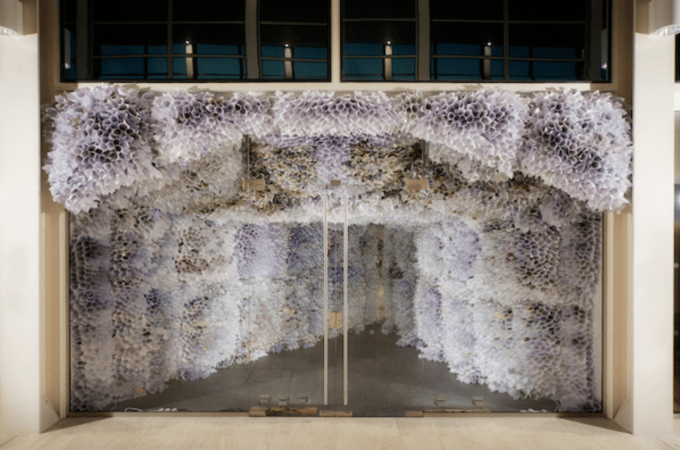
“Ownership of public space was the fringe theme, and I wanted to comment on the hard line between commercial and non-commercial space in Milton Keynes. I got as much breadth of Milton Keynes community as possible to donate their waste paper, from which I constructed a living, breathing representation of the community, recolonizing the commercial space. We had donations from all sorts of charities, civic bodies, interest groups, and individuals, including copies of degree certificates, and old school work!” – Anna Berry (x)
And this video gives you a sense of what it’s like to walk around in…
This was the version that I first discovered and I was just fascinated. I loved the cones and how they looked like petals; I loved the movement of it and how it looked like it was breathing, like it a living thing; I loved the not-quite-white gradient of colour, from yellow to white to purple, making it look even more like a living thing, like a flowering creeper plant, not unlike wisteria.
When this installation ended, the piece took on a new form: “This piece has evolved into a different beast, thanks to an Unlimited RnD Commission.” The shape changed into that of a tunnel, enabling it to work as a standalone and transportable installation; this makes it a great fit for festivals and such and means that more people can experience it.


From Anna Berry’s Instagram account (x)
It’s just as beautiful this way and it’s easy to stay tucked into one of the corners, watching the cones shiver and listening to the mechanical clanking of the apparatus.
“Breathing Room is an immersive installation designed to change the way we experience space around us on a primal level. It is a kinetic light installation in the form of a tunnel, lined with cones that ‘breathe.’ The experience is strange and otherworldly – some find it alters consciousness, others have even been moved to tears… The brightly lit outside is a skeletal armature with a visible slightly-tortuous movement mechanism. This contrasts with the inside, which bathes you in soft luminous light, and moves organically – breathing and blossoming. Having already seen the mechanism, this creates a sense of the uncanny. The immersion in the distinctive movement of the cones is unlike any other sensory experience, and this can feel profound… Breathing Room is hard to convey on screen, because its immersive and experiential nature works on a more primitive level than language can access, whilst visually, the experience hinges on the differential between your visual periphery versus where you are looking.” (x)
This is a really great video with Anna explaining how all of the parts work, the theory behind it, and people’s reactions to it, among other things…
And I always enjoy hearing artists talk about their art…
“A lot of my practice involves long repetitive making of things, which is quite kind of therapeutic and performative. It’s quite characteristic for me to work a lot with cones and they’re really frustrating. I do a massive cone piece and I’m rolling tens of thousands of these things and then I never want to see another cone for, like, a year and then… I need to do cones again and the draw just, you know, pulls me back. They’re really impossible to work with and the geometry of them is difficult and kind of challenging but always kind of exciting so, yeah, I come back to them again and again.”
I find her repeated returnings to cones really interesting and ended up reading through her website (and various articles) to see if I could find out what drew her to them. In one of her artist statements, An Alternative Statement, she wrote: “I work in a variety of media, but am most known (amongst the very few to whom I am known) for paper interventions. They are fragile and ephemeral, and rely on photographic recording. The practice of making them verges on the performative because of the very repetitive and lengthy nature of the making (particularly in comparison to the short-lived result) as well as the sometimes absurd difficulty of placing the paper in the environment. They inhabit a hinterland between installation, performance, and photography.” That kind of reminds me of music in the sense that you can’t truly capture it in any other form in which it exists; they’re in the present in a way that so many forms of art aren’t, which can be both fascinating and infuriating.
I wrote about this in an earlier post but I can’t post about Breathing Room without including my own experience of it…
I’ve wanted to see it in person ever since I discovered it but the closest it had ever come was Bristol and so I was just waiting semi-patiently for it to come further south. And then, in July this year, I saw on social media that it was coming to London and, not only that, you could volunteer to help get it set up before it opened to the public. Despite my back injury at the time (with the accompanying pain and limited mobility), I signed up, absolutely out-of-my-mind excited about the whole thing. It was a really hot day, I got a very stupid looking (and unfortunately long-lasting) sunburn, and my back hurt like hell for days but it was worth every second: it was such a cool experience. The work was definitive and meditative and it felt so special to be contributing to this big, beautiful piece, to something that people find so moving (myself included). Even walking through the half-constructed tunnel was a poignant experience.
I also got to meet Anna herself, which was really special. She was really lovely and we talked about how I’d researched it for my MA and potential ideas for creating a song about it. I would love to do that; I’d just have to decide on an idea for the song first because there are so many potential avenues it could go down. So that was just the cherry on top of a really great experience.
I would’ve loved to have stayed for another shift but I knew that I physically couldn’t handle it and besides, I had somewhere to be that evening. But, at the weekend, I went back to see it in all its glory. And it was glorious. It was an awesome experience, even more special than I could’ve hoped for. Walking up and down inside it, the only one there, was like stepping into another world; it was magical. After a while, I just sat in one of the corners, watching it ‘breathe.’ It’s just unlike anything else I’ve ever seen, ever experienced. I didn’t want to leave; I wanted to live in it. I never wanted the feeling I felt sitting there – whatever it was – to fade or disappear. As I watched the cones quiver, like petals or leaves in the lightest breeze, I swear I could feel the song ideas unspooling in my mind, like balls of string unrolling across the floor; I couldn’t figure out which one to chase first.
If I could have, I would’ve sat there for hours, just soaking it in and letting my thoughts wander; I’ve never been much of a meditator but I think I could’ve made it work sitting there. There was just something so profound about being in that space, something that touched your soul (although it seems that it moves everyone differently). Having said all of that, between my physical limitations and my other time commitments, it wasn’t possible to just stay indefinitely so I did eventually – reluctantly – drag myself out and leave. It was unexpectedly hard, like I was leaving something important behind. I wish I could explain where all of these feelings come from – what they even are – but I don’t think I can, even if I had endless time and endless words. I think that sometimes art is like that: it affects us in ways that we don’t even know how to characterise. I guess it has to be enough to know that it does and really feel them while you’re feeling them.
As thrilled as I am to have finally seen it and as lucky as I feel to have had that experience, I have to confess that I would love to see it again. And fortunately, it’s on right now as part of Liberty Festival 2023 (within This Is Croydon) so you can be sure that I’m going to get there, one way or another.
 Finding Hope