 Finding Hope
The New Plan
Posted on April 28, 2019
The last few months have been tough, medication wise. I had a wonderful, un-depressed Christmas (which I’m massively grateful for) but since then, I’ve been struggling. My mood just kept dropping and my anxiety just kept getting worse and we tried to alter the medication to compensate, to find that perfect balance, but it’s gotten to the point where we just need to try something new. So I’m taking stock of everything and trying to figure out how I feel about all of it.
The Clomipramine (a Tricyclic anti-depressant) worked for a while. As I said, I had a really good Christmas where I felt joyful and energetic and actually happy for the first time in a really, really long time. But then it seemed to lose its effectiveness and my mood dropped, whether that was because I was taking a magnesium supplement (I talk about that here) or because it just had a short shelf life. I don’t know. But it stopped working and my depression returned. Since then, my depression has been stifling and I’ve really struggled with suicidal thoughts, at an intensity I’ve never experienced before.
My anxiety also skyrocketed so, in addition to the Pregabalin (also known as Lyrica) I was already taking, I started taking Flupentixol to help manage it. At first I felt no different but after adjusting the dose, my anxiety decreased dramatically and I started to feel a bit more functional. But in the months since then, it seems there have been a number of difficult side effects: my energy levels dropped dramatically, to the point where even a shower is a real struggle. Standing for any length of time is impossible and I ended up being wheeled around multiple airports in a wheelchair during my Nashville trip. The worst part though was that my hands felt thick and clumsy, like my fine motor skills had just evaporated into thin air. Playing guitar was practically impossible.
At first I didn’t realise that these things were connected to the Flupentixol but thanks to my Mum and her incredible attention to detail, we realised that the dates all seem to match up and since we reduced said medication, these problems have disappeared. I’m ridiculously grateful to have my hands back, even if my anxiety has flooded back in.
We’ve reached a point where I can remain where I am or start over. So I’m starting over. I don’t want to live like this. So, after a lot of thinking and talking to my psychiatrist, I’m coming off both the Clomipramine and the Flupentixol. I’m not a massive fan of the Pregablin either to be honest but even changing two things at once is ambitious. So that one can wait. I’ve already started reducing the meds and I’m bracing myself for a barrage of mood swings, depressive episodes, and more. It’s not going to be fun. But it will be worth it. Hopefully.
The current plan is to come off the two drugs, go the ‘wash out’ period (two weeks of no drugs – apart from the Pregablin – so that there aren’t any negative interactions between the medications), and then start Phenelzine again. Yes, Phenelzine – the drug I stopped taking two years ago because it had stopped working, because the joyfulness it gave me felt fake and suffocating. BUT it’s the only drug that’s allowed me to be functional – creatively and otherwise – so we’re giving it another try. It did work for a long time and if it doesn’t, we’ll try another MAOI (monoamine oxidase inhibitor) anti-depressant.
I’m not sure how I feel about it, to be honest. Part of me is frustrated and disappointed. I’ve spent two years trying to find something better only to end up where I started. But on the other hand, that’s two years of knowledge, experience, and confidence that I didn’t have before. I’m a different person and chances are, my reactions will be different: our bodies change and our chemical makeup is constantly shifting. These medications all but cause a hurricane inside us. So I’m trying to be optimistic. I’m trying to be hopeful.

My Experiences with Therapy
Posted on October 13, 2018
Going to therapy hasn’t always been easy. I feel so, so lucky to have such an amazing therapist now but I had a lot of difficult experiences before I started seeing her. So I thought I’d share some of those experiences. Maybe they’ll be helpful.
After many, many appointments with my GP, I was finally referred to the local NHS Wellbeing service but the session didn’t go well. At this point in time, my anxiety was so bad that I couldn’t talk to people I didn’t know. I just couldn’t. Answers to questions would form in my mind but I couldn’t force them up my throat. So I sat there, in tears, while the doctor tried to get my Mum out of the room and told me he ‘wouldn’t’ help me if I didn’t talk. I don’t want to rant but I WAS STRUGGLING WITH A MENTAL HEALTH PROBLEM. I wanted desperately to be able to talk about it but I couldn’t. I don’t remember much about that appointment but I do remember standing in the street afterwards, shaking and crying and screaming and swearing. I couldn’t understand why no one was helping me when there was so clearly something wrong.
My second attempt at therapy was a bit better. I started Cognitive Behavioural Therapy (CBT) with a really lovely therapist. She was very patient and very open to working around the anxiety that kept me from talking. She was also happy to have my Mum in the room: it helped my anxiety and meant she could provide information. Slowly I started to trust her and started answering questions myself. But it was exhausting, bone achingly exhausting. As hard as we worked, I didn’t feel like we were making any progress and it was too hard to go through that to make no progress. I really liked her and I could tell that she was a really good therapist but the approach wasn’t right for me. I found the format too rigid. In simple terms, CBT is about breaking down your problems and then trying to create change in those areas. I felt, and still do feel, that my problems are too murky for a short stint of CBT. I know now that many of my problems originate from my Autism and the fact that it went undiagnosed for so long but even with that knowledge, the difficult things still feel overwhelmingly huge. I can see CBT being useful for a specific anxiety. For example, we tried to work on my anxiety around making phone calls. But I think the reason it didn’t work is that it wasn’t an isolated problem; it was a piece in a much bigger puzzle. I don’t think you can solve that sort of problem if you don’t know what’s causing it. Plus, being rational about what you’re struggling with in the controlled setting of therapy and being rational when it’s overwhelming you are very different things. CBT sort of assumes that you can still apply the skills you’ve learnt in therapy regardless of how you’re feeling, which can feel impossible, especially if you live with really powerful emotions. But maybe that’s just my perception.
The next thing we tried was Eye Movement Desensitization Reprocessing (EMDR), recommended by a family member. In the few months between finishing CBT and starting EMDR, my anxiety had sky rocketed so starting a new therapy was really hard. It was so bad that I actually never spoke to the guy I worked with. But despite that, and my difficulty with eye contact, communicating with him was easier than it had been with previous therapists. He was fantastic. He accepted my difficulty speaking and suggested writing on a whiteboard. I considered that and it felt possible so that’s what we did. He asked me questions and I replied, scribbling as fast as I could. It worked. And to take the pressure off, we would spend part of the session on the floor, playing dominoes while he asked me questions. I felt absolutely safe there. It was incredibly strengthening to have someone accept my anxieties as they were, to have someone recognise that I wasn’t just being difficult, that I was genuinely struggling with something really hard. And although it didn’t turn out to be the right thing for me, the sessions are still really important to me. For several months, we worked hard. We tried. I felt supported. And even though I didn’t ever speak, I did once sing for him and he almost cried. That was a pretty big moment.
After that, I didn’t go to therapy for a while. There was a lot of life stuff going on and there just wasn’t the time to find someone new. But I did start seeing a new psychiatrist. He prescribed me Phenelzine (which I’ve previously written about) and we spent a lot of time trying to figure out what was causing my problems. I guess it was a type of therapy. We went through my history and analysed my emotions, trying to find a diagnosis. The medication helped and we managed the side effects but it still took a long time. When my university said that they couldn’t help unless I had a diagnosis, I pushed for this and in January 2015, I could finally put names to the issues I was struggling with (apart from the Autism diagnosis which came several months later). My psychiatrist recommended Dialectical Behaviour Therapy (DBT) so we started looking for another therapist.
My current therapist is the first one we met. I just knew she was right; me and Mum walked out, looked at each other, and said, ‘she’s the one.’ We did meet another one but my mind was made up. And we were right. She’s amazing. I’ve been seeing her for three years now and I’m so grateful to have that safe place. DBT suits me much better. It’s based on CBT but, as the Mind website says, it’s “been adapted to help people who experience emotions very intensely.” They both help with changing unhelpful thoughts and behaviours, but DBT also helps you to accept yourself. It’s about a balance between acceptance and change. That really makes sense to me and always has.
In the beginning, I needed my Mum in the room with me and she would answer all the questions. We’d always talked about everything so she knew pretty much all the answers. But over time, I felt more comfortable there. I needed Mum there less and less and eventually I started doing the whole session by myself. Three years later and it’s really, really important to me. It’s a huge part of who I am. It’s not easy; it’s really hard work and I often come home exhausted, sometimes falling asleep on the sofa afterwards. But it’s really satisfying to talk things through, to make connections, to see change happen. I’ve talked about things that I never, ever thought I would talk about and I’ve worked through things I never thought I’d let go of. That’s so huge that I can’t really comprehend it.


So that’s my therapy journey. For me, it’s DBT that works but I’ve seen the others help people too. You need to be ready, you need to find the right approach, and you need to find the right person. It’s not easy but it is worth it.
Getting A Diagnosis – The Mental Illness Edition
Posted on August 18, 2018
This is something I’ve been meaning to write about for a while but it’s such a big topic that I was very daunted by just how much I needed to include. I’d open a word document, stare at it for ten minutes, and then switch to something else. You’ll see what I mean. Getting a diagnosis is a complicated and emotional process that is so different for everyone but I had no idea how difficult it would be when we started pursuing it. So I thought I’d write out my experience just to put out into the world one version of the story. Maybe yours is similar, maybe it’s different. Hopefully you’ll get something out of it either way. And if you’re trying to get one, maybe this will give you some idea of the hurdles. I don’t want to scare anyone off; it was a brutal experience but it was absolutely life changing and life saving, both for my mental health and for who I am as a person.
I’m going to split this into two posts because although they’re linked, the processes for getting the mental health diagnoses and getting the ASD diagnosis were very different for me. I don’t know if that’s the same for everyone. This post will be about getting the mental health diagnoses.
My mental health problems became very acute when I failed an exam at sixth form in March 2013. I was eighteen and it was the first time that had happened. There’s a lot of stuff behind why that was the breaking point but I’ll talk about that in a different post. Otherwise we’ll be here forever; I’m already splitting this post in half. I hadn’t been oblivious to my mental health up until that point but I hadn’t recognised the signs for what they were; my knowledge of mental health had been pretty limited. But I’d always felt like there was something wrong with me (I now know that it’s different rather than wrong but that’s how it felt and sometimes still does feel) and I know that my depression and anxiety had been building up to that moment, that critical incident.
After that, I started seeing a psychiatrist that a family member had recommended (my GP had been unhelpful at best and distressing at worse). He diagnosed me with Clinical Depression and gave me an anti-depressant called Paroxetine to try. I don’t have enough experience to judge whether he was a good psychiatrist or not but I don’t remember feeling particularly supported by him. I only saw him a few times before I switched to a psychiatrist closer to where I lived. The Paroxetine made me incredibly sleepy; it was like they put me into a waking sleep that I still don’t feel I’ve really woken up from. I switched to Sertraline but that was even worse: I felt like a zombie and that was so upsetting that I (unwisely) stopped taking it cold turkey. That was a Bad Move, such a bad one that I still capitalise the first letter of each word. For a while I was very dissociated and then my anxiety came back, even stronger than it had been before. So I was a bit put off by medication but the diagnosis was helpful and I started going to CBT.
That ended up not being the right thing for me and the energy it took was just too much so I quit, not forever necessarily but I needed a break and we wanted to explore some of the other options. I tried several other things over the next year before deciding to try medication again. Both that first psychiatrist and the CBT consultant had been private but I couldn’t get the NHS to help me. I have to say here that I have so much (SO MUCH) respect for the NHS. It has saved the lives of several of my friends and I will defend it to the death but I don’t feel it has yet got it right when it comes to mental health. In my case, my anxiety was so bad that I found it incredibly difficult to talk to people I didn’t know. My Mum would explain the situation but we were repeatedly told that if I wouldn’t talk they couldn’t help. That was very distressing. Logistically I understand that it’s more difficult to communicate if a person can’t talk but that’s not an excuse to refuse care. The not talking was a result of my anxiety, which falls under their job description. They should’ve helped me. They should’ve at least tried. But they didn’t and I was struggling so much that we were forced to go private. I am endlessly, endlessly grateful that my family have been able to make that possible. It has, without a doubt, saved my life.
We found a new psychiatrist in the summer of 2014 and after such a horrible year, I was determined to make it work. I walked into his office, sat down, and started talking. I still don’t know how I did that. I was just as anxious as I had been before but I guess that’s desperation for you. Maybe it was my survival instinct. Anyway. My psychiatrist has since told me that he couldn’t believe I had such bad social anxiety because I had been so articulate and direct. Again, I’m putting that down to desperation (and I wouldn’t be surprised if the ability to mimic ‘normal’ behaviour – something that many girls with autism have learnt to do – came into play here too). But as I told him more, he started to understand where I was coming from and what I was dealing with. He put me on Phenelzine, which made a massive difference (I’ve written more about that here) and we continued our sessions so that he could get as much information as possible.
I wanted him to give me a diagnosis. I wanted a name for the thing (or things) that had so much power over me. I wanted to know what was really me and what was this indistinct, suffocating black shadow. I thought he’d have me do a load of diagnostic tests and questionnaires and then give me his findings but it felt more like therapy, but with a focus on my past experiences (rather than strategies to move forward). He didn’t seem in a hurry to find the answers and I didn’t know how to fast track the process. Eventually we got the deadline I wanted: my university said they couldn’t help me until they had an official diagnosis. But again, it wasn’t how I’d expected it to be and again, it was incredibly slow. Throw in that I’d just started university (which came with new people, new classes, and commuting into London) and I was under a lot of stress, as you can probably imagine. How I didn’t have more autistic meltdowns, I have no idea.
I couldn’t just do nothing. I spent hours searching the internet, looking for anything that might explain my experience. I examined diagnostic criteria and read medical papers; I scrolled through forums and took diagnostic tests. I’ve read a lot about the back and forth on self diagnosis (something I definitely want to discuss in more depth at some point) but for me, I needed a professional diagnosis, both to get the help I needed and to validate how much I’d struggled. Grouping my symptoms together and trying the strategies advised for whatever label fitted that group wasn’t going to be enough. So I used those test results as a starting point. Eventually I came across Borderline Personality Disorder and more specifically, the ‘quiet’ presentation of BPD. This means that they have many of the same symptoms (including mood swings, problems with self worth, unstable identity, and difficulties with relationships) but rather than ‘acting out’, they ‘act in’: they direct their negative emotions inwards, hiding them rather than projecting them onto others. Many struggle with issues around self hatred and self harm. If they lie or manipulate, it’s to protect themselves from perceived abandonment and they may avoid or distance themselves in relationships because they don’t want to be abandoned or because they feel they don’t deserve those connections. The ‘quiet’ presentation made a lot of sense to me because while I struggled with many of the problems associated with BPD, I rarely lash out so this felt like something to explore.
So, buoyed by momentum that discovery had given me, I took it to my psychiatrist. And he shut me down straight away. He said that I didn’t fit the criteria and moved on to something else. I didn’t understand: I was struggling with so many symptoms associated with BPD, almost all of them when you factor in the ‘quiet’ presentation. I couldn’t believe that it wasn’t worth, at the very least, a little bit more discussion. And at the end of the session, he said that he thought we’d done all we could do. I was devastated. And incredulous: we hadn’t achieved anything. If that was it, I was back to square one. Or minus one after everything the process had taken from me.
That session sent me into the worst place I’d been and after a particularly horrific meltdown, I spent several days in a fragile, barely responsive state. But once I recovered from that a bit, I got to work. I went back through my research and symptom by symptom, anecdote by anecdote, I wrote down everything I related to, everything I’d experienced, anything that could be relevant. It wasn’t that I was certain it was BPD, it was that I was certain it was something. This seemed as good an explanation as any and my psychiatrist wasn’t offering anything better.
When I was done, the document was seventeen pages. I’m pretty sure it was longer than my dissertation for university. And then we went back. I presented him with all my research and something very surprising happened. I’d hoped he’d accept it as something to explore and not only did he do that, he admitted he’d been wrong and apologised for dismissing it. Even now, that feels like a very important moment. In my experience, medical professionals aren’t naturally inclined to apologising, let alone admitting to being in the wrong. And I’d been ignored for a long time. When it came to my health, physical and mental, doctors had always looked at the most obvious option and then, when that didn’t fit, they’d just shrugged their shoulders and brushed me off. So this was a big deal.
And at the end of that session, I had my diagnosis. Or more accurately, my diagnoses. He pulled together everything he’d learned about me and diagnosed me with Borderline Personality Disorder, Anxiety, Social Anxiety, Depression, and OCD. It was a very strange experience. Momentous and anti-climactic at the same time. I felt light enough to float away but so exhausted and heavy that I wasn’t sure I could get out of my chair. I felt like I might burst into tears at any moment but I had this weird, hysterical urge to laugh. I felt invincible and incredibly fragile at the same time. Very strange.
Finally getting names for the monsters I’d been struggling with was incredibly validating. It was real. I wasn’t ‘crazy’ or ‘over dramatic’ or ‘too sensitive.’ It also made it real to everyone else. And although part of me was steadfast that something was wrong, I had started to doubt myself, having been dismissed by so many people. I was constantly fighting against falling into a well of despair, of fear that this was just going to be how life was for me. But the diagnosis confirmed that they were problems and most problems have solutions of some sort.
The diagnosis enabled me to get the support I needed at university and gave us some idea of what kind of talking therapy might help. Dialectical Behaviour Therapy (DBT) is recommended for people with BPD and that’s what I’m still doing, about three years later.


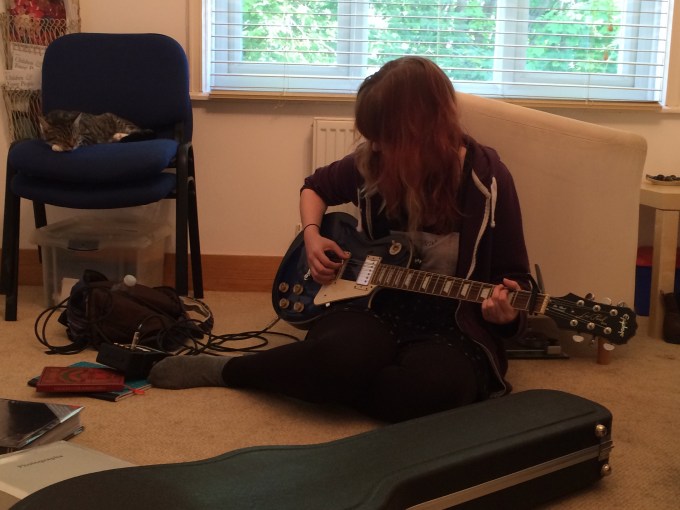
(I have no relevant photos for this post so here are a couple from around that time.)
 Finding Hope