 Finding Hope
Another Anna Akana Video I’m Grateful For
Posted on November 17, 2018
In the middle of my recent bout of depression – the worst one I’ve had – at my lowest point, an Anna Akana video appeared in my YouTube subscriptions. It was called ‘the voice’ and it was about her new short film that was being released the next day.
She talks about how, while 2017 was the best year of her life, her depression was also at its worst. There was a voice – that felt like it was in the room with her – telling her to kill herself. And it got to the point where she had a plan for how she was going to go through with it, which is a major red flag.
“I was just so in pain and I just felt like I had nothing and like I was nobody and I wasn’t worth anything at all and I literally… I have this big whiteboard on my wall and I wrote out DO NOT KILL YOURSELF, like all across it. I put it on post it notes and I put it on my bathroom mirror and like… everyday when the voice came and I would be like ‘SHUT THE FUCK UP!’”
While she still struggles with depression, she says she’s out the other side of that particular battle and she credits getting through to all the mental health education that’s out there and all the things you have to do everyday, hoping that they add up. She also made this new short film, pouring everything into it because she needed something to remind herself of why she’s here. It’s about the moments she wanted to die and all the things she had to live for. I would include it in the post but I just really want to focus on this introduction video (but you can find the short film here). Maybe I’ll write a full post about it when I’ve sorted out all my feelings about it.
I am so grateful for this video. Talking about this stuff is so hard and so to have this raw and uncut video where she talks about this experience but also how she got through it was and is so important to me. It’s helped me in this incredibly hard period and so I wanted to share it here.
“Please don’t kill yourself if you’re also suicidal… just don’t do it. There’s a lot… there’s a lot of great things to live for.”
I Rediscovered Swimming
Posted on November 3, 2018
One of the most common pieces of advice with anything mental health or mental illness related is to exercise. And while that’s not bad advice, it’s not necessarily good advice in the practical sense. It’s about as helpful as saying, ‘eat healthy’ or ‘get enough sleep.’ It’s something that has to be tailored to you. Specific types of exercise will help where others may make you feel worse. So you need to find the one for you.
For example, I hate running. I would love to love it but I hate it. I find it at best uncomfortable and at worst painful: it’s like my bones are rattling inside my body. I’ve heard this from others with Autism but I don’t know if it’s specific to that or whether it’s a coincidence. But anyway, running is not the thing for me. Swimming however…
I have always loved to swim. I love the feeling of moving through water and when I was a kid, I loved the silence that comes from being underwater. I would’ve given anything to be able to breathe underwater so that I could stay in that silence. That’s pretty ironic given that I would grow up to develop anxiety that is triggered by a lack of noise and distraction.
I got back into swimming a couple of months ago. At the beginning, my anxiety was so bad that I couldn’t even swim: the lack of stimulation for my brain meant that I just spiralled and my anxiety became completely overwhelming. So me and my Mum would walk and talk, planning the day or talking through whatever thing was on my mind that morning. Eventually my anxiety mutated into a different state and I was able to swim. It’s had such an impact on my life so I really wanted to write about it.
Swimming pools have the potential to be very difficult for me, from a sensory perspective. When it’s busy, the sound bounces around and around, making it one big fog of noise, which makes me very anxious. And the fact that I’m so short sighted I can barely see without my glasses makes that anxiety even worse: I can’t see anything and the sound feels like it’s coming from everywhere and that causes me paralyzing anxiety. It’s how I imagine it would feel to be on a carousel but if the carousel was going at ten times the normal speed. It’s scary. The best times to get in a quiet swim seem to be first thing in the morning and last thing at night. I’ve been sticking to the morning; it makes for a more productive day for me.
Knowing that this is the time that allows for the best swimming experience, I’ve been getting up early and getting to the gym for about seven forty five (sometimes I even get the pool to myself, which is glorious). And knowing that I have to get up that early, I’m going to bed at a sensible time, rather than accidentally staying up until three in the morning. So a routine sort of formed by accident and that has been so good for me. My relationship with sleep has never been so good.
Exercise has always been difficult for me given my historic struggle with energy but also because ‘weight bearing’ exercise often feels very jarring. As I’ve already said, it makes me feel like my bones are rattling inside my body and each impact makes it worse. Sometimes it’s not that bad and I can be distracted by whatever I’m doing but sometimes it can actually be painful. So swimming is perfect. It takes that whole aspect out of the equation and makes exercise actually enjoyable. It reminds me of my arthritic dog: he goes for hydrotherapy and as soon as he’s in the water, chasing tennis balls, he’s like a puppy again. He loves it and I can totally relate.
The best thing about swimming is that it’s something that makes sense and that’s something I really need at the moment. The world feels hard and unfair and this is something that I can control. The more I swim, the stronger I get. I can see the results. I’ve been swimming most days for the last three months and I see my own progress: I’m swimming further; I’m swimming faster; I can see my body changing. It makes sense. That grounds me.
The one thing I do have to be careful of is my tendency to obsess: about the number of laps, getting to the next ten, getting to a hundred… Once it’s in my head that I ‘have’ to get to a particular number, there’s not much I can do to change my own mind and it causes me serious anxiety if I don’t reach the number I’ve ‘decided on.’ So I have to be aware of that. Sometimes I can avoid it by distracting myself or by deciding on exactly how long I’m going to spend in the pool but sometimes I just have to manage it. Sometimes that’s all you can do.
But overall, rediscovering swimming has been one of the major highlights of this year. It’s helped my physical health and my mental health, as well as my day to day life. So I feel very grateful to have found it again.
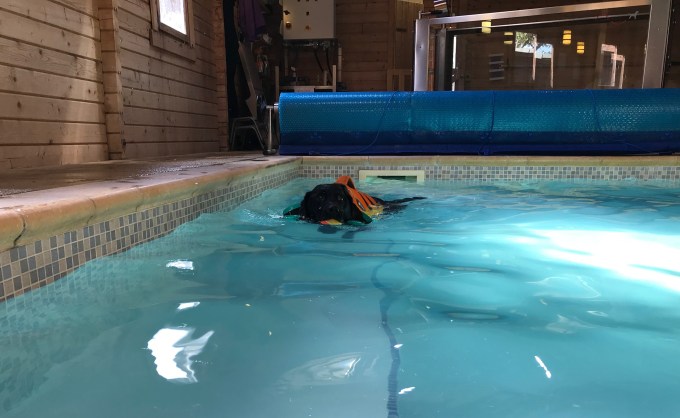
And since I can’t take my phone into the pool with me, here’s a photo of my dog, enjoying his fortnightly swim.
Describing Depression
Posted on October 27, 2018
I love words. I LOVE words. And that’s so viciously ironic for someone living with Autism and mental health problems because they are so difficult to describe, to talk about, to truly put into words. I’ve talked about how much I write and how much I document (this post here) and every now and then I think, “Oh my god, I’ve got it. That’s how it feels.” And then I go to therapy or I talk to a friend or teacher and I go to describe how I’m feeling and I’m just left scrambling. Because these things are so hard to put into words.
Let’s talk about depression specifically. This one seems to have a lot of metaphors attached to it:
- Living in darkness – With the associations between light and good and happiness and therefore the associations between darkness and bad and sadness, the connection here is obvious. It’s also a metaphor that fits with the feeling lost and directionless and not knowing how to move forward. And living in it implies a terrifying finality.
- Winston Churchill’s black dog – We can’t know for sure what Winston Churchill’s mental health was like, whether he suffered from mental illness, from depression, but he did describe periods of great despair that he referred to as his ‘black dog,’ that came and went as it pleased. (While I can understand this metaphor, I personally really don’t like it, being the owner of the the gentlest, sweetest black dog and therefore nothing like Churchill’s description.)
- Having a dark cloud follow you around – Weather metaphors are common in mental health, maybe it’s the all encompassing nature, maybe it’s the lack of control we have over it that makes it a fitting metaphor.
- Being surrounded by fog – Similar to the weather metaphor, it’s uncontrollable and overwhelming. It blots out the sun, makes good indistinguishable from bad, makes it difficult to make your way forward.
- JK Rowling’s dementors – Everyone who’s read Harry Potter knows of dementors and the effect they have on people, essentially sucking the happiness, the joy, the life out of people. JK Rowling has talked about how dementors are the embodiment of her depression, not unlike Churchill’s metaphor.
There are more, of course: everyone has their own descriptions (and they can change depending on the particular state of the depression). On which note, I thought I’d throw in a few of my own:
- Feeling like I’m filling up with water – When I’m deep in depression, I feel like my body is filling up with water and the water level gets higher and higher until it’s reaching my mouth and nose and I start to feel like I’m going to drown in it. And sometimes it feels like something more sinister than water, like ink or oil.
- Feeling like I’m deep underwater – Sometimes I feel like I’m in it so deep that I can’t even see the surface so I don’t even know, which way to swim. And down there, I feel so alone.
- Having a black hole in my chest – On a day to day basis, it drags everything in, making it difficult to even know what I’m feeling before it’s gone and on bad days, it’s so strong that it can feel hard to even stand up straight.
- Feeling like there’s a darkness inside my chest, but deeper than is physically possible for a human body – That’s the only way I can describe this sensation. I understand the dimensions of my ribcage but it feels so much deeper than that, miles deeper. And there’s a darkness there, an ache, like this incredibly deep well of misery.
I posted this on Instagram a while ago:
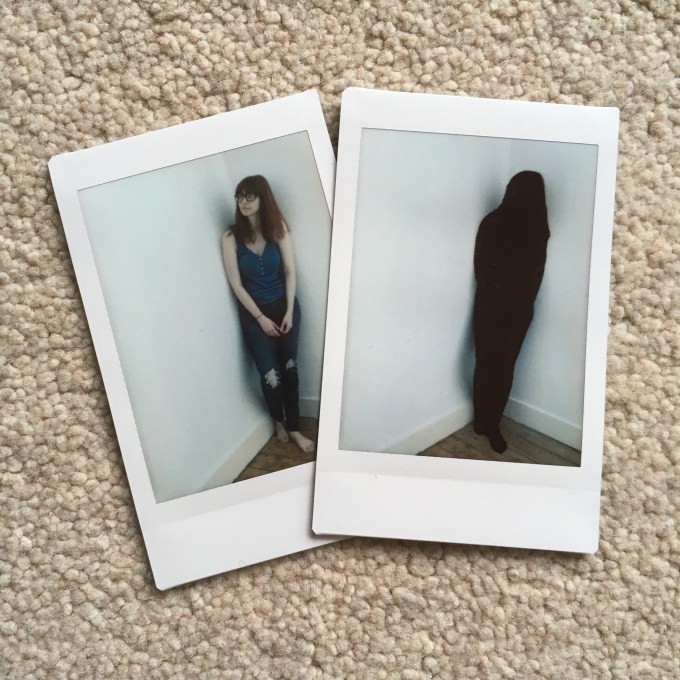
“Ever since I saw @littlepineneedle’s post and the hashtag #seemyinvisible, I’ve been thinking about it and how I could visually represent the things I struggle with. But in the end, I decided just to look at how I’ve been feeling lately. My mental health is a constant balancing act but lately, my depression has been overwhelming. It feels like there’s a black hole in my chest that’s trying to suck everything in and it’s all I can do to stand up straight. Nobody can see it and that only feeds it. It’s been really inspiring to see so many people sharing their stories over the last few days. This is one of the reasons why #mentalhealthawareness is so important: it helps us to feel less alone.” (x)
I’m not entirely sure what I’m trying to do with this blog post. I guess, I’m just trying to put this thing into words.

 Finding Hope