 Finding Hope
An Assessment With A Difference
Posted on October 28, 2020
Over the summer, I received a letter from the local Neurobehavioral Unit. My GP had referred me to them for specialist support for pain (joint pain and pain in general) and I had an appointment with a psychiatrist there who specialises in and has done extensive research into hypermobility, pain, fatigue, and anxiety. I had no idea what to expect or what I was going to get out of it but I’m always willing (even if sometimes a little wary of) trying new things that might help.
My GP had recommended I have a full set of blood tests first so that we had the full, up to date picture before the appointment so I had that done at my local doctors’ surgery. I was a bit nervous about going – with the pandemic and all – but it was quick and easy. I was in and out in less than fifteen minutes. We got the results back a week later: for the most part they were good (my iron is back within the normal range, which was the problem last time) but my Vitamin D was seriously low, so low that I’ve been prescribed a ten week course of Vitamin D supplements.
And then this week, I had the actual appointment.
It was an online appointment but the conversation felt surprisingly easy and natural. Dr J (I’ve decided to refer to her this way to protect my privacy, even though doctor-patient records are, of course, confidential) introduced herself and we talked a bit about her work and what we could potentially get out of the session.
We talked about my Autism diagnosis and she had me do a series of movements with my hands and arms, all of which confirmed a diagnosis of hypermobility. As far as I’m aware it was in the notes from my Autism assessment but it hadn’t been officially diagnosed in its own right. She told me that people with a diagnosis of hypermobility are seven times more likely to have a form of Autism. Seven times! She asked me lots of questions about pain and fatigue (both of which I seriously struggle with) and went on to explain that hypermobile people have weak core muscles which often results in fatigue and pain in other areas as the body compensates. That makes so much sense. It’s all so fascinating to learn. The more I learn about the things I’ve been diagnosed with, the more I understand how they’re all part of a bigger picture, how they link together like the strands of a spider’s web or stars in a galaxy. It all gets clearer and I feel less overwhelmed and less lost; it feels like seeing order in things that used to look random and that is so incredibly helpful. All of the things I struggle with often make me feel broken and moments like this help me in the slow shift from ‘broken’ to… ‘incompatible,’ or something like that. Something less personal. Is it a program’s fault if it isn’t compatible with the computer? No. And with that in mind, it all becomes more about problem solving and work arounds and less about right and wrong. At least, that’s the concept I’m trying to work towards.
She said she would write to my GP and have me referred for pain management, specifically for hydrotherapy. I’ve just started swimming again – Mum and I finally managed to find a pool with a set up that feels safe, or as safe as is possible right now and safer than the others we’ve spoken to – so that would be perfect; I would love to do it, to get fitter and stronger through exercise I enjoy (and that doesn’t cause me ongoing physical pain). I don’t know if it’s available right now – with the pandemic and social distancing measures – but I can’t wait to do it whenever it is. But in the meantime, Dr J recommended some exercises to do in the pool, as well as some very gentle floor based core-strengthening pilates.
She also asked questions about sensitivities, allergies, hay fever, dizziness on standing, lightheadedness, and symptoms like that. I’ve definitely experienced all of those, although not all consistently. When I’d answered all of those questions, she recommended I have a heart rate test and a blood pressure check and said she’d include that recommendation in the notes she’d send to my GP. If they showed numbers within a specific range, given the other symptoms we’d talked about, that could apparently give us another area to explore, health wise.
We also talked about my anxiety and the medication I take for it. She suggested an alternative that might be better suited to my situation so that’s something we’ll discuss with my psychiatrist when I next speak to him.
So Mum and I learned a lot and we have plenty of avenues to explore…
- Continue swimming, adding in the exercises she suggested to strengthen my core muscles.
- Pursue the pain management route, particularly hydrotherapy (as available with the lockdown).
- Try gentle pilates exercises for core muscles.
- Get a heart rate test and a blood pressure check and see where that leads us.
- Talk to my regular psychiatrist about the other anxiety medication.
To be completely honest, it was a bit of a strange experience. I mean, it was really helpful and productive but it was odd for a very specific reason. It was easy. It was a conversation. She asked me things and I answered them. She believed me; she offered lots of advice and suggestions; she’s writing everything up and sending it to my GP. It wasn’t a fight… when up until now, it’s always been a fight. It was this beautiful, precious thing: to ask for help and have someone give it to me, with kindness and understanding and generosity. There will be more fights, I’m sure… more battles, but for now, I’m going to hold onto this feeling and memorise it so that I have it in my pocket like a touchstone for the next time I have to fight to get someone to stop and listen.
I Rediscovered Swimming
Posted on November 3, 2018
One of the most common pieces of advice with anything mental health or mental illness related is to exercise. And while that’s not bad advice, it’s not necessarily good advice in the practical sense. It’s about as helpful as saying, ‘eat healthy’ or ‘get enough sleep.’ It’s something that has to be tailored to you. Specific types of exercise will help where others may make you feel worse. So you need to find the one for you.
For example, I hate running. I would love to love it but I hate it. I find it at best uncomfortable and at worst painful: it’s like my bones are rattling inside my body. I’ve heard this from others with Autism but I don’t know if it’s specific to that or whether it’s a coincidence. But anyway, running is not the thing for me. Swimming however…
I have always loved to swim. I love the feeling of moving through water and when I was a kid, I loved the silence that comes from being underwater. I would’ve given anything to be able to breathe underwater so that I could stay in that silence. That’s pretty ironic given that I would grow up to develop anxiety that is triggered by a lack of noise and distraction.
I got back into swimming a couple of months ago. At the beginning, my anxiety was so bad that I couldn’t even swim: the lack of stimulation for my brain meant that I just spiralled and my anxiety became completely overwhelming. So me and my Mum would walk and talk, planning the day or talking through whatever thing was on my mind that morning. Eventually my anxiety mutated into a different state and I was able to swim. It’s had such an impact on my life so I really wanted to write about it.
Swimming pools have the potential to be very difficult for me, from a sensory perspective. When it’s busy, the sound bounces around and around, making it one big fog of noise, which makes me very anxious. And the fact that I’m so short sighted I can barely see without my glasses makes that anxiety even worse: I can’t see anything and the sound feels like it’s coming from everywhere and that causes me paralyzing anxiety. It’s how I imagine it would feel to be on a carousel but if the carousel was going at ten times the normal speed. It’s scary. The best times to get in a quiet swim seem to be first thing in the morning and last thing at night. I’ve been sticking to the morning; it makes for a more productive day for me.
Knowing that this is the time that allows for the best swimming experience, I’ve been getting up early and getting to the gym for about seven forty five (sometimes I even get the pool to myself, which is glorious). And knowing that I have to get up that early, I’m going to bed at a sensible time, rather than accidentally staying up until three in the morning. So a routine sort of formed by accident and that has been so good for me. My relationship with sleep has never been so good.
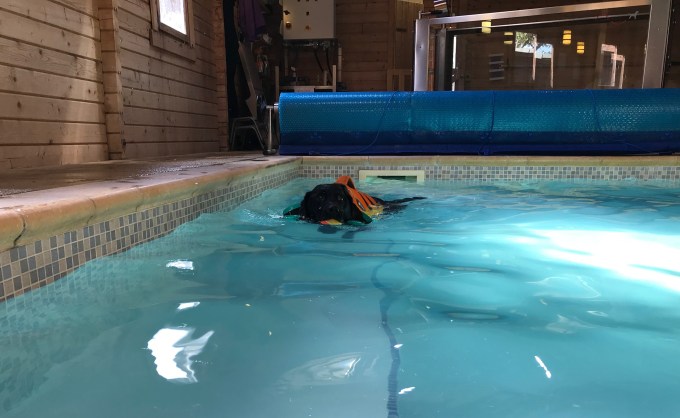
Exercise has always been difficult for me given my historic struggle with energy but also because ‘weight bearing’ exercise often feels very jarring. As I’ve already said, it makes me feel like my bones are rattling inside my body and each impact makes it worse. Sometimes it’s not that bad and I can be distracted by whatever I’m doing but sometimes it can actually be painful. So swimming is perfect. It takes that whole aspect out of the equation and makes exercise actually enjoyable. It reminds me of my arthritic dog: he goes for hydrotherapy and as soon as he’s in the water, chasing tennis balls, he’s like a puppy again. He loves it and I can totally relate.
The best thing about swimming is that it’s something that makes sense and that’s something I really need at the moment. The world feels hard and unfair and this is something that I can control. The more I swim, the stronger I get. I can see the results. I’ve been swimming most days for the last three months and I see my own progress: I’m swimming further; I’m swimming faster; I can see my body changing. It makes sense. That grounds me.
The one thing I do have to be careful of is my tendency to obsess: about the number of laps, getting to the next ten, getting to a hundred… Once it’s in my head that I ‘have’ to get to a particular number, there’s not much I can do to change my own mind and it causes me serious anxiety if I don’t reach the number I’ve ‘decided on.’ So I have to be aware of that. Sometimes I can avoid it by distracting myself or by deciding on exactly how long I’m going to spend in the pool but sometimes I just have to manage it. Sometimes that’s all you can do.
But overall, rediscovering swimming has been one of the major highlights of this year. It’s helped my physical health and my mental health, as well as my day to day life. So I feel very grateful to have found it again.
And since I can’t take my phone into the pool with me, here’s a photo of my dog, enjoying his fortnightly swim.
 Finding Hope