 Finding Hope
Holding On And Letting Go
Posted on January 28, 2018
A while back, a friend shared this article on Facebook and I couldn’t not share it here. I’m currently in the process of going through everything I own in preparation to move house and so I’m coming across a lot of things that I have previously loved. I’m being constantly faced with the decision to hold onto something or to let it go. So I resonated with this piece very strongly.
I thoroughly recommend reading it but here’s a summary. The author describes feeling sympathy for inanimate objects, from “the guitar that doesn’t get played anymore” to “the once loved camera that has now been displaced by a newer one.” And the thought of an object being discarded causes great anxiety and sadness.
I’ve struggled with this all my life. As a child, all my toys had personalities and thoughts and emotions but that hasn’t faded as I’ve grown up even though I no longer play with them. They’re all still in my cupboard, neatly stored in boxes and bags. I feel guilty about that, that it must be uncomfortable and claustrophobic, but it’s better than throwing them away. That would be the ultimate betrayal. Imagining them in a bin or landfill fills me with such overwhelming anxiety and guilt that I can’t think properly. But it’s not just toys; it’s everything. I have a draw full of my old phones (how can I go from carrying them around twenty four seven to throwing them away?), a box of broken Christmas ornaments (it would be so callous to throw them out just because they’re not perfect anymore), my old school jumper, and so on and so on and so on.
Throwing things away is hard for me. I have this anxiety about letting things go, like I’ll lose parts of myself. Anything that has some meaning to me, I have to keep. It’s similar to how I write everything down and take a million photos. It goes with my difficulties around identity, a big part of BPD, and feeling like I have no idea who I really am. So I’m probably assigning aspects of my identity to physical objects in response to that. It certainly doesn’t help with all of this. And I wouldn’t be surprised if there’s a link to the difficulty I have in managing the strength of my emotions. I’ve talked about this before: how strongly I feel emotions and how I sometimes feel other people’s emotions. I’d always assumed that it was another facet of that.
The article discusses some other potential causes:
“There is some evidence to suggest that OCD and Synaesthesia are possible causes. Put simply, Synaesthesia is a neurological condition where the senses are confused. So someone with it, may smell a taste, or see a particular colour when thinking of a specific number. Some people have a form of Synaesthesia known as Personification. This is when a personality or emotion is attributed to an object. It would appear that there is a higher tendency for those on the autistic spectrum to have Synaesthesia in one form or another.”
The link to Synaesthesia is an interesting one. I do have some Synaesthesia-like experiences: with some sounds, I experience specific tastes or sounds. The sound of 7 chords leaves a metallic taste in my mouth so strong that I avoid those chords as much as possible and working on the production of my songs can be a bit of a minefield: high frequencies, like cymbals, are yellow while lower frequencies are dark colours (different depending on the instrument) and the colours in the song need to be balanced for me to be happy with them. It’s hard work and often leaves me with a debilitating headache.
I don’t know what the answer is or whether there is one. But I think the more we talk about this stuff and the more normal it becomes, the less we struggle against it. That takes up so much energy and emotion when living with these things is hard enough. That’s kind of why I started writing all of this stuff down, to feel less alone and hopefully make other people feel less alone too.


(Left: me and my toys when I was about eleven. Right: confetti that I kept from an amazing concert.)
When I Said I Wanted Superpowers, This Isn’t What I Meant
Posted on January 14, 2018
I’ve seen a lot of people make sense of their mental health issues or their Autism or their whatever by saying that it’s given them a superpower: sensitivity to emotions, intense focus, and so on. Despite my love for all things superhero, this has always irritated me and I never really understood why until I talked to my Mum about it. The words just came out and it clicked into place.
For me, it’s too simplistic a concept. At this point in time, I only feel disadvantaged – deprived – by my Autism especially. I’m told I won’t feel like this forever – I know that lots of people feel like it does add something to their lives – but right now, it takes away from my life more than it adds. So it really doesn’t feel like a superpower. If anything, it feels like I’ve suddenly got a superpower that I can’t control. If you want an excellent example of this, watch Agents of Shield: one character develops the ability to control the vibrations around her but because she can’t control it, she essentially causes earthquakes whenever she gets upset or angry or scared. Sometimes I feel kind of like that, like the intensity of my emotions causes irreparable damage to me and everything around me. I’m not causing natural disasters or shattering windows but maybe the effect is just slower.
An example that fits better with Autism might be having enhanced hearing – connected to the sensory sensitivities – but because I can’t control it, I can’t use it. I can’t isolate a single sound and tune out everything else; it’s just a tidal wave of noise, the world with the volume up to maximum. It feels like the best I can do is to manage it, to keep it at a level that doesn’t kill me. I wonder if I’ll ever be able to control it, even a little bit. What if it’s something that you just can’t control, like time or the weather? I worry that it’s one of those things, that it’ll be like this forever. Is it still a superpower if you can’t do anything with it, if you can’t do anything good with it?
I’ve done my fair share of those personality tests that supposedly tell you something about yourself, what animal you’d be or which Hogwarts house you’re most suited to. I think this is something that many people who struggle with identity do: you feel like you don’t know who you are so you’ll take any answers you can get. I’ve definitely fallen into that rabbit hole before. I’ve never found a good one for superpowers though. Mine would probably be something to do with emotions, like being able to manipulate someone’s emotions or transmit my emotions to somebody else. Maybe that’s the problem: maybe the strength of my emotions just falls short of a superpower, maybe one percent more and I’d be able to control them. That fits right into my fear that I’d be something special if I just tried harder, that I’m never trying hard enough. Okay, I’m rambling now.
Anyway. My point is… I’m not even sure what my point is. I guess I’m just thinking out loud. Reading it back it’s a bit of a mess but I needed to put all of this somewhere. Mostly I think I’m scared I’m not enough, not enough of anything. I’d love to know if you’ve thought about any of this, whether you like the superpower metaphor, even what you think your superpower would be… So if you’d like to, please leave a comment below.

(Photo by Richard Sanderson. He called this my ‘superhero pose.’)
Of Stars and Spirals
Posted on January 7, 2018
Warning: This post will contain spoilers for Turtles All The Way Down by John Green. This is not so much a book review as it is a collection of my thoughts about a particular book so I will be talking about the characters and the storyline in some detail. Hopefully it will make sense. If you’ve read the book or don’t mind spoilers, read on but if you want to read the book (which I highly suggest you do) and watch the events unfold, go and do that first. And then maybe you can come back and read this…
As I said in my post about New Years Resolutions, I really want to get back into reading. When I was a kid, I inhaled book after book after book and I have so many memories of forgoing sleep, just so that I could finish whatever story I was in the middle of. I really loved to read. It was my favourite thing. But somehow, with university and my mental health and the rollercoaster that has been my life for the last few years, reading sort of fell off my radar and I really miss it so one of my New Years Resolutions is to try and get back into reading. I want to rediscover what I loved about it. This was the perfect book to start with, even though it hit me with a tidal wave of emotions and I’m still recovering a couple of weeks later. But I think that’s how reading is for me, at least for the moment.
From the moment I heard that John Green’s new book was about a girl with OCD, I knew I wanted to read it and knowing that he has very personal experience with OCD made me even more excited about it. I’ve read several of his books (I especially loved The Fault in Our Stars) and I’ve always really connected to the voices of the main characters. And that was what made reading Turtles All The Way Down such an emotional experience. I read it in one sitting (apart from the first chapter – I realised I was going to read it in one sitting and so I needed to plan for that). I don’t think I’ve ever related so strongly to a book, which is a really big deal since I’ve been struggling to find a book I relate to at all. I found it to be a really true, really full account of dealing with a mental health problem. I’ve always struggled to work out where OCD fits into the mosaic of my mental health so I found this book really helpful in that sense. It shifted a few things in my brain and helped me understand myself a bit better. I’m very grateful for that.

The story is narrated by sixteen-year-old Aza. She’s quiet and thoughtful, trying to manage friends, school, and planning a future, all while struggling with constant anxiety about bacteria, infection, and dying from Clostridium Difficile Infection (also known as C. diff). She describes the anxiety as ‘thought spirals’ or ‘invasive thoughts’. She feels like she has no control over her thoughts, describing them as “not a choice but a destiny,” and often the only way to control them is to check and clean a permanently open cut on her finger, proving to herself that she doesn’t have C. diff.
I love Aza and I really, really related to her, to how she thinks, how she navigates the world. I’ve always thought of my thought spirals as black holes but the descriptions match up pretty closely. And I swear, some of the things she says could’ve been pulled from my own thoughts:
- “Worrying is the correct worldview. Life is worrisome.”
- “I was so good at being a kid, and so terrible at being whatever I was now.”
- “I knew what it was like to be in a feeling, to be not just surrounded by it but also permeated by it, the way my grandmother talked about God being everywhere. When my thoughts spiralled, I was in the spiral, and of it.”
We struggle with a lot of the same things, from the littlest things to the biggest things. Like me, she struggles with her sense of identity; she talks about her “irreconcilable selves” and describes her search for her self as opening Russian dolls, looking for the final solid one but never finding it (I can definitely relate to that, although my current metaphor is a house of mirrors). Like me, she’s untidy, something that flies in the face of a huge OCD stereotype. And like me, she struggles with her body, with having a body: “I disgusted myself. I was revolting, but I couldn’t recoil from my self because I was stuck inside of it.” Finding all of these things in a character feels like such a big deal. I don’t think you can really know how important it is to have a character you relate to until you can’t find one.
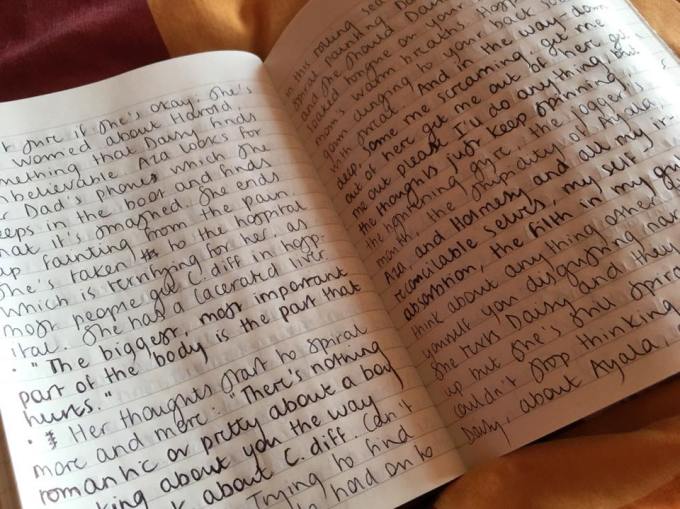
The book could easily fall into the cliché of ‘girl with mental health problem meets boy and suddenly everything is better’ but fortunately, it doesn’t. I was so, so relieved. Aza and her best friend, Daisy, find themselves investigating the disappearance of Russell Pickett, the father of Aza’s childhood friend, Davis. Aza and Davis become very close very quickly but that only makes things more difficult for Aza. He means a lot to her but, as she says, the “actual mechanics of it” are really hard for her. Touching and kissing send her into a panic, a spiral that tightens and tightens. And that’s really hard for her: “I can’t have a normal life if I can’t kiss someone without freaking out.” As much as she wants to be with him, as hard as they try to make it work, her mental illness is just too much. It might sound strange but that is incredibly comforting. Despite the fact that we all know a relationship can’t magically reset your mental health, there still seem to be so many stories where that is exactly what happens. Maybe it’s because the writers want to believe that, for themselves or for someone they care about. But it’s not the truth. To know that there is one story – one more story – out in the world that demonstrates that is a relief to me. I know that my mental health prevents me from being in a relationship regardless of all other factors; seeing someone else experience the same thing helps me, even if that person is fictional. Whether it’s just for now or forever (“I don’t know if I’ll ever be able to.”), that makes me feel a little bit less alone.
The real love story is in Aza and Daisy’s friendship. I fell in love with Daisy and their friendship from the first mention. I loved that she knew when Aza was struggling and just how to help her: “She’d straightened something inside me.” I was almost giddy with excitement to find such a supportive friendship. But then they both get into relationships and they start to drift. Aza’s mental health also starts to drop. The ritual of cleaning her finger becomes less and less effective. The spirals tighten, the voice of her OCD gets stronger, and her desperation increases, leading her to drink hand sanitizer in the hope that it will prevent her from getting sick. Driving home from school one day, she and Daisy get into a vicious argument during which Daisy calls her “extremely self-centred”. I found all of this really upsetting; my stomach kept twisting, so much that it hurt. I was so attached to their friendship that seeing it crumble was really painful. It results in Aza hitting the car in front and at the hospital later that night, the feeling of being surrounded by bacteria is just too much for her and the thought spirals overwhelm her. I don’t want to go into too much detail because you should really just read it. It’s so well written and I related to it so strongly.
After that, Aza has to spend a lot of time and energy on recovering from that. It’s scary and difficult and she feels very fragile but slowly, things do change. She and Daisy rebuild their friendship and while it’s so similar, it’s also very different to how it was before. They talk and they talk properly; those conversations are some of the best in the book.
But as wonderful as that is, it doesn’t solve Aza’s struggles. “Everyone wanted me to feed them that story – darkness to light, weakness to strength, broken to whole. I wanted it too.” She still has thought spirals; she’s still so terrified that she can barely talk about it. Her life – and her future – feel suffocated by her anxiety: “I could never become a functioning grown up like this; it was inconceivable that I’d ever have a career.” This process feels so real to me. I’ve hit breaking point after breaking point and I always expect to feel better, or lightened, afterwards but then all the problems are still there and that can feel devastating. Accepting the reality of her mental health is one of the biggest and most difficult struggles: “I would always be like this, always have this within me. There was no beating it. I would never slay the dragon, because the dragon was also me. My self and the disease were knotted together for life.” But, despite all of that, you can see the evolution in her thinking. She manages to say yes to things that scare her, she has good days, and her relationships get stronger. It’s subtle but her self worth improves too: “You’re the storyteller and the story told. You are somebody’s something, but you are also your you.” That is so much more important than if she’d made massive strides because it’s so real. That progress is slow and subtle and sometimes we don’t even see it happening. But when it’s written out on paper, you can see it and it’s a really good reminder that it’s there. It gives me hope.


Her relationship with her Mum is another thing I really liked in the book. They have a close relationship (“I could always feel my mother’s vibrating strings.”) and she’s a good mother but she says the wrong things sometimes and her concern can just feel like another layer of pressure for Aza. Over the course of the story, they get better at communicating and she learns what helps and what doesn’t, and Aza gets better at telling her. That’s such an important process and I think it sets a really good example: mental health problems can be really hard to understand, on all sides, and we don’t always get it right. Getting it wrong doesn’t make you a bad person; you just have to learn from the mistakes. And communicate. Towards the end, they have a really important conversation where Aza says, “I can’t stay sane for you…” and I really want to highlight that moment. I had a very similar conversation with my Mum. I think that people in our lives ask us to do things for them, thinking that they’re helping you, motivating you, giving you something to live for, when in fact they’re just adding more pressure to an already difficult situation. It’s not their fault – they’re just trying to help – but it can make things worse and they won’t know that unless it’s explained to them. So I think that was really good to have in this book.
Something else I related to was the fact that Aza’s father died several years earlier. When it comes to the events in the story, it’s not particularly relevant but at the same time, it’s very relevant (bear with me). It’s a massive part of who Aza is (it’s interesting that, from an outside perspective, we have a stronger sense of her identity than she does). She keeps her Dad close, driving his car, holding onto his phone to look through his pictures, talking to him… “I thought about how everyone always seemed slightly uncomfortable when discussing their fathers in front of me. They always seemed worried I’d be reminded of my fatherlessness, as if I could somehow forget.” My god, I relate to that. I can’t forget, not for a second. It’s painful but at the same time, I treasure it. I don’t want to forget. It’s part of who I am: “To be alive is to be missing.” It’s one of those before and after moments in your life; it changes you. It was comforting to see my experience (“And the thing is, when you lose someone, you realize you’ll eventually lose everyone.”) reflected back to me in someone else. As I’ve already said, it means so much to me to find a character I relate to so strongly. It makes me feel less alone. It makes me feel more real. “I remember after my Dad died, for a while, it was both true and not true in my mind… My father died suddenly, but also across the years. He was still dying really – which meant, I guess, that he was still living too.” Words like these are such a comfort to me. Aza imagines the moments they should’ve – or could’ve – had and they’re so clear that sometimes she forgets they didn’t happen. I can definitely relate to that.
Something I love about John Green’s writing is how he brings attention to things that are often overlooked or taken for granted: “It’s a weird phrase in English, in love, like it’s a sea you drown in or a town you live in. You don’t get to be in anything else – in friendship or in anger or in hope. All you can be in is love.” He weaves little things – or the little links between little things – into his stories that make the world more intricate, more real. The characters talk about the stars and Kurt Gödel. They have revelations about turtles and intersecting tree branches. Those things, for me at least, mean as much to me as they do to the characters. I mean, I am a space nerd and at least seventy percent of my thoughts are about metaphors but these things, these connections create so many layers to the story. As Aza says, “The world is also the stories we tell about it.”
After seeing what a huge impact this book had on me, my Mum read it, also in the space of a couple of days:
This story has also given me so much. It has helped me to better understand the feelings and anxieties my daughter lives with, and more importantly, another context to talk with her about them. (After reading this I realised that all the quotes she has chosen to include, are ones I have found particularly helpful too). I feel indebted to John Green for this story, for the hope I see it bring to her, and hopefully others too, for the understanding it can give parents and others supporting those with mental health issues, and for giving her a reason to read again. The way he closes the story also give me hope, for the future I wish for her.
It surprised me, how much she loved the ending since I’m still not sure how I feel about it. But I’m so glad she loved the book and that she got so much out of it.
This book means so much to me and I’m really glad it’s the book I chose to get back into reading. It’s definitely one that I’ll hang on to, carry around… It was always have a place on my bookshelf. There’s so much in it, multiple storylines that blend into each other. There’s elements of mystery, elements of romance, family and friendship, identity, loss… And it shows how everything affects everything else. The language is beautiful and brutal and real. I related to so much of it and it put so many of my thoughts into words. I love how he describes everything: he uses phrases like ‘swimming up from the depths’ and ‘sensorial planes’ when talking about thoughts spirals which is just so true, in my experience at least. There will be criticisms – there always are – but this is the book I needed exactly when I needed it and I will always love it for that.
There is so much more I could say – there’s so much I haven’t even mentioned – but I’ll stop there. So I’ll leave you with a quote from Aza’s therapist, who reminds me a lot of my own therapist. She says a lot of good and important things throughout the book but this is my favourite, and my favourite of the book:
“In some ways, pain is the opposite of language… And we’re such language based creatures that to some extent we cannot know what we cannot name. And so we assume it isn’t real. We refer to it with catch-all terms, like crazy or chronic pain, terms that both ostracize and minimize. The term chronic pain captures nothing of the grinding, constant, ceaseless, inescapable hurt. And the term crazy arrives at us with none of the terror and worry you live with. Nor do either of those terms connote the courage people in such pains exemplify.”

“It often dwells in cliche, but only as pop songs and epic poems do, mining the universal to create something that speaks to the familiar rhythms of the heart. At one point Aza thinks about how the string from one musical instrument can cause the string of another to vibrate, if it’s the same note. That’s what this novel does. It will pluck the strings of those in tune with it. It will resonate with, and comfort, anxious young minds everywhere. It might just be a new modern classic.” – Matt Haig, excerpt from his review of Turtles All The Way Down for The Guardian (x)
 Finding Hope