 Finding Hope
Preparing for London Film And Comic Con As A Disabled Person
Posted on October 28, 2023
So, earlier this year, I finally felt able to go to Comic Con for the first time ever after several failed attempts (this was mostly due to my own anxiety, which was then compounded by COVID and COVID anxiety). And it was amazing! I had a really, really special experience. Having spoken to them a lot, I was about as prepared as I could be (given that I’d never been before) and that really helped me enjoy the experience so I thought I’d share what I did beforehand and what I learned from the experience that will make it easier next time, whenever I choose to go. With London’s Winter Comic Con coming up, I hope that these can be useful to anyone wanting to go.
Apply for an Extra Help wristband ahead of time – The Extra Help wristband makes you quickly identifiable to the staff at the event so that they know to give you priority and move you to the front of the queues for your photo and autograph, etc. There’s an extra queue just for these wristbands at the talks and reserved guaranteed seating (although it is still first come first served). There’s a specific help desk for the Extra Help wristbands too and all of the staff were lovely and super patient even when I’m sure I was asking really obvious questions. These wristbands do require certain paperwork to get ahold of but all of that information is here.
Apply for Carers wristband – Even if you don’t need literal ‘caring for,’ having someone there to support you with whatever your particular needs are (for example, I needed someone – in this case, my Mum – there to help me keep my anxiety down, to guide me somewhere quiet if I started to get overwhelmed, and to be someone who knows what to do should I have a meltdown or should something unexpected happen) so that you can focus on the experience rather than worrying about what could go wrong and what you’d do if any number of things happened can completely change the experience. A pass doesn’t allow the carer to get photos or autographs but they can join their person in the talks and so on. (I met some members of a group of friends, some abled and some disabled, who’d organised their ticket buying to allow all of them to go for slightly less money, although that only works if members of the group aren’t interested in meeting anyone and only want to look at the stalls and go to talks with the group member they’ve partnered up with.)
Diamond passes are a good investment for seeing someone that means a lot to you – Because the only person I really, really wanted to see there was Amanda Tapping, I bought a Diamond pass because it made access to all of the Amanda-related parts of the event really easy and straightforward. The pass gave me access to the talk, the autograph, and photo, combining and reducing the price. It also improved the accessibility in that it reduced the queuing times and guaranteeing a seat. It made the whole experience less stressful, although I wouldn’t have been able to afford the luxury for more than one person.
Email beforehand if you have questions – Because I was so nervous, I emailed the organisers several times before the event to get as much information as possible. The staff were great, replying clearly and in good time. Having said that, it’s worth remembering that information does change so it’s probably best, should you need to contact them about anything going on during the actual convention, to contact them closer to the event if possible (although they obviously have to set up and so don’t reply to emails in the last few days leading up it).
The line up changes multiple times – The fact that the schedule changes so much has caused me a lot of anxiety in the past, during previous attempts to go, but now that I know that that is what happens, it doesn’t phase me as much. Knowing that the early ones are really only a basic guide and that you’re not going to be sure until the day before, or even the day of, did reduce my anxiety because I stopped panicking every time they changed it.
There are chairs but you have to search for them – I had fully expected to have to sit on the ground between my events (and at times, I did) but there were a handful of empty tables and chairs here and there around the convention space (I assume for events on different days or something like that). So, on the whole, it was a pretty comfortable experience; I could’ve coped with sitting on the floor but it was very nice not to have to. So keep an eye out because chances are, you’ll find somewhere more comfortable to sit than on the ground.
Keep the map on your phone – It’s a huge, huge space with a lot going on and it’s easy to get turned around so keeping the online map (or a picture of the map – I didn’t want to rely on the assumption that the WiFi would be good) does make it easier to navigate that space and to find things more quickly, something that’s especially helpful if you need to find a bathroom or quiet corner as quickly as possible.
An unexpected and beautiful aspect of my Comic Con experience was how many disabled people I saw and, of course, those were just the people with visible disabilities; there were surely many people there with invisible disabilities, just like me. That was so comforting. I’d been so worried about how my disabilities would affect my experience but here were all of these people with disabilities who were, presumably, having a great time. It helped to reassure me that that was possible, not just for that event but for ones in the future. There were also lots of service dogs around – one of which I spent quite a lot of time with – and that gave me a little bit more confidence about what it will be like to have one myself. I just felt very safe and welcome there (even though I’d never been there before), which is not something I often feel out in the world. So it was a really positive experience, on so many different levels.
And although I don’t know whether anyone who’s part of the organisation will actually see this, I still want to say thank you to all of the staff who were so helpful and accommodating and patient – especially when my anxiety rose and I was less able to function – because it made the experience so much better and so special: I was allowed to be myself, to be anxious, to need help. They didn’t for a single moment make me feel weird or stupid for struggling and I appreciated that more than I can possibly express since that is often the world’s default. My Mum and I emailed to express our thanks but I also want to acknowledge them publicly because I really, really appreciated it.
Here is my Instagram post from after the event…
Amanda Tapping: Embracing Mental Health as a Fandom (Livestream)
Posted on June 18, 2023
I have been a fan of Amanda Tapping – Samantha Carter in Stargate SG-1, Helen Magnus in Sanctuary, actor, director, and more – for years, since I was about fifteen or sixteen (so over a decade). She’s an amazing actor, a fantastic director, a deep and creative thinker, and an incredibly generous person: for years, she did – amongst other things – annual weekend-long charity events, each one raising thousands and thousands of pounds for charity. I’ve always loved her performances, especially as these two characters, (and her commitment to the integrity of the characters) and they had a huge impact on me; even after all these years, there are moments from the shows and from the audio commentaries (that I listened to obsessively) that I see show up in my life and my creative approach. They – and she – really did change my life.
Back in 2016, I had the opportunity to meet her at her annual GABIT event, AT9. This event involved several Q&A sessions when she not only answered questions but told stories from her life and acting experiences. Attendees also got to take photos with her and get her autograph, getting little pockets of time to talk to her. Meeting her was an amazing experience, even if I was so unbelievably nervous that I could barely talk. But she was so sweet, holding my hands the whole time and just pulling me out of myself, making it a little easier. She really is the loveliest human being.
A few weeks ago, I got an email from The Companion, a website focussed on sci-fi media with this goal: “To create the most special, fun, and welcoming place where as a geek, you can be yourself and bring you closer to the creators, actors, experts… and each other. We launched The Companion in October 2020 during lockdown on this shared belief: geeks deserve a high quality home just like fans of sports, fashion, music, and other ‘premium’ genres.” Their think pieces, character and episode analyses, behind the scenes articles and so on are all really interesting and their interviews with so many people involved with these shows are always fascinating and good fun. It’s a great site, even without events like these. Back to said email…
“We’re absolutely thrilled to announce this very special event with Amanda Tapping – and all for a good cause. As one of our cherished Companion members, we wanted you to be the first in line for an opportunity to meet the legendary actor, director, and producer. Join us on June 3rd, 2023, for a live online interview with Amanda Tapping covering a subject close to her heart: mental health. Hear stories of how Stargate fandom saves lives and share some of your own. ‘As part of the sci-fi community, I’ve seen firsthand how we can all come together and support each other,’ says Amanda, ‘and I would like to extend that same compassion and understanding to issues around mental health.’“

So I love Amanda Tapping and mental health is a deeply important cause for me as well so this seemed like a gift from the universe. I bought a ticket straight away. There was also an opportunity to meet her online after the event but, as much as I would’ve liked to, I just felt like it wasn’t right for me. For one thing, it was in a groups for a short period of time and I know I wouldn’t have felt able to say anything I wanted to say with an audience. And it was just too expensive to justify, especially with that context. So I reluctantly clicked away and hoped I’d get another opportunity in the future.
We did, however, have the opportunity to share a story that would be passed on to her and I really liked that idea; it felt much less exposing, even if it did get shared during the livestream. So I wrote about how Sanctuary in particular got me through sixth form when I first started struggling with depression and anxiety; I had this fun little daydream about working on the set, working on the scripts for the show, and I probably spent more time in that world than I did in the real one (I swear, I had multiple cork boards with storylines planned out). I couldn’t have gotten through that period of my life without it, without her.
I really wasn’t sure what to expect from the livestream, how it would go, but it was highly enjoyable despite the emotional nature of it. Everyone was very thoughtful and heartfelt but still funny and ultimately hopeful. I won’t share everything because it was a unique and special experience that we all paid for but there are things that I think no one would mind if I shared because of how they could help people. And I wanted to share the experience of this livestream with someone I love and respect so much.
The first thing Amanda did, after being introduced, was lead everyone through a breathing exercise – breathe in for four, hold for four, out for four, hold for four – that she does with her daughter, Olivia, when she’s feeling “super anxious.” She clarified that she’s not an expert or anything but that she has been through “things” and that she’s maybe, as her daughter has said, a person who “feels things a little too much.” She feels it and she wants to help people who are also feeling it; that was a really nice way of putting it and it was nice to hear. She was pretty emotional from the start, telling us – and there were a lot of us, in the comments and just watching – that she was “really, really grateful that [we were] all [there].”
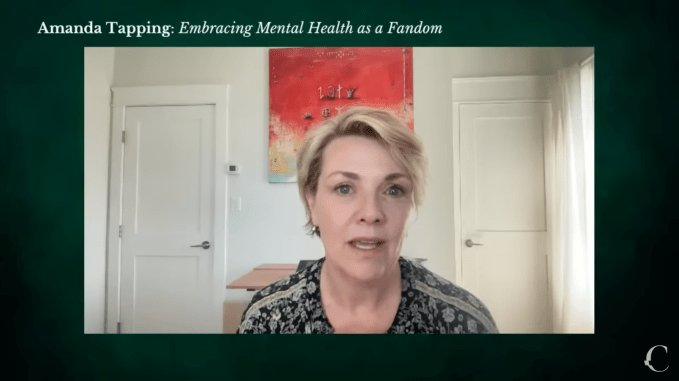
I hadn’t forgotten how much I love her but seeing her again and hearing her voice, I was just overwhelmed by how much she means to me, how much she’s impacted my life. And I was just so, so pleased to see her. It was just pure, overwhelming joy. And from the look on her face, she felt the same way about being there, about connecting with everyone and being ‘together’ again. It was really sweet. And the first thing she shared felt very typically Amanda: it was the analogy of how we all carry bags of rocks, bags that only grow heavier over time, and how we all need to learn how to put them down now and then, take a breath, and just be, just be a person without that burden: “We all have our burdens but I think it’s really important to take a moment and put it down and just see what it feels like to not carry it around for a minute.” We’ll always carry those burdens and they help us to help other people but we need to look after ourselves too.
There was some significant discussion about COVID, both how she’d seen it affect other people (even in the way that people are driving more aggressively) and how she felt it had affected her. She talked quite a bit about her experience – about her family, about her fears, about her losses – more so than I would’ve expected. She’d felt isolated and scared and didn’t understand what was happening and why it was still going on; she had a lot of anxiety, especially watching her daughter go to high school in a mask every day (once schools opened again). And while it was, of course, so important to wear a mask, she talked about how hard it was to breathe with a mask and face shield for fourteen hours a day on a film set, getting home and feeling oxygen deprived. “It was easy to fall into isolation,” she said, “It was easy to go down the rabbit hole as I so often do,” and it took a while for her friends to pull her out of that. It’s amazingly comforting to hear someone you so admire and respect express the same feelings as you. It made me quite emotional to hear and even more so to think about what she was really sharing with us: these really personal details of her life. I’m always so touched when people, especially people like her with public profiles, share such personal details and trust us with them; it feels like an honour, a trust that feels really sacred.
Rebecca, the livestream host, asked her what had helped her that might help others and Amanda talked about several things, all good points and interesting insights into her life:
- She talked about how she and two friends would meet over Zoom every week and have a cocktail hour together. She also did various other Zoom based socialising with other friends, her brothers, her family… The thing that really helped was connecting. (The video connection went out at one point and the screen went dark, which – as Amanda pointed out – was very ironic since there’d been so much talk of connection.) She did talk about how hard that can be though because you know you’ll get a response which you’ll then have to deal with and the whole thing can feel so draining; I can definitely relate to that.
- She also talked about how important it is to share the load with your friends. It is, of course, important to be there for your friends but you also need to let them be there for you. People want to know how you are and they want to help; it can be hard to let them in but it can not only help your mental health but also strengthen your friendship.
- She talked about how exercise makes her feel better and stronger, how it’s taken a long time to feel safe enough to go to the gym again post the height of COVID. She actually talked about having a less than healthy relationship with food during the lockdowns – “Certainly during COVID and everything that went on, I mean, I ate every single feeling I had” and “We ate our feelings, we ate our anxiety, we baked a lot of bread!” – which was very refreshing; so many of us shy away from those conversations but she shared those negative coping mechanisms and how they weren’t good for her and what she did to balance them out: she talked about how it sounds trite but “physical activity is key.” Even if you can’t go for a run, just getting outside is good. She started her day in the woods – her happy place – with Martin Wood (who she’s worked with for years and especially closely on Sanctuary – I cannot express how happy it makes me that they’re still such close friends and hang out regularly), walking their dogs. That was how she got herself mentally prepared for the livestream.
- She said that she’s not good at stopping (somehow this did not surprise me) so she kept moving, getting better at baking and cooking and sewing just to keep herself busy, although she’s trying to get better at relaxing.
- During one of the stories shared (they couldn’t share all of them obviously but they did share a few), the writer talked about rewatching, including a quote from the psychologist Pamela Rutledge: “It can become really therapeutic, especially if you are feeling anxious. Watching the same piece multiple times reaffirms that there’s order in the world and that it can create a sense of safety and comfort on a primal level.” I’ve always found rewatching to be both enjoyable and helpful to my mental health and Amanda clearly felt the same way, that there’s no shame in it and that people shouldn’t be so weirdly judgemental about it: “Whatever you need to put the blanket on yourself and feel safe, even if it’s just safe for an hour, even if it’s just to calm your breathing for an hour, do it… Like, absolutely.” She got visibly emotional again – “I’m gonna cry but…” – and talked about how anxious she had been about the livestream, whether she could actually do it and whether she could do it justice, and so she rewatched Downton Abbey with her daughter which is their thing, especially when one or both of them are anxious (I find it so comforting that we both do this, albeit with different shows). She said that, whatever it takes, we have to allow ourselves these comforts without shame or judgement, whatever it takes to get through. As I said, she was visibly emotional (to the point of actual tears and tissues) and it reminded me of just how much she cares; she cares so fucking much. She cares more than we could possibly imagine and that’s just so moving.
- She and Rebecca discussed the idea of always appearing fine, of never letting people see when you’re struggling. Amanda said that, when she’s running a set, she’ll put on the mask and make sure everyone feels confident and feels like they can rely on her because that’s what they need but, when it’s safe, it’s so important to let it all go and not be okay if that’s what you need. The examples she gave were amazingly honest and, again, I was touched that she would share these things with us; She’s such an open, generous person and the fact that she trusts us with these parts of her life mean so much to me that it’s almost overwhelming. As she said, this idea of allowing yourself to be yourself and fully feel what you’re feeling isn’t new or groundbreaking but it is important and needs to continue to be part of the conversation. She said, “It will be okay and it will pass,” and it was hard not to feel her conviction even though I often don’t feel that way.
- They also talked about social media and how often it can become the highlight reel of your life (I’ve always found this viewpoint really interesting because it never, ever occurred to me to use social media in that way and so I never have, which makes it fascinating to me that people do), which isn’t a new concept (family photo albums, for example) but has gotten out of control with social media. Amanda said that she noticed herself doing that on Instagram and that maybe she needs to post “the shit” more often. They also discussed how easy it is for people to send hateful messages through social media and Amanda said how hurtful it was – and still is – to read some of the awful messages about herself or the show she was in at the time, although the worst ones were when people attacked her appearance: “It killed me every time I read something crappy.” They talked about how one of the best ways to handle that sort of thing is to take it to a friend, to talk it through and even make fun of it to make it less painful.
Back to the stories for a moment. As I said, a handful of the stories submitted were shared over the course of the livestream. (Mine wasn’t one of them – I think it was probably too long and also didn’t serve as a jumping off point for more questions – but that was fine; they’re all being passed on to her so she will see it. That’s good enough for me. Apparently they were all really uplifting and just amazing examples of this fandom, that they reflect a deeply inspiring reality of how these fandoms have been so much more than just sources of entertainment for so many people: how they’ve provided solace, a sense of belonging, and even lifelines in the worst times, a description that was really moving to me.) There were lots of people saying that she and her work as various characters have saved their lives and you could see how much that meant to her. At one point, she used the word ‘verklempt’ (a word I’d never heard before but which means ‘overcome with emotion’ and you could really see that she was). One of the stories talked about fandom really well and what it means to people and Amanda was really taken with the description…

“Wow, that’s beautiful put. Holy moly. And it’s true. I don’t know if I can add to that, that’s just very beautifully articulate.”
Rebecca talked about how, in researching for the stream, she found articles about how sci-fi and how the escapism it provides can be bad for your mental health and found that very surprising. That had surprised her because she’s personally always used sci-fi to get more in touch with the world around her. Amanda completely agreed and they talked about how that idea bothered them both – that the escapism of sci-fi is a bad thing – and why. Amanda talked about how sci-fi is so often maligned and characterised as the ‘geeky’ genre; I find it so heartening to know that she’s always been able to see what it could be. She talked about how she doesn’t think you can escape too far, that being able to escape is important: we can escape into the thing and then, through the internet, we can connect with people all over the world. A lot of people just don’t get that. And following on from that, she talked about how, in her experience, the Stargate fandom is full of really nice people and the Sanctuary fans were always so generous and kind, how she constantly sees fans supporting each other, online and in real life, and how fiercely they wanted to help with her charity, Sanctuary For Kids. She said that she’s observed a special and unique generosity from sci-fi fans, perhaps because so many people feel seen by the characters and shows in this genre.
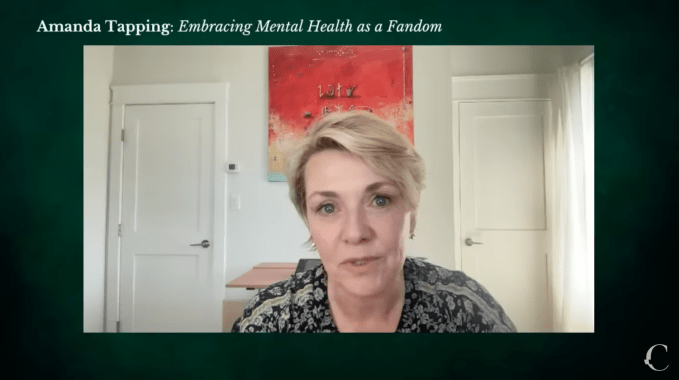
She talked about how hearing people’s stories means so much to her, how it’s had such a big impact on her. Apparently her favourite stories are the ones about what the characters mean to people and how those connections have made them feel stronger (she mimed hugging everyone, which was really cute). The number of stories like that was really moving but there were also so many stories about how people felt that Amanda herself had saved them and Rebecca asked her what that felt like. You could see how deeply that moved her – continues to move her – and she sniffed so I think it had actually moved her to tears. She could see how much Sam Carter meant to all of these people, especially young women and that felt like a huge sense of responsibility, that Carter was – and still is – this huge role model. She felt like she couldn’t let the show screw up her story so she would fight the writers on certain decisions despite not being a confrontational person. She’s talked about that a lot and it always makes me think how lucky we all were to have Amanda Tapping cast as Samantha Carter because someone else might not have pushed so hard for the character and for the audience.
The final story described Amanda as being “a light in the darkness” and she was clearly quite overwhelmed by that (something that I found both surprising and really touching, considering how often she must’ve seen messages like this over the years): “Wow, um, the only thing I can say to that is that, um, it works both ways and that, in my hours of darkness, the fandom has helped me see the light and feel okay. It’s not that you’re just helping each other, you’ve certainly helped me and I know a lot of other actors who go, ‘Oh, like, people do care and people do like us…’ And, for me, I…. It’s really important to me to connect to fans when I meet them… It’s given me a whole other world of experience. But it does, it goes both ways. It absolutely goes both ways. I’ve been lifted up out of fires more than you guys could possibly know, by your kindness and your generosity and your love.” She was visibly emotional again and I was practically weeping. It’s easy to think that we, as individuals, don’t affect her but clearly we do and that’s a lot of feeling that I’m not entirely sure what to do with.
Eventually they wrapped up the livestream and Amanda wished us all goodbye: “I love you all and it’s been a real honour to be a part of this fandom. It’s been such a huge gift in my life so thank you.” She blew us a kiss and then it was over. It was moving and thoughtful and considerate and generous and a really lovely experience. I really hope that they do do more of these conversations – Amanda said that she wants to revisit all of this, how this is just the start, just scratching the surface of a very big conversation – because it was very inspiring and I think they really could do good, even if none of us know what that looks like yet.
It was a lovely hour and I really hope that they continue to do these discussions. And seeing Amanda on my screen again, hearing her talk about all of these things that are so important to all of us, I would so love to see her again. I would have reversed my decision on the post stream meet and greet sessions on the spot. She’s visiting London for London Film and Comic Con in July and I’ve been going back and forth about going for months, even more so after the livestream. I would love to meet her again – so much has changed since the last time I saw her (not that I’d be filling her in on everything but I feel different and this me would like to meet her) – but conventions feel so scary and overwhelming, overstimulating on every level. But then I got an email that she was doing a talk too and, after a long conversation with my Mum, I’ve decided to try. There are other cool people there but I’m not going to try and take on too much, just going to Amanda’s talk and meeting her. Hopefully I will be able to handle it – the noise, the people, the anxiety – and have a good time; the tickets have been purchased and now I guess we just have to wait and see.
 Finding Hope