 Finding Hope
A Study of Autism
Posted on December 20, 2017
Last week I got to take part in another Autism research study. I’ve done a couple of these before but that was before I was writing this blog and I just haven’t got around to writing them up. So far I’ve done two at Kent University; the second one involved seeing my brain waves, which was really cool (although the saline gel that made it easier to pick up my brain waves was not cool – it was gross). This one was at Sussex University and focussed on how people see, process, and remember colour. I was really excited about it since I seem to be very sensitive and responsive to colour. And even though I’ve been really struggling with my energy, I had a really good time.
I was there for about three hours. To begin with, I did a couple of tasks to assess my colour vision and a couple of Autism questionnaires. And later on I did an IQ test. These tasks aren’t used for a clinical evaluation but to provide quantitative scores so that you can compare all the data in the study. This makes the research more reliable because you’re not, for example, comparing two people with vastly different abilities. I’m not massively into IQ tests as an idea – my Psychology teacher used to say that the only thing a high IQ proves is that you’re good at IQ tests – but I did get a great deal of satisfaction out of completing one of the tasks that I’ve previously never been able to do.
The main part of the session was devoted to several different tasks involving colour. One had me putting names to different coloured squares of card, another involved manipulating the colours in various images to turn them grey, and a third required me to repeatedly choose which of two squares was bluer. When we were done, all of these tests were explained to me, what each one showed and how they would draw their conclusions. Had I not fallen in love with songwriting, I probably would’ve done Psychology at university and it’s something that I’ve really missed so I geeked out over it. It was really fun.
I get so much out of doing these research studies. It feels so good to use my Autism for something positive when most of the time, it’s something that I struggle against. I’m still wrestling with how that discovery has changed my life so to be able to channel it into something that will help people helps me. The other reason I like doing these is because all that’s required of me is to be myself as an Autistic person. I don’t have to moderate my behaviour, consciously or unconsciously, and that is so freeing. It’s also kind of empowering: it reminds me that I’m a productive person who can contribute, that I’m not less because I’m Autistic, that I can do good. It’s easy to forget that when you’re struggling with something overwhelming.
So it was a good day. I definitely recommend getting involved with these sorts of projects if you can. I often hear about them through my local Autism charities so search out the ones near your location if you’re interested!

Christmas and Autism
Posted on December 9, 2017
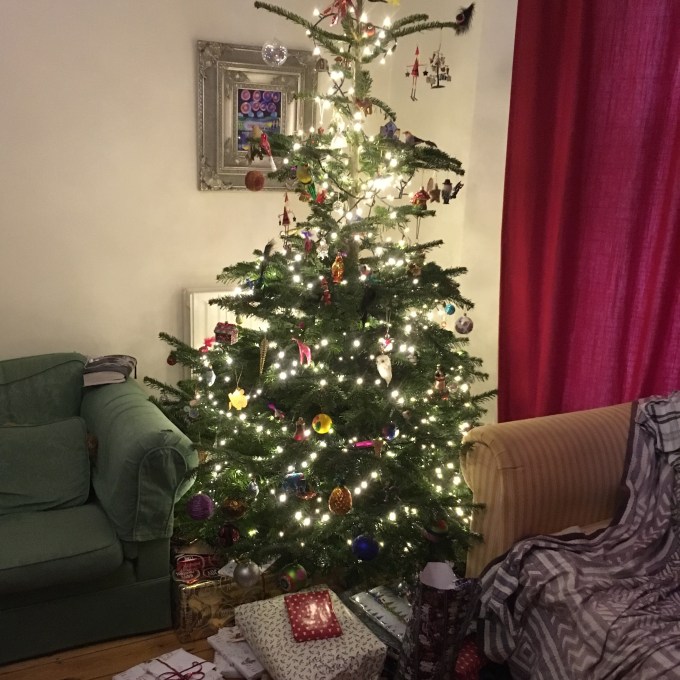
Christmas and Autism aren’t hugely compatible. Lots of bright lights, noise, high emotions, family, socialising… It can all get too much. It can be a really stressful time. So I’ve been thinking about the past few Christmases and the one coming up and how I can make it restful and comfortable but also enjoyable.
Make sure you have the medication you need – To run out and go into withdrawal (depending on the kind of medication you have) is awful anyway but it’s adding insult to injury to have to go through it during a time that is characterised by its joyfulness. So make sure you know the dates your doctors/pharmacy will be closed and make sure you have the medication to get through that time. Please. If you need any extra motivation, do it for me. You do not need to go through that.
Plan presents with friends and family – I get really anxious about receiving gifts. I always worry that I’m not reacting positively enough, that I’m letting the giver down. I worry that they’ll see a microsecond of anything other than joy and that will upset them. Another anxiety about presents comes from the times when I feel really far away and disconnected from myself, something I often feel at times of high emotion. When I feel like that, something like being given a present doesn’t impact me the way it would if I didn’t feel like that and that brings it’s own myriad of emotions: guilt, frustration, loneliness, etc. I feel like I’m being ungrateful and the lack of personal connection to whatever I’ve been given makes me feel very alone, like people don’t know me. I know that it’s my head messing with me but that doesn’t make the emotions any less real. To counteract those feelings, I’ve started discussing present buying with my family and friends. Asking for things can feel really, really, REALLY awkward but if I’ve learned anything, it’s that talking things through does help. So we talk about that and we talk about what I want and what they want, the more specific the better. It does take out the surprise element but I don’t really like surprises anyway and if you have anxiety, chances are you don’t like them either. For example, for my birthday, the biggest surprise was which poetry book I got from a particular writer. It made the whole day so much easier on my emotions.
Get as much information as possible – I make a point to know what’s going on as much as possible. For me, the biggest anxiety is food so when it comes to the important meals (such as Christmas Eve and Christmas Day – the ones where my family all get together), I make sure there will be at least a couple of things I can eat. I’m lucky because my family are very used to my struggle with food so they do take that into account when planning a meal and that means a lot to me. It makes a massive difference to my Christmas experience.
Space out social events – Obviously there are some things you can’t avoid but where possible, I try and space out the socialising to give myself time to recover and recharge. And knowing in advance allows me to prepare myself, physically, mentally, and emotionally. This makes it a bit easier to regulate my mood. Some things can’t be helped but my aim is to try and keep my emotions relatively even, rather than the tumultuous up and down that they can be, which is exhausting and upsetting.
Try not to beat yourself up about negative emotions – Something I also struggle with at Christmas is this feeling that I’m not enjoying myself enough, like if I’m not ecstatic I’ve somehow failed Christmas. I’ll look around at everyone and they’re all laughing hysterically at some ridiculous Christmas dinner activity (anyone else have those differently tuned whistles that you had to blow in a particular order to play Christmas songs?) but I feel like crying. I’ve had that experience a couple of times and it’s one of the most isolating feelings I can think of. It makes me feel so alone and disconnected from everyone and it’s horrible. I haven’t figured out what to do about this feeling yet but I think the first step is acknowledging it and accepting that it’s there. My plan is to try some of the things I listed in a previous post about connecting to the world around me. I’ll report back with whether it works or not.
Accept the anti climax – I often crash after Christmas and really struggle with the anti climax. That really drags my mood down. I’m hoping that spreading out the Christmas events will soften that a little and I plan to have some fun, gentle things to do to afterwards but again, I’m trying to acknowledge and accept it. I probably won’t be as calm about it when I’m in it; I’ll probably rage against it as is my default these days but I can but try. At the end of the day, that’s all you can do.
When you can’t get out of a stressful event, create a safety net – If there’s a stressful event that I have to go to, I plan as much as possible. I’ll scout out somewhere to retreat to or bring/find a friend who can rescue me if needed. I create a safety net for myself and often it’s existence is enough. It takes off the pressure.
Take the time to think about the sad stuff if you need to – At Christmas, I can’t help but think of the people who aren’t there, who are gone for whatever reason. I miss them, not necessarily more than any other time but in a more obvious way. They are not there at Christmas dinner, there’s a glaring hole in your shopping list, and there’s no present from them on Christmas morning. I think we do a disservice to ourselves and our emotions to push that aside, because it’s a holiday about joy or because it’s too hard. But if it’s something you want to do, you have to do it in a way that works for you. Sometimes it feels right to raise a glass at dinner and sometimes it’s right just to take a few moments to think of them. Sometimes it’s right to flip through photo albums and sometimes it’s right to cry about it. Grief and sadness aren’t things you can do to someone else’s formula. But I think it’s important to take the time to remember and acknowledge the sad stuff, in whatever way you choose.
Ultimately, it’s all down to communication and planning. Planning, planning, and more planning, as always. That’s what I’m learning. I hope this has been somewhat helpful and that you guys all have the lovely, safe Christmases you deserve.
Originally written for Ambitious About Autism. You can find it here.
 Finding Hope