 Finding Hope
Autism Tattoo Ideas
Posted on April 1, 2022
I have been thinking about and wanting to get a tattoo representing my Autism for a really long time now. There is a tattoo I want to get first because the symbolism is important to me but being autistic is such an important part of my identity and I would, at some point, like to get a tattoo to commemorate that. But figuring out what the right one is is taking a while and a lot of thought.
In my search for inspiration, I’ve now seen a lot of different tattoos representing Autism and I thought I’d share what I’ve found as well as some of my own ideas…
I’ve done a lot of searching and as far as I can see, most people go with the obvious symbols…
Puzzle Pieces:
The puzzle piece is definitely the most well known symbol associated with Autism, having been used by Autism charities and organisations for decades. As far as I can tell, most autistic people feel that the puzzle piece symbol is, at best, problematic and, at worst, offensive in that it symbolises something missing, symbolises autistic individuals as being less than neurotypical individuals. But despite this negative view, most of the tattoos I’ve found online involve the puzzle piece in some way.


Top left (x), top right (x), bottom centre (x)
As I said in my post about symbols associated with Autism: “Personally, I don’t hate it as a symbol. To me, the puzzle piece doesn’t represent something that’s missing; it represents the idea that we’re all puzzles and we wouldn’t be complete without every single thing that makes us who we are. We’re mosaics and we are who we are because of each piece that builds up the picture. I know many people feel that Autism isn’t just one piece and I agree but my point is that I don’t see the puzzle piece as something missing but as something fundamental. So I don’t hate it but I think it’s history – it’s original meaning – is too entrenched in society’s consciousness to ever really be changed. I doubt it could ever be a purely positive symbol at this point.” Personally, I wouldn’t choose it for a tattoo that represents my experience of Autism.
Infinity Symbols:
I’ve also seen infinity symbols come up a lot in the symbolism around Autism…

(x)
I understand why people like the infinity symbol and while there are some gorgeous tattoos out there (like this one), it just doesn’t really resonate with me as a symbol for Autism since it relates to so many other things. It doesn’t specifically represent Autism to me and that’s what I need this tattoo to do.
Rainbows:
Some people use rainbows to represent Autism, most likely a reference to the Autism ‘spectrum’…

(x)
While this is my preferred of the common Autism imagery, it feels too close to the LGBT+ rainbow flag. I’m queer and so I wouldn’t feel like I was appropriating the imagery but there’s a reason why these identities and causes have their own colours, right? Being LGBT+ and/or being autistic are both really important parts of who we are and I think, by using the same colours for these two identities, there’s potential for confusion when that’s the opposite of the point of these identifying colours and symbols. Maybe I’m overthinking it but it doesn’t feel like enough if it could be mistaken for something else.
Combinations of the Three:
Most of the tattoos I’ve come across involve at least two, if not all three, of these…


Left (x), centre (x), and right (x)
Some of them are really beautiful but none of them feel right and, for me, being autistic is so much about feeling that it has to feel right – beyond the idea that, if you’re going to have something on your body for the rest of your life, you’re going to want it to feel right.
Takiwātanga:
‘Takiwātanga’ is the Maori word for Autism and translates as ‘in their own time and space.’ This seems to be increasingly popular, I imagine because of the feeling of acceptance it evokes.


I really like the sentiment and I’ve seen some stunning tattoos that incorporate the word, the two above included, but I’m not sure it’s right for me. As much as I loved the parts of New Zealand I’ve visited – I think it’s the country I’ve felt most at home in – I’m not sure a word is what I want or what feels right for this tattoo when, so often, being autistic feels so difficult to describe.
More Unusual Ideas:
While the previous images and symbolism seem to be the most common, I have seen other beautifully creative ways of representing Autism…


To me at least, these tattoos seem more like the individual’s representation of Autism or something symbolic of it and I guess that’s what I’m looking for: my personal symbol or imagery representing my experience of being autistic. I just haven’t found it yet.
Ideas I’m Thinking About:
There are a handful of ideas that I keep coming back to so I thought I’d include those as well, just in case they resonate with anyone else. None of these images are exactly what I’d choose but they do illustrate the general ideas I have.
Circle of Three
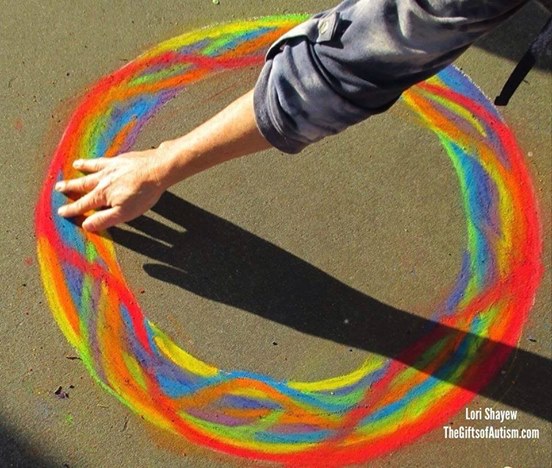
The Circle of Three is a symbol for Autism created by Lori Shayew and Kelly Green to represent the different aspects that make up each individual person: “In light of the recent news that the rainbow is not an arc, but a circle. (Thanks for the proof NASA) It’s time to recreate the new model. Colours of the rainbow weaving in motion. We are recognised for all of our colours… It’s time to break down the spectrum (low-mod-high) and allow our innate gifts to bloom and flourish. Don’t we all excel at some things, but not in others? No big deal. We can jump from yellow to red to indigo to green and back again. Maybe then there are no colours, only light.”
(x)
I really like this as a similar but distinct variation of the rainbow and the way that it can be personalised according to each person: all you have to do is assign colours to different areas of your life – as you feel comfortable doing so – and then interweave them in a way that best represents you as a person.
A Whale
A long time ago, before I was diagnosed as autistic, I read the story of The Loneliest Whale – a whale who’s call is indistinguishable to other whales – and I’ve never forgotten it. I related to it at some level and that connection I felt has never gone away. I want to write more about this whale and how multiple communities have felt a connection to it and found solace in the story but now’s not really the time.
I’m not sure the whale alone would be enough to represent my being autistic but for me, that connection is there so it wouldn’t surprise me if the image of a whale found its way into my Autism tattoo.
The Use of the Rainbow or Colour Spectrum
Light and colour are important to me and to my perception of the world, particularly my perception of music, which is possibly the most important thing to me. So, the inclusion of a rainbow or spectrum of colour isn’t out of the question. I’m just not sure how.
Space
Being autistic, I feel so incredibly sensitive to the world around me. Sometimes it feels like I can feel the waves and particles in the air, the vibrations of every thing, the world turning, the frequencies of stars… It’s like all of my senses have been calibrated to be extra sensitive, too sensitive. And for some reason, that makes me feel weirdly connected to space and to stars. So the presence of these in a tattoo representing Autism would make sense to me.
Again, like the whale idea, it couldn’t exist on it’s own but I can imagine it as part of something bigger, although I wouldn’t want it to be a huge tattoo.
A Combination?
At this moment in time, the idea that feels most comfortable – feels most representative of my experience of being autistic – is something like this…


Something along the lines of these tattoos, but that involves some of the elements I’ve talked about or even all of them, is what I’m thinking about currently. But as I’ve said, I want to get it right so I’m taking my time to think through every detail and make sure I’m sure.
Getting a tattoo is not going to be an easy thing for me. I’m sensitive; sensory information is always loud for me. The sound won’t be easy. The pain won’t be easy (I’m sensitive to it but not afraid of it). The ongoing anxiety around COVID won’t be easy. So, yeah, it won’t exactly be fun. That’s part of the reason I want to get a smaller, simpler one first. But this is important to me so I am going to make it happen.
Do any of you guys have tattoos that represent being autistic? Being neurodivergent? I’d love to see them!
Parenting a Young Adult With Autism Spectrum Disorder: I Interview My Mum
Posted on March 31, 2021
Since this is my blog, the experiences are predominately from my point of view but I thought it would be really useful, as well as interesting, to get a different perspective on the same scenario. So, with that in mind plus the fact that most resources are aimed at the parents of young autistic children, I asked my Mum if I could interview her about what it’s like to be the parent and often advocate for a young adult with Autism Spectrum Disorder. I came up with a list of questions and she answered them. I had almost no input on her answers, only to ask for more information or detail if I thought she hadn’t fully answered the question or finished a thought. We’re hopeful that this could be of some help to parents with adult children managing a form of Autism.
I’ve talked about what it was like for me to get a late diagnosis but what was that experience like for you?
The process of getting a diagnosis for you was frustrating at best and distressing at worst. You were very clear about your need to know the causes of your difficulties and so refusal from medical professionals to engage with that need was hard to witness. I needed to do the research, follow up possible assessments and/or therapies and talk about your challenges against a backdrop of suspicion of being overprotective and a distrust of my motives. Even when it became clear that your inability to talk for yourself at the outset was a result of Selective Mutism and your experience with those professionals, I was still met with a resistance to engage with me on your behalf.
Although I’m more able to speak for myself now, what has it been like having to do so much advocating for me?
It always felt like it was my role to do this until you were able to do it for yourself. I wasn’t trying to fix things, just get your voice heard, your experience understood so that the problems you were facing could be addressed and the right support provided.
I knew all the answers to questions you were being asked because we’d talked about it all beforehand. Both before and after your diagnosis, it has just felt like I can be the means to you being heard and hopefully understood as and when you are not able to do it yourself.
As in your first question, this doesn’t always work! And I do often feel frustrated by a refusal to accept my intentions, confusing it with a reluctance to ‘allow’ you to speak for yourself/become independent.
Knowing me but having an outside perspective, what would you consider to be the positives and negatives of having Autism Spectrum Disorder?
This is really difficult for me as all I see is YOU, with all your qualities and all your challenges. Combine this with the fact that each person with ASD presents so differently and I do find it difficult to generalise. Understanding more about women on the spectrum now, I see your very singular focus on anything you set out to do as a positive. I think your intense empathy is a double bind, giving you a compassion that can then often be overwhelming. The biggest negative I see is your level of anxiety. This is often debilitating and always massively exhausting and affects most aspects of your life.
How do you think things would’ve been different if my ASD had been recognised when I was younger?
This is a little easier to answer as I think, from all I see now, knowing about it earlier may have enabled us to access support for you and given you access to specialist resources. Having said that, I wonder if a diagnosis earlier might have ended up giving you a label that meant expectations, both your own and society’s, may have been different for you. Increased awareness of and understanding surrounding neurodiversity is relatively recent.
What do you think is the most important skill or trait when it comes to parenting a young adult with ASD?
This question makes me want to ask you what you feel has been most important but my sense is that being there for you, trying to put aside any preconceptions and opinions of my own so that I am able to really listen and hear what you are telling me, leave aside any of my own anxieties or fears, to support and encourage you to do what you want to do; a combination of protection when things are tough and support to push forward when you feel able.
I also feel it has been important to be prepared to read and research for myself and learn all about the condition so I can share this whenever it feels necessary to inform the argument for support. And to be prepared to persist when first attempts are met with a negative response.
I’ve often talked about feeling like a burden for not moving out or contributing more as a young adult. What are your thoughts on this?
In answering this, I would like to reference a quote here, which I think explains how I feel about this. I found this during one of my searches and thought it was a positive recognition of the difference I see and how it affects your life in the sense of the ‘what’ and ‘how’ you contribute and participate. Keri Opai, a Mental Health Service Award Winner in New Zealand, consulted the Maori disabled community in order to develop variants in language that differ from what he called the “sometimes condescending English terms,” and instead emphasised the ‘gaining [of] strength and ability.’ So the word for ‘disabled’ itself is ‘whaikaha,’ which means to “have strength or to be differently able.” He also spoke of people with autism having ‘their own timing, spacing, pacing and life-rhythm’ and so interpreted autism as ‘takiwatanga,’ meaning ‘in his or her own time and space.’ (Te Reo Hapai, the Language of Enrichment by Keri Opai)
I do understand that you feel this way though but I know that you do what you can when you can, and that this inevitably fluctuates according to what you have going on at any particular time. With the anxiety and fatigue you experience on a daily basis, and your focus being studying at the moment, it just doesn’t make sense that you do more than you are able to, nor that you would move out to live independently, with all the extra demands that would make on you, yet. There is plenty of time ahead for that. Until then, I get to enjoy your company and give you the support you need.
I’ve been taking various medications and going to different forms of therapy for years now. What do you think have been the effects of those, positive and negative?
I have always felt that it would be a combination of therapy and medication that would be likely to be the best way forward, and I think we both agree now that this has been the case. It was challenging to find a therapist that you felt able to work with but once we did, we knew instantly that you could start moving forward, in your own time and in whatever way felt possible, something your therapist has always supported.
Regarding medications, I do have concerns about their effects on you physically as well as mentally and appreciate that living together does mean I can help monitor these effects and see patterns and changes that maybe you can’t.
What do you think the hardest part of living with ASD is?
Again, looking at you, I would say that the hardest part for you, of living with ASD, is the sense of feeling different and feeling left behind your peers; and watching you being so exhausted by managing the mental health issues that have troubled you as a result of the late diagnosis.
Do you feel your life is different because I’m autistic?
Yes, my life is different to what I had expected it would be at this point, but then so is yours. But we deal with that, and make it the best we can, for both of us.
What has been or is the hardest part of parenting a young adult with ASD?
I have often felt very isolated, and criticised for continuing to be your voice when you are not able to speak. And I do worry about the barriers you may face in a world that does not always recognise the assets and abilities of neurodiverse people, expecting autistic people to change rather than have society change the many inhospitable or incompatible environments and expectations that may hinder them.
What help/advice would have been helpful to you at any point?
All the way through… someone willing to believe in my intentions and acknowledge that, I, as a parent, only have your best interests at the core of everything I do.
So hopefully her responses to these questions have been helpful or reassuring to the parents among you guys. During this process, she actually realised that she had questions for me so we decided to do the same thing in reverse and that post will be up tomorrow!
 Finding Hope