 Finding Hope
World Autism Awareness Day – Inclusive Quality Education For All
Posted on April 2, 2022
Given that the theme for this day was only announced by the UN a week or so ago, this isn’t as prepared as I would’ve liked; I would’ve liked more time to work on it, to organise my thoughts on the topic. ‘Cause this week has just been chaos, both in reality and emotionally: I had to leave my cats at a cattery, pack for my trip to the US, fly to Boston, go to a concert there, and then fly to Nashville, where I’ve been super busy. And all of that has been very stressful. So it’s not ideal but I’ve done the best I could with the time and emotional energy I’ve had.
Given that the theme set by the UN this year is ‘inclusive quality education for all,’ I thought I’d write a bit about my experience in education as a young autistic woman. I wasn’t diagnosed until I was twenty so, while my years in school were obviously affected by my being autistic, we didn’t know that that was the cause.
During primary and secondary school, things were pretty okay. I loved learning so that was never the hard part for me. I was shy – painfully so (P.E. and drama classes were cause for weekly distress) – and I was exhausted by being in school but otherwise I think it was fairly normal. For the most part, I was a high achiever: I learned to read and write well very quickly; I was top of the class in most subjects (some of which I tried hard in but some of which I seemed naturally good at); I was in my school’s ‘gifted and talented’ stream for multiple subjects. I was left to myself a bit, I think; I guess there’s a logic to the idea that you don’t need to help a smart kid be smart but then, in the long run, said smart kid doesn’t learn how to learn, if that makes sense. I picked things up very quickly so no one ever really taught me how to study; once I got to the harder stuff, I started to struggle.


Things were fine until sixth form college, when that problem really kicked in. But still, I pushed through: I worked harder, I exhausted myself further. But I thought there was something wrong with me. I thought I was stupid, that I was missing something; it never occurred to me that something like ASD meant my brain processed information differently, that the combination of the undiagnosed ASD and my all-consuming attempts to keep up were having a detrimental affect on my physical and mental health, or that I wasn’t being supported as I should’ve been. I had individual teachers who were kind and understanding but the institution itself offered no support at all. By the time I was taking my A Levels, I was so burned out and worn down that I was right on the edge of a breakdown. I ended up taking a gap year between the end of sixth form and the beginning of the university as I tried to get a handle on my spiralling mental health.


I went to the same university for both my BA and my MA (although with a few years in between), mostly because it allowed me to pursue my greatest special interest (songwriting) and study it in depth. I was diagnosed with several mental health problems during my first year of the BA and then ASD between the first and second year, which was when my university became more open to supporting me (it is worth pointing out however that I had to fight for almost every step because they simply didn’t understand why I needed what I told them I needed). They had what was called a Student Support Agreement that was supposed to be sent to all of my tutors before classes started so that they knew the difficulties I struggled with and what sort of accommodations I might need but I’d often introduce myself to a tutor and they’d have no idea what I was talking about.
In general, most of my tutors tried to understand; they were as accommodating and supportive as the university would allow them to be. They wanted to know; they wanted to understand; they wanted to make things easier for me (obviously not easier than it was for everyone else but to put me on the same level as my peers so I wasn’t disadvantaged). And while, I don’t mind – and even at times enjoy – educating others on Autism, it took a lot of energy to have those conversations at the beginning of every semester, sometimes multiple times. (It’s also worth pointing out that having those conversations can be really enjoyable when the person wants to learn but it can be a totally different story when you’re having those conversation out of necessity and the person isn’t really engaged.) It wasn’t until the last semester of my Masters that I worked with a tutor who was neurodivergent herself and it was a completely new way of experiencing education; feeling so understood and accommodated was amazing and that was definitely reflected in my work.
But while the individuals were open, for the most part, I felt like the institution wasn’t particularly interested in my experience as a neurodivergent student. It’s a small school so there were never that many of us (or there weren’t when I last spoke to them about it) because there weren’t that many of us in general and I don’t think they saw us as worth investing in (as in, it wasn’t financially worthwhile to educate all of their tutors on Autism and other neurodevelopmental conditions for just a handful of students) despite the benefits it could have for all of the students and for the tutors themselves.
Having said that, when I started the Masters I was introduced to the person brought in to support students with Autism and ADHD. I was feeling really optimistic about going back to uni – that progress was being made – but I hadn’t even known her a month when her actions triggered the biggest meltdown I’d had to date in the middle of a busy London train station, which was a traumatic experience. After that, I never heard from her again and found out from someone else that she’d transferred me back to Student Services without her ever saying anything to me. And all of that was with her training and experience. So I didn’t have a lot of faith in their efforts after that. I’m still talking to them though and I hope that I can still help them make the university experience better for neurodivergent students. They could – and they should – be doing more. With so many neurodivergent students dropping out of university, more needs to be done and I think the starting point is teaching the teachers.


I think it’s worth pointing out that I am in a fairly privileged position: I’m from a white, middle class family with a good support system and I went to good schools throughout my time in education. I was also able to go to university and had support from home that allowed me to do that in the way that was best for me. I was (and am) very lucky. But despite all of that, education has been an incredibly distressing experience.
Ultimately, everyone in education needs to know more about Autism and other neurodevelopmental conditions; knowledge and understanding is the only way that the education experience is going to get better for neurodivergent students. All of these institutions have been built on ableist foundations and I don’t have the answers on how to fix that but I do know that, without the knowledge, nothing will ever change.
“Is Autism A Gift?” (At New Scientist Live)
Posted on September 22, 2018
A while back, my brother told me about an upcoming talk called ‘Is Autism A Gift?’ Naturally, I was curious. And slightly sceptical. For me, Autism has been one struggle after another but I’m aware that that is likely due to the late diagnosis rather than the actual Autism. But who knows. So I was really intrigued as to what the talk would be like.
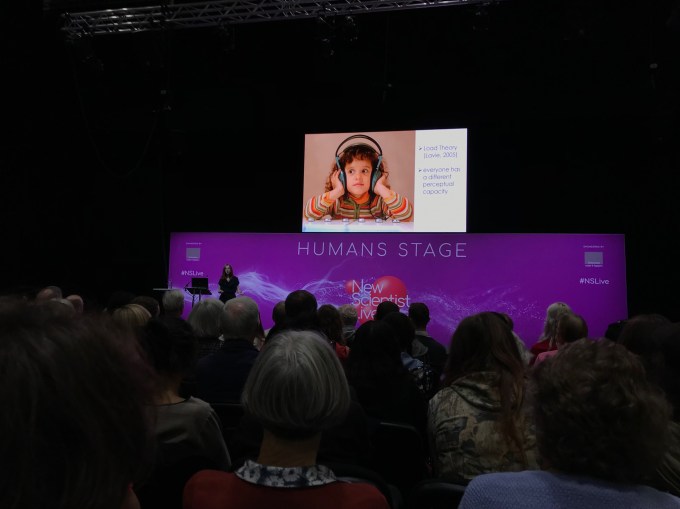
The talk was part of New Scientist Live, which is a huge event – a festival, really – all about “ideas and discoveries for everyone curious about science and why it matters.” I couldn’t describe it better than they do. It’s full of stalls, interactive experiences, and stages for talks on all different subjects. Had I not had previous engagements on the other three days of it, I would’ve loved to stay longer and explore more. I was almost giddy with all the potential for learning.
The speaker was Dr Anna Remington, the director of UCL’s Centre for Research in Autism and Education and a leading authority in the area of superior abilities in Autism. And she had me from the beginning: she asked how many people were autistic or had a personal connection to Autism, almost the entire audience put their hands up, and she said, “I personally feel that you are the experts.” She was warm and enthusiastic, the perfect combination of fascinated and respectful. I liked her straight away.
She started off with a brief outline of Autism, of the social aspects (struggling with non-literal language, eye contact, managing relationships) and the non-social aspects (the need for routine, areas of intense interest, sensory sensitivities). She also talked about the language around it, about using ‘autistic people’ rather than ‘someone with Autism,’ because so many people feels that it’s so intrinsic to their identity. She quoted someone she’d worked with: “You can’t separate the autism from me. It’s not something I carry around in a bag with me, it’s something that’s absolutely part of my personality and identity.”
She said that so many talks are about the difficulties of Autism but that she wanted to talk about some of the positives, not the savants but the areas where autistic people are shown to excel. She walked us through some studies – some visual tasks and some auditory, done with both children and adults – and showed us how the groups with autistic people did significantly better.
She introduced the idea of ‘perceptual capacity’: “The amount that we can process at any given time is known as our perceptual capacity. Everybody has a slightly different perceptual capacity and whether we process something depends on whether our capacity is full up or if there’s still room left over… Now the crucial thing is that we have to assign our whole capacity at any given time. You can’t assign just part of it. So, if the task that you’re doing doesn’t fill up the whole of your perceptual capacity, then anything that’s left over will automatically process something irrelevant around you.”
I found this whole concept fascinating. This is the idea behind why people listen to music while working or doodle while talking on the phone, filling in that left over capacity with information that doesn’t interfere with what you’re trying to do. I have always had stuff playing in the background (audiobooks, movies, TV shows – not music because I get distracted by thinking about the mechanics of the song and of the lyrics) and was always told that I couldn’t possibly do whatever I was doing well with that much ‘distraction.’ So it was very satisfying to know that I’d been right all along. If you want to know more about this, this article is very helpful.
She finished with why this research, why these findings, matter and how they can be applied in education and employment to improve the experience and opportunities for autistic people. The research is really exciting and I would love to be involved in some way; as I mentioned in my post about taking part in Autism research studies (here), there’s something really empowering about it, about feeling part of change. I spoke to her about it after the talk and she was absolutely lovely.
My one negative about it all was the level of background noise, this constant drone of indistinguishable voices. It made it difficult to hear the talk and it’s one of the things that I’ve found really drains my energy. But, although it completely wore me out, it was so worth it. It was such a positive experience and I’m looking forward to seeing where this research leads.
 Finding Hope