 Finding Hope
“Is Autism A Gift?” (At New Scientist Live)
Posted on September 22, 2018
A while back, my brother told me about an upcoming talk called ‘Is Autism A Gift?’ Naturally, I was curious. And slightly sceptical. For me, Autism has been one struggle after another but I’m aware that that is likely due to the late diagnosis rather than the actual Autism. But who knows. So I was really intrigued as to what the talk would be like.
The talk was part of New Scientist Live, which is a huge event – a festival, really – all about “ideas and discoveries for everyone curious about science and why it matters.” I couldn’t describe it better than they do. It’s full of stalls, interactive experiences, and stages for talks on all different subjects. Had I not had previous engagements on the other three days of it, I would’ve loved to stay longer and explore more. I was almost giddy with all the potential for learning.
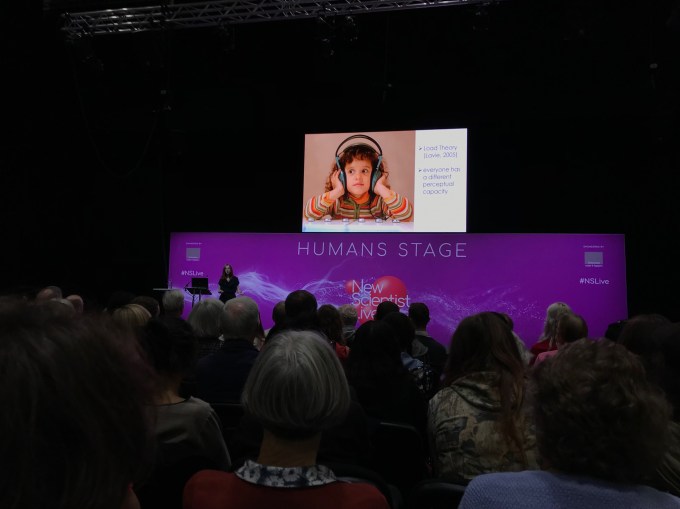
The speaker was Dr Anna Remington, the director of UCL’s Centre for Research in Autism and Education and a leading authority in the area of superior abilities in Autism. And she had me from the beginning: she asked how many people were autistic or had a personal connection to Autism, almost the entire audience put their hands up, and she said, “I personally feel that you are the experts.” She was warm and enthusiastic, the perfect combination of fascinated and respectful. I liked her straight away.
She started off with a brief outline of Autism, of the social aspects (struggling with non-literal language, eye contact, managing relationships) and the non-social aspects (the need for routine, areas of intense interest, sensory sensitivities). She also talked about the language around it, about using ‘autistic people’ rather than ‘someone with Autism,’ because so many people feels that it’s so intrinsic to their identity. She quoted someone she’d worked with: “You can’t separate the autism from me. It’s not something I carry around in a bag with me, it’s something that’s absolutely part of my personality and identity.”
She said that so many talks are about the difficulties of Autism but that she wanted to talk about some of the positives, not the savants but the areas where autistic people are shown to excel. She walked us through some studies – some visual tasks and some auditory, done with both children and adults – and showed us how the groups with autistic people did significantly better.
She introduced the idea of ‘perceptual capacity’: “The amount that we can process at any given time is known as our perceptual capacity. Everybody has a slightly different perceptual capacity and whether we process something depends on whether our capacity is full up or if there’s still room left over… Now the crucial thing is that we have to assign our whole capacity at any given time. You can’t assign just part of it. So, if the task that you’re doing doesn’t fill up the whole of your perceptual capacity, then anything that’s left over will automatically process something irrelevant around you.”
I found this whole concept fascinating. This is the idea behind why people listen to music while working or doodle while talking on the phone, filling in that left over capacity with information that doesn’t interfere with what you’re trying to do. I have always had stuff playing in the background (audiobooks, movies, TV shows – not music because I get distracted by thinking about the mechanics of the song and of the lyrics) and was always told that I couldn’t possibly do whatever I was doing well with that much ‘distraction.’ So it was very satisfying to know that I’d been right all along. If you want to know more about this, this article is very helpful.
She finished with why this research, why these findings, matter and how they can be applied in education and employment to improve the experience and opportunities for autistic people. The research is really exciting and I would love to be involved in some way; as I mentioned in my post about taking part in Autism research studies (here), there’s something really empowering about it, about feeling part of change. I spoke to her about it after the talk and she was absolutely lovely.
My one negative about it all was the level of background noise, this constant drone of indistinguishable voices. It made it difficult to hear the talk and it’s one of the things that I’ve found really drains my energy. But, although it completely wore me out, it was so worth it. It was such a positive experience and I’m looking forward to seeing where this research leads.
When Things Get Really Bad
Posted on September 1, 2018
Since I last posted on here, literally all I’ve done is survive.
After putting up last week’s post, I went to therapy, which just about wrecked me. It was really hard going. I don’t want to get too into what we talked about and what I’m currently struggling with because I’m really struggling with it and I’m still figuring out how to put all of it into words. But I think the gist of it is important to include: I’m struggling with ‘feeling’ autistic, like I’m never going to be able to function the same way as everyone else. I don’t know how to cope with a thought like that. And that has really triggered my depression, in a massive way. I feel like I say this every time, but it feels like the worst place I’ve ever been; but maybe I say it every time because each time takes more out of me.
It looks so small and simple when I write it out like that. But in reality it’s powerful enough to overwhelm everything.
I left therapy feeling absolutely drained. I didn’t know how I was going to get through the day, get through the week to the next session. But somehow I did, one minute at a time. This week has been about survival because sometimes that’s all you can manage – I feel like I’m standing on the very edge of the black hole that is my depression and it’s taking all of my focus to not get pulled in. So while I feel like I’ve achieved nothing, I’ve actually achieved everything. At least that’s what I’m trying to tell myself.
So I thought I’d write down what I do when I’m in this place, where the only thing I can do is survive:
Each day, I get up at seven and go to the gym to swim for thirty minutes. I always want to do more but through trial and error (usually error), I’ve found that this is the amount I can do and still kind of function. If I push on, I end up falling asleep during the day and screwing up my sleeping pattern or I end up in a place where everything makes me cry. So I’m trying to be sensible and build it up slowly.
I get home and head for the living room. I curl up on the sofa, turn on the TV and continue the rewatch of whatever TV show I’m watching (currently The Mentalist). I’m not really watching; it’s more about having familiar, comforting background noise so that the scary thoughts can’t get in. Then I find something that will distract me from all the overwhelmingly difficult things. The activities that work best for me are playing piano and printing, cutting, and sticking pictures from Tumblr into notebooks. And sometimes reading a book works, if I have the concentration to actually read.
And I use those things to get me through the day. I spend time with the animals in my house. I’m lucky enough to have a Mum who works from home so that I can have someone with me when I need to have someone with me. I try to eat well.
And then I go to bed not too late and start all over again.
It’s a hard thing to get my head around and I’m aware that I’m very hard on myself. Because even though I genuinely believe that sometimes all you can do is survive, I find myself getting desperately upset that I’m ‘not doing anything.’ I feel like I’m not trying hard enough – in my mental health, in my music, in my life – and that I should ‘push through it.’ And it’s so hard to think that when I feel so overwhelmed by my depression.
And, outside all of that stuff, someone I care about is in hospital and no one really knows what the outcome is going to be. So I’m trying to manage all the anxiety around that too but it’s like trying to stand on ground that’s constantly shifting.
I think that, if I keep writing, I’m going to end up going in circles: ‘it’s okay to focus on surviving’ to ‘I should be trying harder’ and back to ‘it’s okay to focus on surviving’ and round and round and round. So I’m going to stop here. But regardless of all my anxieties and negative thoughts, I know that it’s okay to focus on surviving. And I hope you know that too.
Getting A Diagnosis – The Autism Edition
Posted on August 19, 2018
This is something I’ve been meaning to write about for a while but it’s such a big topic that I was very daunted by just how much I needed to include. I’d open a word document, stare at it for ten minutes, and then switch to something else. You’ll see what I mean. Getting a diagnosis is a complicated and emotional process that is so different for everyone but I had no idea how difficult it would be when we started pursuing it. So I thought I’d write out my experience, just to put out into the world one version of the story. Maybe yours is similar, maybe it’s different. Hopefully you’ll get something out of it either way. And if you’re trying to get one, maybe this will give you some idea of the hurdles. I don’t want to scare anyone off; it was a brutal experience but it was absolutely life changing and life saving, both for my mental health and for who I am as a person.
I’m going to split this into two posts because although they’re linked, the processes for getting the mental health diagnoses and getting the ASD diagnosis were very different for me. I don’t know if that’s the same for everyone. This post will be about getting the ASD diagnosis and follows on from the one about my mental health diagnoses. If you’ve read that one already, you’ll know that it took several years to get to that point.
During our search – mine and my Mum’s – for an explanation as to why I was struggling so much, Autism came up several times. We didn’t pursue it straight away because I didn’t fit what we knew of it and because multiple health professionals had dismissed it. So we focussed on the mental health perspective and managed to get those diagnoses in January 2015. But it kept coming up and after talking to practically everyone we knew, we ended up at ASSERT, a local charity that supports people with Autism Spectrum Disorder. On their advice, we contacted the Brighton and Hove Neurobehavioural Service and that resulted in an assessment (in August 2015).
The assessment itself was pretty intense: three hours of answering questions about my life and my experiences, followed up by another appointment where it was all explained to me. The woman who assessed me was lovely, which made it easier, but it was exhausting. Afterwards, I received an eight page report with all the relevant information. I know I’ve already written a post about the presentation of Autism in women but this is the more detailed, clinical side of it, to give you an idea of what was asked and what went into getting an Autism diagnosis.
The questions – and the report – were broken down into several sections:
DEVELOPMENTAL HISTORY
As a child, me and my brother played make believe games that involved the creation of very elaborate worlds, with characters and histories, and they often lasted for months, if not years. My other staple ‘game’ was arranging my toy animals into “carefully crafted scenes.” I did this over and over again, in a “notably ordered and systemised” way.
I was incredibly shy and although my speech and language were ‘well developed,’ I did struggle socially. I didn’t have many friends but the friendships I made were incredibly important to me (“the very commonly observed capacity for young women on the spectrum to make very intense, uncompromising attachments to individuals”) and the loss of those connections was “deeply traumatic.”
I did well in school because I had “an unyielding need for perfection” and a “capacity for intense engagement in subjects.” No one (including me) noticed any difficulties because I was quiet and hardworking (“like many young women on the spectrum”) but having said that, I was absolutely exhausted by school. I’d get home, collapse on the sofa, and kind of zone out, almost leaving my body. Time would pass and while I was still functional, it felt like I was on autopilot until I ‘returned’ to my body. That was how I processed school and how it completely exhausted me.
The one thing that I did notice and struggle with was my absolute need to follow every rule: “Lauren has a lifelong sense of right and wrong and cannot deviate from rules.” I’ve always struggled with the way people seem to know which rules are important, who they apply to, and so on. And even when there was good reason to break a rule, I could not do it.
“Moving to the chaotic, unstructured, unfamiliar sixth form [was] deeply traumatic. It was at this point that her meltdowns and mental health became of acute, identifiable concern.” Couldn’t have put it better myself.
RECIPROCAL SOCIAL COMMUNICATION
“Although Lauren has worked hard to integrate socially, she has clear lifelong social difference.” Socialising has always felt incredibly complicated and stressful. “Lauren has the almost universal autistic sense of feeling ‘alien’ (or as if behind glass) from other people. She feels exhausted by the social world. People are mysterious and chaotic to her, and although she is highly observant of others and learns and copies social behaviours, the possibility of unpredictable social behaviour provokes acute anxiety. She shows evidence of the triad of impairment but this is scaffolded and obscured by her intelligence and vigilance.”
Eye contact is tiring and uncomfortable. It feels so intimate – too intimate. And I don’t know which eye you’re supposed to look at.
I’ve always struggled with making phone calls, particularly when it’s someone I don’t know. Because I’m only hearing someone’s voice, I feel like I’m not getting enough information to ‘read’ the social interaction and so I get really anxious about saying the wrong thing or getting overwhelmed and missing things. I can just about handle it with people I know, where I’ve learned the ‘conversational rhythm.’
It’s a myth that people with Autism aren’t empathetic. I’ve always felt like my empathy is overwhelmingly strong, to the point where it can actually incapacitate me. For example, after finding out that a friend was severely ill, I was so distressed that I was barely able to get out of bed for about three days: “[Lauren] is prone to fixating on helping people and is often very upset when this is not possible. Women on the spectrum are often highly sensitive to suffering in others and are drawn to the ‘caring’ role. This can leave them socially and emotionally vulnerable.”
I get overwhelmed very quickly, because I can’t process things as quickly as they happen. The best way I’ve found to process stuff (experiences, sensations, emotions) is to write everything down: “Lauren writes everything down in micro-detail and through this process she has learnt much about the human state and the social world that is not intuitive. The detail and perseverative nature of this recording is authentically aspergic.”
RESTRICTIVE AND REPETITIVE BEHAVIOURS (NEED FOR SAMENESS)
I’ve always had the intense focus and ‘restricted interests’ that people often associate with Autism. I’ve bounced from one to another to another my whole life. When I was twelve, I wrote a twenty thousand word story that I researched in “encyclopaedic detail.” I even knew the longitude and latitude of where all the characters were throughout the story. Every detail is important: “Authenticity is of enormous importance to her.” A truer statement was never made and it’s true for every part of my life, from my songwriting to the clothes I wear.
I’ve also always had a “strong need for sameness and routine.” I didn’t even really realise it until I was asked. Everything I ‘routinely’ do has a very precise order: “She has certain non-functional rituals that she needs to perform in order to feel safe and soothed.” And any change – big or small – can send me into a spiral of anxiety, which can lead to a meltdown. “She has a need for perseverative repetitive activity to soothe her anxiety and dampen the flood of intrusive information. She has the same TV programs on and listens to the same audiobooks again and again.”
SENSORY SENSITIVITY
I have always been “highly sensitive to sensory phenomena.” I struggle to manage and process se nsory information but with sound and taste in particular. But all of my ‘sensory sensitivities’ increase when I’m under stress.
“[Lauren] appears to be particularly affected by multiple streams of sensory experience: finding, for example, places where people gather cacophonous, overwhelming and she is swamped in anxiety about all the possible permutations of each person’s life.” When I walk down the street, I’m overwhelmed by the fact that every person I pass has favourite colours, foods they don’t like, phone numbers they can’t remember, important dates coming up, and so on and so on and so on. It’s beautiful and terrifying and exhausting.
One of my biggest issues sensitivity-wise is with food and I’ve struggled with it all my life. I’m very sensitive to taste and texture so I can only eat plain foods and I hate having different foods touch each other. I find pretty much everything to do with food overwhelming: the ingredients in a meal, the preparation of food, all the sensory information… This is apparently a common autistic experience.
“Some evidence of hypermobility which is a unifying diagnosis with autism.”
CONCLUSION
“The essential features of ASD as specified in DSM-V are persistent, pervasive and sustained impairment in reciprocal social communication and social interaction; and restricted, repetitive patterns of behaviour, interests, or activities and may be most apparent in difficulties in processing and responding to complex social cues. These symptoms are present from early childhood and limit or impair everyday functioning.” My assessor took in everything we’d told her and determined that I met the diagnostic criteria for Autism Spectrum Disorder, at level one, which is ‘requiring support.’ I meet all the difficulties likely to be experienced at this level.
“It is apparent that Lauren also has issues pertaining to personality disorder. She was vulnerable to the development of personality disruption due to the complexities of her developmental difference and her experience growing up (essentially as a ‘square peg in a round hole’) was sufficiently complex and invalidating as to cause her enduring distress and propensity for emotional intensity.”
Getting the diagnosis itself was very affirming but the conclusion of the report was also really positive: “She has amazing potential and I am really hopeful that, in time, this explanation will come to be a meaningful map for a resilient and contented future.”
This isn’t a complete report, just some snippets to give you an idea of what the session was like and some of the traits that make up an Autism diagnosis. It’s not a checklist or the ASD criteria. I just remember having no idea what was going to happen and the anxiety that that caused me. So if I can make it less scary for someone else, that’s something I really want to do.


(Again, no relevant photos but here are some from around that time.)
 Finding Hope