 Finding Hope
Side Effect City
Posted on November 1, 2017
Just over a month ago, I started taking Venlafaxine for my depression. I’ve tried lots of different anti depressants in the past, many of which I had a bad reaction to, so I was nervous. Weaning myself off the Phenelzine was hard and I was very, very depressed but somehow, I reached a point where I felt ready to feel different. It was a bit like breaking the surface after being underwater. I was, and still am, desperate to feel better.
Week 1
I started on a very low dose, half the lowest therapeutic dose, so that my body could get used to it. But despite that, I felt the effects straight away and incredibly strongly. I was very nauseous. It was so bad that I couldn’t really concentrate on anything else; all my concentration was focussed on not throwing up. It made me dizzy and I was tired all the time. I did check with my psychiatrist to make sure it was okay to keep going with it and he said it would pass so I focussed on tolerating it.
The other immediate change was my sleep. I went from struggling to wake up before eleven (and I mean really struggling: it felt like I was drowning) to being wide awake at eight o’clock in the morning. It was bizarre.
Week 2
The nausea faded around the beginning of the second week, which I was very grateful for. My mood, while still pretty low, was stable, and I was still waking up much earlier than I had been able to previously. However I started having headaches and I was exhausted all the time, which made it very hard to do anything.
Week 3
In the third week, I went up to the lowest therapeutic dose. This caused a pretty dramatic reaction. For the first few days I was so tired that I fell asleep in the middle of the day, something I haven’t done in years. But despite that, I was waking up even earlier, between six and six thirty am.
By the middle of the week, I couldn’t concentrate at all. I couldn’t hold a conversation, I couldn’t follow the storyline of a forty-minute TV episode, I couldn’t even play a game on my phone… That was scary, but I couldn’t even really feel that because I couldn’t seem to process the emotion. I started to feel faint and very shaky and that went on for several days. If I stood up for longer than a couple of minutes, my legs started to shake and my hands shook so badly that I couldn’t hold a pen. That was very unpleasant.
Week 4
Most of the fourth week was lost because of severe, unexplained leg pain that had me in tears. My psychiatrist didn’t think it had anything to do with the medication and DVT was ruled out but other than that, we don’t know what caused it. I’ve been taking painkillers since and it’s been better. So that tired me out and overwhelmed everything else. But since then, the shaking has mostly stopped and I’m back to waking up between eight and nine in the morning.
This week is the first where I’ve felt different mentally and emotionally while taking Venlafaxine. I wouldn’t say I feel better but I’ve been feeling a bit lighter. That feels very strange and a bit scary. With this new lightness, I’ve been feeling a bit lost which I’ve written about here. I’ve been so depressed for so long that I can’t remember what it’s like to not be depressed. But despite all of those confusing emotions, I am pleased that this medication is starting to work. It will probably take another month or so to really know how it’s affecting me but it’s looking positive and I’m really grateful for that.
One Woman With Autism
Posted on October 14, 2017
Ask anyone about Autism and they’ll most likely describe the stereotype: difficulty socializing, a ‘lack of empathy’, specific and focused interests. But, as with everything, it’s so much more complex than that, especially for girls and women with Autism. While there are various statistics on the ratio of boys to girls, it’s clear that there are many more girls and women with Autism than was originally thought. And because the diagnosis of Autism has always been based on the male presentation of Autism, it can be really difficult for girls and women to get diagnoses and support. I can’t speak to anyone else’s experience but I can speak to mine.
I was a shy kid. I was so shy, and so anxious, that I couldn’t be left at after-school clubs or activities. I was petrified and cried until my Mum would take me home. I was constantly told I was too sensitive, that I took things too personally, that I needed to grow a thicker skin. And that really upset me – but then I was being too sensitive, wasn’t I?


These issues continued through my childhood and into my teenage years. I was always anxious and strived for perfection in everything. I was a vigilant rule follower; I couldn’t, and still can’t, break a rule for anything. I was terrified of turning in homework late, convinced it was an unforgivable act. The one time I did forget a piece of homework (because I’d taken it out of my bag to check I’d packed it and then forgotten it in a panic about being late – another constant anxiety), I cried in a corridor and my hands shook when I told my teacher. It was fine, of course, but it didn’t help my anxiety. I was so scared of doing something wrong, of getting into trouble.
In addition to that, I never felt like I quite fitted in. Anywhere. I felt like I was stuck behind glass, separated from everyone else and unable to break through it. Everything seemed so much easier for everyone else; everything they seemed to do effortlessly took all of my energy, leaving me exhausted. I couldn’t understand why I just couldn’t cope as well as everyone around me. For some unknown reason, I couldn’t function as well as everyone else and that made me feel like I was broken. Despite all of this, no one clocked that there was a problem, not a doctor, not my family, not me.
What had always just been a feeling of not coping started to take over other areas of my life. I’d always done well as school, despite missing more than eighteen months when I struggled with an unidentified illness that caused debilitating fatigue. My lowest grade at GCSE was an A (although I was disappointed with not having achieved more A*s). I got to Sixth Form and everything changed. Suddenly every class, every test was a struggle. Learning and applying knowledge had always been something that had come easily to me, something I’d enjoyed, and all of a sudden, it had become so difficult and that was incredibly distressing. My anxiety got higher and higher and depression started to creep in. I was constantly exhausted and just getting through the day started to feel like an impossible task.
The turning point came when I failed an exam. I locked myself in a toilet stall and scratched at my arms over and over with a broken paper clip, desperate to feel anything other than this howling feeling of failure that came from somewhere deeper than I’d ever experienced. I don’t know how long I sat there and I don’t remember much of that day, but that was when my family and I started to realise that there was something really wrong.
A lot went into getting my diagnosis. I’ve lost count of all the doctors I’ve seen, the amount of times we left without any answers, the amount of books we read. I’ve been diagnosed with multiple mental health problems and tried a lot of different medications. I tried various therapies like CBT and EMDR. Nothing helped. But due to my Mum’s never ending commitment, I ended up at the Brighton and Hove Neurobehavioural Service and after several hours answering questions, I walked out with a diagnosis of Autism Spectrum Disorder. To start with, I was too exhausted by getting to that point to take it all in but slowly, everything started to make sense. All these disconnected pieces of my life and my personality began to click into place.
I’ve always felt emotions strongly. If something goes well, I feel like I’m bulletproof. If something goes badly, I can end up in a meltdown: crying, shaking, screaming, and often self-harming. Either that, or I go into shutdown where I retreat to my room and lie in the dark, unable to think or talk properly. Sometimes a meltdown leads to a shutdown and it can last for days, or even weeks.
I’m extremely sensitive. To a lot of things. A change of plan, loud noises, bright lights, unfamiliar people and places, all of those things increase my anxiety, making it difficult for me to function, to make decisions, to interact with people or the environment around me. Processing that information takes a lot of energy and I’m easily exhausted and overloaded. Too much sensory information, too many demands placed on me, the closer I get to a meltdown. It’s a fragile existence, like walking on a tightrope.


I’ve never had trouble with empathy, with ‘stepping into another’s shoes’. Or more accurately, I’ve never found that difficult to do. My struggles tend to be with the other extreme: I’ve been told I’m too empathetic. I frequently experience other people’s emotions as if they’re mine and with such strength that I feel completely overwhelmed. It’s strange and upsetting to, for example, feel grief for someone I didn’t know. It can feel like I’m intruding even though all I ever want to do is help because I know how strong those emotions can be. It’s incredibly difficult for me to see someone upset and not be able to do anything. It can also be very difficult to do something as simple as walk down the street. I just feel overwhelmed by how big everyone’s lives are, how much makes up a person: memories, favourite colours, foods they hate, things they want to happen, things they don’t want to happen, phone numbers they’ve forgotten, songs stuck in their heads. I could go on forever. And when I’m surrounded by people, I feel all of that pressing in on me. It makes it hard to breathe.
Socialising is difficult. Again, processing all the information around me takes a lot of energy: a person’s words, body language, tone, how other people are reacting, everything going on in the background. It’s hard work. It feels like everyone else has a rulebook that I never received and so I’ve had to learn how to be social. Where everyone else processes all this information automatically, I have to actively process it, which takes a lot of energy. So it’s not hard to imagine why I’m tired out very quickly by social situations. Of course many people don’t notice this and have no idea that I’m autistic. Even the visible signs go unnoticed, like my difficulty with eye contact. Aside from the fact that I have no idea how long you’re supposed to hold eye contact for or which eye you’re supposed to look at it, I also feel very vulnerable when someone is looking into my eyes, like they can tell what I’m thinking and feeling.
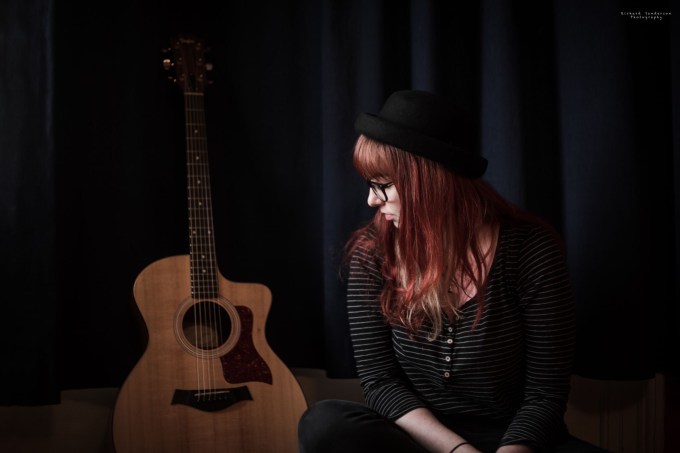
I do have my own specific interest: writing, in all forms, but my favourite is songwriting. I’ve read a bit about these focussed interests and apparently the interests in the female presentation of Autism tend to go under the radar because they can be similar to a neurotypical girl’s interests, like animals, TV shows, books, particular singers or music groups. It’s the intensity that’s different. I’ve never simply liked something; once I’m interested in something, nothing else matters. When I’m writing, I lose all sense of time. I recently spent ten hours working on a particular piece and only stopped because I noticed my hands shaking. When I looked up, it was dark and I realised that a whole day had passed and I hadn’t eaten. Writing, and writing songs, is everything to me. It’s the only thing I want to do, the only thing I want to do for the rest of my life. It’s hard though, because there’s a big part of me that feels like my life isn’t worth living if I’m not doing that one thing, if I’m not doing songwriting. The music industry is tough as hell so it’s terrifying to think like that. But that’s the truth.
Of course there are other symptoms and this is just one presentation of Autism. As the specialist that diagnosed me said, we are the experts of our own Autism. But, in my experience, it’s really hard. And it’s made harder when there’s so little understanding around the way Autism affects girls and women. Life post-diagnosis is difficult but at least I know what I’m struggling with. I’m learning what helps and what doesn’t. Not knowing was awful. I felt like I was drowning, like I couldn’t even find the surface. And the years of asking for help and being turned away made it worse. The lack of awareness and understanding about how Autism affects girls and women has real consequences. The time it takes to get a diagnosis and the repeated invalidation causes problems of their own. The people supporting me now think that that was part of the reason I developed Borderline Personality Disorder, a mental health problem that involves instability of mood, behaviour, and self image. And I will never forget one particular doctor’s opinion, that maybe that’s just how life was going to be for me. That remains one of the most upsetting experiences of my life and years later, I’m still struggling to believe that I will ever be happy.
I am so lucky to have found the people who are supporting me now and I feel it because I know that without them, there’s a very real chance that I wouldn’t be here now. But there are so many people without this support. There needs to be more information, more awareness, more understanding of Autism in women. Too often it goes unidentified and the effects of that can be worse than the struggles caused by the Autism itself.
Coming Off Phenelzine
Posted on September 27, 2017
Just over a month ago, I decided to change medications. It was a long time coming but I eventually managed to speak to my psychiatrist and we came up with a plan. The first step was weaning myself off the Phenelzine and the second was going drug free for at least a couple of weeks to make sure it was out of my system before trying the new medication. I kept notes to track any patterns in mood and since I couldn’t find many accounts of coming off Phenelzine when I searched online, I thought I’d write about my experience. As always, this is only my experience, which will be specific to the dosage I took and the duration for which I took it.
Week 1
I was already on half of the prescribed dose so, to start the weaning off process, I went down to a quarter of the prescribed dose. Very quickly I felt very irritable, snapping at people over things that normally wouldn’t bother me. I was also overly emotional and ended up in tears a lot, sometimes multiple times a day.
Week 2
In the second week, I stopped taking the Phenelzine altogether. My anxiety skyrocketed and remained really high, higher than it’s been in a long time. My mood was also very fragile, so even small things made me very upset and depressed.
Week 3
In week three (the second week without any medication), I felt completely exhausted; some days, I was so tired that I could barely get out of bed. I was very depressed and felt blank, empty, completely disconnected. It was like everything just bounced off me. I’ve gone through periods of feeling like this before so, even though it isn’t pleasant, it wasn’t unfamiliar.
Week 4
Although I’d already been off the Phenelzine for two weeks, I decided to wait a little bit longer before trying the new drug. It was two weeks minimum and I’ve always been very sensitive to medication so I wanted to make sure it was completely out of my system before starting the next one. I didn’t want any chance of an overlap distorting that experience; I didn’t want to risk writing off something that could help over something as small as a few more days. For that last week, I was just really tired. My mood seemed to stabilise a bit and everything just felt less turbulent. It was that settling of my mood that made it easier to think more clearly and I felt ready to try the new medication.
It’s worth pointing out that my mood has been consistently low throughout all of this. I’ve had a couple of days where I felt a little bit lighter but on the whole, I’ve been feeling very depressed, hence the change in medications.
And now I’m onto the next stage: trying the new medication. I’m nervous but I’m really ready not to feel like this anymore.
 Finding Hope