 Finding Hope
My Experiences with Therapy
Posted on October 13, 2018
Going to therapy hasn’t always been easy. I feel so, so lucky to have such an amazing therapist now but I had a lot of difficult experiences before I started seeing her. So I thought I’d share some of those experiences. Maybe they’ll be helpful.
After many, many appointments with my GP, I was finally referred to the local NHS Wellbeing service but the session didn’t go well. At this point in time, my anxiety was so bad that I couldn’t talk to people I didn’t know. I just couldn’t. Answers to questions would form in my mind but I couldn’t force them up my throat. So I sat there, in tears, while the doctor tried to get my Mum out of the room and told me he ‘wouldn’t’ help me if I didn’t talk. I don’t want to rant but I WAS STRUGGLING WITH A MENTAL HEALTH PROBLEM. I wanted desperately to be able to talk about it but I couldn’t. I don’t remember much about that appointment but I do remember standing in the street afterwards, shaking and crying and screaming and swearing. I couldn’t understand why no one was helping me when there was so clearly something wrong.
My second attempt at therapy was a bit better. I started Cognitive Behavioural Therapy (CBT) with a really lovely therapist. She was very patient and very open to working around the anxiety that kept me from talking. She was also happy to have my Mum in the room: it helped my anxiety and meant she could provide information. Slowly I started to trust her and started answering questions myself. But it was exhausting, bone achingly exhausting. As hard as we worked, I didn’t feel like we were making any progress and it was too hard to go through that to make no progress. I really liked her and I could tell that she was a really good therapist but the approach wasn’t right for me. I found the format too rigid. In simple terms, CBT is about breaking down your problems and then trying to create change in those areas. I felt, and still do feel, that my problems are too murky for a short stint of CBT. I know now that many of my problems originate from my Autism and the fact that it went undiagnosed for so long but even with that knowledge, the difficult things still feel overwhelmingly huge. I can see CBT being useful for a specific anxiety. For example, we tried to work on my anxiety around making phone calls. But I think the reason it didn’t work is that it wasn’t an isolated problem; it was a piece in a much bigger puzzle. I don’t think you can solve that sort of problem if you don’t know what’s causing it. Plus, being rational about what you’re struggling with in the controlled setting of therapy and being rational when it’s overwhelming you are very different things. CBT sort of assumes that you can still apply the skills you’ve learnt in therapy regardless of how you’re feeling, which can feel impossible, especially if you live with really powerful emotions. But maybe that’s just my perception.
The next thing we tried was Eye Movement Desensitization Reprocessing (EMDR), recommended by a family member. In the few months between finishing CBT and starting EMDR, my anxiety had sky rocketed so starting a new therapy was really hard. It was so bad that I actually never spoke to the guy I worked with. But despite that, and my difficulty with eye contact, communicating with him was easier than it had been with previous therapists. He was fantastic. He accepted my difficulty speaking and suggested writing on a whiteboard. I considered that and it felt possible so that’s what we did. He asked me questions and I replied, scribbling as fast as I could. It worked. And to take the pressure off, we would spend part of the session on the floor, playing dominoes while he asked me questions. I felt absolutely safe there. It was incredibly strengthening to have someone accept my anxieties as they were, to have someone recognise that I wasn’t just being difficult, that I was genuinely struggling with something really hard. And although it didn’t turn out to be the right thing for me, the sessions are still really important to me. For several months, we worked hard. We tried. I felt supported. And even though I didn’t ever speak, I did once sing for him and he almost cried. That was a pretty big moment.
After that, I didn’t go to therapy for a while. There was a lot of life stuff going on and there just wasn’t the time to find someone new. But I did start seeing a new psychiatrist. He prescribed me Phenelzine (which I’ve previously written about) and we spent a lot of time trying to figure out what was causing my problems. I guess it was a type of therapy. We went through my history and analysed my emotions, trying to find a diagnosis. The medication helped and we managed the side effects but it still took a long time. When my university said that they couldn’t help unless I had a diagnosis, I pushed for this and in January 2015, I could finally put names to the issues I was struggling with (apart from the Autism diagnosis which came several months later). My psychiatrist recommended Dialectical Behaviour Therapy (DBT) so we started looking for another therapist.
My current therapist is the first one we met. I just knew she was right; me and Mum walked out, looked at each other, and said, ‘she’s the one.’ We did meet another one but my mind was made up. And we were right. She’s amazing. I’ve been seeing her for three years now and I’m so grateful to have that safe place. DBT suits me much better. It’s based on CBT but, as the Mind website says, it’s “been adapted to help people who experience emotions very intensely.” They both help with changing unhelpful thoughts and behaviours, but DBT also helps you to accept yourself. It’s about a balance between acceptance and change. That really makes sense to me and always has.
In the beginning, I needed my Mum in the room with me and she would answer all the questions. We’d always talked about everything so she knew pretty much all the answers. But over time, I felt more comfortable there. I needed Mum there less and less and eventually I started doing the whole session by myself. Three years later and it’s really, really important to me. It’s a huge part of who I am. It’s not easy; it’s really hard work and I often come home exhausted, sometimes falling asleep on the sofa afterwards. But it’s really satisfying to talk things through, to make connections, to see change happen. I’ve talked about things that I never, ever thought I would talk about and I’ve worked through things I never thought I’d let go of. That’s so huge that I can’t really comprehend it.


So that’s my therapy journey. For me, it’s DBT that works but I’ve seen the others help people too. You need to be ready, you need to find the right approach, and you need to find the right person. It’s not easy but it is worth it.
“Is Autism A Gift?” (At New Scientist Live)
Posted on September 22, 2018
A while back, my brother told me about an upcoming talk called ‘Is Autism A Gift?’ Naturally, I was curious. And slightly sceptical. For me, Autism has been one struggle after another but I’m aware that that is likely due to the late diagnosis rather than the actual Autism. But who knows. So I was really intrigued as to what the talk would be like.
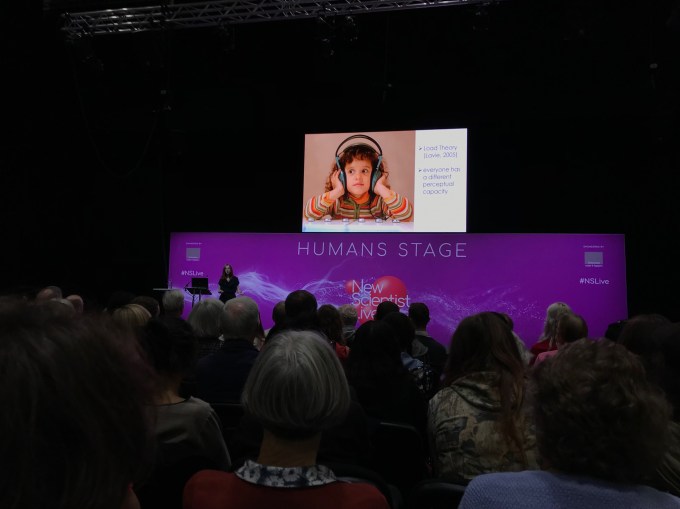
The talk was part of New Scientist Live, which is a huge event – a festival, really – all about “ideas and discoveries for everyone curious about science and why it matters.” I couldn’t describe it better than they do. It’s full of stalls, interactive experiences, and stages for talks on all different subjects. Had I not had previous engagements on the other three days of it, I would’ve loved to stay longer and explore more. I was almost giddy with all the potential for learning.
The speaker was Dr Anna Remington, the director of UCL’s Centre for Research in Autism and Education and a leading authority in the area of superior abilities in Autism. And she had me from the beginning: she asked how many people were autistic or had a personal connection to Autism, almost the entire audience put their hands up, and she said, “I personally feel that you are the experts.” She was warm and enthusiastic, the perfect combination of fascinated and respectful. I liked her straight away.
She started off with a brief outline of Autism, of the social aspects (struggling with non-literal language, eye contact, managing relationships) and the non-social aspects (the need for routine, areas of intense interest, sensory sensitivities). She also talked about the language around it, about using ‘autistic people’ rather than ‘someone with Autism,’ because so many people feels that it’s so intrinsic to their identity. She quoted someone she’d worked with: “You can’t separate the autism from me. It’s not something I carry around in a bag with me, it’s something that’s absolutely part of my personality and identity.”
She said that so many talks are about the difficulties of Autism but that she wanted to talk about some of the positives, not the savants but the areas where autistic people are shown to excel. She walked us through some studies – some visual tasks and some auditory, done with both children and adults – and showed us how the groups with autistic people did significantly better.
She introduced the idea of ‘perceptual capacity’: “The amount that we can process at any given time is known as our perceptual capacity. Everybody has a slightly different perceptual capacity and whether we process something depends on whether our capacity is full up or if there’s still room left over… Now the crucial thing is that we have to assign our whole capacity at any given time. You can’t assign just part of it. So, if the task that you’re doing doesn’t fill up the whole of your perceptual capacity, then anything that’s left over will automatically process something irrelevant around you.”
I found this whole concept fascinating. This is the idea behind why people listen to music while working or doodle while talking on the phone, filling in that left over capacity with information that doesn’t interfere with what you’re trying to do. I have always had stuff playing in the background (audiobooks, movies, TV shows – not music because I get distracted by thinking about the mechanics of the song and of the lyrics) and was always told that I couldn’t possibly do whatever I was doing well with that much ‘distraction.’ So it was very satisfying to know that I’d been right all along. If you want to know more about this, this article is very helpful.
She finished with why this research, why these findings, matter and how they can be applied in education and employment to improve the experience and opportunities for autistic people. The research is really exciting and I would love to be involved in some way; as I mentioned in my post about taking part in Autism research studies (here), there’s something really empowering about it, about feeling part of change. I spoke to her about it after the talk and she was absolutely lovely.
My one negative about it all was the level of background noise, this constant drone of indistinguishable voices. It made it difficult to hear the talk and it’s one of the things that I’ve found really drains my energy. But, although it completely wore me out, it was so worth it. It was such a positive experience and I’m looking forward to seeing where this research leads.
When Things Get Really Bad
Posted on September 1, 2018
Since I last posted on here, literally all I’ve done is survive.
After putting up last week’s post, I went to therapy, which just about wrecked me. It was really hard going. I don’t want to get too into what we talked about and what I’m currently struggling with because I’m really struggling with it and I’m still figuring out how to put all of it into words. But I think the gist of it is important to include: I’m struggling with ‘feeling’ autistic, like I’m never going to be able to function the same way as everyone else. I don’t know how to cope with a thought like that. And that has really triggered my depression, in a massive way. I feel like I say this every time, but it feels like the worst place I’ve ever been; but maybe I say it every time because each time takes more out of me.
It looks so small and simple when I write it out like that. But in reality it’s powerful enough to overwhelm everything.
I left therapy feeling absolutely drained. I didn’t know how I was going to get through the day, get through the week to the next session. But somehow I did, one minute at a time. This week has been about survival because sometimes that’s all you can manage – I feel like I’m standing on the very edge of the black hole that is my depression and it’s taking all of my focus to not get pulled in. So while I feel like I’ve achieved nothing, I’ve actually achieved everything. At least that’s what I’m trying to tell myself.
So I thought I’d write down what I do when I’m in this place, where the only thing I can do is survive:
Each day, I get up at seven and go to the gym to swim for thirty minutes. I always want to do more but through trial and error (usually error), I’ve found that this is the amount I can do and still kind of function. If I push on, I end up falling asleep during the day and screwing up my sleeping pattern or I end up in a place where everything makes me cry. So I’m trying to be sensible and build it up slowly.
I get home and head for the living room. I curl up on the sofa, turn on the TV and continue the rewatch of whatever TV show I’m watching (currently The Mentalist). I’m not really watching; it’s more about having familiar, comforting background noise so that the scary thoughts can’t get in. Then I find something that will distract me from all the overwhelmingly difficult things. The activities that work best for me are playing piano and printing, cutting, and sticking pictures from Tumblr into notebooks. And sometimes reading a book works, if I have the concentration to actually read.
And I use those things to get me through the day. I spend time with the animals in my house. I’m lucky enough to have a Mum who works from home so that I can have someone with me when I need to have someone with me. I try to eat well.
And then I go to bed not too late and start all over again.
It’s a hard thing to get my head around and I’m aware that I’m very hard on myself. Because even though I genuinely believe that sometimes all you can do is survive, I find myself getting desperately upset that I’m ‘not doing anything.’ I feel like I’m not trying hard enough – in my mental health, in my music, in my life – and that I should ‘push through it.’ And it’s so hard to think that when I feel so overwhelmed by my depression.
And, outside all of that stuff, someone I care about is in hospital and no one really knows what the outcome is going to be. So I’m trying to manage all the anxiety around that too but it’s like trying to stand on ground that’s constantly shifting.
I think that, if I keep writing, I’m going to end up going in circles: ‘it’s okay to focus on surviving’ to ‘I should be trying harder’ and back to ‘it’s okay to focus on surviving’ and round and round and round. So I’m going to stop here. But regardless of all my anxieties and negative thoughts, I know that it’s okay to focus on surviving. And I hope you know that too.
 Finding Hope