 Finding Hope
BPD and Feeling Abandoned
Posted on November 11, 2017
Feeling abandoned is a big thing when it comes to Borderline Personality Disorder. And events as everyday as someone not immediately responding to a text can trigger that feeling. The smallest slight can be incredibly upsetting and anything bigger can feel devastating. It’s never ending and exhausting. And with the fear of being abandoned hanging over you, relationships (of any kind) can be very stressful. They can feel like a waiting game, wondering how long it will take for the other person to give up on you.
As someone with BPD, I feel emotions very strongly and when something upsetting happens, it feels like I’ve been hit by a massive wave and it’s all I can do to find my way back to the surface. The emotion overwhelms me and there’s no room for logical reasoning. It doesn’t matter what else is going on; all my energy is taken up trying to process all of that feeling. It can take weeks to recover and I feel more fragile each time.
And what makes it more difficult is the fact that it’s not completely irrational; there is ‘evidence’ to support the fear. People have abandoned me in the past, both voluntarily and involuntarily, so whenever I try and talk myself out of the panic, my BPD lays out all these examples, ‘proving’ to me that I will always be abandoned. It’s an exhausting cycle.
I’m not going to go through my history of feeling abandoned, example-by-example, but there is one experience that I want to share. I think it’s too important to leave out. A few years ago, someone really important to me cut ties when I was in the lowest place I’d ever been (something they were aware of). I felt completely abandoned and it had a massive impact on my mental health and view of the world. I was so hurt and so confused and for a long time, those emotions overwhelmed everything. I felt broken. But slowly, that weight lifted. It took two years but I’m finally free of it. And that’s amazing. But it’s not the end of it. That experience has affected me, especially when it comes to my relationships and my anxiety around them. And like I said, it’s hard to talk myself out of that fear when I feel like I’m about to go through all that again.
I’ve wanted to write about this for a while but I wasn’t sure how to frame it, if that makes any sense. But a conversation with one of my best friends brought all of this to the surface.
So let me tell you a story:
One of my best friends had just come back from a trip to the US and was desperate to go back. I was in a pretty fragile place already (dealing with another situation where I felt like I was being abandoned) and watching her plan her next trip abroad felt a lot like she was abandoning me. I didn’t want to say anything and I felt guilty for feeling the way I did: she was building her career and she was so excited and here I was, wanting her to stay. But in the end, I had to say something. We’ve always talked everything through so, even though I was terrified of sounding needy and pathetic, I reached out and told her how I was feeling. She knows a lot about my mental health difficulties so I told her how I struggle with feeling abandoned and that I might need some extra reassurance around her upcoming trip.
(I want to add that although it might sound easy, it wasn’t. Part of me – a big part of me – was convinced that expressing these feelings would be the ‘final straw’ and that she would abandon me on the spot, that I had finally become too much to deal with. This is something that I think is often misunderstood about BPD. This reaction is not because of the other person; it’s because of the BPD. The other person could be the most reliable person in the world. It doesn’t matter. It’s the BPD telling you that everyone will leave, that you’re not enough to make the other person stick around. So defying that and telling my friend how I felt was very, very scary.)
And this is the important bit: how my friend reacted. Instead of telling me I was being ridiculous or brushing off my request, she responded compassionately. She told me not to feel pathetic or guilty, that she understood why I was feeling the way I was. She asked me how she could help, and said that she would do whatever she could to make it easier for me. She said, “I am not going to leave you.”
It was such a relief that I burst into tears. It meant (and still does mean) so much to me. She validated my feelings, asked me what she could do, and gave me the reassurance I needed. I wish everyone responded this way. Perhaps ironically for a condition with such close links to invalidation, these feelings often get written off as being oversensitive or overdramatic. And in my experience, that only makes it worse. Things are better now that the important people in my life understand where these feelings come from; before the diagnosis, the only explanation was that I was very sensitive and therefore needed to ‘toughen up’. It was a fault. And that’s what I thought too. But now that we understand it, we know how to handle it, how to approach it.
I will likely need to hear this again and again to combat my fear of being abandoned but that doesn’t minimise the importance of this moment. As I’ve said, change is a series of moments like these, moments I hold very close, like charms on a charm bracelet.
A Fear of Fireworks
Posted on November 8, 2017
I hate Bonfire Night. I really, really hate it.
When I was fifteen, I was at the cinema with my two best friends. We were in the middle of a film when something brushed through my hair and landed between mine and my best friend’s feet. I don’t remember now if I knew it was a firework or whether my survival instinct just kicked in automatically because I was out of my seat in a split second. I tripped over a bag as I raced down the row and someone hauled me back up, dragging me with them. My memory of those few seconds is weird, almost as if belongs to somebody else.
But, fortunately for all of us, someone from the row in front of us had stamped out the firework before it had gone off (while threatening to cut the balls off the person who’d thrown it). The lights switched on and a cinema employee came running in to see what had happened. Someone had come up the back stairs, thrown a firework into the crowd, and then done a runner. It looked like someone had thrown a pebble into a pond, we’d all moved outwards, standing almost in a circle with the firework in the middle. There were offers of compensation and calling of ambulances but everyone was okay, apart from the shock of it. I don’t think it had really sunk in because they rewound the film and we sat through the rest of it, although the three of us held on tight to each other until the film ended. On the bus home, we all jumped every time someone hit the buzzer for the next stop.
I was freaked out but I didn’t really take it in until the next time I saw fireworks. I was with my family, we were a significant distance from where they were going off, but I went into a panic. I felt like my ribcage was shrinking or like my lungs were swelling and I couldn’t breathe. I wanted to run. I wanted to run until I physically couldn’t anymore. And after talking to my Mum about it, I realised where that feeling had come from. Worst-case scenario, that firework could’ve gone off in our faces. I don’t want to think about the consequences of that.
Over the years, I’ve avoided fireworks wherever possible. But I haven’t been able to block them out completely. Even when I’m curled up in my room, I can hear them. I don’t have quite the same dramatic response as I did but they’re still a source of anxiety. Every time I hear one go off, my stomach twists. I can’t relax; it’s like there’s a current running under my skin.
As much as I’d like to order the world to stop setting off fireworks, that’s just not possible. I can’t control that but there are some things I can control, things that make the experience a little bit easier:
- Create a calming environment – Fireworks going off outside my window is stressful enough without adding extra anxieties. So I try and remove the unnecessary ones and surround myself with safe things. For me, that’s familiar things. So on Bonfire Night this year, I took myself up to my room and curled up in bed with my cat and one of my favourite TV shows.
- Try to distract myself – Giving myself something to work on helps to shift the focus from my anxiety. Otherwise I’m just waiting for the next firework to go off, amping up my anxiety even more. What works depends on how anxious I am or how tired I am. Sometimes it needs to be something simple, like playing a game on my phone, something that doesn’t require a lot of brainpower. Sometimes it needs to be something that takes up every inch of my brain, like playing the piano.
- Making sure I have support – While there’s nothing anyone can actually do to help, having people checking in on me and making sure I’m okay (or at least not completely losing my shit) does make me feel a bit better. Or a little bit less panicked. And I’ll take what I can get. I think it just brings me back to Earth a bit when my anxiety starts to spiral out of control.
None of these things fix the problem or remove my anxiety but as I’ve written before, sometimes that’s not possible. Sometimes all you can do is get through it and try not to make it worse. This anxiety has gotten better over time; the sound of fireworks no longer sends me into a panic attack. Maybe one day I won’t even blink when I hear one go off. Maybe I won’t even notice it. But until that day, I’m just trying to make it through with as little anxiety as possible.


The End of an Era
Posted on November 5, 2017
I did it. I graduated.
The last three years have been a whirlwind. As I said in my Instagram post on Thursday, “my degree was an endless mix of inspiring, exhausting, frustrating, ridiculous, exciting, stressful, and joyful.” That’s the short version. The long version is very long. I dealt with a lot of grief and disappointment. I struggled with my mental health, discovered I was Autistic, and started to untangle all the threads that come from that. And that’s outside of university. At uni, I wrote hundreds of songs, met some amazing people, got the opportunity to go to Nashville, and ultimately, became a better songwriter. There were classes I loved and classes I hated. It was a constant battle to keep the lid on my anxiety and sometimes I failed. But I wouldn’t change it. My experience is coloured massively by how good my third and last year was. There were moments where I hated it, where it made me incredibly anxious, where I had meltdowns so bad I thought I’d never recover. There were moments I thought I’d never get through, that I couldn’t do what I was being asked to do. But somehow I did. Somehow I’m here, with a first and two graduation ceremonies under my belt.
The first graduation was for UEL, The University of East London. My school, The Institute of Contemporary Musical Performance, is a specialist music college and while it operates independently, it’s officially part of UEL. So we were invited to one of their graduation ceremonies. My Mum and my Granny came to this one. It was very formal – it was caps and gowns. That was something I was looking forward to and something I was very let down by. I’d thought it would be fun but it became a very stressful experience. Maybe it didn’t fit properly, maybe that’s just how it is but my cape kept sliding back and strangling me and my cap kept falling off my head. It took seven bobby pins to keep it on my head. As someone who struggles with sensory stuff, which includes the way clothes feel, that was really hard and really ratcheted up my anxiety. Fortunately, spending time with my friends, messing around and laughing, helped to keep it at a bearable level.
The ceremony itself was a bit strange. Because I only went to UEL once, it kind of felt like I was intruding, like I didn’t belong there. All the talk of the ‘UEL community’ made me feel a bit disconnected from the whole thing but the speakers were very good. I’d like to share something Geoff Thompson, the chair of the governors, said in his speech: “You are strong. Don’t ever, ever forget that you are strong… Never, never, never, never, never, NEVER give up on your dreams. It is not an option. It is not a choice.” You know, that was just what I needed to hear, just as I’m leaving university and heading out into an uncertain world. It was inspiring. It was empowering.
And all of a sudden, we were lining up to walk across the stage to shake the chancellor’s hand. It was weird: I had tunnel vision. No one could have applauded me as I walked across the stage and I wouldn’t have noticed. I was completely focussed on walking towards the chancellor, shaking his hand, and walking down the steps. It’s funny how something that you usually don’t have to think about – like walking – suddenly seems to take a lot of effort. But I did it, I got back to my seat, and I cheered for my friends. We threw our caps and then it was over. Graduation one was done. I’d thought I’d stay for a drink with my coursemates but after all the anxiety, I was completely exhausted. So I (eagerly) returned my gown and headed home.


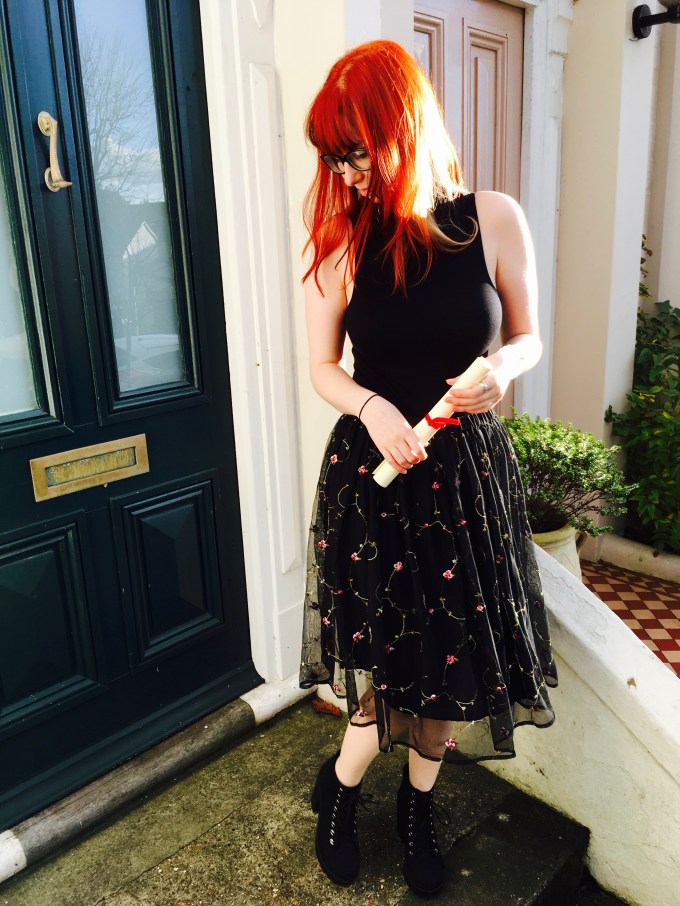
The second graduation was a couple of days later and much more fun. This was just our school so it felt a lot more personal. Even though I don’t have many friends outside my course, I recognised a lot of faces from the other courses and we’d all shared the same space. We’re all connected by that. We didn’t have to wear gowns but it was still formal. Everybody looked gorgeous; it was really fun to see everyone dressed up. All four of my parents came to this one, which was amazing. I’ve never had all of them at a school thing before so that made me very happy. I was positively giddy.

I really enjoyed the ceremony. The head of each course made a speech and then presented each of their students with the scroll. My favourite speech came from my programme leader, Jonathan. It was thoughtful and warm and inspiring. He even gave this blog a shout out, along with two other projects my friends have worked on. It was a very special moment. Another special moment was watching one of my best friends receive her scroll while her own song played. That was awesome.
And suddenly, it was my turn and I was walking across the stage, giving Jonathan a hug, and accepting my scroll. We posed for the photo and then I was moving again. I was a bit more aware of what was going on this time. The UEL one was a good rehearsal in that regard. There wasn’t an opportunity to thank my parents so I made the best of what I had. I located them in the crowd and did this:


It was important to me to do that.
Everyone received their scrolls and then we gathered for the reception. It was lovely to celebrate with everyone, to catch up, to introduce my parents to all these people who have played such an important part of my life in the last three years.
And that was graduation. The only other thing to add is that, to celebrate, we headed out for drinks. It was my first experience being in a club and my first experience drinking cocktails, neither of which I would say I enjoyed but it felt very empowering to try those new things and not feel trapped by my anxiety. Major thanks to my friends for looking after me and making it such a positive experience.
I will write more about my experience at university at some point but it’s a pretty big task. I need to go through my diaries and pull together some stuff before I can write an accurate account of that time but I will manage it at some point. It was a crucial time in my life. It’s a big part of who I am.
 Finding Hope