 Finding Hope
World Mental Health Day 2024 (Mental Health In The Workplace)
Posted on October 14, 2024
Yes, my World Mental Health Day post is late but – somewhat ironically perhaps – my mental health has been so bad recently that, on World Mental Health Day itself, I couldn’t actually get out of bed or engage with anyone or anything. But I did want to share some thoughts about this day before we leave it too far behind…
I’ve been struggling with the themes for World Mental Health Day for several years now and this year turned out to be no different. When it was announced that the theme was to be ‘Mental Health in the Workplace,’ I could barely suppress an eye roll. It is, of course, a valid cause: anyone struggling with their mental health should be able to go to a designated person or department and get whatever support they need. But, if I’m honest, I feel like this is something that should already be in place, something that should fall under the Equality Act. I also can’t help thinking that mental health support in the workplace isn’t an area that an awareness day can actually create change around: that’s on each individual workplace. So, on a societal level, it requires very little work (and, in my opinion, nothing is likely to change – as cynical as that sounds).
And this brings me to my ever-growing frustration with World Mental Health Day: it feels increasingly performative. The themes and call to action are vague at best and, at this point, the day itself is just lacking inspiration and innovation. As far as I can tell, there’s no campaign, very little effort to fundraise, and – honestly – I wouldn’t even know it was happening if I didn’t have these days noted in my planner. Then the day comes around and it’s all empty, performative platitudes on social media before everyone forgets again. Cynical, I know, but that is my experience of World Mental Health Day every single year.
I also feel the need to point out that this year’s theme feels, at least, somewhat ableist: there is a massive group of people who are unable or who have never been able to work due to mental ill health and this theme excludes them without a second thought. The irony of this would be laughable if it wasn’t so depressing, considering how desperate the UK government is to force disabled and mentally ill people into the workforce – regardless of the damage it will do to this group of people. This callous, single-minded approach strikes terror in the hearts of every single person I know who is part of this community. This is an area where a focussed, passionate campaign from The Mental Health Foundation could actually do some good. Time and money and effort put into improving the mental health services and support systems, and therefore the mental health of those not currently able to work, would allow so many people to work, whether it be after time off or for the very first time.
Before we go any further, I do just want to note that, personally, I think that our current capitalist model of work is abusive and exploitative and damaging and that there are so many other systems that would benefit both the individual and the industry they work in but, for the sake of the theme and this post, we’ll continue on the basis that it isn’t as horrific as it is (otherwise I will literally spiral into a pit of despair).
The point I’m making here is that I don’t know anyone who’s been unable to work due to mental ill health, whether that’s for short or long periods of time, who doesn’t want to contribute in some way, whether that’s to a specific workplace or industry, to society as a whole, or simply to the needs of their family and community. The number of people on benefits who don’t feel any inclination to work or who are faking in order to get benefits is a lot smaller than we were brainwashed – by The Conservative Party – to believe. I fully believe that human beings want to help and create and contribute and, if the mental health services were better and allowed more people to access support, more people would be doing those exact things.
But, of course, helping those with life-altering mental health struggles is a lot harder and requires a lot more time and effort and money and, at my most cynical, I feel like these areas are being avoided by organisations like The Mental Health Foundation because they require a lot of all of those things. Real change requires more than downloadable social media graphics and tweeting clichés.
I’m tired of the performances, of the empty promises. Maybe it’s my autistic, black and white thinking but I just don’t understand why improving the mental health services isn’t a priority since ANY improvement would make a significant difference. This seems to be the most obvious, most efficient solution, even if it isn’t the fastest. Especially, as I said, ANY improvement would create positive change. And the more work that goes into these services, the more people they can help and, therefore, the more people there will be returning to the workplace (given that that seems to be the government’s ultimate priority, whereas mine is simply that more people are able to access support and hopefully improve their mental health, maybe even recover from certain mental illnesses). I’m sure it comes down to money – because it always does, doesn’t it? – but this seems like such an obvious solution with such clear long term benefits. I just don’t understand and I’m tired of workplaces, healthcare professionals, organisations, and government caring so little about such a big group of people that they are responsible for.
And because this has been a very cynical and depressing post, here is a picture of my dog – we all know how good animals are for our mental health, even if only for a momentary boost…

“Is Autism A Gift?” (At New Scientist Live)
Posted on September 22, 2018
A while back, my brother told me about an upcoming talk called ‘Is Autism A Gift?’ Naturally, I was curious. And slightly sceptical. For me, Autism has been one struggle after another but I’m aware that that is likely due to the late diagnosis rather than the actual Autism. But who knows. So I was really intrigued as to what the talk would be like.
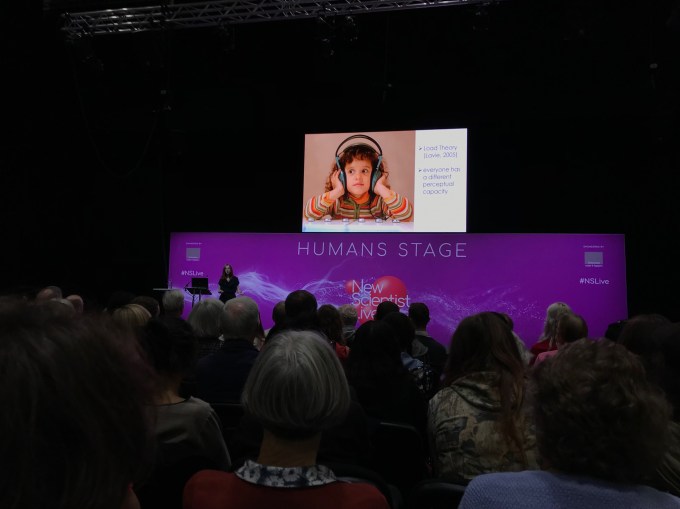
The talk was part of New Scientist Live, which is a huge event – a festival, really – all about “ideas and discoveries for everyone curious about science and why it matters.” I couldn’t describe it better than they do. It’s full of stalls, interactive experiences, and stages for talks on all different subjects. Had I not had previous engagements on the other three days of it, I would’ve loved to stay longer and explore more. I was almost giddy with all the potential for learning.
The speaker was Dr Anna Remington, the director of UCL’s Centre for Research in Autism and Education and a leading authority in the area of superior abilities in Autism. And she had me from the beginning: she asked how many people were autistic or had a personal connection to Autism, almost the entire audience put their hands up, and she said, “I personally feel that you are the experts.” She was warm and enthusiastic, the perfect combination of fascinated and respectful. I liked her straight away.
She started off with a brief outline of Autism, of the social aspects (struggling with non-literal language, eye contact, managing relationships) and the non-social aspects (the need for routine, areas of intense interest, sensory sensitivities). She also talked about the language around it, about using ‘autistic people’ rather than ‘someone with Autism,’ because so many people feels that it’s so intrinsic to their identity. She quoted someone she’d worked with: “You can’t separate the autism from me. It’s not something I carry around in a bag with me, it’s something that’s absolutely part of my personality and identity.”
She said that so many talks are about the difficulties of Autism but that she wanted to talk about some of the positives, not the savants but the areas where autistic people are shown to excel. She walked us through some studies – some visual tasks and some auditory, done with both children and adults – and showed us how the groups with autistic people did significantly better.
She introduced the idea of ‘perceptual capacity’: “The amount that we can process at any given time is known as our perceptual capacity. Everybody has a slightly different perceptual capacity and whether we process something depends on whether our capacity is full up or if there’s still room left over… Now the crucial thing is that we have to assign our whole capacity at any given time. You can’t assign just part of it. So, if the task that you’re doing doesn’t fill up the whole of your perceptual capacity, then anything that’s left over will automatically process something irrelevant around you.”
I found this whole concept fascinating. This is the idea behind why people listen to music while working or doodle while talking on the phone, filling in that left over capacity with information that doesn’t interfere with what you’re trying to do. I have always had stuff playing in the background (audiobooks, movies, TV shows – not music because I get distracted by thinking about the mechanics of the song and of the lyrics) and was always told that I couldn’t possibly do whatever I was doing well with that much ‘distraction.’ So it was very satisfying to know that I’d been right all along. If you want to know more about this, this article is very helpful.
She finished with why this research, why these findings, matter and how they can be applied in education and employment to improve the experience and opportunities for autistic people. The research is really exciting and I would love to be involved in some way; as I mentioned in my post about taking part in Autism research studies (here), there’s something really empowering about it, about feeling part of change. I spoke to her about it after the talk and she was absolutely lovely.
My one negative about it all was the level of background noise, this constant drone of indistinguishable voices. It made it difficult to hear the talk and it’s one of the things that I’ve found really drains my energy. But, although it completely wore me out, it was so worth it. It was such a positive experience and I’m looking forward to seeing where this research leads.
 Finding Hope