 Finding Hope
Tips For Travelling as an Autistic Person
Posted on July 7, 2018
Travelling is hard work for everybody. It’s exhausting and stressful and frustrating. But add in sensory issues or anxiety or whatever it is you struggle with and it can be a traumatic experience. Since we are now in the summer holidays and prime travelling time, I thought I’d put together some things that I found helpful to do as an autistic person who struggles with anxiety. I would like to point out (again) that there is a maddening lack of resources (and even simple testimony) for or from the point of view of autistic people. I spent hours searching for something but there was next to nothing; all the advice was for parents of young autistic children. Of course that information is important but it’s very demoralising to an autistic adult – essentially being compared to a child – especially one who was diagnosed late and has had to work so hard, often unaided, to manage their difficulties.
PLAN AHEAD – I know, this is my advice for everything, but it really does help. Struggling with unexpected change is a common trait in Autism and while planning can’t prevent all of those changes, it can make a huge difference. It can also give you a confidence boost, knowing that your actions have prevented a certain amount of anxiety.
SPEAK TO A TRAVEL AGENT – Being able to hand some of the responsibility off to someone else can be really helpful, especially if you have limited energy. You have to prioritise the tasks and if there are people who can help, that is a valuable resource. These people are also more likely to know the ins and outs of booking flights and accommodations etc and will therefore be more equipped to help you get what you need and want to get the most out of your trip.
CHOOSE YOUR ACCOMMODATION CAREFULLY – Having somewhere where you can have time out and recharge is so important when travelling. We all have different sensory needs and different things we can tolerate so choosing a place to stay is really important. For example, staying with other people (people I don’t know) causes me a lot of anxiety so when we look through Airbnb, we look at places that allow us to be the sole inhabitants. It won’t be the same for everyone but if you can identify what you need, you can hopefully find somewhere to stay that can be a restful place rather than a stressful one.
WRITE A LIST OF EVERYTHING YOU’LL NEED AND HAVE SOMEONE CHECK IT – Having a list makes packing so much easier and having someone check it for you just reduces the chances of making a stupid mistake like forgetting your pyjamas. Because that really isn’t something you need to deal with when you arrive wherever you’re going. Also make sure that you’ve got any medications or medical equipment that you need because those can be particularly difficult to get hold of, especially if you’re in another country.
PACK AN EMERGENCY KIT IN YOUR CARRY ON BAGGAGE – On the off chance that your bags get lost along the way, pack a change of clothes, some medication, etc in your carry on bag so that you can at least get up the next day and work out a solution.
BRING YOUR OWN FOOD – You’d need to check with your airline but there are certain foods that you can take in your suitcase that won’t cause you any problems while travelling. That means that, at the very least, you’ll have something to eat when you get to your destination. But in my case, it gave me a staple food that I knew I could eat in case I couldn’t find anything I could tolerate. It took away some of the anxiety, for which I was grateful.
PREPARE SPECIFICALLY FOR THE FLIGHT – Apparently, we’re flying in this hypothetical. Many people have fears associated with flying and while I don’t have any magic words of wisdom there, there are a couple of tricks to make it slightly less difficult, especially if you have sensory issues. Take sweets to suck on and relieve the pressure in your ears. Wearing a mask over your face can help if you’re worried about bad reactions to everyone’s germs in one confined space, as well as chemicals from perfumes etc. I’ve also found that a playlist of familiar music helps with the constant noise of flying. And wearing comfortable clothes: you’re most likely gonna look awful when you get there anyway so why bother with anything more than a T-shirt and leggings.
BUILD IN TIME OUT AND DON’T FEEL GUILTY FOR IT – Easier said than done, I know but burning yourself out in the first couple of days doesn’t make for a good trip. So try to take breaks between things and listen to your body: if you need to rest, rest. It will make the whole trip more enjoyable and worthwhile if you do.
As of now, I think that’s all I’ve got. But if you guys have any tips that you’ve found helpful, please let me know!


Snapshot #2: Taylor Swift’s Reputation Tour
Posted on July 4, 2018
In case you guys hadn’t figured it out yet, I’m a big Taylor Swift fan and so, of course, I had to go and see her live when she brought the Reputation Stadium Tour to Wembley Stadium. One of my very favourite memories is seeing her 1989 Tour at Hyde Park in 2015: the music, the sun setting, the way I felt. It was magical. So I was very excited to see her perform again and ended up seeing both of the Wembley shows. With something like this – a huge show that I’m very emotionally invested in – I find it better for my overall mental health to see it twice. That helps to manage my anxiety about missing something or getting overwhelmed; I have a second chance to take it all in, which lessens the pressure a bit and makes it easier for me to cope with everything going on. It wasn’t cheap but I don’t regret it: Taylor is one of my favourite artists (and people), she doesn’t tour here very often, and concerts are the only thing that I really spend money on. So although I do struggle with anxiety around money, this experience wasn’t too bad.


The shows were amazing. Taylor is an incredible performer and the songs work so well performed live. The band, the dancers, and the backing vocalists were all fantastic too and the whole show was completely seamless. The setlist was a really great mix of songs from Reputation, as well as at least one song from each of her previous albums thrown it. That was really cool. And because she chose to perform ‘So It Goes…’ as the surprise song (she performs an acoustic version of a song in her back catalogue each night to keep an element of unknown in a very choreographed show) on the first night, we got to hear the whole Reputation album live. That was very special.
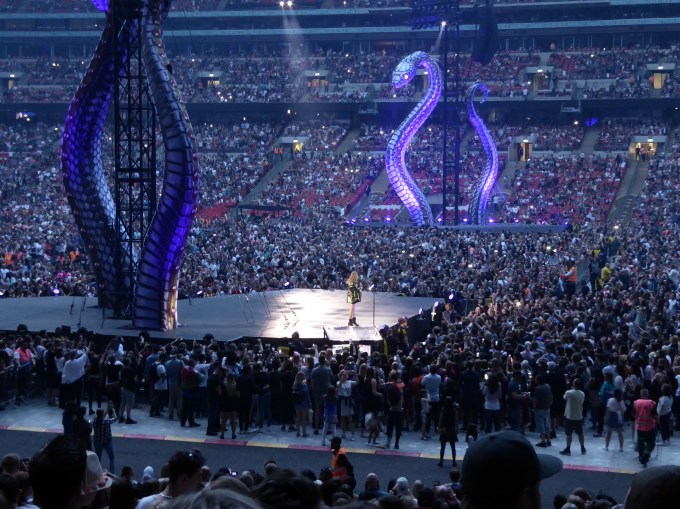
I’m not really a fan of Stadium gigs – Taylor is probably the only person I’d go to a stadium to see – because you end up spending so much time looking at the screens in order to see the person performing but a combination of the ginormous screens built into the stage and the multiple b-stages around the stadium did make it feel smaller. Plus, Taylor is such a compelling performer and the crowd was so engaged that you almost didn’t notice the size. Having said that, I do hope that, one day, she’ll go back to playing smaller venues. I mean, she could sit on a box, playing acoustic guitar for two hours and most of that stadium would still want to go.


My favourite performance was ‘Getaway Car,’ which is also my favourite song on the album. The graphics were beautiful and by that point, it was dark so the light up bracelets we’d been given were the only way to see the crowd. It was a magical sight.
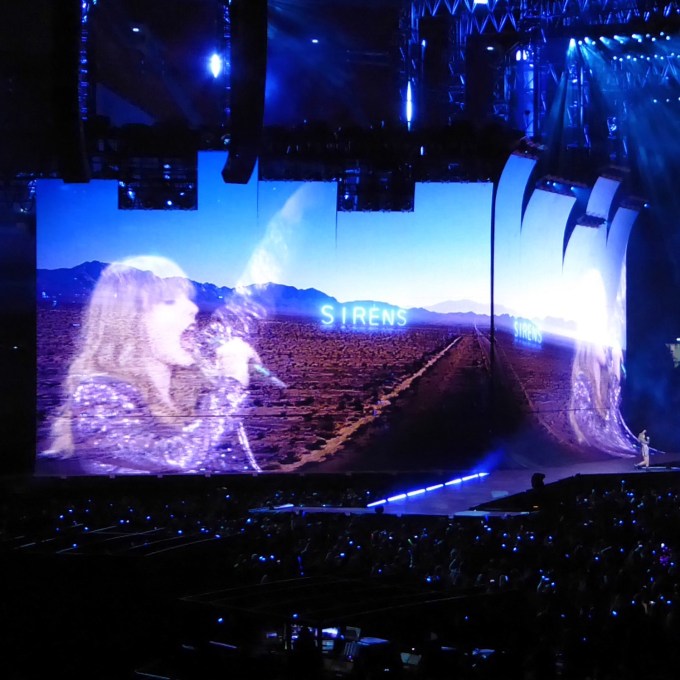
My favourite moment of the two shows was Taylor’s mashup of ‘Long Live’ and ‘New Years Day’ (from her Speak Now album and Reputation album respectively) on the first night. It’s always a special moment because she dedicates it to the fans who’ve stuck by her. Halfway through, the whole crowd started cheering and it went on so long that I thought they’d have to cut a song from the setlist; every time it started to fade, it picked up again with more enthusiasm than before. You can see it in the video below: it clearly meant a lot to her. I’ve seen several people saying that she’s milking it – exploiting the situation – and that really irritates me because, when it comes to Taylor Swift, everyone seems happy to judge without context. This is the context: after last year, when everyone was demonising her and calling her a ‘snake’ (don’t get me started on that – that’s another example of people jumping at the chance to criticise her without actually investigating the situation first), she, in her own words, “went through some really low times.” The choices she makes have always centred firmly around what her fans want and suddenly she wasn’t sure if anyone would even show up. So this moment (that the video shows) is important. This moment is proof that she was wrong, that her fans see her for who she truly is and always will, and she’s just taking it in.
Oh, and it was pretty cool when she brought out Robbie Williams on the second night…

It was also really special because I got to go with one of my best friends and on the second night, we got dressed up, inspired by the Look What You Made Me Do music video. I’ve never done that for a concert before but it was SO much fun; it made the concert experience last longer and feel fuller. I had moments of feeling incredibly self conscious – and disgusting, if I’m being completely honest – but I also had moments of feeling really good and really confident. It’s complicated but I’m really glad we did it.


We had a really amazing time. I was in the middle of a really difficult time with a lot of very difficult emotions and while it didn’t fix that – that would be a bit much to put on a concert, even a Taylor Swift concert – it was a wonderful escape and I’m really grateful for that. And Wembley Stadium was really helpful in making the concert as stress-free as possible. I’m still getting used to the fact that I’m eligible for disabled access and tickets but not only does that make it more possible for me to physically go to the shows but the validation of how I struggle makes the shows much more enjoyable. It has been my experience that there’s a weird pressure at concerts to always be standing, always be dancing, always be having the best time, which isn’t always possible for me: I can’t stand for long periods of time. And because my difficulties are invisible, I’ve had people assume that I’m not enjoying myself and therefore don’t ‘deserve’ to be there as much as someone who would stand and jump and dance through the whole show. It’s stupid and reductionist but it is there. I don’t want to rant about this but I think it’s worth commenting on. Having a disabled ticket didn’t change that but by validating my experience, it gave me the confidence to enjoy the concert within my own abilities: I stood and danced when I felt able to; I sat when I needed to; I sang along to every song. And I had an amazing time.

I paid the price for going to (and dancing at) concerts two nights in a row: the muscles in my legs were stiffening up before we even made it to the tube station, which made walking physically painful. By the next morning, my whole body hurt and it took almost a week to recover fully. It sounds over the top but it’s the truth. I don’t know why my body reacts this way; I’ve spoken to several doctors and they all seem to think it’s to do with my Autism – although that tends to be their answer for anything unexplained. So, for now at least, I just have to manage it.

I guess the point of this post (beyond just writing it for fun) is to talk about managing concerts as an autistic person. They’re busy and overwhelming and complicated but there are ways to make them possible. I also wanted to talk about doing something like going to a concert when you’re deep in depression. You’re allowed to do fun things when you’re struggling; it doesn’t make your struggle less valid. And it doesn’t have to be a life-saving experience. That’s a lot of pressure. We’re all just trying to get through and sometimes that means singing your heart out at a concert.

I Finally Read Reasons To Stay Alive By Matt Haig
Posted on July 1, 2018
So, I was having a particularly difficult day and I found myself online, reading articles about depression and looking for insight. I even found myself googling ‘reasons to keep going,’ not in a suicidal way but because I was in the midst of all these overwhelmingly huge, complicated, and awful feelings and I felt like I needed some clarity, a straight answer to a very big question. You probably won’t be surprised to know that I didn’t find one but I realised that I was essentially searching the title of the book that was sitting on my bedside table: Reasons To Stay Alive by Matt Haig. I’ve had it on my to-read list for months but I haven’t had the concentration or motivation to actually read for about a year. Maybe I was finally desperate enough that I was able to push through that. Maybe it was influenced by my recent change in medication. Who knows. We don’t live in a vacuum. Everything affects everything.
I have to admit that I have very mixed feelings about this book. There was so much hype around it and everyone I know who’s read it has recommended it to me. I expected to love it but like most things in life, it wasn’t that simple. If you’re reading this and thinking, “Oh god, she’s going to criticise the crap out of this and I don’t wanna know,” please give me a chance and hang in there a little bit longer. These are just my thoughts, good and bad and different. Hopefully I’ll have something useful to add to the discussion around the book.

The first thing is that I love Matt Haig’s writing. I find it easy and natural to read but also powerful and evocative. And there were parts that made me laugh; I found the continuing comparisons to having various body parts on fire very amusing. He’s a very engaging writer. I like the way he talks about depression, frank but empathetic. Here are some of my favourite quotes from the book:
- “There’s no right or wrong way to have depression, or to have a panic attack, or to feel suicidal. These things just are.”
- “If your leg is on fire, it is not selfish to concentrate on the pain, or the fear of the flames. So it is with anxiety. People with mental illnesses aren’t wrapped up in themselves because they are intrinsically more selfish than other people. Of course not. They are just feeling things that can’t be ignored.
- “The main thing is the intensity of it. It does not fit within the normal spectrum of emotions. When you are in it, you are really in it.”
- “Depression can be exacerbated by things being all right externally, because the gulf between what you are feeling and what you are expected to feel becomes larger.”
- “People say, ‘take it one day at a time.’ But, I used to think to myself, that is all right for them to say. Days are mountains. A week was a trek across the Himalayas. You see, people say that time is relative, but it really bloody is.”
- “Life is hard. It may be beautiful and wonderful but it is also hard. The way people cope is by not thinking about it too much. But some people are not going to be able to do that.”
- “I stared at a cherry tree and felt flat. Depression, without the anxiety. Just a total, desperate flatness.”
I think that descriptions like these would be particularly helpful to those who haven’t actually experienced depression but are trying to understand what it’s like for someone they know or someone they love.
And in a similar vein, I think he describes the seriousness of depression incredibly well: “Depression is a disease so bad that people are killing themselves because of it in a way they do not kill themselves with any other disease.” We all talk a lot about how serious depression is but it’s not often that someone can so succinctly get the message across.
This, I think, is my favourite quote from the book:
“Most of the time we do not feel the near-infinite nature of our physical selves. We simplify by thinking about ourselves in terms of our larger pieces. Arms, legs, feet, hands, torso, head. flesh, bones. A similar thing happens with our minds. In order to cope with living, they simplify themselves. They concentrate on one thing at a time. But depression is a kind of quantum physics of thought and emotion. It reveals what is normally hidden. It unravels you, and everything you have known. It turns out that we are not only made of the universe, of ‘star-stuff’ to borrow Carl Sagan’s phrase, but we are as vast and complicated as it too. The evolutionary psychologists might be right. We humans might have evolved too far. The price for being intelligent enough to be the first species to be fully aware of the cosmos might just be a capacity to feel a whole universe’s worth of darkness.”
I’ve described depression as having a black whole in my chest and this quote reminds me of that. When I’m deeply depressed, it feels like ‘a whole universe’s worth of darkness.’ It does. It’s that strong and overwhelming.
I also like the format of the book. Having not done much reading (because depression – and quite possibly my medication – dulled all the parts of me that made reading a book possible or enjoyable), reading a whole book was a very daunting challenge so having short, succinct chapters made it feel much more possible. It may well be a good analogy for how we tackle depression: trying to fight it as a huge, indistinct is such a difficult, exhausting task. Breaking it down into manageable steps seems like a better idea.
Now, onto the more difficult stuff. I have to say, I found the book pretty upsetting. There were several major differences in our experiences of depression and while I know, of course, that this is his experience of depression only that he’s writing about (which is absolutely his right), I ended up feeling like we have struggled with entirely different illnesses. That, I think, made it much harder to connect to the book. I mean, I’ve just talked about how much I liked his descriptions of depression and I do but while we have both really FELT depression, our actual experiences and the circumstances around having depression are completely different. I don’t think I’m explaining this very well. Let me give you the analogy of dog breeds: they’re all essentially dogs – they all have dog DNA – but they appear in hundreds of different ways. That’s how this feels to me. We’ve both had the DNA of depression, but where his is bulldog, mine is a German Shephard (I’m not gonna lie – trying to find two different breeds of dog that are very different without belittling either of our experiences by comparing one of them to a dachshund or a Chihuahua was a challenge).
The biggest thing for me was that I felt like there was this inherent implication that, after being depressed, you will never be that low again. Because you lived through it, because you survived it, or whatever, that you have this new perspective on the world that will somehow protect you from depression. It’s a belief that many people have but for me that is just not true. Each time I think I’ve reached the lowest point I can possibly survive, there’s always more. There’s always worse.
On a similar theme, he references another common idea, that feeling the good stuff is worth feeling the bad stuff: “You know, before the age of twenty four I hadn’t known how bad things could feel, but I hadn’t realised how good they could feel either. That shell might be protecting you, but it’s also stopping you feeling the full force of that good stuff.” Let’s say that’s true. What does that matter if the bad to the good have odds like 364 to 1? Is it worth it? I’m not sure. In my experience, the bad stuff is so much more devastating than the good is good. I’m not attributing this idea to Matt specifically but I feel like it’s worth commenting on. This idea equates the strength of good and bad emotions (something that is practically impossible), and suggests that it’s acceptable (and even expected) to feel really terrible, simply because you’ve had some good moments. I’m just really wary of anything that justifies struggle and trauma.
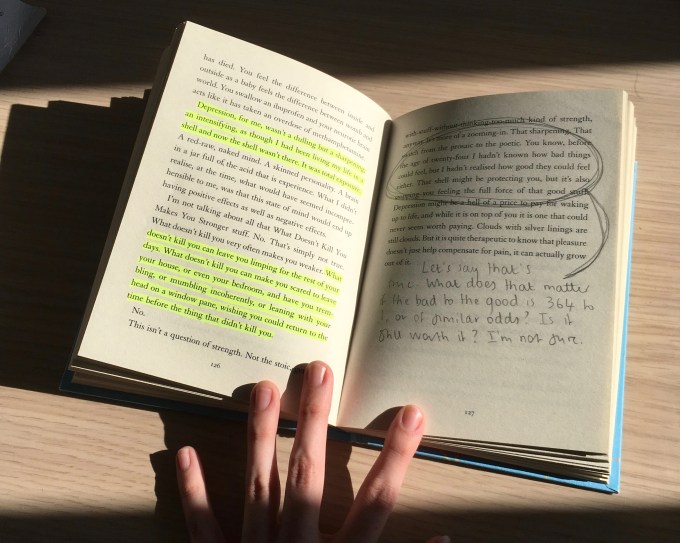
About halfway through the book, he talks about how he overcame his separation anxiety when his partner needed him to, because she had to go to the hospital with her sick mother and someone had to be at the house. I found that really hard to read, because a lot of the time, for a lot of people, that’s not the case. For me, that’s not the case. Anxiety, depression, mental illness… they don’t go away just because you need them to. I wish they did and, if I’m honest, it just made me feel more pathetic. I can’t help thinking that it would’ve been more helpful if he’d mentioned some of the times it hadn’t been like that and then said something like, “I don’t know why it was different this time.” Just to represent that problem, to give it context. I mean, I’m making an assumption that there were moments where he couldn’t overcome his anxieties but I think it’s pretty safe to say of anyone who’s struggled with severe anxiety for an extended period of time.
The chapter ends with, “needless to say, they came back,” in reference to his paralyzing anxiety that something would happen to his partner and her parents while not in his sight. This is something that I struggle with on a daily basis but my fears not coming true hasn’t ever dulled those fears. Instead I feel like my time – my run of good luck – is running out. You can only throw heads so many times, you can only be lucky so many times before the inevitable bad thing happens. In my experience, anxiety isn’t rational and can’t be managed as if it is.
He goes on to say, “I had reasons to force myself to be strong…” which, I have to say, irritated me. We know that depression and anxiety and so on are illnesses and are therefore out of our control. It’s not logical. You can’t reason with it or simply will yourself out of it. In my experience, my reasons keep me going for a while, get me through what I need to get through, but then I crash, often lower than before. It’s great and important that he found that motivation and I don’t want to take away from that I just don’t think it’s as straightforward as that.
“…To put myself in situations I wouldn’t have put myself in. You need to be uncomfortable.” I hear this expression all the time and I HATE it. I hate it enough to put the word hate in capital letters. I am ALWAYS uncomfortable. I cannot remember the last time I was comfortable in anyway, whether it be emotionally, mentally, or physically. Maybe my ASD makes it impossible to be comfortable. Maybe there’s another explanation. So, how does that fit into this formula? I don’t know the answer. And what if there’s no good in it, no purpose? What if that’s all there is? I don’t know the answers to those questions either.
“People often use the word ‘despite’ in the context of mental illness. So-and-so did such-and-such despite having depression/anxiety/OCD/agoraphobia/what-ever. But sometimes that ‘despite’ should be a ‘because.’ For instance, I write because of depression.” I don’t disagree but I’d like to propose an addition: and. So-and-so did such-and-such and they have depression/anxiety/OCD/agora-phobia/whatever. I have struggled with identity stuff for a long time – probably from my BPD and the late diagnosis of ASD (which obviously does affect everything I do as it is something I was born with) – but I’d like to think that I am not who I am solely because of my mental illnesses. A lot of people say that their experiences with mental illness have made them kinder, more compassionate and thoughtful people and that’s amazing but I don’t think they give themselves enough credit. Everything we become we were always capable of becoming and the circumstances and coincidences that start those chain reactions shouldn’t get all the glory.
Despite the parts of the book that I struggled with, there were parts that really spoke to me. There were several quotes that I related to so strongly that my chest physically hurt when I read them:
- “The weird thing about depression is that, even though you might have more suicidal thoughts, the fear of death remains the same. The only difference is that the pain of life has rapidly increased.”
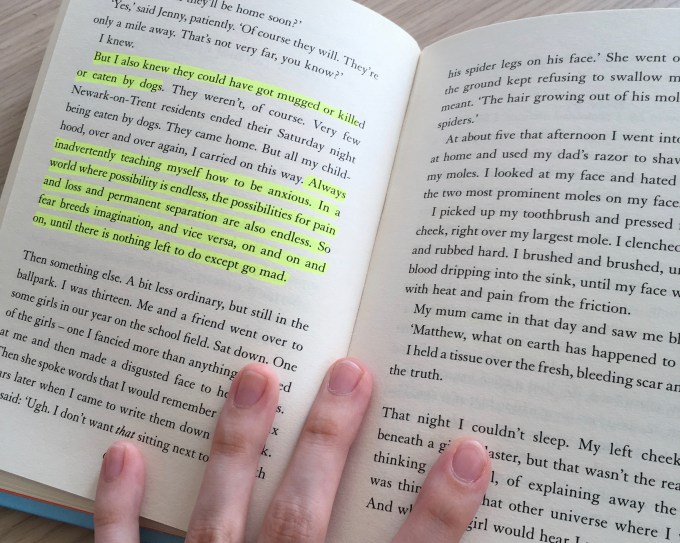
- “In a world where possibility is endless, the possibilities for pain and loss and permanent separation are also endless. So fear breeds imagination, and vice versa, on and on and on.”
- “So, if [the universe] catches you smiling, even fake smiling, then – well, that stuff’s just not allowed and you know it, so here comes ten tons of counterbalance.”
- “Depression, for me, wasn’t a dulling but a sharpening, an intensifying, as though I had been living my life in a shell and now the shell wasn’t there. It was total exposure.”
- “He was looking at me like I was my former self. How could he not see the difference?”
- “I was scared of the quiet. I was scared, I suppose, of having to slow down and soften the volume. Scared of having nothing but my own mind to listen to.”
- “And we are scared of our own crumbling, and the crumbling of others.”
- “If the stone falls hard enough, the ripples last a lifetime.”
- “Feeling. That is what it is all about.”
Ultimately I have mixed feelings about this book. I can see why people love it and why people find it helpful. And I think, had this been my first experience of depression, it would’ve helped me too. I would’ve found it inspiring. But I struggled to connect with it and I found that very upsetting. Maybe it’s my fault for reading it when I did; maybe I was too depressed for anything to help. Maybe, if I’d read it when I wasn’t feeling so completely hopeless, I would’ve had a different experience. Maybe I would’ve felt the differences less and the similarities more. I’ll never know. But regardless, I’m really glad that it’s helped people. Having your struggles and your experiences validated can change everything. As Matt says in the book: “There is nothing lonelier in the world than being surrounded by a load of people on a different wavelength.” That, right there, is why I write this blog.
I hope this was interesting and I hope I’ve managed to represent my emotions about the book (reading it was a very emotional experience), rather than blindly praising it or bluntly criticising it. Despite struggling with the book, I love Matt Haig’s writing and he is one of my favourite people to follow on social media; I have great respect for him. I’m really looking forward to hearing him speak on Tuesday and to reading Notes on a Nervous Planet when it comes out.

 Finding Hope