 Finding Hope
Autism Tattoo Ideas
Posted on April 1, 2022
I have been thinking about and wanting to get a tattoo representing my Autism for a really long time now. There is a tattoo I want to get first because the symbolism is important to me but being autistic is such an important part of my identity and I would, at some point, like to get a tattoo to commemorate that. But figuring out what the right one is is taking a while and a lot of thought.
In my search for inspiration, I’ve now seen a lot of different tattoos representing Autism and I thought I’d share what I’ve found as well as some of my own ideas…
I’ve done a lot of searching and as far as I can see, most people go with the obvious symbols…
Puzzle Pieces:
The puzzle piece is definitely the most well known symbol associated with Autism, having been used by Autism charities and organisations for decades. As far as I can tell, most autistic people feel that the puzzle piece symbol is, at best, problematic and, at worst, offensive in that it symbolises something missing, symbolises autistic individuals as being less than neurotypical individuals. But despite this negative view, most of the tattoos I’ve found online involve the puzzle piece in some way.


Top left (x), top right (x), bottom centre (x)
As I said in my post about symbols associated with Autism: “Personally, I don’t hate it as a symbol. To me, the puzzle piece doesn’t represent something that’s missing; it represents the idea that we’re all puzzles and we wouldn’t be complete without every single thing that makes us who we are. We’re mosaics and we are who we are because of each piece that builds up the picture. I know many people feel that Autism isn’t just one piece and I agree but my point is that I don’t see the puzzle piece as something missing but as something fundamental. So I don’t hate it but I think it’s history – it’s original meaning – is too entrenched in society’s consciousness to ever really be changed. I doubt it could ever be a purely positive symbol at this point.” Personally, I wouldn’t choose it for a tattoo that represents my experience of Autism.
Infinity Symbols:
I’ve also seen infinity symbols come up a lot in the symbolism around Autism…

(x)
I understand why people like the infinity symbol and while there are some gorgeous tattoos out there (like this one), it just doesn’t really resonate with me as a symbol for Autism since it relates to so many other things. It doesn’t specifically represent Autism to me and that’s what I need this tattoo to do.
Rainbows:
Some people use rainbows to represent Autism, most likely a reference to the Autism ‘spectrum’…

(x)
While this is my preferred of the common Autism imagery, it feels too close to the LGBT+ rainbow flag. I’m queer and so I wouldn’t feel like I was appropriating the imagery but there’s a reason why these identities and causes have their own colours, right? Being LGBT+ and/or being autistic are both really important parts of who we are and I think, by using the same colours for these two identities, there’s potential for confusion when that’s the opposite of the point of these identifying colours and symbols. Maybe I’m overthinking it but it doesn’t feel like enough if it could be mistaken for something else.
Combinations of the Three:
Most of the tattoos I’ve come across involve at least two, if not all three, of these…


Left (x), centre (x), and right (x)
Some of them are really beautiful but none of them feel right and, for me, being autistic is so much about feeling that it has to feel right – beyond the idea that, if you’re going to have something on your body for the rest of your life, you’re going to want it to feel right.
Takiwātanga:
‘Takiwātanga’ is the Maori word for Autism and translates as ‘in their own time and space.’ This seems to be increasingly popular, I imagine because of the feeling of acceptance it evokes.


I really like the sentiment and I’ve seen some stunning tattoos that incorporate the word, the two above included, but I’m not sure it’s right for me. As much as I loved the parts of New Zealand I’ve visited – I think it’s the country I’ve felt most at home in – I’m not sure a word is what I want or what feels right for this tattoo when, so often, being autistic feels so difficult to describe.
More Unusual Ideas:
While the previous images and symbolism seem to be the most common, I have seen other beautifully creative ways of representing Autism…


To me at least, these tattoos seem more like the individual’s representation of Autism or something symbolic of it and I guess that’s what I’m looking for: my personal symbol or imagery representing my experience of being autistic. I just haven’t found it yet.
Ideas I’m Thinking About:
There are a handful of ideas that I keep coming back to so I thought I’d include those as well, just in case they resonate with anyone else. None of these images are exactly what I’d choose but they do illustrate the general ideas I have.
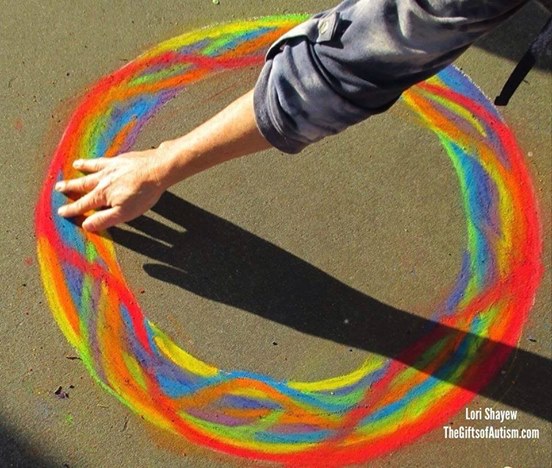
Circle of Three
The Circle of Three is a symbol for Autism created by Lori Shayew and Kelly Green to represent the different aspects that make up each individual person: “In light of the recent news that the rainbow is not an arc, but a circle. (Thanks for the proof NASA) It’s time to recreate the new model. Colours of the rainbow weaving in motion. We are recognised for all of our colours… It’s time to break down the spectrum (low-mod-high) and allow our innate gifts to bloom and flourish. Don’t we all excel at some things, but not in others? No big deal. We can jump from yellow to red to indigo to green and back again. Maybe then there are no colours, only light.”
(x)
I really like this as a similar but distinct variation of the rainbow and the way that it can be personalised according to each person: all you have to do is assign colours to different areas of your life – as you feel comfortable doing so – and then interweave them in a way that best represents you as a person.
A Whale
A long time ago, before I was diagnosed as autistic, I read the story of The Loneliest Whale – a whale who’s call is indistinguishable to other whales – and I’ve never forgotten it. I related to it at some level and that connection I felt has never gone away. I want to write more about this whale and how multiple communities have felt a connection to it and found solace in the story but now’s not really the time.
I’m not sure the whale alone would be enough to represent my being autistic but for me, that connection is there so it wouldn’t surprise me if the image of a whale found its way into my Autism tattoo.
The Use of the Rainbow or Colour Spectrum
Light and colour are important to me and to my perception of the world, particularly my perception of music, which is possibly the most important thing to me. So, the inclusion of a rainbow or spectrum of colour isn’t out of the question. I’m just not sure how.
Space
Being autistic, I feel so incredibly sensitive to the world around me. Sometimes it feels like I can feel the waves and particles in the air, the vibrations of every thing, the world turning, the frequencies of stars… It’s like all of my senses have been calibrated to be extra sensitive, too sensitive. And for some reason, that makes me feel weirdly connected to space and to stars. So the presence of these in a tattoo representing Autism would make sense to me.
Again, like the whale idea, it couldn’t exist on it’s own but I can imagine it as part of something bigger, although I wouldn’t want it to be a huge tattoo.
A Combination?
At this moment in time, the idea that feels most comfortable – feels most representative of my experience of being autistic – is something like this…


Something along the lines of these tattoos, but that involves some of the elements I’ve talked about or even all of them, is what I’m thinking about currently. But as I’ve said, I want to get it right so I’m taking my time to think through every detail and make sure I’m sure.
Getting a tattoo is not going to be an easy thing for me. I’m sensitive; sensory information is always loud for me. The sound won’t be easy. The pain won’t be easy (I’m sensitive to it but not afraid of it). The ongoing anxiety around COVID won’t be easy. So, yeah, it won’t exactly be fun. That’s part of the reason I want to get a smaller, simpler one first. But this is important to me so I am going to make it happen.
Do any of you guys have tattoos that represent being autistic? Being neurodivergent? I’d love to see them!
The Symbology of Autism
Posted on March 31, 2022
Just as many medical conditions, charitable causes, and organisations use certain colours and symbols to identify and differentiate themselves, Autism has multiple symbols and colours associated with it. They all have their own histories, their own origins, their own connotations. Here are several of the most well known…
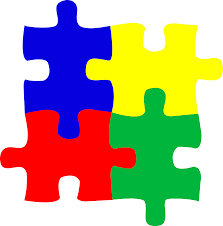
The Puzzle Piece
The puzzle piece is the most well known symbol related to Autism, dating back to the early 1960s. It was created by a board member of the National Autistic Society, Gerald Gasson, in 1963 based on Autism being a ‘puzzling’ condition. The original logo included not only a puzzle piece but the illustration of a crying child, to represent how children were ‘suffering’ from Autism. Obviously this is deeply problematic and has perpetuated the negative stereotypes about Autism for decades.
Over the years, there have been many, many different puzzle piece designs attached to Autism related organisations and charities. It’s also been associated with the idea that being autistic means you are missing something, that you are missing something that everyone else has; that may be a feeling that many autistic people experience at some point in their lives but it’s not something that should define us or that should be stated as fact. Another meaning associated with the puzzle piece is that Autism is a puzzle to be solved and, by extension, autistic individuals are puzzles to be solved, another stereotype that many autistic people dislike and dispute.
(x)
Personally, I don’t hate it as a symbol. To me, the puzzle piece doesn’t represent something that’s missing; it represents the idea that we’re all puzzles and we wouldn’t be complete without every single thing that makes us who we are. We’re mosaics and we are who we are because of each piece that builds up the picture. I know many people feel that Autism isn’t just one piece and I agree but my point is that I don’t see the puzzle piece as something missing but as something fundamental. So I don’t hate it but I think its history – its original meaning – is too entrenched in society’s consciousness to ever really be changed. I doubt it could ever be a purely positive symbol at this point.
The Colour Blue
The use of the colour blue was first used to represent Autism by Autism Speaks (used in their ‘Light It Up Blue’ campaigns), instantly making it something to avoid given everything the organisation has done (x) (x). And the colour was chosen because Autism was believed to be far more common in boys, something we now know isn’t true; it’s just that the signs are often more easily observed in boys and men than in girls and women. Given the history with Autism Speaks and the misinformation implied by the colour, this is something to move away from.
(x)
Rainbows
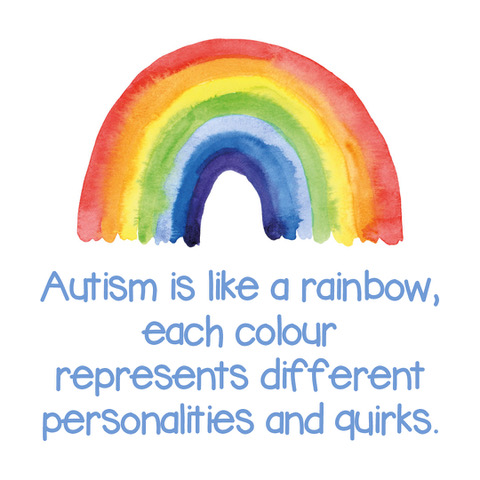
Most likely due to the use of the word ‘spectrum,’ rainbows have been associated with Autism and with neurodiversity. Many feel that the range of colours represents the different abilities, challenges, and identities of the autistic individuals the rainbow symbol represents.
(x)
While I understand the association, the rainbow will always be firmly associated with being LGBTQIA as for as I’m concerned and attaching it to both identities will not only cause confusion but feelings of appropriation. While I know that isn’t the intention, using it for two different communities and ways we identify is only going to cause problems.
The Colour Gold
The choice of gold developed in deference to the use of the colour blue: “The idea is to have a common thread that runs through all groups, advocates and supporters that was easily recognised, different and came from the autistic community, not from those who think they speak for us.” (x) It’s based on the chemical symbol for gold, ‘Au,’ the first two letters of Autism and autistic and it has multiple positive connotations. Gold is something that is strived for, something rare and valued and treasured, giving autistic individuals a sense of being special, rather than less than – a feeling the puzzle piece often results in. It’s also not gender specific, just like Autism.

(x)
Infinity Symbols
Like the gold symbol above, infinity symbols are fairly popular when representing Autism (often rainbow or gold coloured) because it represents everyone, every variation of Autism. The rainbow infinity symbol specifically was chosen to be the symbol for neurodiversity by Judy Singer (an autistic woman with an autistic child and sociologist) in the 1990s. This symbol therefore represents not just Autism but other neurodevelopmental conditions such as ADHD, Dyslexia, Dyspraxia, and more. The infinity symbol not only represents the variation within the community but the inclusion of everyone in it no matter what their strengths, challenges, and so on are.
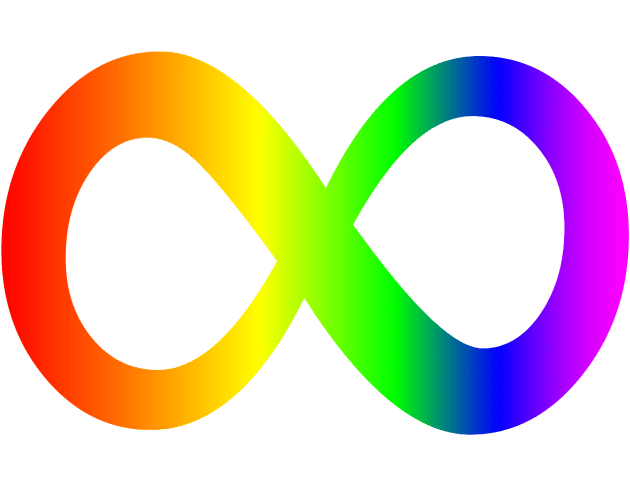
(x)
I have nothing against the use of infinity symbols but for me, it’s too vague; it can represent too many things. I was using it in Maths long before I found out I was autistic so, in my head, it’s all about numbers and equations and that’s not how I see Autism at all. So, because of that, it just doesn’t really work for me; I don’t feel like it represents me as an autistic person or as a person in the autistic community.
Rainbow Circle
The rainbow circle is one of the most recent symbols representing Autism, created by Lori Shayew and Kelly Green: “In light of the recent news that the rainbow is not an arc, but a circle. (Thanks for the proof NASA) It’s time to recreate the new model. Colours of the rainbow weaving in motion. We are recognised for all of our colours… It’s time to break down the spectrum (low-mod-high) and allow our innate gifts to bloom and flourish. Don’t we all excel at some things, but not in others? No big deal. We can jump from yellow to red to indigo to green and back again. Maybe then there are no colours, only light.” (x) The logo for ASAN – the Autistic Self Advocacy Network, an organisation created by and for autistic people – is not dissimilar to this symbol.


This is probably my favourite of the Autism symbols. While the traditional rainbow feels very entrenched and important in the LGBT community, this uses the fitting aspects but clearly distinguishes these two communities. I also really like that it can be personalised for each different person by changing the number and colour of the bands, chosen to represent your experience of being autistic as you see fit. So, with the general design being pretty recognisable, it can represent the community and the individual.
There have been more over the years but, as far as I know, these are the most significant ones, the ones that keep coming up. I’m not sure if we’ll ever find a colour or a symbol that we all agree on – I’m not sure if we need to – but I think transparency around the symbols and their histories… that is important. If there’s anything I’ve missed or more information I can add, please let me know. And I’d love to hear your thoughts on the different symbols so please leave a comment below if you feel so inclined!
 Finding Hope